
A person inside a pressurised spacecraft could hear a knock. Air in the cabin carries sound, and solid parts of the vehicle can carry vibrations. An ordinary sound wave cannot cross the surrounding vacuum from a distant object to the spacecraft.
The Draw Shelf story behind this article is fiction: three knocks in an imagined orbital cabin, a suspicious-looking Moon, piano notes and a stereo test. None of those events is presented here as an astronaut’s report. The scene poses a useful physical question: what path could a sound take to someone’s ears?
Why can’t ordinary sound cross a vacuum?#
Sound is a mechanical disturbance. In air, a vibrating object produces small changes in pressure that spread through the surrounding gas. The material supplies the connection between one part of the wave and the next.
A vacuum lacks that material. Making the source louder does not supply a transmission path across empty space. The source itself can still vibrate, but that is different from a sound reaching a separated listener.
The rule concerns the medium, not the location. Gas inside a space station, water in a container and solid spacecraft parts can all transmit mechanical disturbances even though the whole vehicle is in space.
Sources: [1]
Could a knock travel through the spacecraft’s wall?#
Yes, in principle. A physical tap can set a panel vibrating. If those vibrations reach an interior surface and disturb the cabin air strongly enough, someone inside may hear them. This is a possible mechanical path, not evidence that the fictional knocking happened.
The distinction is easiest to see with a tuning fork. A struck fork in a vacuum still vibrates within its own solid material, even though it cannot launch an ordinary airborne sound into the surrounding empty space. Contact with another object changes the available route for vibration.
Whether a particular tap would be audible depends on the panel, connections, damping and background noise. The story does not provide those engineering details, so assigning a precise loudness or identifying an external cause would be guesswork.
Why can astronauts hear one another over radio?#
A radio link converts information between different physical forms. A microphone responds to a voice where there is air. Electronics encode the signal onto electromagnetic radiation, which can cross vacuum. At the receiving end, a speaker or headset produces a new mechanical vibration that the listener hears.
The sound wave from the speaker’s mouth does not travel intact across the gap between spacecraft. The information travels by radio, and sound is recreated locally. That distinction explains how communication remains possible during a spacewalk without making vacuum behave like air.
A loudspeaker playing inside a pressurised cabin would work through the cabin’s air. Hearing recorded piano notes there would not show that music had travelled acoustically from the Moon.
Is the International Space Station quiet inside?#
The ISS contains operating equipment that produces noise. Fans move air and cool hardware; pumps, valves and other mechanisms contribute to the acoustic environment. Silence outside the vehicle does not make the inhabited interior silent.
NASA’s acoustics teams test flight hardware and work with designers to reduce noise at its source. This work matters for speech, alarms and sleep. A useful cabin must let people distinguish a warning or a colleague’s voice from the machinery around them.
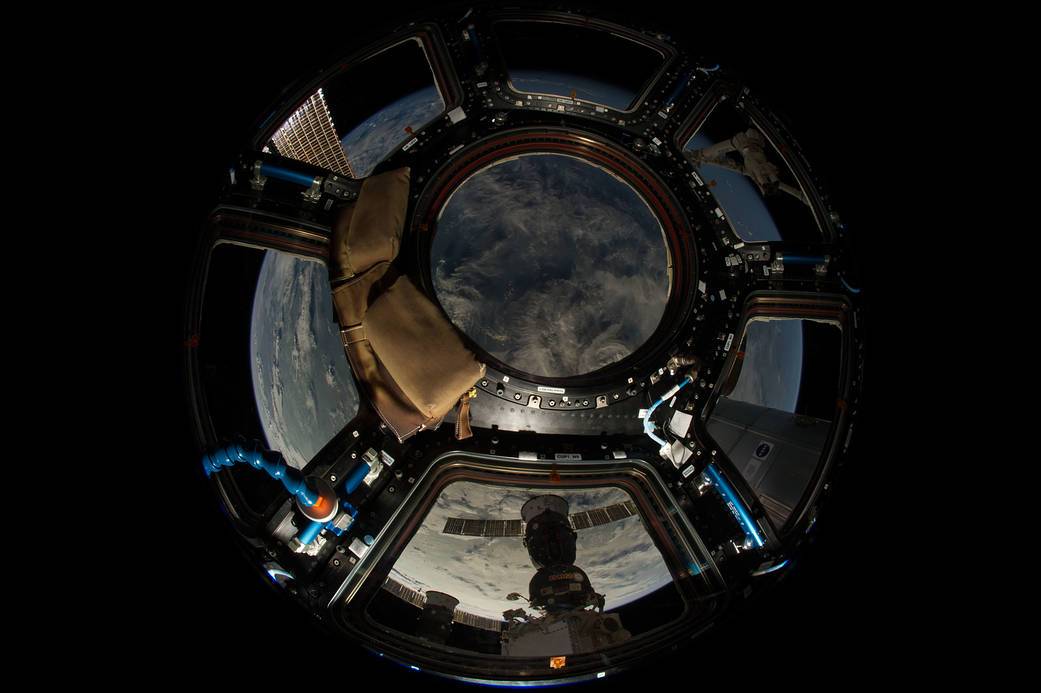
The cover photograph shows a real ISS Cupola view taken during Expedition 40 on July 6, 2014. It supplies the physical setting of a windowed orbital interior. It is not an image of the fictional incident, and it contains no evidence of unexplained knocking.
Why not simply turn off noisy fans?#
Ventilation and equipment cooling are working functions of a spacecraft. Removing their noise by stopping them would also remove the airflow they provide. The engineering task is to make the required airflow quieter while preserving performance.
NASA’s quiet-fan research examines that trade-off. Fan design, the airflow path and noise-control hardware affect the result; the same installation must meet more than an acoustic target. A fan that sounds pleasant but fails to move enough air would not solve the underlying problem.
This is why “quiet spacecraft” usually means controlling avoidable noise, rather than eliminating every sound-producing mechanism. The ordinary hum of equipment can coexist with clear communication and audible alarms when the system is designed appropriately.
Sources: [4]
Are recordings of “space sounds” fake?#
Some are scientific translations of data into an audible form. Sonification can map measurements to pitch, loudness or timing. Such a recording can communicate real data without being what a microphone floating in vacuum would record.
There are also environments in space with enough matter to carry pressure waves. Chandra observations of the Perseus galaxy cluster reveal ripples in hot gas associated with activity around its central black hole. An audible rendering raises those extremely low frequencies into the human hearing range.
That example does not provide an acoustic route from a distant object through vacuum to a spacecraft cabin. It shows why a claim about “sound in space” needs to name the medium, the measurement and any transformation applied. Our article on space sonification separates those cases in more detail.
Sources: [5]
Keep exploring
Sources & further reading
Follow the original research, records, and explanations behind this story.
- Anatomy of an Electromagnetic Wave NASA Science
Mechanical waves need matter; electromagnetic waves can travel through vacuum.
- Energy Traveling Through Space NASA Goddard — Cosmicopia
Cabin air, vibration in a solid tuning fork and radio transmission.
- Acoustics and Noise Control NASA
Equipment noise, acoustic testing and design requirements.
- NASA Quiet Space Fan Research to Benefit Commercial Space Stations NASA
Ventilation and cooling performance alongside noise control; no prototype numbers quoted.
- New NASA Black Hole Sonifications with a Remix NASA / Chandra
Pressure waves in cluster gas and audible resynthesis, not a vacuum microphone recording.
- The View From Station’s Cupola NASA
Existing Expedition 40 image taken July 6, 2014; unrelated to the fictional story.
Follow the thread