
A molten copper–cobalt sample can separate into two liquids while it is still liquid. Under suitable conditions, a cobalt-rich region collects inside a copper-rich shell. Other samples freeze with many small droplets scattered through them instead.
The difference matters. Making two liquids is one event; moving them into a particular arrangement takes time. Experiments in reduced gravity help researchers separate these processes and understand how a metal acquires its internal structure as it cools.
How can one molten alloy become two liquids?#
A mixed liquid is not necessarily stable at every temperature. For some copper–cobalt compositions, cooling an undercooled melt reaches a range in which two liquids of different compositions can coexist. Researchers call this a liquid miscibility gap.
One phase contains more cobalt and the other more copper. The labels “cobalt-rich” and “copper-rich” are deliberate: they do not mean that the sample has sorted itself into two perfectly pure elements. Both phases can contain both metals, in different proportions.
This separation also differs from crystallisation. Two liquid regions can develop before the sample becomes solid. A finished specimen records the combined effects of separation, movement and freezing, so its appearance alone needs careful interpretation.
Sources: [1]
Why must the melt be undercooled?#
Undercooling means that a liquid remains liquid below a temperature at which solidification is thermodynamically possible. Crystal formation still has to begin. Avoiding contact with a container helps researchers reach these temporary states without the container contaminating the melt or encouraging crystals to form.
For the copper–cobalt system discussed here, the liquid separation region lies below the liquidus, the boundary above which the equilibrium material is entirely liquid. The experiment must therefore keep the sample liquid long enough to enter that region.
“Cool it down” is not a complete recipe. Composition determines which part of the phase diagram a sample follows, while its thermal history determines how long it spends there. A result from one mixture cannot simply be assigned to every copper–cobalt alloy.
What moves one liquid toward the centre?#
Surface and interfacial tension affect how the separated liquids arrange themselves. Temperature differences can drive Marangoni motion: flow associated with differences in tension along an interface. In small cooling droplets, this can help move one phase inward while the other occupies the outside.
In the copper–cobalt drop-tube experiments reported by Mullis and colleagues, researchers found both rounded core-and-shell particles and particles whose separated regions had not completed that rearrangement. The cobalt-rich regions appeared darker in backscattered-electron images, with copper-rich material lighter.
The oil-and-water comparison is useful only up to a point. It conveys that two liquids can remain compositionally distinct. A metal droplet also has changing temperature, internal flow and an approaching solidification event, all of which affect where those liquids end up.
Sources: [3]
Does microgravity mean gravity has disappeared?#
No. An orbiting laboratory and its contents fall around Earth together. They appear almost weightless relative to one another even though Earth’s gravitational attraction remains substantial. Short periods of free fall can also be created in drop facilities and parabolic aircraft flights.
For a liquid experiment, the useful change is the reduction of ordinary buoyant rising and settling. That makes other influences easier to investigate. Microgravity does not remove surface tension or prevent the apparatus from stirring the sample.
It also does not require an open container floating around the cabin. The experiment remains inside controlled equipment. The levitation system positions the sample, while the surrounding apparatus controls heating, cooling and the measurement environment.
How do researchers heat a drop without a crucible?#
Electromagnetic levitation uses fields to position an electrically conducting sample and induce currents that heat it. Electrostatic levitation is a different approach: electric forces position a charged specimen, with a separate laser supplying heat in the NASA ground facility described by Lee and SanSoucie.
Keeping the sample away from container walls improves access to undercooled states and enables non-contact measurements. Optical instruments can track temperature and shape. Researchers still have to account for evaporation and contamination, which can change the composition or measured properties.
Levitation is therefore part of the measurement method, not evidence that gravity has been switched off. Ground experiments and space experiments can both use levitation, but the forces and flows they must control differ.
Why is the cover full of small spots?#
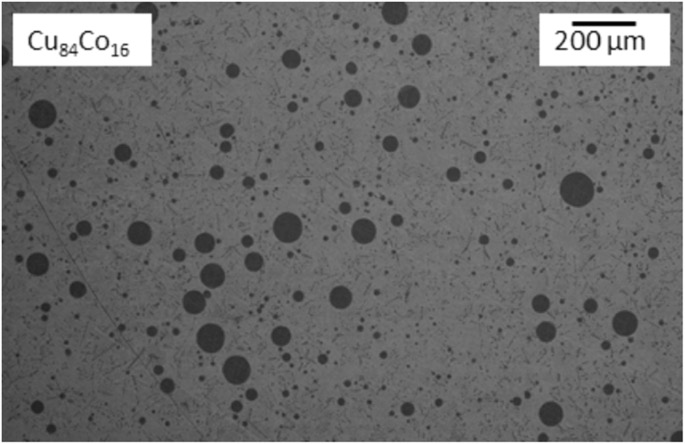
The published micrograph shows cobalt-rich droplets dispersed through a copper-rich matrix after an alloy was undercooled and solidified during a parabolic flight. Its scale bar is 200 micrometres, or one fifth of a millimetre. The dark spots are not holes or planets.
This image illustrates phase separation without a single large central core. It is useful evidence against treating a neat shell as the automatic result of microgravity. It is also a view of the solidified material, not a photograph through a transparent molten metal.
The research question is how processing produces that final structure. Comparing compositions, cooling histories and flow conditions helps test explanations. A striking arrangement is a starting point for that comparison; it does not, by itself, establish a reliable manufacturing process.
Sources: [2]
Keep exploring
Sources & further reading
Follow the original research, records, and explanations behind this story.
- Surface Tension, Phase Separation, and Solidification of Undercooled Cobalt–Copper Alloys Advanced Engineering Materials / Wiley
Cobalt-rich and cobalt-poor liquid phases and microgravity experiments.
- Electromagnetic levitation containerless processing of metallic materials in microgravity: rapid solidification Matson et al., npj Microgravity
Liquid miscibility gap, convection effects and exact microscopy provenance.
- Reduced gravity processing of Cu-Co metastable monotectic alloy via drop-tube processing Mullis, Jegede and Cochrane / University of Leeds
Observed core-shell and incomplete rearrangement; Marangoni explanation and cooling dependence.
- Experiments using a Ground-Based Electrostatic Levitator and Numerical Modeling of Melt Convection for the Iron-Cobalt System in Support of Space Experiments Lee and SanSoucie / JOM
Containerless methods, electrostatic positioning, laser heating and composition controls.
- What Is Microgravity? NASA
Free fall, residual Earth gravity and ground-based research environments.
Follow the thread