
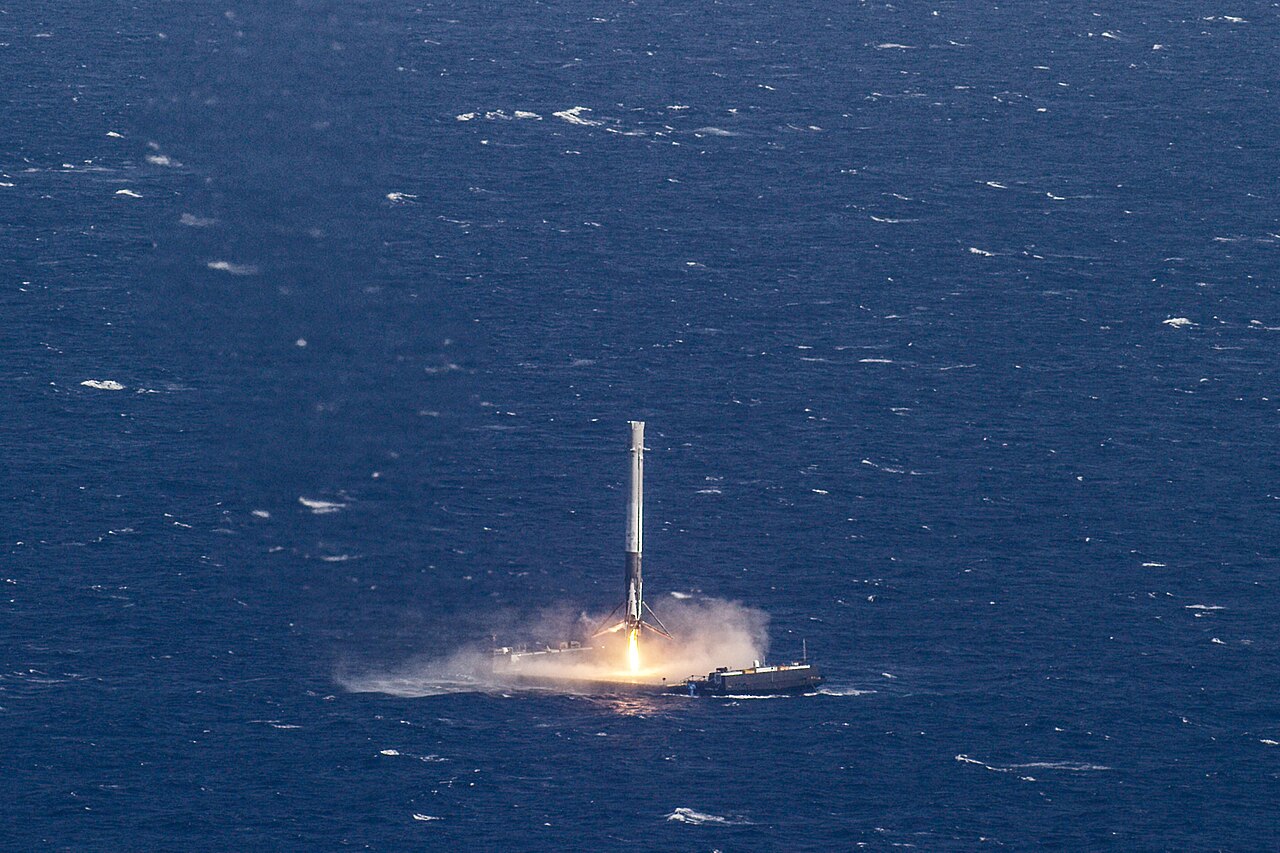

The rocket descending toward an ocean platform has already handed off its payload. It is Falcon 9’s first stage, returning while the upper stage continues the flight. Recovering that booster requires a sequence of turns, engine burns and aerodynamic steering. Flying it again adds another task: establishing that the recovered hardware is fit for a new mission.
Which part of Falcon 9 comes back?#
Falcon 9 has two stages. Nine Merlin engines power the first, burning rocket-grade kerosene with liquid oxygen. The second stage has its own engine and propellant. After separation, it carries on accelerating the payload while the first stage follows a return trajectory.
NASA’s description of the vehicle identifies landing legs and grid fins as essential recovery hardware. They travel folded during ascent, when the rocket must climb through the atmosphere without those structures deployed. The legs provide a stance for touchdown; the fins help control the descent.
The returning booster is therefore only part of the launch vehicle. A photograph of it on a landing platform does not show the upper stage or the spacecraft that continued toward orbit. Keeping those vehicles separate makes the rest of the flight easier to follow.
Sources: [1]
Does the payload wait for the booster to land?#
No. After staging, the two vehicles have different jobs and proceed independently. NASA’s published launch-day schedule for Crew-9 on 28 September 2024 provides a useful example. It placed stage separation and second-stage ignition at about two minutes after liftoff, first-stage landing at about eight minutes, and Dragon separation at about twelve minutes.
Those were scheduled milestones, with times explicitly subject to change. They illustrate the order of events rather than set a timetable for every Falcon 9 mission. The payload’s destination and flight profile affect what happens after separation.
This also explains why landing success and launch success are different questions. The returning stage can reach its platform while the upper stage still has work to do. To establish payload delivery, follow the upper-stage burns and spacecraft deployment, not just the landing image.
Sources: [2]
How does the booster turn around and slow down?#
NASA’s launch-and-landing diagram shows cold-gas thrusters turning the first stage after separation. A turn changes where the engines point; an engine burn then changes the vehicle’s motion. Pointing the booster back toward a destination is not enough to send it there.
The diagram distinguishes a boostback burn, used to adjust the trajectory toward the landing area, from an entry burn that reduces speed before the later descent. Grid fins provide aerodynamic steering as the stage travels through the atmosphere. Near the surface, another engine firing slows it for vertical touchdown.
These functions should not be collapsed into one long firing. Between burns, the vehicle continues moving under gravity and aerodynamic forces. Nor should a particular illustrated sequence be treated as an exact script for every mission: a return toward the launch site and a landing farther downrange require different trajectories.
Sources: [3]
Why land on a ship instead of returning to land?#
The booster has travelled away from the launch site by the time it separates. Returning to that site demands a trajectory change; a platform farther along its path offers another destination. The choice is tied to the mission’s performance requirements, not simply to whether an empty landing pad is available.
An FAA assessment of a proposed Pacific recovery area explicitly described offshore landings for heavier payloads when the first stage could not return to Vandenberg. That document concerns a particular historical operating proposal, but it makes the underlying tradeoff concrete: payload delivery and booster recovery must fit within the same mission plan.
An ocean landing is still a landing on a structure. The photograph above shows the CRS-8 booster approaching a drone ship on 8 April 2016. The platform provides a deck for the landing legs and a way to bring the recovered stage back to port; it is not a planned splashdown.
Is a landed booster ready to launch again?#
Landing preserves hardware that can be examined. SpaceX’s Falcon User’s Guide describes servicing and inspection as part of reflight, alongside learning from returned flight hardware. A successful touchdown supplies that opportunity; it does not itself certify every component for another ascent.
A recovered stage is available to inspect. Approving it for another mission requires evidence about its condition and suitability for that flight. A landing photograph cannot supply that evidence.
The FAA’s historical Pacific proposal described securing the booster, bringing it to harbour and transporting it to a testing facility before a later return to a launch site. Present-day details can differ. The relevant point is that a return flight also creates ground operations, rather than ending the work at engine shutdown.
When did recovery become an actual second flight?#
On 30 March 2017, SES-10 launched on a Falcon 9 with a previously flown first-stage booster. SES recorded the event in its first-quarter results, and SpaceX identifies 2017 as its first reflight of an orbital-class rocket. Here “orbital-class” describes the launch vehicle’s role; it does not mean the recovered first stage had completed an orbit.
That second launch answered a question that landing alone could not: could returned hardware contribute to another payload mission? The distinction remains useful whenever a new recovery system is demonstrated. Landing, inspection and successful reflight are separate accomplishments, with different evidence behind each.
Does reuse make launches free or unlimited?#
Reusing a stage spreads its construction cost across more than one flight. As an accounting example, imagine a component that costs ten units to build. If it completes five flights, its construction cost averages two units per flight. That arithmetic says nothing about the cost of fuel, recovery, inspection, repairs or other expendable hardware.
It also assumes that five successful uses actually occur. Losing a stage early or spending heavily to prepare it changes the result. A landing video cannot establish the operator’s total cost, the customer’s price or how soon another launch will be possible.
Reuse removes the need to manufacture a replacement first stage for every launch it serves. It still has to work within a broader operation that prepares payloads, launch vehicles and launch sites. The satellites delivered by that operation then have their own jobs, from navigation to weather observation and communications.
Sources: [5]
Keep exploring
Sources & further reading
Follow the original research, records, and explanations behind this story.
- Commercial Crew Program Press Kit NASA
Two stages, nine engines, propellants and folded recovery hardware. Other dated statistics and inconsistent timeline wording omitted.
- NASA’s SpaceX Crew-9 Launch Day Milestones NASA
Scheduled timings explicitly subject to change, used only as a dated example.
- Falcon 9 launch and landing sequence NASA
Functions of successive manoeuvres, not a universal flight timeline.
- Finding of No Significant Impact: Falcon 9 Iridium Landing Area Federal Aviation Administration
Historical offshore option for heavier payloads; recovery and transport to testing. Not used as current regulatory advice.
- Falcon User’s Guide SpaceX
Manufacturer account of inspection, servicing and 2017 reflight; dated flight counts and promotional reliability claims omitted.
- First Quarter 2017 Results SES
Customer confirmation of 30 March 2017 SES-10 launch with previously flown first stage; no financial forecasts used.
- Falcon 9 first stage landing on Droneship Wikimedia Commons / SpaceX
SpaceX CRS-8 photograph, 8 April 2016; CC0 dedication confirmed by permission ticket2015032410033985.
Follow the thread