
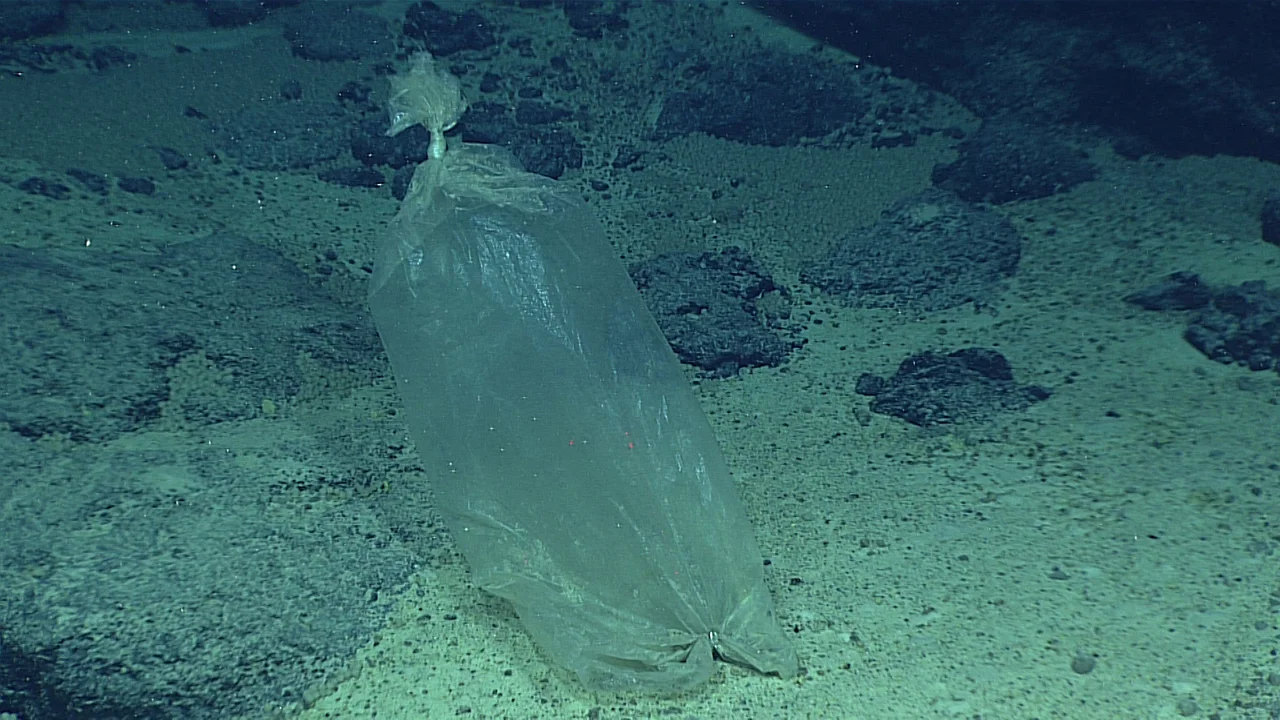
A camera at the bottom of the ocean can show that something is there. It cannot, by itself, show the route it took. That distinction matters in the story of a plastic bag recorded in the Mariana Trench: a familiar disposable object in a place that seems impossibly remote.
The observation is documented. The complete travel story is not. Following the evidence means keeping the two apart, then asking what other research can tell us about how plastics move through the ocean.
Start with the observation#
In a 2018 paper, Sanae Chiba and colleagues examined decades of deep-sea imagery. Their Figure 2 identifies plastic debris observed by the remotely operated vehicle KAIKO on May 20, 1998, at a recorded depth of 10,898 meters in the Mariana Trench. The paper describes the deepest plastic item in its dataset as a bag.
This was an observation later brought together with many other records, not a discovery first made when the paper appeared. The depth belongs to this particular sighting; it is not a new measurement of the ocean’s maximum depth. Nor does a picture establish where the item was manufactured or discarded. The firm claim is already substantial: recognizable plastic debris had reached a hadal environment, far below the depths of ordinary coastal activity.
Sources: [1]
Put the observations on a depth scale#
The KAIKO sighting at 10,898 meters and the NOAA photograph at 3,767 meters refer to separate objects, places and years. On a common vertical scale, the KAIKO record is almost 2.9 times as deep as the NOAA scene. That ratio compares recorded depths; it does not link the objects or describe a route between them.
The diagram plots both depths against the sea surface, with a linear axis. It deliberately leaves out an invented trench profile. A dramatic cross-section can suggest that we know the path an object followed down a slope, when the observations establish only where it was seen. Accurate labels make the two images more informative than a single generic picture of litter in deep water.
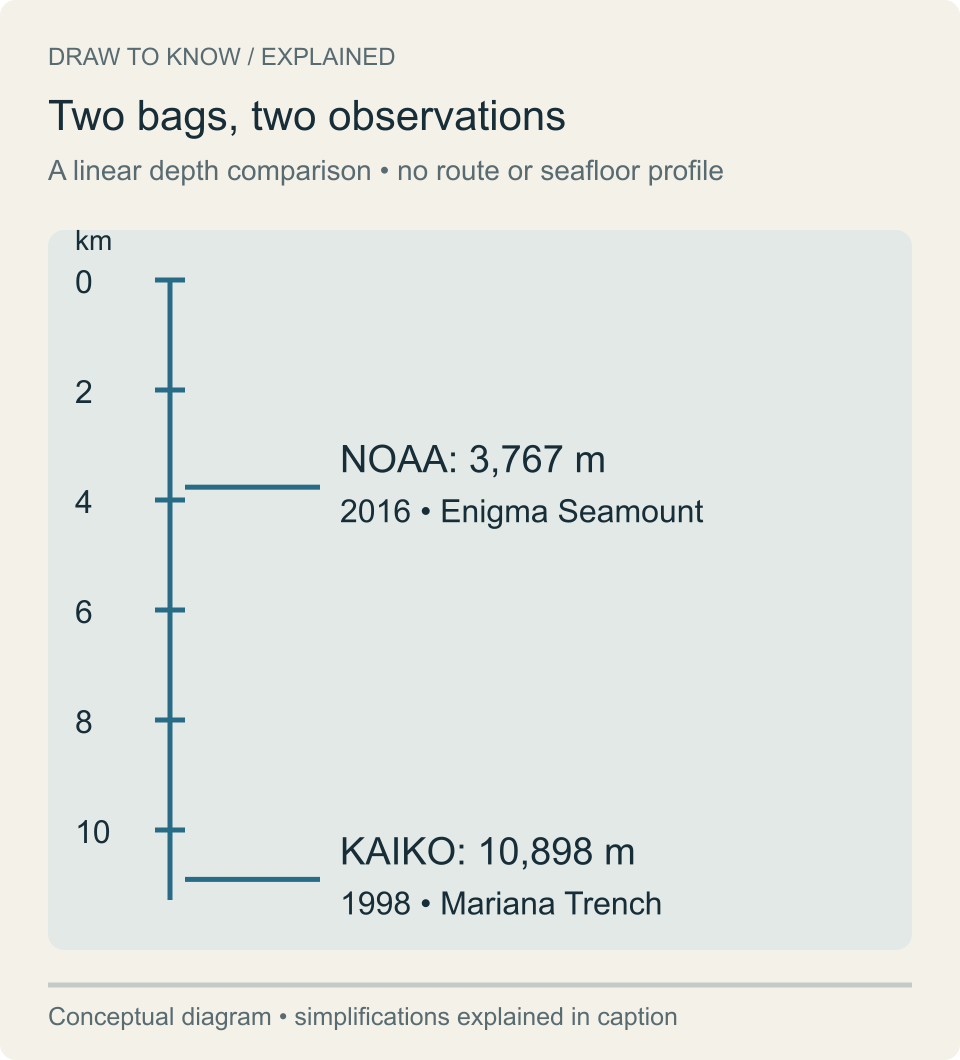
Image unavailable.
A linear depth axis places the 2016 NOAA observation at 3767 meters and the separate 1998 KAIKO observation at 10898 meters.
How an old dive becomes new evidence#
JAMSTEC’s Deep-sea Debris Database made archived observations publicly searchable in 2017. Research vehicles had filmed the seabed over many years, leaving records that could later be examined for human-made debris. The archive links the objects to information about the dives, making an isolated picture more useful than an image circulating without context.
A camera survey nevertheless sees only the ground in its field of view. Darkness, sediment, resolution and the chosen route affect what is detectable. A recognizable bag is easier to identify than a tiny particle, and a place with many dives has more opportunities to yield records. The archive establishes presence across observed locations. Reading it as a complete inventory of everything in the trench would go beyond what those observations can show.
Sources: [2]
What a camera survey can miss#
A vehicle's track is a sampling path. The area illuminated and visible to the camera is only a strip around it, and objects outside that strip may never enter the record. Even inside the view, sediment can conceal debris and small fragments may fall below the image's resolving power. Changing the survey route, altitude or image quality can change what is detected without any change in the true amount of litter.
The invented survey map below makes this distinction visible: a sighting tells us that an object was present in an observed patch. To estimate abundance across a wider region, researchers also need a sampling design, surveyed area and an account of detection limits. An unvisited patch is unknown, not demonstrably clean.
JAMSTEC therefore combines methods. Its research descriptions include collecting water and sediment samples and using hyperspectral imaging to identify material from spectral patterns. These measurements answer questions that a distant view of a recognizable bag cannot answer by itself.
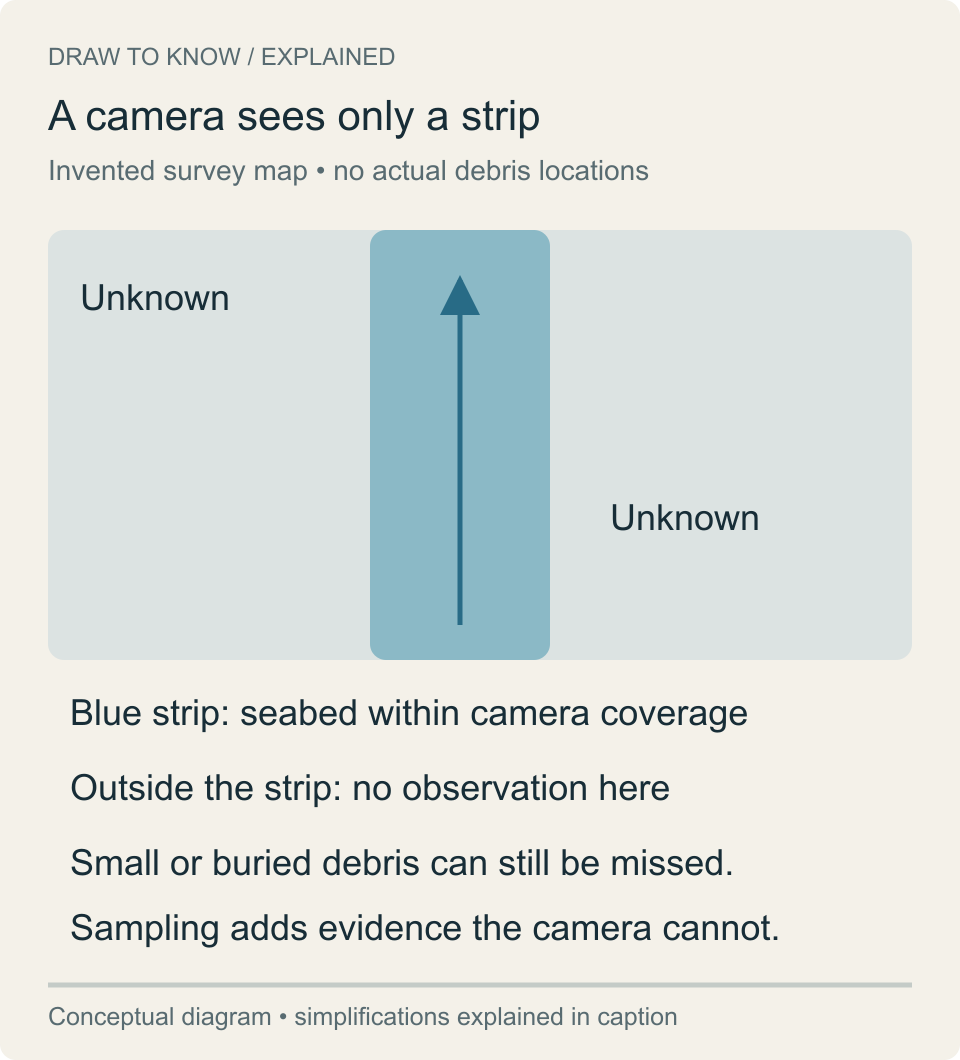
Image unavailable.
An invented camera survey strip crosses a larger unobserved area. Unobserved regions are labeled unknown, not clean.
The missing journey#
Plastic reaches the ocean through several routes. Wind, runoff, streams and storm drains can move land-based litter into water. Fishing gear can be lost or abandoned directly at sea. Some plastic floats; some sinks. A location on the seabed therefore does not identify a single source or a single transport mechanism.
For the KAIKO bag, an honest reconstruction has blank spaces: the place of release, time spent near the surface, changes to the material, and the final descent. Ocean circulation can transport debris, but saying that a current could carry an object is different from demonstrating which current carried this one. Without tracking data or other distinguishing evidence, a detailed journey from a particular shop, river or country would be a story we supplied rather than a finding from the image.
Sources: [3]
One possible mechanism: life adds weight#
Floating plastic does not necessarily remain unchanged. Organisms can colonize its surface, a process called biofouling. An experimental study published in 2021 found that such growth increased the density of polyethylene samples in North Sea coastal waters enough for them to sink.
The same research also found a complication: if a fouled piece fragments, some smaller pieces may regain buoyancy. Sinking is therefore not always a simple, permanent switch from surface to seabed. Material, size and the organisms attached to it matter.
This experiment supports a mechanism that can help explain why initially buoyant plastic occurs underwater. It does not establish that biofouling carried the 1998 bag into the Mariana Trench. The study involved different material samples and conditions, and the bag’s history was not measured. It gives us a plausible process to investigate, rather than a solved itinerary.
Sources: [4]
The physics behind floating and sinking#
Water supplies an upward buoyant force equal to the weight of the water an object displaces. Gravity supplies the object's downward weight. For an ideal fully submerged object in still water, its average density relative to the surrounding water determines the direction of the imbalance: lower density favors rising and higher density favors sinking.
Biofouling can change that balance by adding attached material with its own mass and volume. The force diagram illustrates the idea; it does not assign a measured density to the KAIKO bag. A flexible item can change shape, and trapped gas or attached organisms can change its effective behavior. Shape and drag also influence how quickly an object moves through water.
Consequently, a possible sinking mechanism does not give us a sinking speed, release date or final destination. Currents can move an object sideways while it descends, and later changes can alter its buoyancy again. Those are reasons to study transport, not evidence for a particular route taken by this bag.
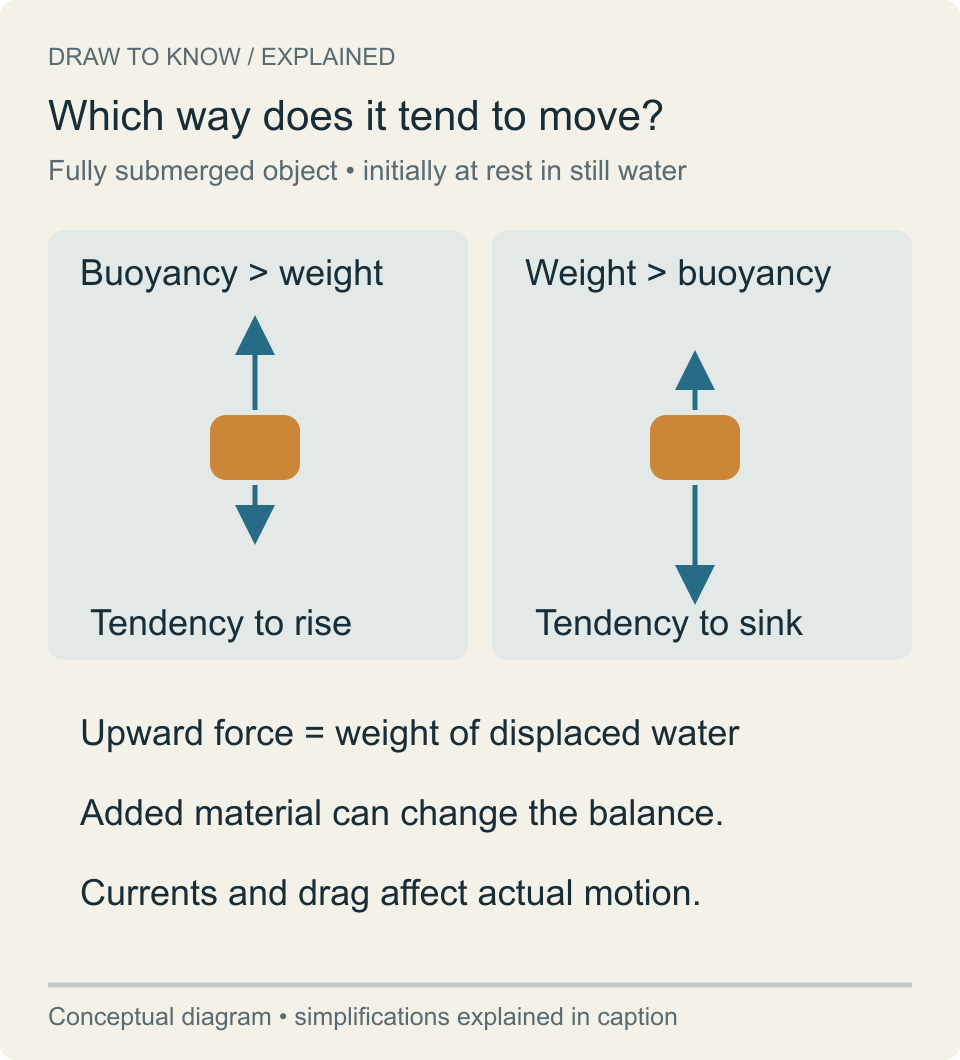
Image unavailable.
Two submerged objects show qualitative force balances: greater buoyancy favors upward acceleration; greater weight favors downward acceleration.
Independent observations widen the picture#
The trench observation is not the only evidence of debris reaching deep water. A separate review of Pacific expeditions from 2015 to 2017 found human-made debris during 17.5 percent of 188 dives. Those dives covered depths from 150 to 6,000 meters and recorded several kinds of material, including plastic and fishing gear.
The NOAA photograph at the top of this article comes from that wider context: a bag on Enigma Seamount at 3,767 meters. Keeping its caption with it is essential. Substituting it for the 1998 KAIKO image would falsely merge two observations. Together, properly identified records support a broader pattern; they do not become one continuous filmed journey. The coral image below documents a different interaction again: line physically entangled with an animal.
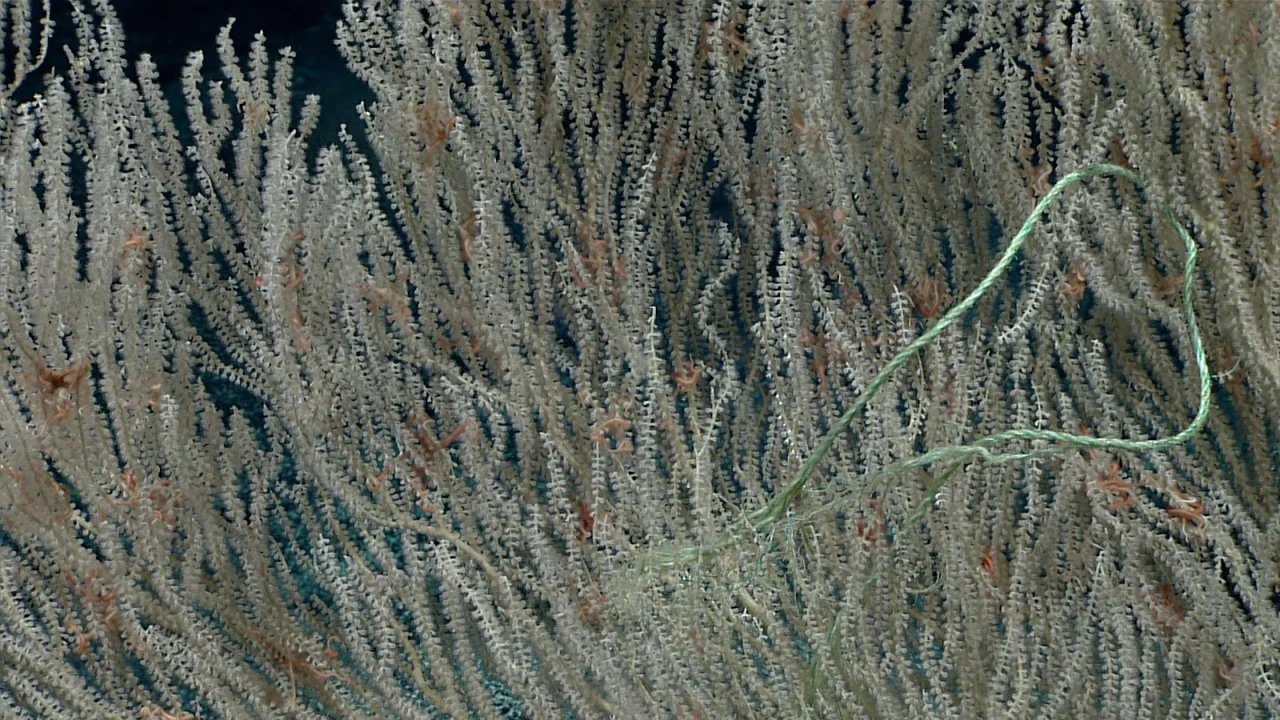
Image unavailable.
Fishing line caught among the branching arms of a large deep-sea coral.
Sources: [6]
A bag on the seabed and particles in an animal are different findings#
A 2019 study led by Newcastle University examined 90 amphipods from six deep Pacific trenches. The researchers reported ingested particles in animals from all six areas. The identified material included plastics as well as semi-synthetic cellulosic fibers. That distinction matters: every reported fiber should not automatically be described as a fully synthetic plastic.
These samples add biological evidence to the photographs of larger objects. They do not show that every animal in every trench contains plastic, or that the particles came from the photographed bag. A visual record of debris, identification of ingested material and measurement of harm are separate steps. Each answers a different question, and each needs its own evidence.
Sources: [5]
The question after the striking image#
Microplastics are plastic pieces or fibers smaller than 5 millimeters. Larger items can fragment into them, so an object becoming harder to see does not mean the material has left the environment. NOAA identifies ingestion as a concern while also emphasizing that the effects of exposure still require research.
The KAIKO record changes what we can reasonably assume about remoteness. Great depth did not prevent this object from arriving. What the record cannot supply is a universal pollution count or a complete account of ecological damage. The useful next questions are measurable: what materials are present, how are they transported, which organisms encounter them, and what happens after that encounter? The image starts those questions. Careful sampling and repeated observation are how researchers work toward the answers.
Sources: [7]
Keep exploring
Sources & further reading
Follow the original research, records, and explanations behind this story.
- Human footprint in the abyss: 30 year records of deep-sea plastic debris Chiba et al., Marine Policy (2018)
Primary study. Figure 2 identifies KAIKO, May 20, 1998 and 10,898 m. An accessible author-paper copy was checked; article text is original, not a reproduction.
- Our Approach: Deep-sea Debris Database JAMSTEC
Agency description of the archive, sampling methods and remaining research gaps.
- A Guide to Plastic in the Ocean NOAA National Ocean Service
Land- and sea-based entry routes and the difference between fragmentation and removal.
- Biofouling impacts on polyethylene density and sinking in coastal waters Amaral-Zettler et al., Water Research (2021)
Experimental support for a possible sinking mechanism; not a reconstruction of the 1998 bag’s path.
- World’s deepest waters becoming ultimate sink for plastic waste Newcastle University
Research team’s report of particles in sampled trench amphipods; includes synthetic and semi-synthetic material.
- Deep-sea Debris in the Western and Central Pacific NOAA Ocean Exploration / Diva Amon
Separate 2015–2017 observations, image provenance and limits of large-debris visual surveys.
- Microplastics NOAA Marine Debris Program
Definition below 5 mm, sources, ingestion and limits of knowledge about effects.
- Buoyancy: Archimedes Principle NASA Glenn Research Center
Buoyant force equals the weight of displaced fluid; used for the conceptual force balance, not to reconstruct a particular bag’s route.
See the story in motion
Watch our illustrated video, then explore another question below.
Watch on YouTubeFollow the thread