
A planet does not need to shine for astronomers to detect it. If it passes almost directly in front of a distant star, its gravity bends the star's light and briefly makes that star appear brighter. This effect, gravitational microlensing, can reveal small, cold worlds that drift through the galaxy without an identified host star.
The light comes from the background star. The foreground planet supplies the gravitational lens. Separating those two roles explains both the method's strength and its limits: a clear detection can reveal a planet's mass scale while leaving its surface, atmosphere and exact history unknown.
What is a rogue planet?#
A rogue, or free-floating, planet travels without being gravitationally bound to a host star. Some may have formed in planetary systems and escaped after gravitational encounters. Others may have formed through the collapse of a gas cloud, more like isolated stars, but with planetary masses.
The formation route is difficult to reconstruct from a brief observation. Finding an isolated object does not show which encounter expelled it, or even establish that it was expelled. Population studies can test whether one origin produces the observed range of masses and locations.
In practice, researchers often write “free-floating planet candidate.” That qualification matters because a star on a sufficiently wide orbit can evade the observations used to find the planet.
Sources: [3]
How can gravity make a distant star brighter?#
Mass changes the geometry through which light travels. When a foreground object passes close to the line of sight to a background star, light can reach us along bent paths. The unresolved images contribute more light than the star normally sends toward us, producing a temporary increase in measured brightness.
Astronomers record a light curve: brightness plotted against time. As the alignment improves and then worsens, the magnification rises and falls. The lens need not emit detectable light, which makes the method useful for dark objects.
This is different from photographing a planet beside a star. It is also different from a transit, in which an orbiting planet blocks some of its own star's light. Microlensing uses an unrelated background star as the source.
Sources: [1]
Does a short brightening reveal the planet's mass?#
A short event points toward a small lens, but duration alone is not a unique measurement of mass. Distance and relative motion also affect how long the alignment lasts. A light curve therefore needs additional information before the mass and distance can be separated.
OGLE-2016-BLG-1928 illustrates the problem. Its reported Einstein timescale was 41.5 minutes. This is a fitted characteristic crossing time, rather than a stopwatch measurement of the entire visible brightening. The finite angular size of the background star left a measurable signature in the curve, allowing researchers to estimate the lens's angular Einstein radius.
The remaining distance uncertainty still allowed a range from roughly Mars mass to Earth mass. The study also excluded stellar companions only within a projected distance of 8 astronomical units. One astronomical unit is the average Earth–Sun separation. Neither result supplied a photograph of a terrestrial surface.
Sources: [2]
What did Gaia add to a ground-based detection?#
The event KMT-2024-BLG-0792, also named OGLE-2024-BLG-0516, was observed in May 2024 from Earth and by Gaia. The two locations saw slightly different alignments, with the event appearing about two hours later from Gaia. This provided microlensing parallax, an extra geometric constraint.
Together with the other light-curve information, that constraint allowed the researchers to separate mass from distance. The result reported in 2026 put the lens in the Saturn-mass range. The key advance was a measured mass, rather than a mass inferred mainly from the statistical properties of the surrounding galaxy.
Parallax here is a difference in viewing geometry. The timing difference should not be read as a simple extra light-travel time between the spacecraft and Earth.
Sources: [3]
Are all rogue planets invisible?#
No. Young planetary-mass objects can still glow with heat left from formation. Some can be found through direct imaging, especially in infrared light. NASA identifies PSO J318.5-22 as a free-floating object discovered through direct imaging in 2013.
Microlensing reaches a different population: objects whose own light may be too faint to detect. An old, cool, low-mass body can still bend the light of a background star. The methods therefore select different kinds of targets, and their discoveries should not be treated as interchangeable samples.
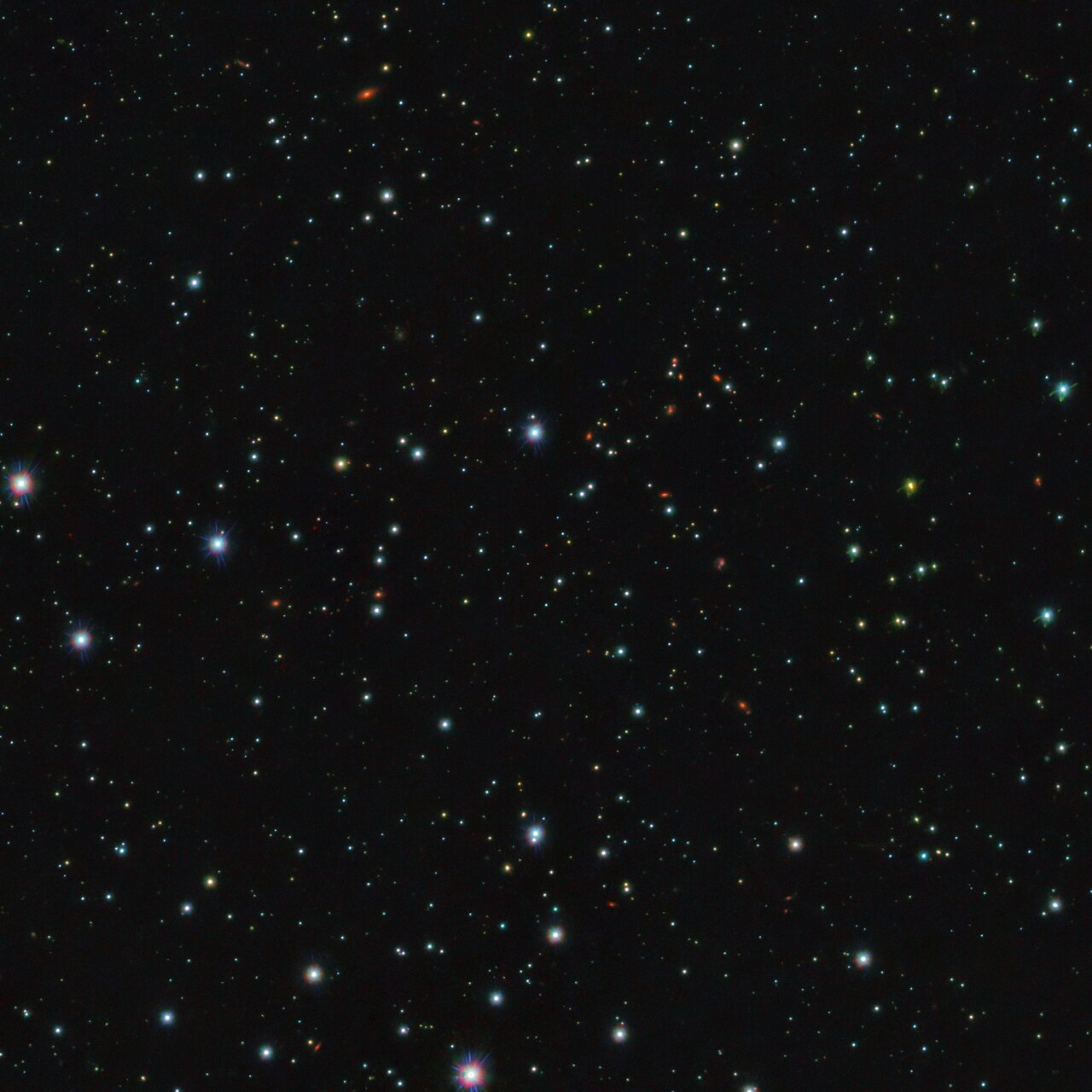
The cover shows another directly imaged example, the central red point in a combined VST and VISTA image released by ESO. It is a different object from the microlensing examples above. Its appearance should not be assigned to a planet detected only through lensing.
How many free-floating planets might exist?#
A 2023 analysis of nine years of MOA survey data led to an estimate of about 20 rogue planets per star in the Milky Way. This is a population inference from a survey, not a catalogue containing trillions of individually identified planets.
To turn detections into an abundance estimate, researchers must account for the events their survey could miss. A short event may occur between observations; another may be too weak to distinguish from noise. The inferred mass distribution also matters. A population dominated by small planets can contain many objects while contributing relatively little total mass.
The estimate should therefore travel with its method and date. Future surveys can revise it by measuring more events and testing the assumed detection efficiency.
Sources: [6]
What remains unknown after the brightening ends?#
The close alignment is temporary. Astronomers cannot schedule an identical repeat once the lens and source have moved apart. Rapid observations from several locations can capture information that would otherwise be lost, while later imaging can still constrain a possible host.
A microlensing mass does not measure radius, atmospheric composition or temperature. Calling an object Earth-mass says how much matter it contains; it does not establish Earth-like weather or habitability. Likewise, a Saturn-mass measurement does not show rings.
A detection can establish a planetary lens, constrain its mass and place limits on nearby stars. Combining many such results lets astronomers investigate how frequently planetary systems lose worlds, without inventing a detailed landscape for each unseen planet.
Keep exploring
Sources & further reading
Follow the original research, records, and explanations behind this story.
- Microlensing NASA Science
Geometry and detection method
- A terrestrial-mass rogue planet candidate detected in the shortest-timescale microlensing event Mróz et al. / ApJ Letters
Timescale, mass-distance ambiguity and host limits
- Astronomers Confirm Rogue Planet Candidate as a Planet for the First Time Peking University
Joint observation and possible formation routes
- Limits on a Host Star around a Saturn-mass Free-floating Planet Candidate Mróz et al. / arXiv
September 2026 preprint; host exclusion limits
- Where the Nightlife Never Ends NASA Science
Direct imaging discovery and residual heat
- New Study Reveals NASA’s Roman Could Find 400 Earth-Mass Rogue Planets NASA
2023 demographic estimate and temporary alignment
- The faint red glow of a rogue planet ESO
Direct image combining VST and VISTA; a different object from the lensing examples.
Follow the thread