
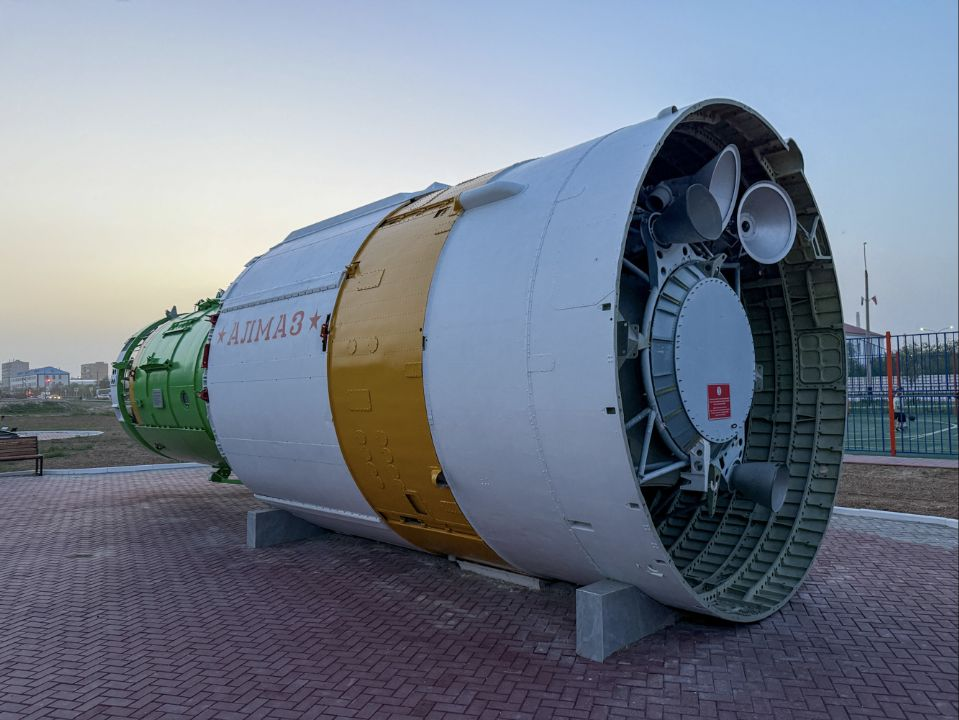

In 1974, a Soviet space station carried a cannon into orbit. According to space historian Anatoly Zak’s account, ground controllers fired it after the crew had left. The station was Salyut 3, publicly presented as part of a civilian-sounding series but built for a military program called Almaz.
A gun fixed to a spacecraft raises a surprisingly practical question: how do you aim it when the platform itself is floating? The answer links the station’s military purpose to the way a spacecraft turns and reacts to a push.
Why did a space station carry a cannon?#
Almaz was designed for military reconnaissance: observing the Earth from orbit for military intelligence. The Soviet Union used the public Salyut name for stations from different programs. Salyut 3, launched on June 25, 1974, was the Almaz station known internally as OPS-2.
The station carried a self-defense gun. Zak’s historical account says its existence became public after the Cold War. The weapon was meant to defend the station, but the reported firing was a test, not a battle or an attack on another spacecraft.
The programs also shared hardware. NASA historian John Uri describes how an Almaz shell and components derived from Soyuz spacecraft helped create the first civilian Salyut station. A shared outward lineage did not make every station’s mission the same.
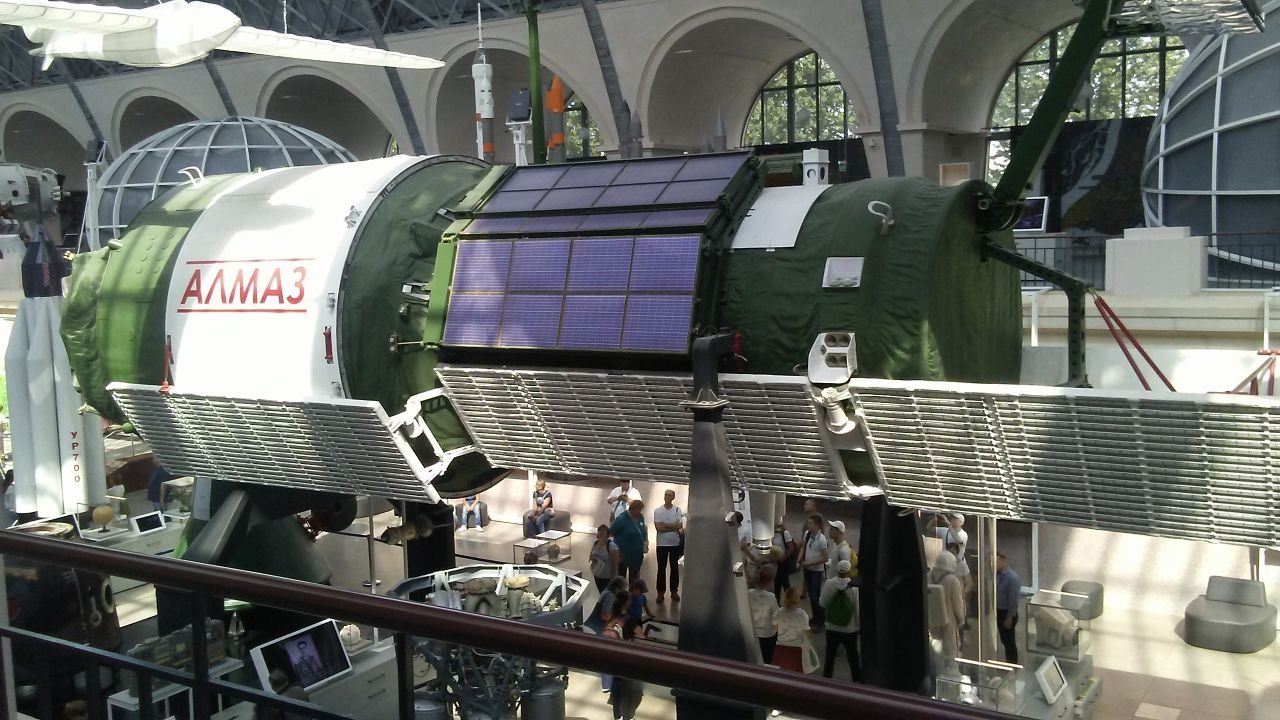
Image unavailable.
Green and white Almaz station exhibit with solar arrays in a Moscow museum.

Was a crew aboard when it fired?#
Pavel Popovich visited Salyut 3 aboard Soyuz 14, according to Zak’s history. Popovich’s later interview is among the sources cited in that account.
The gun test was separated from that crewed visit. Zak reports that shaking during ground tests ruled out firing with people aboard. That distinction matters: the crew lived and worked on the station, but the reported orbital firing came after they had departed.
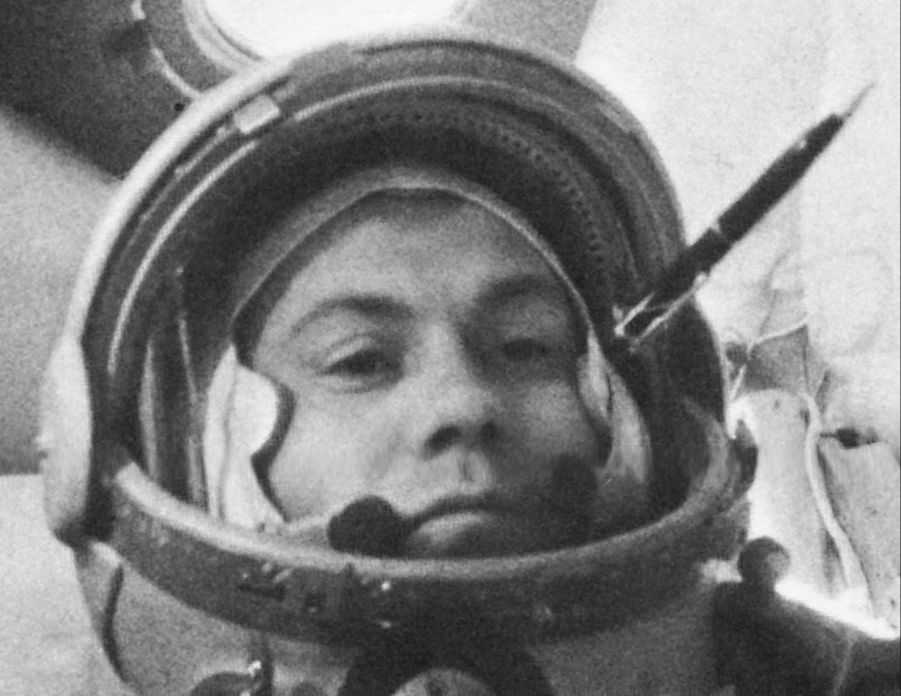
Image unavailable.
Black and white portrait of Pavel Popovich wearing a pressure helmet.

Sources: [1]
How could a fixed gun be aimed in space?#
Zak describes the gun as fixed to the forward part of the station. To change where it pointed, the station itself had to change its attitude: its orientation in space. Attitude controls turn a spacecraft to put an instrument, docking port, or in this case the gun, in the required direction.
Firing also gives the spacecraft a push in the opposite direction to the departing projectile. This is a physics inference about a free spacecraft, not a measured account of Salyut 3’s motion. Thrusters can provide opposing impulses to correct motion, although the available account does not establish a precise correction or its size for the test.
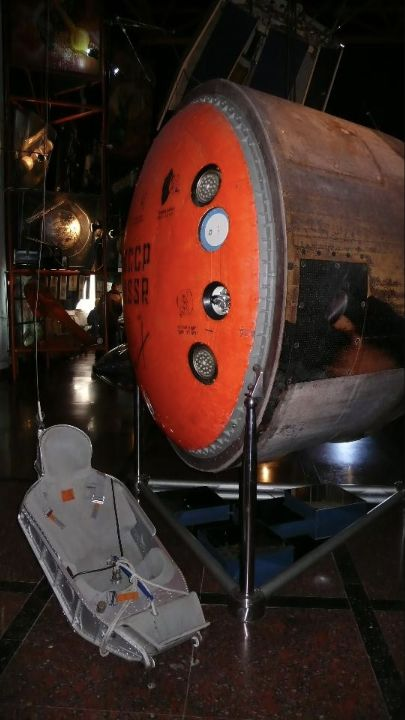
Image unavailable.
A scorched Soyuz reentry capsule and seat displayed in a museum.

What happened when the cannon was fired?#
Zak reports that ground controllers commanded the gun to fire during the station’s uncrewed phase, shortly before its descent from orbit. His account draws on Russian historical sources and assistance from people at the station’s manufacturer.
Aiming a fixed weapon depended on pointing an entire orbiting station, while its firing introduced another motion the spacecraft would have to accommodate.
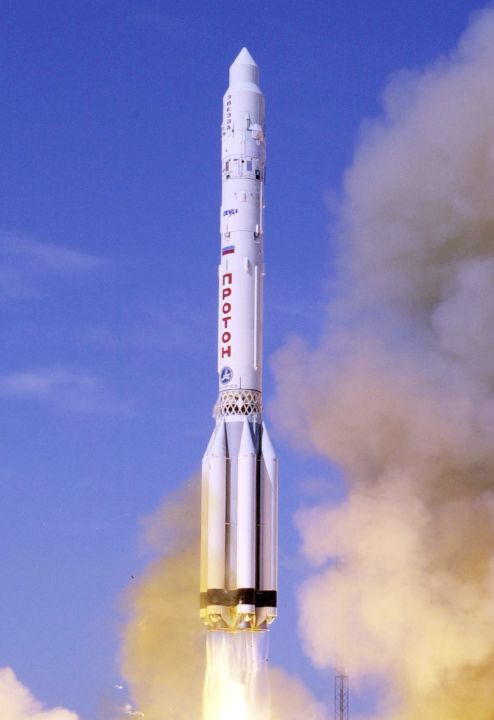
Image unavailable.
White Proton-K rocket climbing through smoke with bright exhaust.

Sources: [1]
Keep exploring
Sources & further reading
Follow the original research, records, and explanations behind this story.
- Salyut-3 (Almaz OPS-2) space station RussianSpaceWeb.com
Anatoly Zak’s historical account of the station, crew, fixed self-defense gun and uncrewed ground-commanded firing.
- 50 Years Ago: Launch of Salyut, the World’s First Space Station NASA
John Uri on military Almaz and the origins of the first civilian Salyut; does not document the cannon test.
- Newton’s Laws of Motion NASA Glenn Research Center
Second-law momentum change and third-law equal-and-opposite forces support the qualitative recoil explanation, not measurements of the Salyut 3 test.
Follow the thread