
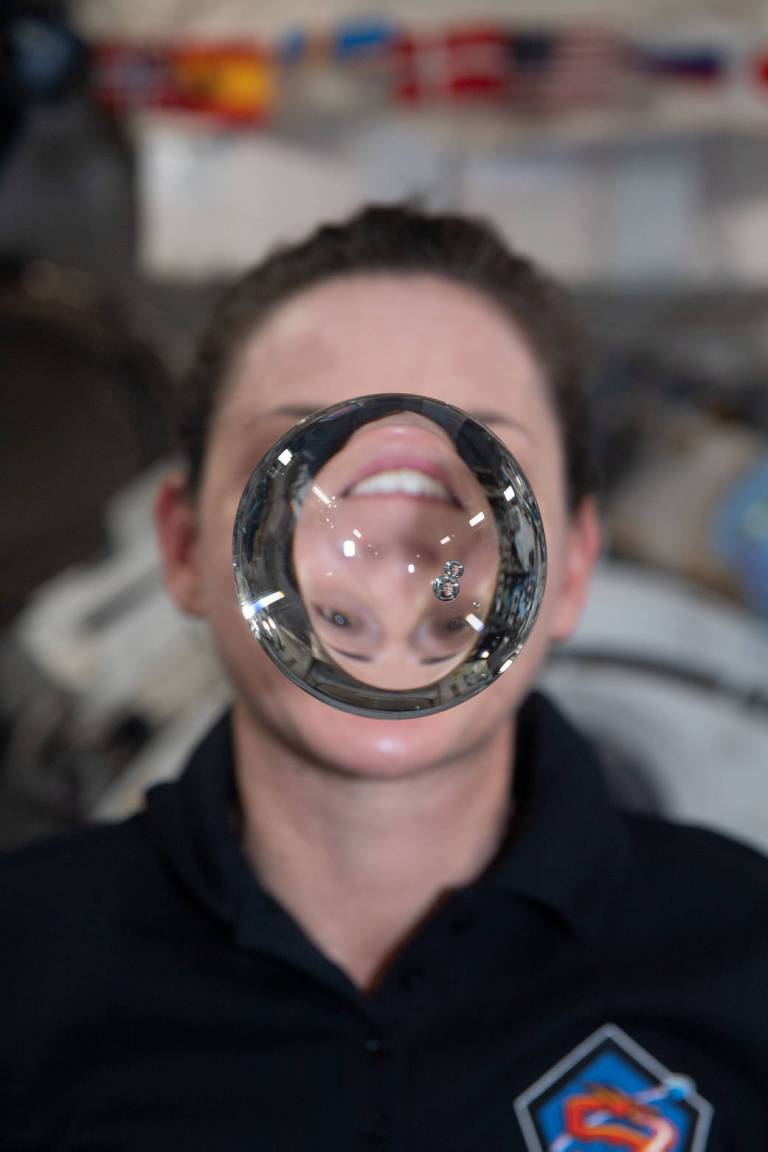
A floating ball of water is a real spacecraft experiment. So is a conversation between astronauts. Neither means that gravity has disappeared or that a human voice can cross empty space.
The setting matters. A water demonstration inside the International Space Station takes place in a pressurised cabin, with air around the liquid and Earth pulling on the entire spacecraft. Change the surroundings, or change how the spacecraft moves, and the result changes too.
Is there gravity at the space station?#
Earth still exerts a strong gravitational pull at the station’s altitude. At roughly 400 kilometres above the surface, gravitational acceleration is about nine-tenths of its surface value. The station has climbed only a small distance compared with Earth’s radius.
Gravity bends the spacecraft’s path into an orbit. Without that inward acceleration, a moving spacecraft would continue along a straight path rather than circle Earth. The floating crew are therefore living in a place where gravity is essential to their motion.
The distinction is between gravitational attraction and the support you feel while standing. On the ground, a floor prevents you from falling and pushes against your feet. In orbit, the cabin and its occupants fall together, so the floor does not need to provide that continuous support.
Sources: [1]
Why does falling not bring the station down?#
The station has substantial sideways velocity. As gravity bends its path downward, Earth’s surface curves away beneath it. With a suitable combination of height and velocity, that curved path continues around the planet.
An astronaut, a loose tool and a drop of water already share the spacecraft’s orbital motion. Releasing the tool does not remove its sideways velocity. It remains close to the astronaut because both follow almost the same falling path.
This also explains why a brief period of apparent weightlessness can happen much closer to the ground. An experiment falling inside a drop tower does not escape Earth’s gravitational field. Its container and contents simply accelerate together for the duration of the drop. An orbit extends that falling condition without requiring an indefinitely deep tower.
Sources: [2]
Why does floating water become round?#
Surface tension favours a smaller liquid surface. For a given volume, a sphere has the least surface area, so a freely suspended drop tends towards that shape when other disturbances are small.
On a kitchen counter, gravity and contact with the surface strongly affect the shape of a puddle. Inside a freely falling cabin, the water does not collect at the bottom of the room in the same way. Surface effects become easier to see, including the tendency to form a rounded blob.
A photograph captures one moment. It does not prove that every drop remains perfectly spherical: touching it, moving the surrounding air or disturbing the liquid can alter its shape. The cover photograph shows a water sphere with Nicole Mann’s image refracted through it aboard the station on February 12, 2023. It is a cabin demonstration, not an exposed pool in vacuum.
Does every bubble rise to the top?#
An air bubble rises through an ordinary glass of water because of buoyancy in a gravitational field: the surrounding liquid develops a pressure difference with height. In an approximately weightless experiment, that familiar upward sorting is greatly reduced. An air bubble can remain suspended within a water drop.
Air has not become as dense as water. The missing ingredient is the usual gravity-driven separation relative to the container. A bubble’s motion can still depend on disturbances and contact with nearby surfaces.
Water also remains capable of sticking to other materials through adhesion. A drop attached to a leaf is therefore a different situation from an isolated sphere. The USGS illustration of a water drop and an enclosed air bubble makes both effects visible: the liquid is rounded, but it is also in contact with a plant. Removing a familiar downward flow does not remove all the other forces acting on water.
Sources: [4]
Can astronauts talk normally inside a spacecraft?#
Yes. The cabin contains air, which carries pressure disturbances from a speaker’s voice to a listener’s ears. Sound also travels through liquids and solids; it is not restricted to Earth’s atmosphere.
The relevant question is whether there is material to carry a mechanical disturbance. Moving the same room into orbit does not make its air incapable of transmitting sound. Conversely, placing an ordinary sound source in a vacuum removes the surrounding air that would carry its vibrations to a distant listener.
A tuning fork can still vibrate in vacuum. Its material has not lost its mechanical properties. But a nearby person cannot hear those vibrations across an empty gap in the usual airborne way. The source vibrating and the sound reaching someone are separate parts of the process.
Sources: [7]
How can astronauts speak over a radio?#
A microphone converts the pressure variations of speech into an electrical signal. Communication equipment encodes information onto electromagnetic radiation, which can cross vacuum. At the receiving end, equipment recovers the information and a speaker produces new pressure waves near the listener.
The voice therefore changes physical form along the route. Sound travels through air near the microphone; radio waves carry information between antennas; sound is produced again at the destination. The radio transmission is not a pressure wave somehow surviving without air.
Radio waves and visible light belong to the electromagnetic spectrum. Both can travel through vacuum. That property lets a spacecraft communicate with Earth even though the intervening space cannot carry an ordinary shouted conversation.
What about recordings called the sounds of space?#
The label alone does not identify the measurement. It might describe sound recorded in a cabin, a scientific signal converted into audible frequencies, or data mapped to musical notes. Those are different methods with different meanings.
Space also contains gas and plasma, so a blanket claim that no mechanical waves exist anywhere beyond Earth is too broad. Pressure disturbances can occur where there is suitable material. That does not provide a continuous, audible path from a distant object to a person on Earth.
To interpret a recording, first ask what instrument collected the original data and what conversion produced the audio. Our guide to space sonification follows those distinctions in more detail. The source and transmission path determine what the recording can tell you.
Keep exploring
Sources & further reading
Follow the original research, records, and explanations behind this story.
- What Is Microgravity? (Grades 5–8) NASA
Gravity remains strong at station altitude; shared free fall explains apparent weightlessness.
- What is Microgravity? NASA Glenn Research Center
Orbital sideways motion and Earth-based free-fall demonstrations. Historical aircraft details are not used.
- In outer space, water forms a sphere, and an air bubble does not rise USGS Water Science School
Surface-area explanation and NASA photograph; simplified no-gravity wording is not repeated.
- Water in Space: How Does Water Behave in Outer Space? USGS Water Science School
Reduced buoyancy and attachment to surfaces. Density is not claimed to change; inaccurate opening gravity wording is corrected by NASA free-fall explanation.
- Astronaut Nicole Mann’s image refracts through a sphere of water NASA
Exact image identity and cabin microgravity context.
- Anatomy of an Electromagnetic Wave NASA Science
Mechanical waves need matter; electromagnetic waves can propagate through vacuum.
- Cosmicopia: Energy Traveling Through Space NASA Goddard Space Flight Center
Cabin speech, a vibrating fork in vacuum and communication by electromagnetic radiation.
- New NASA Black Hole Sonifications with a Remix Chandra X-ray Center
Gas can support pressure waves; sonification involves a specified data-to-audio conversion.
- Data Sonifications NASA
Instrument data can be represented as audio; no audio or video played.
Follow the thread