

On 18 March 1965, Alexei Leonov became the first person to leave a spacecraft in orbit and float outside it. He remained attached to Voskhod 2, with Pavel Belyayev inside. The outward journey made history. The return exposed a problem that a photograph of a floating cosmonaut cannot show: a pressurised suit can keep someone alive while making it difficult to bend, reach a control or pass through a hatch.
How long was the first spacewalk?#
The Fédération Aéronautique Internationale distinguishes two durations. Leonov was out for 23 minutes 41 seconds in total and free floating for 12 minutes 9 seconds. The latter became the ratified record. The familiar description of a roughly twelve-minute spacewalk refers to that free-floating interval.
These figures do not describe two different flights. They use different boundaries around the same operation. Time associated with leaving and returning through the airlock is not identical to time spent floating outside it.
For Leonov, the interval outside the hatch was only part of getting safely from the cabin into space and back.
Sources: [1]
Why did Voskhod 2 need an inflatable airlock?#
Voskhod 2 used a chamber that expanded outside the spacecraft. Leonov could enter it from the cabin, close the inner hatch, then proceed toward the exterior. The arrangement let the main cabin remain pressurised while the chamber connected the cosmonaut to vacuum.
An airlock is more than a second door. Its pressure must change between the two environments. Before opening outward, the chamber is isolated from the cabin and depressurised. On the return journey, the outside hatch must close before the chamber can be repressurised and reopened to the cabin.
A person who has reached the mouth of the airlock has therefore not finished the return. They must get their body and equipment far enough inside to close the hatch and complete the pressure transition.
Why did his spacesuit become difficult to move?#
Inside a pressure suit, gas pushes outward. Outside it, the near-vacuum provides almost no opposing pressure. The suit must contain that difference while allowing its wearer to move. ESA’s account describes Leonov’s suit becoming rigid enough to make movement difficult.
The same underlying design problem appears in later suits, though their construction differs. NASA describes a gas-holding bladder and a restraining layer that keeps it in the intended shape. Joints, gloves and the rest of the pressure garment must permit useful movement while maintaining the protective enclosure.
Being weightless does not remove this resistance. An astronaut may float without supporting their weight against a floor and still have to work hard to bend a pressurised sleeve or glove. Weightlessness and gravity are a separate issue from the forces within the suit.
How did Leonov get back through the hatch?#
In his later written interview with the FAI, Leonov described his fingers no longer reaching the glove tips and his feet shifting inside the boots as the suit changed shape. He could not operate his camera as he had during training. Those were immediate problems with reach and control, not merely discomfort.
He recalled unsuccessful attempts to return feet first, the method he had practised. He then lowered the suit pressure, which improved his ability to move, and entered head first. Inside the narrow chamber, he still had to turn around to operate the hatch closure.
This is Leonov’s retrospective account of an emergency decision. It should not be read as a general procedure for spacewalkers. Reducing pressure changes the protection the suit provides; his solution addressed a dangerous situation with the hardware and time he had available.
Sources: [3]
Why is a supply of oxygen not enough?#
A suit must keep a person within a workable physical environment. Oxygen is one part of that job. The pressure has to remain suitable, exhaled carbon dioxide must be removed, and the astronaut’s body heat must be managed while they work.
NASA’s description of modern EVA equipment separates the pressure garment from the life-support system. A regulated oxygen supply, circulating gas and carbon-dioxide removal work together. Cooling equipment removes excess heat. These details explain the functions required; they are not a claim that Leonov’s 1965 suit contained the same equipment as a later American suit.
Movement is another requirement. A suit that supports breathing but prevents a person from reaching the hatch controls has failed at a task essential to the mission. Suit performance has to be assessed with the wearer doing the intended work.
Sources: [4]
Why do early and later accounts sound different?#
The FAI’s fiftieth-anniversary account explicitly notes that the report submitted after the flight did not describe Leonov’s difficulties getting back inside. The later interview gives a much more detailed account of the suit and re-entry problem.
A record establishes a measured performance; it need not describe every difficulty. Later recollection adds experience, but should be identified as recollection.
There is no need to attach an invented countdown to make this episode serious. The documented difficulties with the suit, entry orientation and hatch are enough. Keeping those particulars separate from dramatic retellings makes the return easier to understand.
What still had to be learned after Leonov?#
Leaving the cabin proved that a person could operate outside a spacecraft in a suit. Performing sustained, controlled work was a further challenge. NASA’s history of the Gemini programme describes the effort needed to make spacewalks productive, including underwater training used by Buzz Aldrin.
Tethers prevent separation from the spacecraft; handholds and restraints let a spacewalker maintain a useful position while working. These solve different problems. Remaining attached does not automatically place an astronaut’s hands where a tool or connector needs them.
Later spacewalks supported assembly, maintenance and repair. The Skylab crew’s work to free a jammed solar array is one example. The activity developed from demonstrating an exit into doing jobs that could keep a spacecraft operating.
What was the hardest part of the doorway home?#
Leonov had to fit the suited body through the opening, control his orientation inside and reach the mechanism that restored a sealed compartment. The hatch, suit and human movement belonged to one task. Testing them separately could not reveal every difficulty of using them together.
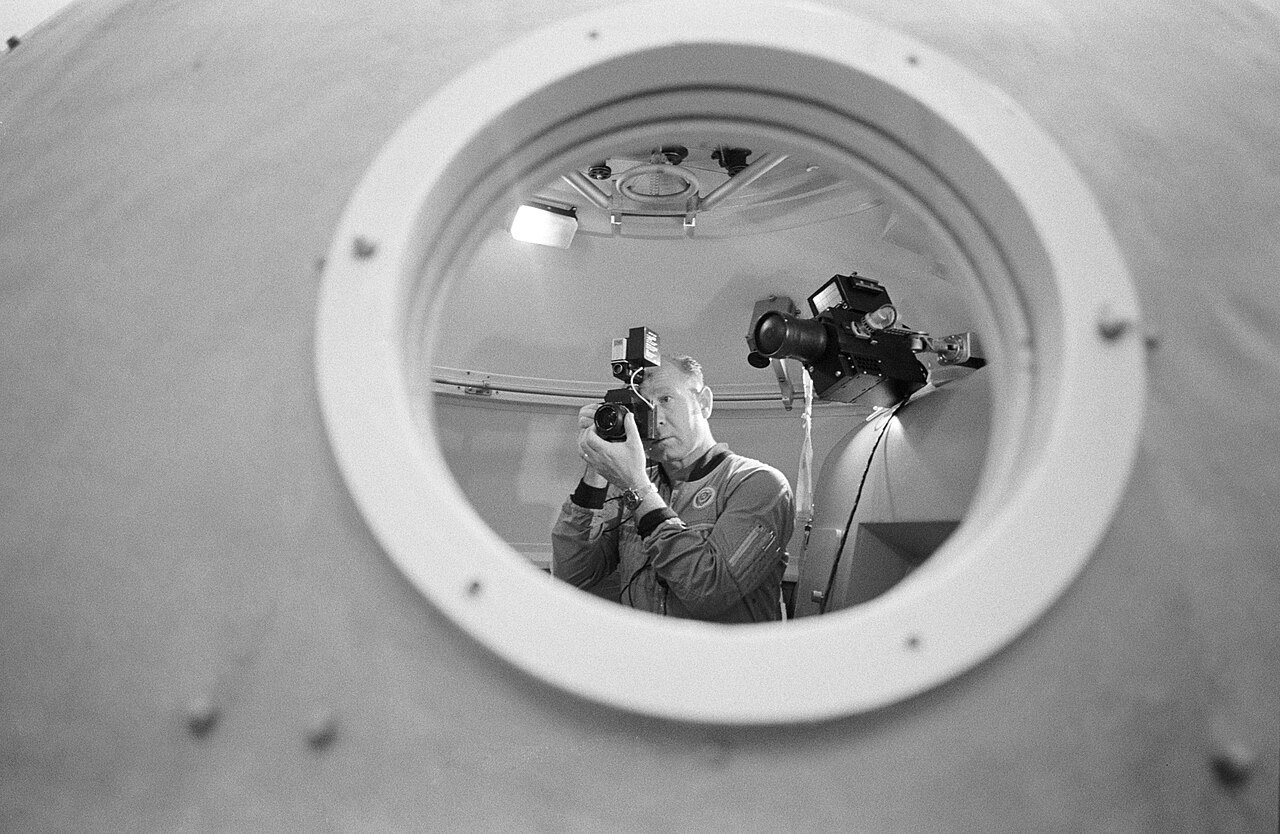
The cover photograph shows Leonov during Apollo-Soyuz ground training in 1975, a decade after the first spacewalk. It is not a view of his 1965 return. That earlier flight established a requirement that remained: an EVA has to include a workable route back into the spacecraft, with enough mobility left to complete it.
Keep exploring
Sources & further reading
Follow the original research, records, and explanations behind this story.
- 18 March 1965: Leonov Successfully Made the First Spacewalk Fédération Aéronautique Internationale
Distinguishes 23 min 41 sec outside from 12 min 9 sec free floating; discusses omissions in initial report.
- Alexei Leonov: The Artistic Spaceman ESA
Voskhod 2 crew, inflatable airlock and pressurised suit difficulty.
- Interview with Alexey Leonov, the First Man to Walk in Outer Space FAI / Alexey Leonov
Retrospective first-person account of glove fit, camera controls, reduced pressure and head-first return.
- Spacewalk Spacesuit Basics NASA
Modern suit explanation used only for general pressure and life-support functions.
- What Is a Spacewalk? NASA
General airlock and tether functions; simplified historical duration not used.
- Space Station 20th: Spacewalking History NASA
Subsequent development of useful EVA work and underwater training; dated totals not used.
- Leonov during Apollo-Soyuz simulation, S75-21715 NASA Johnson Space Center / Wikimedia Commons
1975 ground simulation photograph, not the 1965 spacewalk; NASA-origin public-domain attribution.
- Spacesuits Built to Handle Pressure NASA
General pressure-garment principle; legacy Shuttle suit description not treated as Leonov’s hardware.
Follow the thread