
Apollo 10 flew a lunar module close to the Moon and brought it back without landing. Six months later, Apollo 12 landed beside a robotic spacecraft that had been waiting there since 1967. Between them came Apollo 11 and the first human footsteps. The missions on either side of that event tested different parts of the journey: whether the flight sequence worked, and whether astronauts could reach a particular place worth exploring.
Why fly to the Moon without landing?#
Apollo 10 had a planned stopping point. Its job was to rehearse the lunar flight before a crew attempted the final descent and touchdown. The landing itself was reserved for the next flight.
The crew had already practised in simulators, often with Mission Control participating. Those sessions let astronauts and controllers repeat procedures, change checklists and work through failures. Flying the spacecraft at the Moon added conditions a simulator could only represent: actual navigation measurements, communications and interactions between two vehicles far from Earth.
A rehearsal also had to include the return. Getting a lunar module close to the surface would be of little use if its occupants could not rejoin the spacecraft that would take them home.
Sources: [3]
How close did Apollo 10 get?#
Thomas Stafford, Eugene Cernan and John Young flew Apollo 10 in May 1969. Stafford and Cernan entered the lunar module Snoopy. Young remained in the command and service module, Charlie Brown, while the two spacecraft separated in lunar orbit.
Snoopy lowered the nearest point of its orbit and passed over the planned Apollo 11 landing area. NASA’s statistical mission history gives a lowest measured altitude of 47,400 feet, roughly 14.4 kilometres. The often quoted 50,000 feet describes the approximate planned low pass.
At that height, Snoopy was still a flying spacecraft. It did not hover just above the ground or begin a landing that the crew then abandoned. The pass allowed tests of the landing radar and observations of the terrain and lighting along the approach.
Sources: [1]
What did the crew rehearse after the low pass?#
Stafford and Cernan separated Snoopy’s ascent stage from its descent stage, fired the ascent engine and carried out the rendezvous sequence that would follow a lunar liftoff. They had never stood on the surface, but they could still test how the departing portion of the lander would meet Charlie Brown again.
The separation sequence included an unexpected rotation. The later investigation traced it to a guidance control mode set to AUTO when it should have remained in ATTITUDE HOLD. Stafford restored the spacecraft’s orientation manually. Calling the flight a rehearsal should not suggest that its risks were imaginary.
After docking, Stafford and Cernan moved back into Charlie Brown with their cameras and film. Apollo 10 had exercised the connection between descent operations and the journey home; a successful touchdown and actual launch from the surface still lay ahead.
What made Apollo 12’s landing different?#
On 19 November 1969, Pete Conrad and Alan Bean landed Intrepid in the Ocean of Storms. Richard Gordon remained in lunar orbit aboard Yankee Clipper. Their target included something unusually specific: Surveyor 3, a robotic lander already resting on a crater slope.
NASA’s statistical summary places Intrepid 535 feet from Surveyor, about 160 metres. Other NASA accounts use slightly different or rounded distances. The useful conclusion is that the spacecraft stood within walking distance, close enough for the crew to carry out the planned visit.
That was a practical test of precision. Landing somewhere safe on the Moon and landing near a selected scientific target are different demands. A target that lies beyond the crew’s available walking time might as well be much farther away. Apollo 12 connected navigation accuracy to work the astronauts could actually perform.
Sources: [4]
Why bring back pieces of Surveyor 3?#
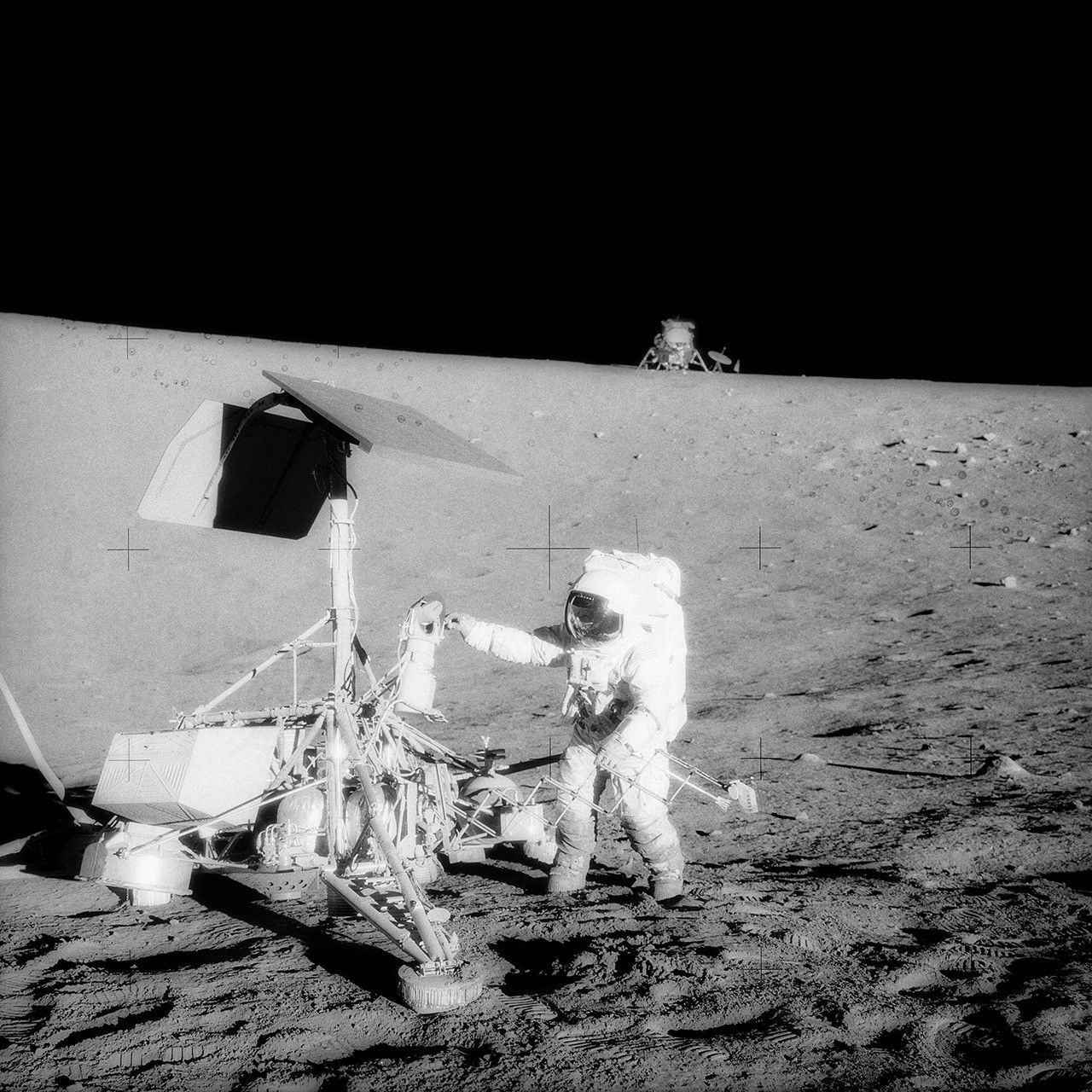
During their second moonwalk, Conrad and Bean reached Surveyor 3, photographed it and removed its television camera, soil scoop and other components. The hardware had spent about 31 months on the lunar surface. Returning it gave engineers access to physical objects they could examine with laboratory equipment on Earth.
The cover photograph shows Conrad beside Surveyor, with Intrepid visible beyond the crater rim. It records the result of the accurate landing: the old robotic mission and the new crewed mission were close enough to appear together in one photograph.
The retrieval was not a repair visit intended to restart Surveyor. The parts themselves became samples of how spacecraft materials and equipment had changed during their time on the Moon.
What could engineers learn from the returned camera?#
The camera offered more than a view of its dusty exterior. The engineering report describes examinations of electrical circuits, optical and mechanical components, internal materials and surface coatings. Investigators could compare different kinds of damage and ask whether lunar exposure caused them.
Its abstract reports that most camera parts endured the environment well, while surface discolouration involved lunar dust contamination and radiation damage. It also notes that many anomalies had causes other than exposure on the Moon. A returned instrument therefore needs an investigation, not just a photograph and a verdict that space ruined it.
Those findings concern this hardware and its particular exposure. They do not establish that every camera, coating or mechanism would survive equally well, or that the same results apply over an unlimited time.
Sources: [7]
Did Apollo 12 do science beyond the Surveyor visit?#
The astronauts also collected lunar samples and deployed the Apollo Lunar Surface Experiments Package, or ALSEP. The instruments were intended to gather data after the crew left, extending the scientific work beyond the hours available for moonwalks.
One experiment used the discarded ascent stage. After Conrad and Bean returned to Yankee Clipper, controllers directed the empty stage into the Moon. The seismometer left on the surface recorded the impact. An event with a known artificial origin supplied a useful signal for investigating how seismic vibrations travelled through lunar material.
This required the landing mission to work as a sequence: carry the instruments, place them on the ground, return the crew to orbit, then use expendable hardware for a further measurement.
Sources: [5]
How do these missions fit around Apollo 11?#
Apollo 11’s first footprints belong between two different tests. Apollo 10 rehearsed the flight operations around a landing. Apollo 12 demonstrated that a crew could reach a selected location accurately enough to perform work tied to that location.
Neither result made later flights routine or removed the need for judgement. Each narrowed a particular uncertainty. Read together, the missions show why a programme needs more than a single successful arrival: crews must be able to repeat the journey, choose where they arrive and bring back evidence that the next investigation can use.
Keep exploring
Sources & further reading
Follow the original research, records, and explanations behind this story.
- Apollo 10: Testing the LM in Lunar Orbit NASA
Mission objectives, measured minimum altitude and guidance-mode incident.
- Two Months Until the Moon Landing NASA
Separation, radar test and return to Charlie Brown.
- Apollo 10: A Great Amount of Team Work NASA
Flight rehearsal supplemented ground simulations and procedures.
- Apollo 12: The Second Lunar Landing NASA
19 November landing, 535-foot separation and crew roles.
- Apollo 12: The Pinpoint Mission NASA
Surface experiments and controlled ascent-stage impact.
- Apollo 12 Makes a Pinpoint Landing on the Moon NASA
Camera, scoop and other parts retrieved after 31 months.
- Test and Evaluation of the Surveyor 3 Television Camera Returned from the Moon by Apollo 12 NASA
Engineering examination of returned components and environmental effects.
- Apollo 12 and Surveyor 3 NASA
Pete Conrad beside Surveyor 3, with Intrepid behind him.
Follow the thread