
Apollo 11’s first moonwalk combined a first attempt at working on another world with a short scientific field expedition. Neil Armstrong and Buzz Aldrin collected rocks and soil, photographed their surroundings, inspected the lunar module and deployed instruments. Michael Collins remained in lunar orbit aboard Columbia, the spacecraft that would bring all three home.
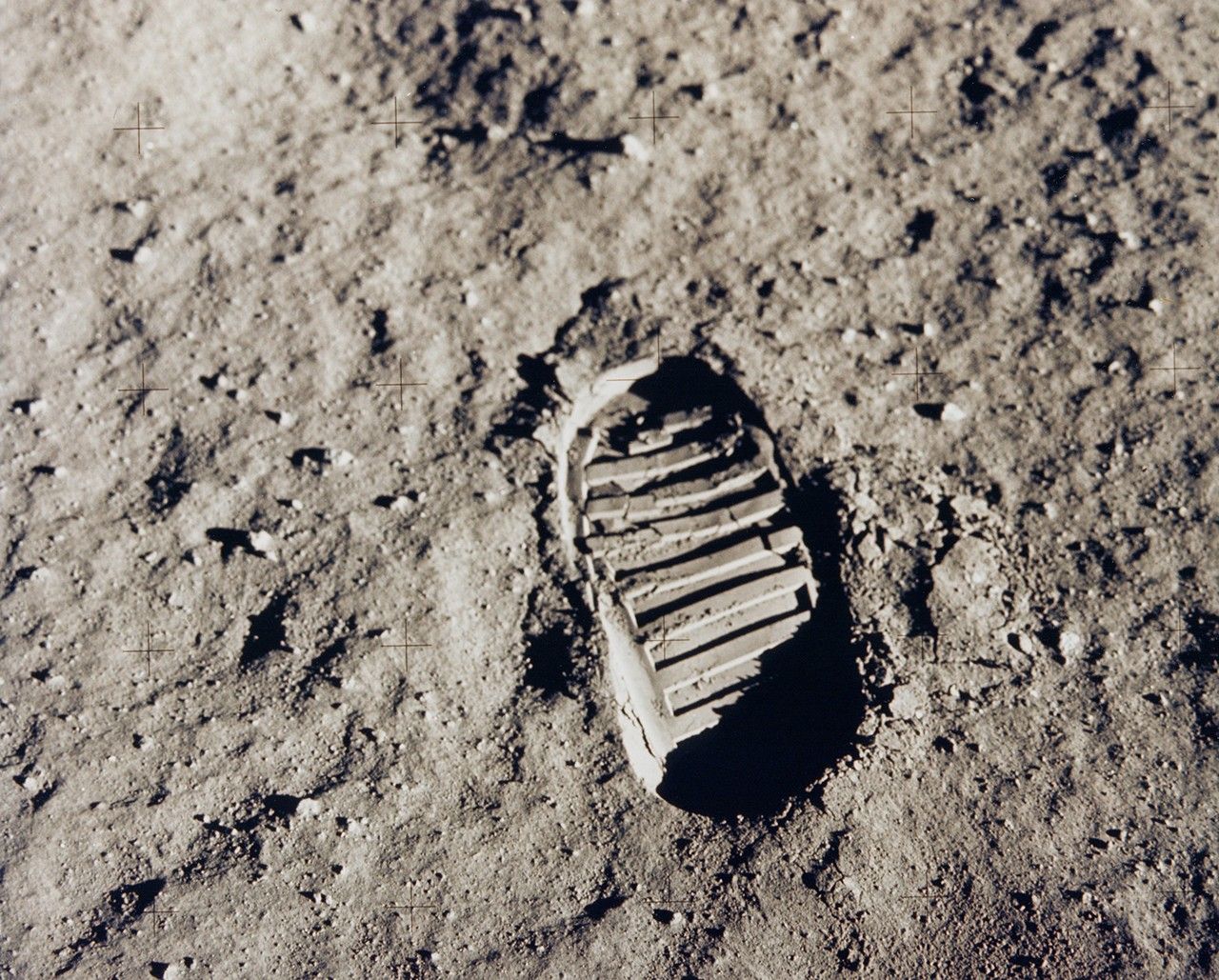
The close-up bootprint shown here records a deliberate soil test by Aldrin. It does not show Armstrong’s first step. The photograph documents scientific work done later in the same moonwalk.
When did the astronauts first step onto the Moon?#
Eagle landed in the Sea of Tranquility on July 20, 1969. Armstrong stepped onto the surface at about 02:56 GMT on July 21, which was 10:56 p.m. Eastern Daylight Time on July 20 in the United States. Both dates therefore appear in accounts of the first step. Aldrin followed about nineteen minutes later.
Landing and walking were separate operations. After touchdown, the crew checked the spacecraft and prepared for a possible early departure. A successful landing would have been little comfort if they could not leave again. They also had to prepare their suits and portable life-support equipment before opening the hatch.
The television camera was carried on the lunar module. Armstrong deployed its equipment assembly while descending, allowing viewers on Earth to see him reach the surface. A camera operator was not waiting outside to photograph his arrival.
Why did Armstrong collect a sample almost immediately?#
The early collection was called the contingency sample. Its purpose was to secure some lunar material even if a problem cut the moonwalk short. Armstrong gathered nearby soil and small rocks before the more extensive sampling work.
That order reflects the practical limits of a first landing. Photography, equipment inspection and experiments all competed for time. Securing a small sample early meant that the scientific return did not depend on completing every later task. It was a precaution, not evidence that an emergency was already happening.
The astronauts worked from detailed checklists. Their observations included ordinary-looking actions such as bending, walking and checking the lander. Reporting how those actions went helped engineers compare real lunar work with the assumptions used in training.
Sources: [2]
Whose footprint appears in the famous photograph?#
Buzz Aldrin made the print and photographed it as part of a soil-mechanics task. NASA’s image library identifies a sequence of photographs, AS11-40-5876 through 5880, associated with the test. The cover image is AS11-40-5878, showing the fresh impression after Aldrin moved slightly to photograph it again.
A carefully recorded footprint can reveal more than the fact that someone stood there. Its shape documents how the surface responded to a boot pressing into it. The photographs allowed specialists to examine the disturbed material after the astronauts returned. A single picture, however, is not a complete measurement of the strength of the ground at every depth.
Calling it “the first footprint” confuses the historical first step with a later scientific photograph. Armstrong made the first human step onto the Moon; Aldrin made this photographed test impression during the same mission.
How can dry lunar dust hold such a clear print?#
The loose surface material is called regolith. It includes fragments produced as impacts break and rework lunar rock. Its fine particles differ from the rounded grains often found in terrestrial sand: many have sharp, freshly fractured surfaces because wind and running water have not worn them smooth.
A boot rearranges and compacts that material. The resulting shape does not require the dampness that helps a footprint hold together in wet beach sand. The comparison with a beach is useful only up to a point; lunar regolith has a different particle history and lives in a very different environment.
Dust also became a working problem. It clung to boots and suits and came back into the cabin. The same sharp material that records a tread can abrade equipment. A clear footprint is therefore both a memorable image and evidence of the surface that astronauts and their hardware had to handle.
Which scientific experiments did Apollo 11 deploy?#
The crew placed a passive seismometer to measure ground motion. Its observations could help researchers investigate the Moon’s interior. It was sensitive enough to record the astronauts’ activity nearby, a reminder that an instrument must distinguish its target signals from local disturbances.
They also set out a laser-ranging retroreflector. This array returns light toward its source. Researchers on Earth can time a laser pulse’s round trip to estimate the Earth–Moon distance; the reflector itself does not need to send a powered radio message for that measurement.
Measurements of lunar distance also help explain the Moon’s retreat and the future of total eclipses.
The solar-wind experiment used a sheet of aluminum foil to collect particles arriving from the Sun. The crew exposed it outside, then recovered it for analysis on Earth. These experiments followed three different paths: transmitting measurements, reflecting an Earth-sent signal, and bringing captured material home.
What did the collected rocks reveal?#
Apollo 11 returned about 21.6 kilograms of lunar material. Much of the rock collection consisted of basalts and breccias. Basalt forms as molten rock cools; breccia consists of fragments of older rocks assembled into another rock. Together they preserve evidence of volcanism and the repeated impacts that modified the surface.
Small highland fragments within some breccias also mattered. Their composition helped researchers develop the idea that the young Moon had once possessed an extensive molten outer layer, often called a magma ocean. This inference came from studying returned material, rather than from something the crew could establish by looking out of Eagle’s window.
The landing site was one small part of the Moon. Its samples provided evidence about that location and clues to broader history, while later missions collected from other terrain. A successful first collection did not make the Moon geologically uniform or fully understood.
Sources: [7]
How long did the moonwalk last, and will the tracks survive forever?#
The extravehicular activity lasted about two and a half hours. Eagle remained on the surface for roughly twenty-one and a half hours before its ascent stage launched to rejoin Collins. Time spent landed should not be confused with time spent walking outside.
The tracks face no ordinary rain or wind erosion, but the lunar surface is still changing. Meteoroids strike it, and material thrown out by impacts disturbs nearby ground. Lunar Reconnaissance Orbiter observations have shown that this churning can be faster than older estimates suggested.
There is no single guaranteed expiry date for an individual print. Its survival depends on what happens at that location. “No weather like Earth’s” is a good reason to expect long preservation; it is not a promise of permanence. The photographs and returned samples preserve records even as the ground itself changes.
Keep exploring
Sources & further reading
Follow the original research, records, and explanations behind this story.
- Apollo 11 — Apollo by the Numbers NASA
Chronology, crew activities, EVA and surface-stay durations.
- Wide Awake on the Sea of Tranquillity NASA
Used for work priorities. Its 9:56 p.m. EDT wording is inconsistent with Apollo by the Numbers; the article uses the latter’s 10:56 p.m. EDT.
- Apollo 11 Bootprint NASA
Photographic provenance and crew roles.
- Apollo 11 Image Library NASA Apollo Lunar Surface Journal
Identifies the bootprint penetration experiment; written captions are not reproduced.
- What Is Lunar Regolith? NASA
Fragmented sharp material, lack of terrestrial wind/water rounding and abrasion.
- 50 Years Ago, On the Way to the Moon: Lunar Science Announced NASA / John Uri
Instrument purposes; no present performance claim.
- Apollo 11 Lunar Samples Lunar and Planetary Institute
Used for rock types and geological interpretation, not the page’s unqualified no-water wording.
- Earth’s Moon Hit by Surprising Number of Meteoroids NASA
Observations and model-dependent churning; no exact lifetime promised for a particular footprint.
Follow the thread