
Earth will eventually lose total solar eclipses as the Moon recedes and its apparent disk becomes too small to cover the Sun. NASA gives an estimate of more than 600 million years using today's rate of recession. That is a conditional timescale, not a prediction of a particular final eclipse.
The reason involves two different changes in distance: the Moon moves closer and farther away during each orbit, while tidal interactions gradually enlarge that orbit. The first already produces different kinds of eclipses. The second changes which kinds will remain possible in the distant future.
How can the Moon cover a much larger Sun?#
An object blocks your view according to the angle it occupies in your sky. Its physical diameter alone does not decide the result. A nearby coin can hide a distant building without being remotely comparable in size.
The Sun is roughly 400 times the Moon's diameter and roughly 400 times farther away. Those ratios nearly cancel. From Earth, their disks therefore have similar apparent diameters. During a suitable alignment, the Moon can hide the Sun's bright visible surface.
For a small angle, apparent diameter is approximately physical diameter divided by distance. This relationship explains what recession changes: with the Moon's diameter held constant, increasing its distance decreases the angle it occupies. It does not need to shrink physically to become too small for a total eclipse.
Sources: [1]
Why are some solar eclipses total and others annular?#
The Moon follows an elliptical orbit. Nearer Earth, its apparent disk is larger; farther away, it is smaller. During a central alignment with a sufficiently large lunar disk, observers in the Moon's central shadow see totality. When the lunar disk is smaller than the Sun's, a bright ring of the solar surface remains around it. That is an annular eclipse.
Partial eclipses concern a different part of the geometry. The disks overlap without the Moon covering the whole solar disk from the observer's location. A total eclipse can therefore be visible as a partial eclipse to people outside its narrow path.
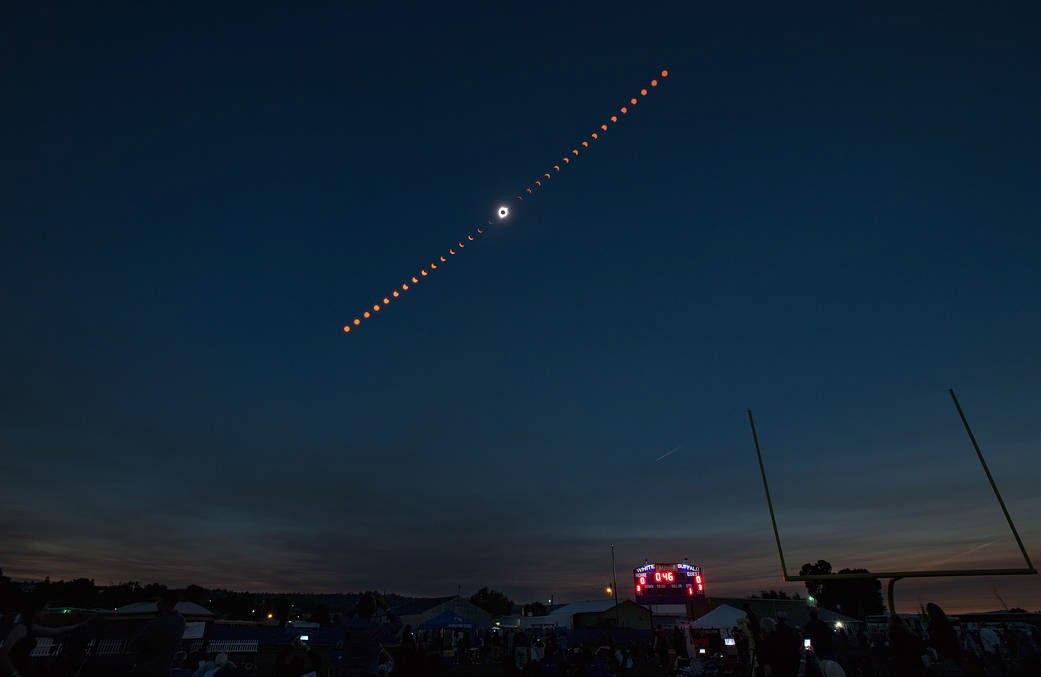
The cover photograph is an existing composite of different moments during the August 21, 2017 eclipse over Madras, Oregon. Its row of solar images records successive stages; it does not show multiple Suns or a sequence of future eclipse types.
Why doesn't every new Moon cause an eclipse?#
A new Moon puts the Moon on the Sun's side of Earth, but that does not guarantee precise alignment. The Moon's orbital plane is tilted relative to Earth's orbit around the Sun. At many new Moons, the lunar shadow passes above or below Earth.
A solar eclipse needs the new Moon to occur close to where those orbital planes intersect. Distance then helps determine whether the central eclipse is total or annular. Alignment and apparent size are separate requirements: a Moon large enough to cover the Sun cannot produce an eclipse if its shadow misses Earth.
Sources: [2]
Why is the Moon moving away from Earth?#
The Moon's gravity raises tides on Earth. Earth's faster rotation carries the tidal deformation ahead of the direction toward the Moon in a simplified picture of the interaction. That displaced mass exerts a gravitational torque on the Moon, transferring angular momentum from Earth's rotation into the lunar orbit.
Earth's rotation slows, while the Moon's orbit expands. Real oceans respond through moving water constrained by basin shapes and depths, so the familiar drawing of two smooth tidal bulges is a simplified explanation of the torque.
The Moon's increasing orbital distance is compatible with a longer orbital period. Recession should not be pictured as a steady outward rocket thrust. It is the accumulated result of gravitational interactions and tidal energy dissipation.
How do scientists measure the Moon's recession?#
Lunar laser ranging measures the travel time of light sent from Earth to reflectors on the Moon and back. Repeated observations allow researchers to fit the lunar orbit and identify its long-term evolution. NASA reports a present average recession of about 3.8 centimeters per year.
That annual change is much smaller than the Moon's ordinary distance changes during an orbit. Comparing two arbitrary nightly distances would mostly reveal the orbital motion. The long-term trend comes from fitting many measurements with a model that accounts for that motion and the observing geometry.
This average describes the gradual change in the orbit across repeated measurements. The distance still rises and falls during individual orbits.
Sources: [4]
Where does the 600-million-year estimate come from?#
NASA Space Place describes an additional distance of approximately 23,500 kilometers and asks how long it would take to accumulate at 3.8 centimeters per year. Converting to the same units gives 2.35 billion centimeters. Dividing by 3.8 centimeters per year gives about 618 million years, or roughly 620 million years at the precision appropriate to this example.
This arithmetic reproduces the scale of NASA's explanation. It does not independently establish the distance threshold, or account for every future change in the Earth-Moon-Sun system. Treating it as a date requires assuming that the relevant orbital geometry and recession rate behave as the simplified calculation expects.
An analogy is estimating a journey's duration from the speed measured at one moment. The division is correct; the prediction depends on how well that speed represents the rest of the journey.
Sources: [1]
Why can't we name the final eclipse's date?#
The history of tidal evolution already shows why a constant-rate extrapolation needs caution. A 2022 study by Farhat and colleagues modeled oceanic tidal dissipation and found that resonances can produce substantial changes in the evolution of lunar distance, Earth's rotation and axial tilt. The model addressed the system's past, rather than supplying a calendar for its final future eclipse.
A resonance occurs when forcing efficiently excites a system's natural response. In an ocean, that can change how much tidal energy is dissipated. The paper's relevance here is the dependence of orbital evolution on that response; it is not evidence that one particular future date has been established.
The reviewed sources support a distant loss of totality as the Moon recedes, and a useful illustrative scale of hundreds of millions of years. They do not support counting down to a precisely known final event.
Would all eclipses disappear at the same time?#
No. A Moon that looks too small to hide the whole Sun can still pass in front of part of it. Annular and partial solar eclipses remain geometrically possible after total solar eclipses become impossible, provided the required alignments still occur.
Lunar eclipses use another arrangement: Earth lies between the Sun and Moon, and Earth's shadow falls on the Moon. Their conditions cannot be inferred simply from whether the Moon's apparent diameter exceeds the Sun's. Losing total solar eclipses does not by itself mean losing every kind of eclipse.
For the same distinction between a changing appearance and a physical change over time, see why Saturn's rings seem to disappear. In the lunar case, the question is how the geometry of a shadow changes as an orbit evolves.
Sources: [2]
Keep exploring
Sources & further reading
Follow the original research, records, and explanations behind this story.
- How Is the Sun Completely Blocked in an Eclipse? NASA Space Place
Apparent-size comparison and conditional 23,500 km / 3.8 cm per year example.
- Eclipses and the Moon NASA Science
Solar and lunar eclipse geometry and the tilted lunar orbit.
- Secular Acceleration of the Moon NASA / Espenak and Meeus
Tidal torque, rotation and secular recession.
- Measuring the Moon’s Distance NASA / LPI Bulletin
Laser pulse travel time, reflectors and measured recession.
- The Resonant Tidal Evolution of the Earth-Moon Distance Farhat et al. / Astronomy & Astrophysics
Historical oceanic tidal model and limits of simple extrapolation.
- 2017 Total Solar Eclipse NASA
Existing composite photograph over Madras on August 21, 2017.
- The Moon is Front and Center During a Total Solar Eclipse NASA Goddard
Eclipse geometry and NASA’s approximate distant-future estimate.
Follow the thread