
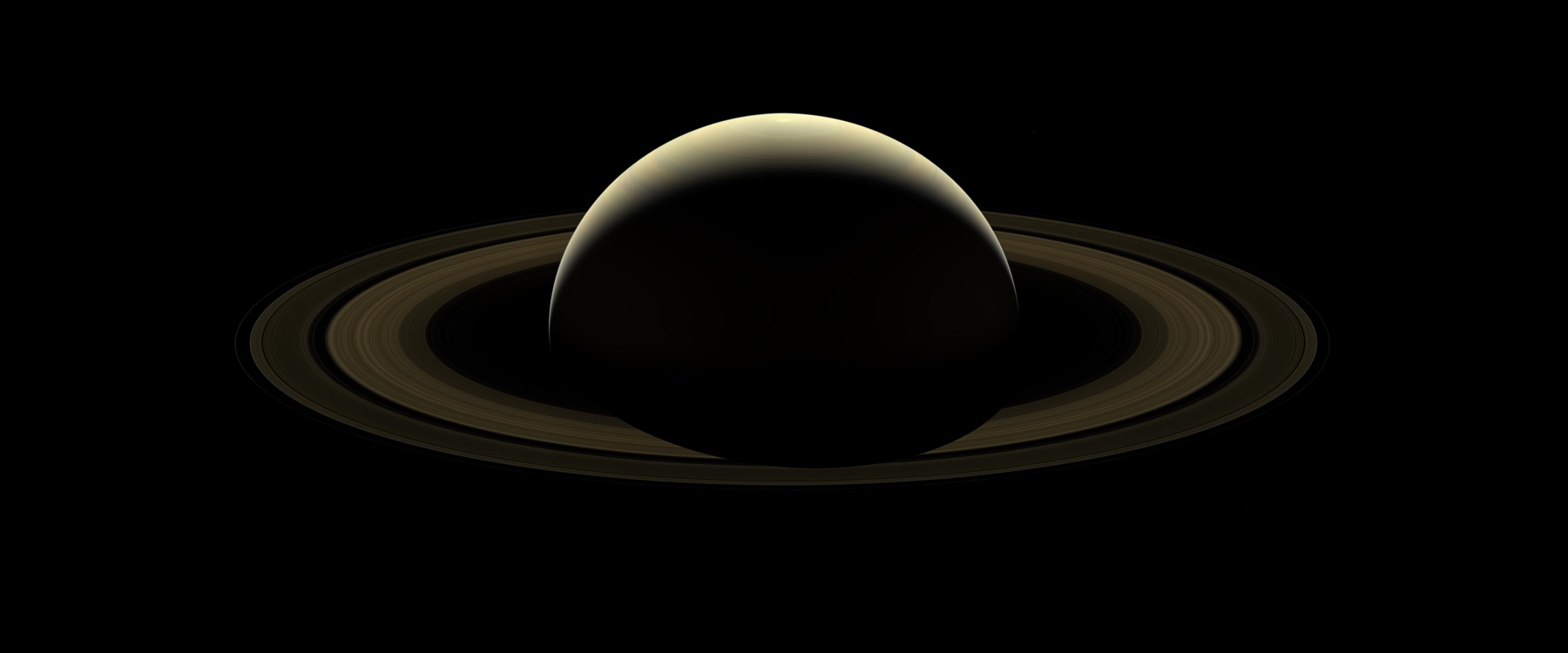
Saturn is losing material from its rings. Small particles and material derived from them reach the planet's atmosphere, while impacts and exchanges of debris change the rings' orbits over time. The uncertain part is how those processes add up over millions of years. There is no agreed date when Saturn will lose its familiar appearance.
A second kind of disappearance is much easier to predict: the rings become difficult to see when Earth views their thin edge. That change reverses as the viewing angle changes. It does not mean the ice has fallen into Saturn.
What are Saturn's rings made of?#
The bright rings consist mainly of water ice, divided among countless separate particles. Dust and other material make up a much smaller fraction. A photograph can make the rings look like a solid disk, but the particles travel in their own orbits. Different distances from Saturn correspond to different orbital speeds.
The familiar broad bands are the A, B and C rings. Between A and B lies the Cassini Division, a gap about 4,700 kilometres wide. Much fainter rings extend the system beyond the bright bands seen in ordinary telescope images. Describing the future of the bright main rings therefore does not automatically describe every dusty ring around Saturn.
The main rings are thin compared with their width. NASA gives a typical vertical thickness of about 10 metres, although local structures can rise much farther. That geometry explains why a wide, bright feature can nearly vanish from a particular viewing direction.
Why do the rings sometimes disappear from view?#
As Saturn travels around the Sun, the angle at which we see its equator changes. The rings lie close to that equatorial plane. Seen at a slant, they spread across a large area of the sky; seen edge-on, their visible area shrinks to a narrow line.
This happens on a roughly 15-year cycle. Images from 2025 showed the rings much less prominently than images from 2020. The same geometrical effect confused Galileo after his early observations: the apparent features on either side of Saturn could disappear and later return.
A ring-plane crossing tells us about orientation. To establish that material is leaving the rings, astronomers need measurements of particles, atmospheric chemistry or changes in the ring system. Comparing two photographs taken at different angles cannot by itself measure a loss of mass.
What is ring rain, and how does it reach Saturn?#
Some tiny icy particles acquire an electric charge through sunlight or interactions with the surrounding plasma. Plasma is gas containing charged particles. Once charged, a grain responds to Saturn's magnetic field as well as to gravity. Under suitable conditions, it can move along magnetic field lines toward the upper atmosphere.
The name ring rain describes this transfer of ring material. It does not mean ordinary liquid raindrops falling from a cloud. Water-bearing material changes the chemistry of Saturn's ionosphere, the electrically charged part of its upper atmosphere.
Astronomers have studied infrared emission from H3+, an ion containing three hydrogen nuclei. Water arriving from the rings affects the reactions that control these ions. Bright bands at particular latitudes can therefore provide evidence about the incoming material. Converting that glow into a mass-loss rate requires a chemical model; the telescope does not count every falling grain.
Sources: [3]
Is ring rain the only way the rings lose material?#
Cassini also detected a large influx near Saturn's equator during its final orbits. That flow must be distinguished from the higher-latitude ring rain traced through atmospheric emission. Combining estimates without checking which region and process they describe can produce a misleading total.
Micrometeoroids help move material through the rings. These small incoming objects strike ring particles and throw out debris. The debris travels before striking another part of the rings, transferring mass and angular momentum. Angular momentum describes rotational motion about Saturn; redistributing it changes where material can orbit.
In a 2023 model, Richard Durisen and Paul Estrada found that these exchanges, together with the addition of incoming meteoroid material, could drive substantial inward flow. Their calculated rates were compatible with Cassini's measurements for plausible choices of the model parameters. This offers a physical explanation for inward transport, while leaving uncertainty about its persistence and strength.
When will Saturn's rings disappear?#
Published estimates span a wide range because they answer a conditional question: how long would the present rings last if particular loss processes continued in the way a model describes?
NASA's 2018 account discussed roughly 300 million years from the inferred ring rain alone, with a shorter lifetime when equatorial inflow was included. The 2023 transport model estimated about 15 to 400 million years. Each projection depends on the assumed rates and processes.
A simple estimate divides the available mass by the rate of loss. If the rate doubles, that estimated lifetime halves. But the calculation assumes the rate stays constant and the available mass is known. A changing ring system can violate both assumptions. A short interval of unusually strong inflow would be especially misleading if extended across the entire future.
The observations show a changing ring system, but they cannot yet establish a precise timetable.
Why do scientists question the measured inflow rate?#
An independent check comes from Saturn's atmosphere. If a large supply of ring material enters as gas, or vaporizes on arrival, it should produce chemical changes that remote observations can detect.
Julianne Moses and colleagues tested this in photochemical models. Their study, submitted in 2022, found that infrared and ultraviolet observations from Cassini's final years lacked the predicted chemical effects of sustained, substantial vapor input.
The researchers described two possible explanations. The strong inflow could have been a relatively recent event. Alternatively, much of the material could have arrived as extremely small dust grains that behaved differently from vapor or larger grains that burn up on entry. The study did not establish that the rings were losing no material. It showed why the form and history of that material matter when interpreting a spacecraft measurement.
Sources: [5]
Does losing material prove that the rings are young?#
Age and remaining lifetime are different questions. A measurement of current loss tells us about present activity. Reconstructing when the rings formed also requires knowing their earlier mass, how they changed and how efficiently they retained incoming debris.
One approach uses their relatively clean ice as a clock. If darker dust continually accumulates, a low dust fraction can indicate a short exposure time. Cassini-based studies reported in 2023 used this argument to support ages of a few hundred million years.
That interpretation depends on how much dust arrives and remains. In a 2026 reassessment, Gregorio Ricerchi and Aurélien Crida examined gravitational focusing, impact vaporization and possible cleaning through space weathering. Their models allowed substantially longer exposure ages. Under some assumptions, the dust fraction approaches a steady value, so its present value no longer gives a unique formation date.
The debate about ring age does not erase evidence of inward transport. It does caution against combining a proposed young age and a proposed short future lifetime into one settled history.
What did Cassini show, and what would improve the forecast?#
Cassini supplied close observations of the rings and measurements from the region between Saturn and its innermost rings. Its final approach made material accessible that was difficult to study from farther away. The mission ended in September 2017; the article on Cassini's Grand Finale explains why the spacecraft entered Saturn's atmosphere.
The cover image is a natural-color mosaic assembled from 42 Cassini camera images. It shows the geometry and brightness of the ring system shortly before the mission ended. It cannot show a future disappearance or establish a loss rate on its own.
A better forecast needs observations over time. Measurements of atmospheric compounds can test whether the strong equatorial inflow persisted. Monitoring ring rain across Saturn's seasons can reveal whether sunlight changes its strength. Models must then connect those observations to the changing mass and structure of the rings.
For a reader comparing headlines, the useful questions are specific: which loss process was measured, over what interval, and which assumptions turn that measurement into a lifetime? Those details explain why the evidence for change can be strong while the timetable remains uncertain.
Keep exploring
Sources & further reading
Follow the original research, records, and explanations behind this story.
- Saturn Facts NASA
Ring composition, main ring names, geometry and thickness.
- Saturn’s Rings Appear to Disappear NASA Astronomy Picture of the Day
Changing viewing geometry, the roughly 15-year cycle and 2025 appearance.
- NASA Research Reveals Saturn is Losing Its Rings at “Worst-Case-Scenario” Rate NASA
2018 ring-rain interpretation, charging, H3+ and conditional lifetime estimates.
- Large mass inflow rates in Saturn’s rings due to ballistic transport and mass loading Durisen and Estrada / Icarus
Model of angular-momentum transport and the conditional 15–400 Myr lifetime.
- Saturn’s atmospheric response to the large influx of ring material inferred from Cassini INMS measurements Moses et al. / Icarus
Missing predicted atmospheric signatures and transient-inflow or nanograin alternatives.
- Saturn’s Rings: Young and Ephemeral, Three NASA Ames Studies Say NASA Ames
2023 interpretation of ring pollution, age and meteoroid-driven evolution.
- Saturn’s rings age I.: Reconsideration of the exposure age Ricerchi and Crida / Icarus
2026 reassessment: focusing, vaporization and space weathering can undermine a unique pollution age.
- A Farewell to Saturn NASA Jet Propulsion Laboratory
Identity of the final natural-color Cassini mosaic; 42 images and mission-end context.
Follow the thread