
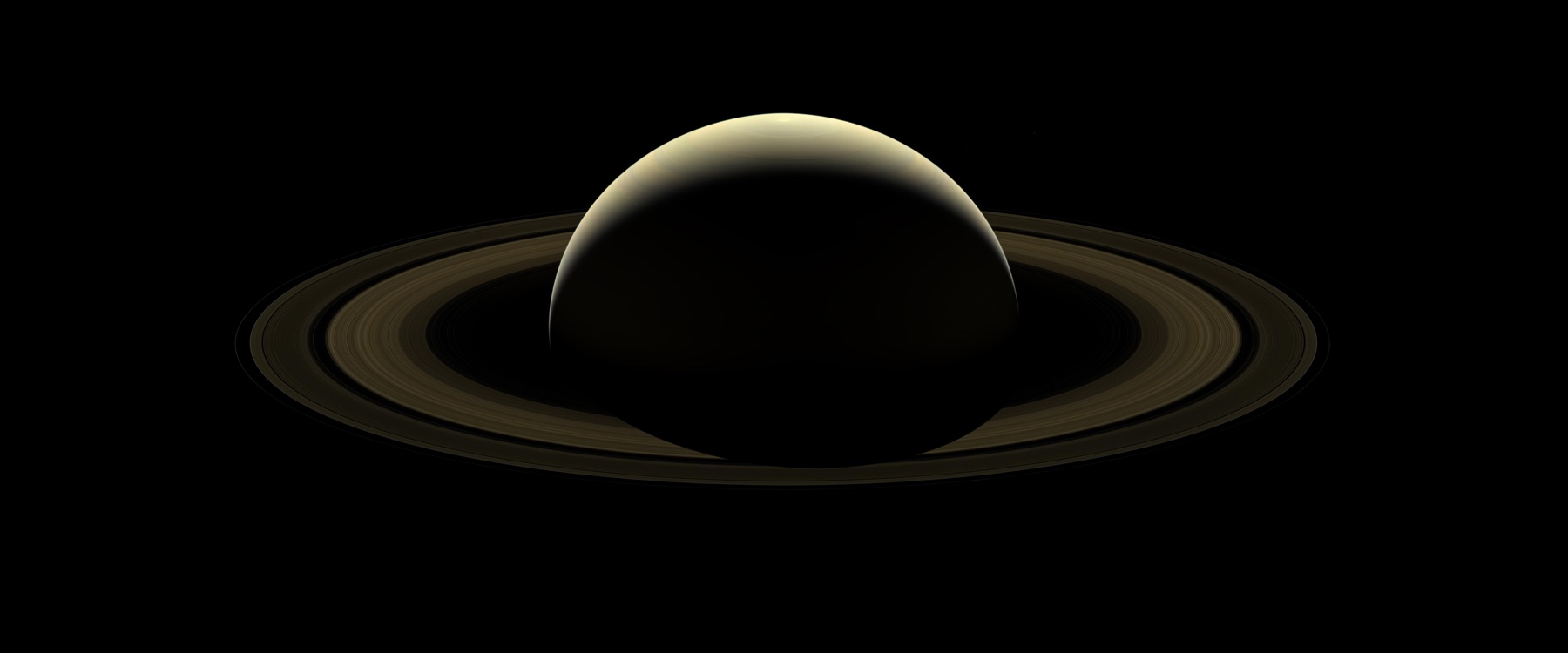
Cassini deliberately entered Saturn’s atmosphere on September 15, 2017 because its maneuvering propellant was running low and the team wanted to prevent a future uncontrolled collision with Enceladus or Titan. Its instruments still worked. The ending used the control that remained to protect those moons and collect observations that a safer orbit could never provide.
After thirteen years exploring Saturn, its rings and its moons, Cassini had changed what needed protecting there. Understanding its final assignment means following three different limits: how long a spacecraft can steer, what its instruments can establish, and what a radio signal can tell us about an ending no camera observed.
Why end the mission while Cassini still worked?#
A working instrument does not guarantee a spacecraft can keep operating safely. Cassini’s maneuvering propellant was running low. Without adequate control of its trajectory and orientation, the team could no longer guarantee where it would eventually go.
Its electrical supply was a different resource. Three radioisotope thermoelectric generators converted heat from radioactive decay into electricity. They powered instruments and spacecraft systems; they could not replenish the chemical propellant used to maneuver. A later engineering account found the generators were still supplying power at the end.
The team therefore chose to end the mission while it could still direct the spacecraft. The final plunge also removed the possibility of a later accidental collision with Enceladus or Titan. Cassini’s mission did not end because every instrument had failed, or because someone waited for the last usable drop of propellant to disappear.
What made Enceladus worth protecting?#
Enceladus offered evidence of an environment that could support life as we know it. Cassini found a global ocean beneath its icy shell and sampled material escaping through south-polar fractures. These plumes brought otherwise inaccessible material into space, where the spacecraft could examine it during flybys.
Cassini detected molecular hydrogen in plume gas during a 2015 encounter; researchers announced the result in 2017. Water reacting with rock beneath the ocean was the most plausible explanation. Such reactions can supply chemical energy. On Earth, microbes can obtain energy by combining hydrogen with carbon dioxide to make methane, without needing sunlight.
That establishes a possible energy source, alongside water and relevant chemistry. It does not establish organisms, an ecosystem, or a biological origin for the methane. Cassini had found reasons to investigate habitability, not a detection of life.
Planetary protection addresses a different uncertainty: a spacecraft launched from Earth might carry surviving microbes. NASA’s mission FAQ cites space-exposure experiments showing that some microbes and spores can survive for years. The concern was a possible future contamination event, not a claim that Cassini was known to carry living organisms when it reached Saturn. Deliberate disposal avoided leaving that uncertainty attached to an uncontrolled spacecraft.
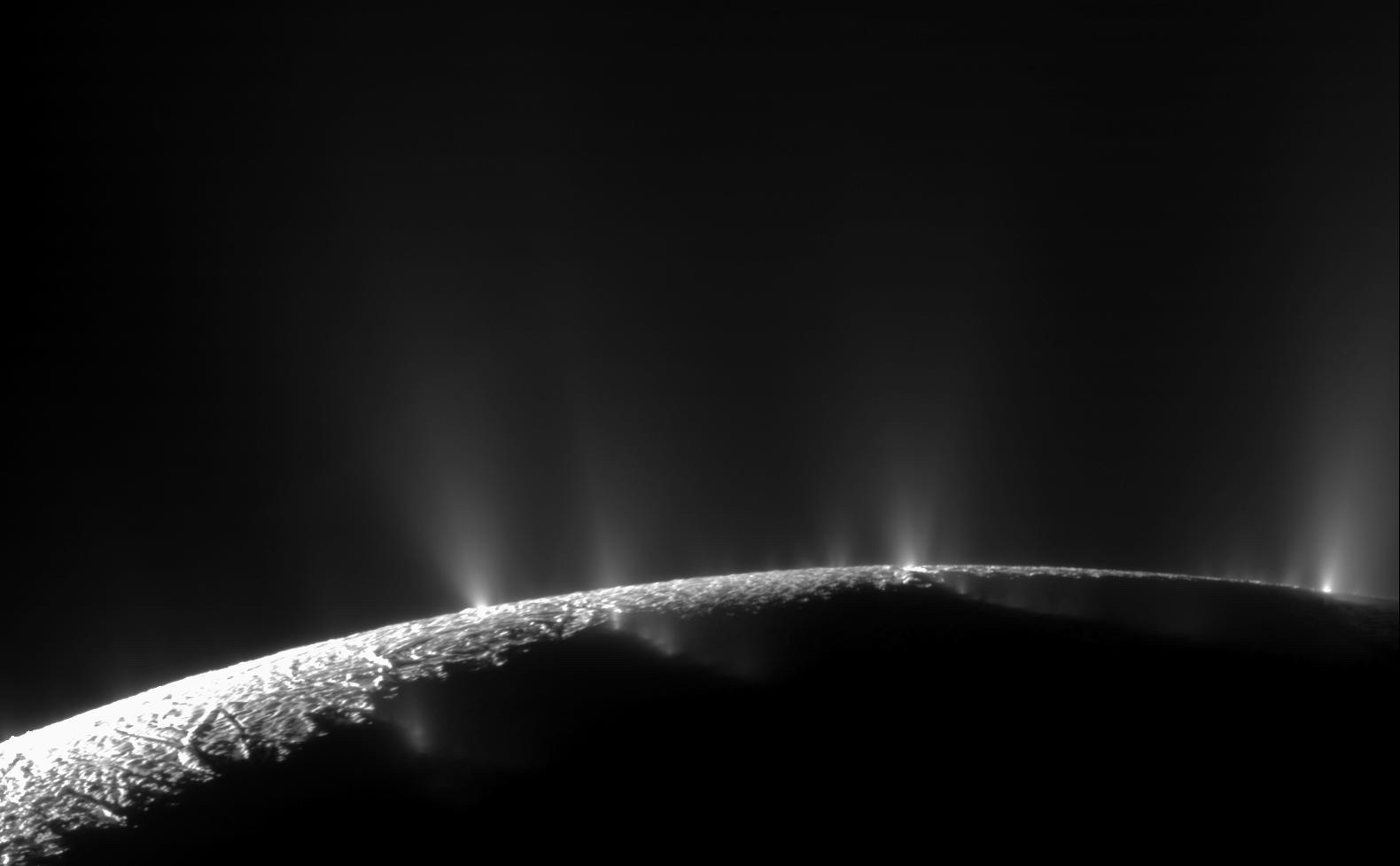
Image unavailable.
Bright jets rise above the curved, fractured limb of Enceladus in a monochrome mosaic.
Why include Titan, and what has changed since 2017?#
Titan was also valuable because of its complex chemistry and possible watery interior. Its surface lakes and seas contain liquid hydrocarbons, including methane; these are chemically and physically different from an ocean of liquid water beneath an ice shell. The mission’s protection rationale included Titan’s potential for prebiotic chemistry: chemical processes relevant to the steps preceding life.
A 2017 description of Titan’s interior was not a final verdict. In December 2025, JPL reported a reanalysis of Cassini’s radio-tracking data. The researchers interpreted strong internal energy dissipation as evidence for layers of slush and isolated pockets of liquid water, rather than a global liquid ocean.
The inference comes from how Titan deforms under Saturn’s tides and how that deformation affects its gravity. Scientists do not have a photograph of the interior. The new interpretation changes the model of where water may be present; it does not demonstrate that Titan is lifeless or make the earlier decision to protect it mistaken. Preserving a place for future investigation does not require knowing the answer in advance.
Could Cassini have been left in orbit instead?#
Other endings were considered. NASA’s mission FAQ says planners evaluated a long-lived parking orbit around Saturn as well as other scenarios. Disposal in Saturn was a selected mission design, not the only imaginable trajectory.
Nor did low propellant mean that no additional observing time was physically possible. The end-of-mission press kit said the remaining propellant could support a few more years of operations under another plan, while judging their scientific value lower than that of the Grand Finale. That conditional comparison is different from promising another unrestricted tour of the moons.
An alternative had to be assessed against several constraints together: the propellant available to reach it, useful science along the way, and the long-term protection of the moons. Continuing to drift around Saturn would not by itself settle the contamination problem. The chosen ending combined a controlled destination with an unusually valuable last observing campaign.
Saturn was an acceptable disposal destination because the atmosphere would destroy the spacecraft, while deeper layers would melt and disperse surviving material. The mission FAQ also reports the assessment that Saturn’s atmosphere lacks conditions favorable to life as we know it. Protecting the moons did not mean treating every part of the Saturn system as an equivalent biological environment.
How did Titan help aim Cassini at Saturn?#
Titan’s gravity reshaped Cassini’s orbit. During a flyby, the spacecraft exchanges orbital energy and momentum with the moving moon. The direction and geometry of the encounter determine how the spacecraft’s path around Saturn changes. This lets a mission obtain a large change in trajectory while spending much less onboard propellant than a comparable rocket maneuver would require.
The April 22, 2017 Titan encounter sent Cassini into the sequence of orbits passing inside the main rings. A final distant encounter on September 11 adjusted its path toward the terminal atmospheric entry four days later.
These encounters did different jobs. April opened the route into the ring gap; September set the final collision course. The ending was built into a sequence of carefully navigated orbits, rather than commanded as a sudden downward turn on the final morning.
Were the 22 Grand Finale dives all fatal plunges?#
No. The 22 dives were passages through the space between Saturn and its innermost ring. Cassini emerged from each to continue around the planet. The first ring-gap crossing took place on April 26, 2017.
The terminal plunge came afterward, on a final partial orbit. This trajectory continued into denser atmosphere instead of carrying the spacecraft safely back out. Counting the 22 successful ring-gap passes and the terminal entry as the same kind of event hides the essential difference in their design.
The official close-orbit illustration shows the earlier ring-grazing paths in gray, the Grand Finale paths in blue, and the terminal path in orange. It is a conceptual trajectory rendering. Its purpose is to show which side of the rings each path occupies; it should not be used to measure clearances or reconstruct Cassini’s position at a particular second.
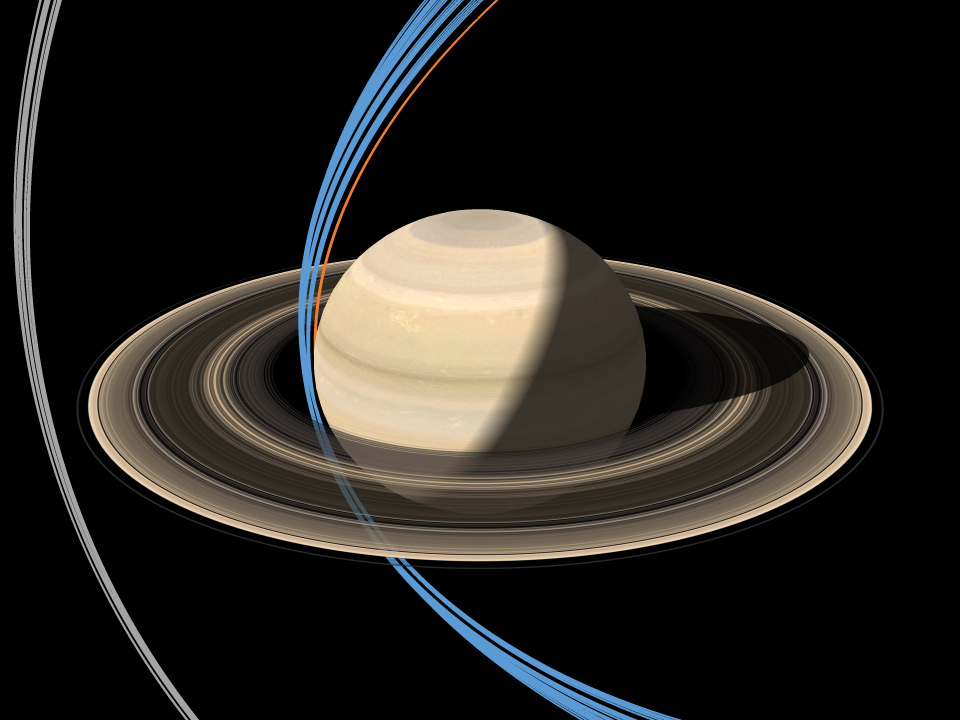
Image unavailable.
Conceptual rendering of Saturn and its rings with gray paths outside the rings, blue paths inside them, and an orange path toward the planet.
What could Cassini measure inside the ring gap?#
The gap gave Cassini access to gravitational forces, magnetic fields and material that had been difficult to separate from farther away. NASA describes this region as roughly 2,000 kilometers wide, about 1,200 miles. The useful change was its location between the planet and the rings.
For gravity measurements, radio tracking revealed tiny changes in the spacecraft’s velocity. Inside the rings, scientists could better distinguish the rings’ gravitational contribution from Saturn’s much larger pull. A 2019 analysis used six close passes to estimate the rings’ mass at roughly forty percent of the mass of Saturn’s moon Mimas. Mass measures the amount of material, not how broad or bright the rings look.
Other instruments measured the magnetic field and sampled gases and dust directly. Results reported in 2018 included material falling from the rings into the atmosphere, with water and a surprisingly varied chemistry. Some charged particles followed magnetic-field lines; other material entered near the equator.
These findings belong to the analysis of the Grand Finale campaign. They were not all discoveries announced during the last minute of descent. Repeated passes let researchers compare conditions and combine different instruments’ measurements; the fatal entry supplied final in-situ atmospheric measurements along a path from which Cassini could not return.
Why keep transmitting during atmospheric entry?#
Any measurement left aboard Cassini would be lost with it. During the final approach, the spacecraft switched from playing back recorded observations to transmitting fresh measurements from instruments sampling its surroundings. The science included atmospheric composition, magnetic fields, particles and dust.
Sending those measurements required pointing the high-gain antenna accurately toward Earth. As Cassini descended, atmospheric forces increasingly pushed it away from that orientation. Thrusters fired to oppose the disturbance, consuming the control authority deliberately reserved for the ending.
JPL’s October 2017 reconstruction used the final engineering telemetry to trace this struggle. Cassini held its orientation against the atmosphere for 91 seconds, with thrusters working at full capacity during roughly the last twenty seconds before signal loss. The last eight seconds of telemetry showed the spacecraft beginning to tip backward.
The narrow radio beam then moved away from Earth. Receiving data depended on keeping that beam aligned, so useful communication could end while parts of the spacecraft still functioned. Atmospheric entry did not have to destroy the radio instantly to silence it.
When did the mission end: at Saturn or on Earth?#
The event at Saturn and its reception on Earth were separated by the travel time of light. On the final day that delay was about 83 minutes. “Real time” transmission meant sending observations promptly after collecting them, not delivering them instantaneously across interplanetary space.
JPL’s subsequent account of the control-room calls records the terminal S-band signal disappearance at 11:55:46 UTC on September 15, 2017: 4:55:46 a.m. Pacific Daylight Time. That is an Earth-received timestamp. The corresponding loss of pointing at Saturn occurred roughly 83 minutes earlier, around 10:32 UTC.
Those timestamps do not date a photographed explosion. They date the disappearance of a received radio signal and the corresponding spacecraft event inferred after allowing for propagation. NASA’s published advance timeline explicitly labels its entries as estimates; atmospheric drag on preceding orbits changed the predictions. Quoting a predicted minute as an exact achieved event would give the schedule more precision than it contains.
Did Cassini photograph its own destruction?#
No. Its final imaging-camera exposure was taken on September 14 at 19:59 UTC, spacecraft event time, hours before atmospheric entry. The monochrome visible-light image shows the night-side region where Cassini would later enter. Sunlight reflected from the rings illuminated the scene. The region rotated into daylight before the spacecraft arrived.
The cameras’ last look and the instruments’ last live measurements were therefore different observations made at different times. The broad farewell portrait of Saturn used for this article’s cover is different again: a natural-color mosaic assembled from 42 frames captured on September 13.
The observed ending on Earth was a radio signal fading away. JPL’s reconstruction distinguishes the loss of telemetry, the encoded measurements, from the remaining carrier wave; the carrier disappeared 24 seconds later. A brief apparent return in the signal came from an antenna side lobe as Cassini tipped, according to the engineers’ interpretation.
Disintegration in the atmosphere follows from the planned trajectory and entry physics. No camera watched from beside Cassini to record the breakup, and signal loss alone does not identify its exact instant. Illustrations of a burning spacecraft visualize that expected outcome. They are not photographs returned from the final descent.
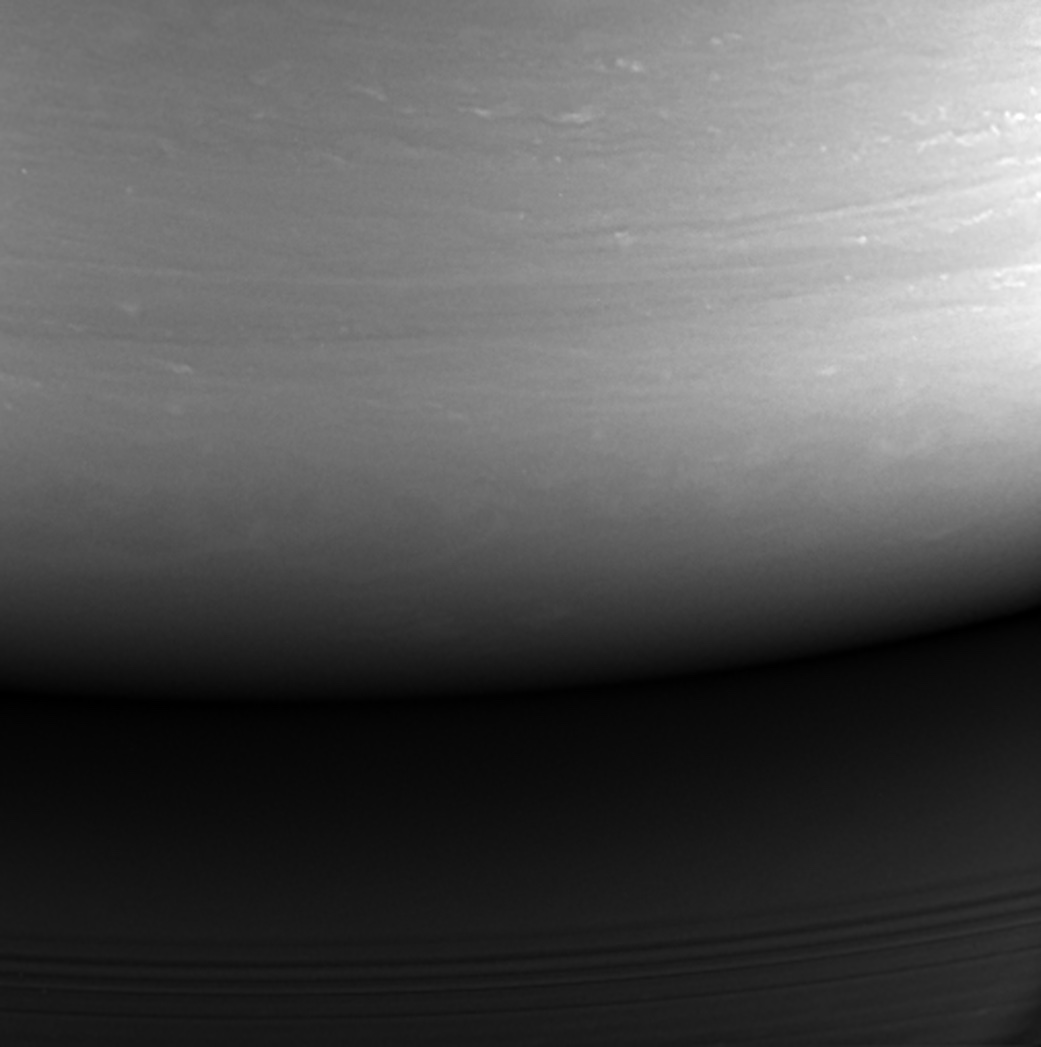
Image unavailable.
Monochrome cloud bands above Saturn’s dark curved limb, illuminated by light reflected from the rings.
What did the ending leave unanswered?#
The mission left both new measurements and questions that measurements alone cannot settle. Whether anything lives in Enceladus remains separate from the evidence for a habitable environment. Titan’s interior remains a problem of interpreting indirect observations, as the 2025 reanalysis demonstrates.
The Grand Finale also found Saturn’s magnetic field extraordinarily well aligned with its rotation axis. A later magnetometer study constrained the dipole tilt to less than 0.007 degrees, a small fraction of one degree. Explaining how the planet generates such an almost symmetric field still requires models of its hidden interior.
The rings provide another example of the boundary between observation and history. The 2019 gravity work measured their mass and used it, with assumptions about contamination and evolution, to argue for a relatively recent origin. Cassini did not directly measure a ring’s birthday. Recovering that history requires a model of how material accumulates, escapes and changes over time.
The controlled ending protected moons where later missions could test ideas Cassini could only suggest. The observations sent to Earth remain available for further analysis.
Keep exploring
Sources & further reading
Follow the original research, records, and explanations behind this story.
- Grand Finale Overview NASA Science
Controlled disposal, Enceladus and Titan rationale, 22 orbits, mission chronology.
- FAQ NASA Science
End of Mission questions: alternatives, microbes, first crossing and disposal.
- The End of Cassini’s Mission NASA/JPL-Caltech
End-of-mission FAQ: conditional remaining operations and trade against Grand Finale science.
- Cassini’s Radioisotope Thermoelectric Generators (RTGs) NASA Science
Three generators; decay heat converted into electrical power.
- Cassini Power During the 20 Year Mission and Until the Final Plunge into Saturn NASA Technical Reports Server / JPL
Public technical-record abstract reports electrical output continuing through end of mission.
- Ingredients for Life at Enceladus NASA Science
2015 hydrogen sampling announced 2017; hydrothermal inference and explicit no-life-detection limit.
- NASA Study Suggests Saturn’s Moon Titan May Not Have Global Ocean NASA/JPL-Caltech
December 2025 reinterpretation of tidal response as slush and water pockets; not categorical proof of absence.
- Cassini’s Mission Finale at Saturn NASA JPL Education
April 22 Titan gravity assist, ring-gap route and distinction of final partial orbit.
- End of Mission Timeline NASA Science
Spacecraft event versus Earth received time; 83-minute delay; September 11 flyby; explicitly projected estimates.
- Close Orbits: Cassini Grand Finale (Artist’s Concept) NASA Science
Exact grey/blue/orange path meanings; source of existing mission illustration.
- Measurement and implications of Saturn’s gravity field and ring mass Iess et al., Science; author copy hosted by Weizmann Institute
Paper summary and abstract: six gravity passes; ring mass 0.41 ± 0.13 Mimas masses; age depends on evolution models.
- NASA’s Cassini Data Show Saturn’s Rings Relatively New NASA/JPL-Caltech
2019 radio-gravity analysis, six passes, ring mass and model-based age interpretation.
- Groundbreaking Science Emerges from Ultra-Close Orbits of Saturn NASA Science
October 2018 results: gap width, sampled ring material, fields and new questions.
- Cassini Significant Events 9/13/17 - 9/19/17 NASA Science
Achieved final playback and direct live transmission of in-situ instrument data.
- Reconstructing Cassini’s Plunge into Saturn NASA/JPL-Caltech
October 2017 engineering reconstruction: 91 seconds, final tipping, carrier vs telemetry, antenna side lobe.
- Cassini’s family takes the plunge JPL Universe, October 2017
Page 5 reports Julie Webster’s S-band signal-loss call at 11:55:46 UTC.
- Impact Site: Cassini’s Final Image NASA
Actual last visible-light image, September 14 19:59 UTC spacecraft event time, ring illumination and later entry region.
- A Farewell to Saturn NASA/JPL-Caltech
Hero image identity, 42-frame natural-colour mosaic; official product and exact credit.
- Cassini Image Mosaic: A Farewell to Saturn NASA/JPL-Caltech
Explicit September 13 capture date, contrasted with November 21 publication.
- Bursting at the Seams: the Geyser Basin of Enceladus NASA/JPL
Two-image mosaic observed November 21, 2009, visible jets and archive credit.
- The landscape of Saturn’s internal magnetic field from the Cassini Grand Finale Cao et al., arXiv preprint of Icarus study
Abstract: dipole tilt under 0.007 degrees; suggested deep interior explanation is a model.
- JPL Image Use Policy NASA/JPL-Caltech
Editorial/educational reuse, attribution, third-party limits and no endorsement.
See the story in motion
Watch our illustrated video, then explore another question below.
Watch on YouTubeFollow the thread