
In 1977, a six-year-old’s greeting left Earth on a gold-plated record. Alongside it went music, natural sounds, and pictures of our world. Copies of that Golden Record travel aboard both Voyager spacecraft. Its message is physical: a future finder would have to play a groove, rebuild the pictures, and work out what they mean. The engraved cover offers clues to each step.
What is the Voyager Golden Record, and why was it sent?#
The Voyager Golden Record is a physical message from Earth carried aboard both Voyager spacecraft. It was not one of their scientific instruments, and it was not needed for their journey. NASA added it as a time capsule: an attempt to show a hypothetical future finder something of our planet and the life on it.
A previous pair of probes, Pioneer 10 and 11, carried metal plaques showing where they came from. The Voyager team had more room for an idea with much greater range. Instead of sending only a picture and a map, they could send voices, the sounds of the natural world, music, and images describing Earth in 1977.
Voyager 2 launched on August 20, 1977; Voyager 1 followed on September 5. Each carried the same message. Both visited Jupiter and Saturn, while Voyager 2 continued to Uranus and Neptune. The records accompanied these scientific journeys; neither spacecraft was sent to deliver one to a particular planet or civilization.
For another perspective on the mission, follow how Voyager 1 took the Pale Blue Dot photograph.
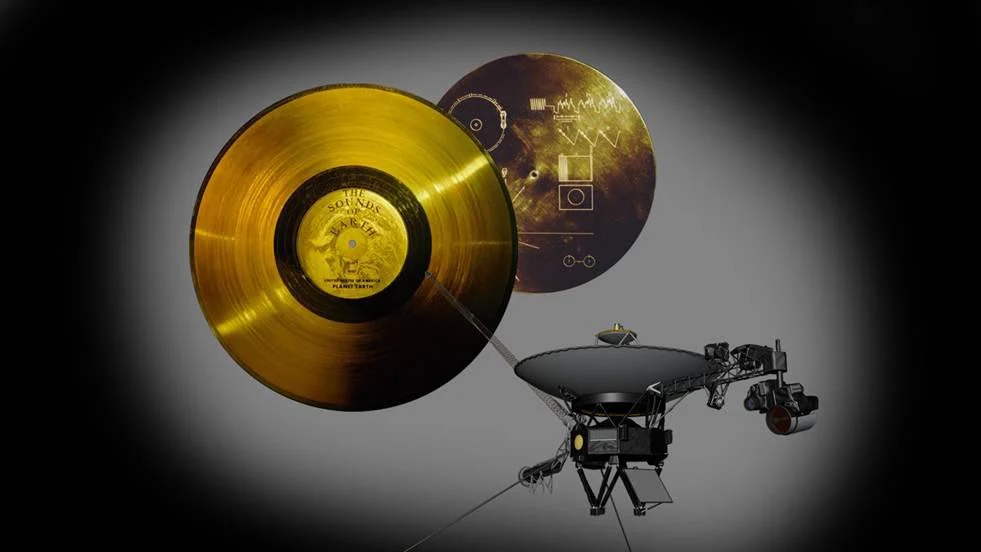
Image unavailable.
NASA/JPL composite showing the gold-plated disc, a separate cover with diagrams, and a spacecraft rendering with the record location circled.
Is the Golden Record made of gold, and where is it mounted?#
The disc is made of copper plated with gold, not solid gold. It is about 12 inches, or 30 centimeters, across and sits within a protective aluminum assembly on the outside of each spacecraft. The actual grooved disc and the engraved protective cover are separate objects, even though photographs often show only the cover.
A phonograph groove is fragile as an information surface: its microscopic shape carries the message. The package includes a cartridge and stylus, the needle-like part needed to trace a groove. It does not include a complete powered record player, amplifier, speaker, or image display. A finder would need to build the rest of the playback system.
Photographs taken during assembly show technicians placing the package against the spacecraft structure. A NASA/JPL diagram likewise identifies where it sits beneath the conspicuous high-gain dish antenna. That location does not mean the antenna sends the record’s contents. The antenna serves the spacecraft’s separate radio system.
What sounds and music did the team choose to represent Earth?#
The record combines a sound essay about life on Earth with roughly 90 minutes of music drawn from different traditions. Ocean surf, wind, thunder, birds, and whales are among the natural sounds. Human activity appears too: the recordings include examples such as footsteps, transport, and a kiss.
The musical selections range widely but are not a comprehensive world anthology. NASA’s track list includes Bach’s Brandenburg Concerto No. 2, a Javanese court gamelan piece, Senegalese percussion, Chuck Berry’s “Johnny B. Goode,” Chinese guqin music, Valya Balkanska singing a Bulgarian song, and Blind Willie Johnson’s “Dark Was the Night.” Each selection carries a place, a history, and an interpretation beyond its vibrations.
This breadth is part of the message, but it has an unavoidable limit. A song can communicate pattern, rhythm, and changes of pitch even if the listener understands none of the culture behind it. Whether it communicates grief, celebration, ceremony, or entertainment is another matter. The record preserves performances; their meanings are not packed into the groove as instructions.
Who is speaking in the greetings, and who was the child?#
The Golden Record includes greetings in 55 languages, and one brief English greeting was spoken by six-year-old Nick Sagan, the son of astronomer Carl Sagan. His words were: “Hello from the children of planet Earth.” NASA’s retrospective and Nick’s own later interview confirm his age and identity.
Nick recalled that his father placed him in front of a microphone at Cornell University and asked what he would want a visiting extraterrestrial to know. That small domestic moment became an unusually durable trace of a child’s voice. He did not compose an elaborate speech about Earth; he greeted someone he could not picture.
Linda Salzman Sagan organized the multilingual greetings. NASA reproduces her account of a difficult choice: a small number of languages accompanied by a decoding guide might have been easier for a foreign intelligence to decipher. Instead, the team chose many different voices, allowing them to sound together as a statement about the diversity of Earth. The speakers did not all receive a fixed script.
The sound essay also includes intimate, wordless material. Ann Druyan, a creative director of the record project, later described the sound of a kiss and a mother greeting her newborn baby. Those details are supported by her recollection; the available official account does not identify the mother or baby by name. It would be a mistake to treat that sound as the same recording as Nick’s greeting.
Who had the authority to choose a portrait of humanity?#
The contents were chosen by a small team led by Carl Sagan for NASA, not by a global vote or an agreement among all the people of Earth. Ann Druyan helped shape the sound essay, Linda Salzman Sagan coordinated the greetings, and other collaborators contributed scientific, technical, musical, and visual expertise.
They were working with a finite amount of space, a demanding deadline, and the limits of what could be gathered and cleared for use in 1977. Even with a strong intention to include different cultures, every choice displaced another possible song, language, landscape, or ordinary life. Some aspects of Earth could be shown with a diagram. Other aspects, such as fairness or fear, were nearly impossible to convey without a shared social context.
There was also a tension between comprehensibility and representation. Fewer languages might be easier to analyze; more languages better express that humans do not all speak alike. A scientific drawing may be easier to interpret than a family photograph, yet it may say less about how being human feels. The makers chose to preserve both types of information.
How was the message manufactured as a real record?#
Engineers produced the Golden Record through phonograph manufacturing techniques: they prepared recordings, cut a master, made metal copies, and gold-plated the finished copper discs. NASA’s manufacturing account identifies the JVC Cutting Center in Boulder, Colorado, and the James G. Lee Record Processing facility in Gardena, California, among the participants.
The process matters because it was not a miniature computer archive. There is no file system to browse, no operating system to boot, and no laser that must read digital marks as on a compact disc. The information exists as precisely formed physical variations along a spiral groove. Making reliable copies meant preserving those small variations through a succession of physical production steps.
A hand-etched inscription added another kind of message. Between the label and the grooves appears a dedication to makers of music across worlds and times. JPL’s historical account credits Timothy Ferris with wanting a human hand to leave a trace on the record. Unlike the encoded audio and pictures, this inscription was directly etched onto the object as visible writing.
How does a groove turn motion back into sound?#
A phonograph groove stores sound as a changing physical path. As a record turns, a stylus following that path moves in response to its tiny variations. A suitable pickup converts that movement into an electrical signal, which can then drive equipment that produces pressure waves we hear as sound.
The idea is an analog correspondence: the shape changes continuously, and the recovered signal changes with it. Imagine tracing a winding line with a pencil while moving the paper steadily. The sideways turns carry information about the motion used to draw the line. In a record, the turns are microscopic and arranged into a long spiral rather than a line across a page.
Speed is essential. Play the groove too quickly and every change happens at the wrong rate; voices become higher and shorter. Play it too slowly and they become lower and stretched out. The Voyager record was intended to rotate at 16⅔ revolutions per minute, meaning one revolution takes about 3.6 seconds. The cover encodes this interval so the listener does not have to guess a familiar human unit such as “rpm.”
The simplified illustration shows the principle, not a literal cross-section of the Voyager groove or a complete device supplied onboard. A finder would still need to design the mechanical support, controlled rotation, amplification, and a way to convert the signal into something perceptible. The stylus is a starting tool, not the finished solution.
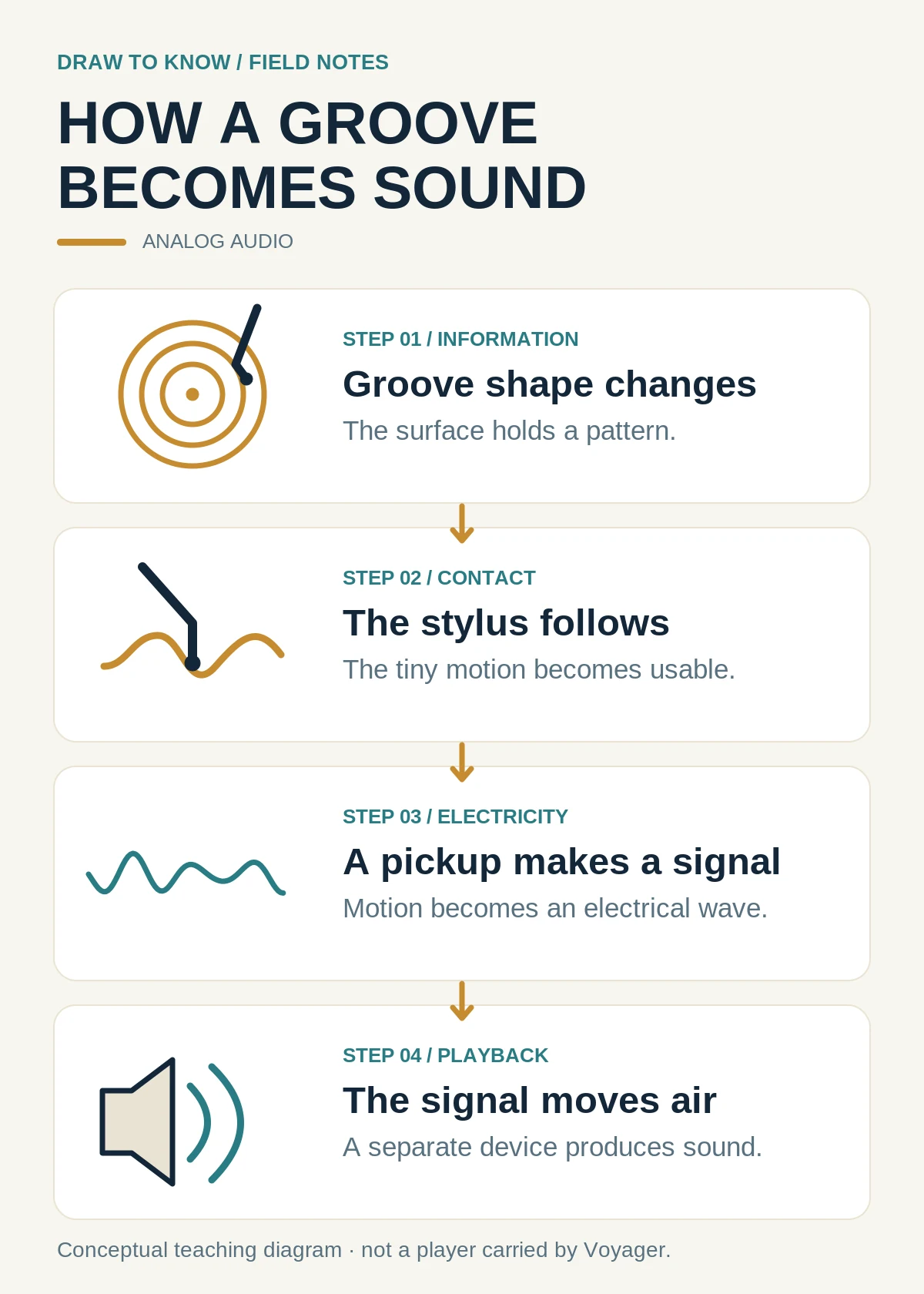
Image unavailable.
Four-panel instructional graphic showing a wavy phonograph groove, vibrating stylus, electrical waveform, and speaker output.
How can the same groove contain pictures?#
The Golden Record stores pictures as analog signals that can be converted into rows or columns of brightness. It does not contain loose photographic prints, JPEG files, or the kind of data structure found on a computer memory card. A finder must interpret one portion of the recorded signal as visual information rather than ordinary sound.
To understand the idea, imagine taking a black-and-white image and reading its brightness one thin line at a time. Dark areas become one signal level; bright areas become another. The many changes can be written as a single time-varying waveform. On playback, a receiver must recognize where each line begins, place the lines in the intended order, and choose how wide and tall to make the final image.
NASA’s explanation of the cover describes a scan made of 512 vertical picture lines, with staggered interlacing, and a line interval of approximately eight milliseconds. This is closer in concept to analog television than to storing modern image files. The precise signal on the actual disc is not reproduced by the illustrative waveform in this article.
The team selected scientific diagrams, landscapes, organisms, people, and documents. NASA’s contents listing gives 115 images. A 2002 JPL retrospective gives 116 pictures without explaining the difference. We use the current contents figure and leave that discrepancy unresolved rather than inventing a reconciliation.
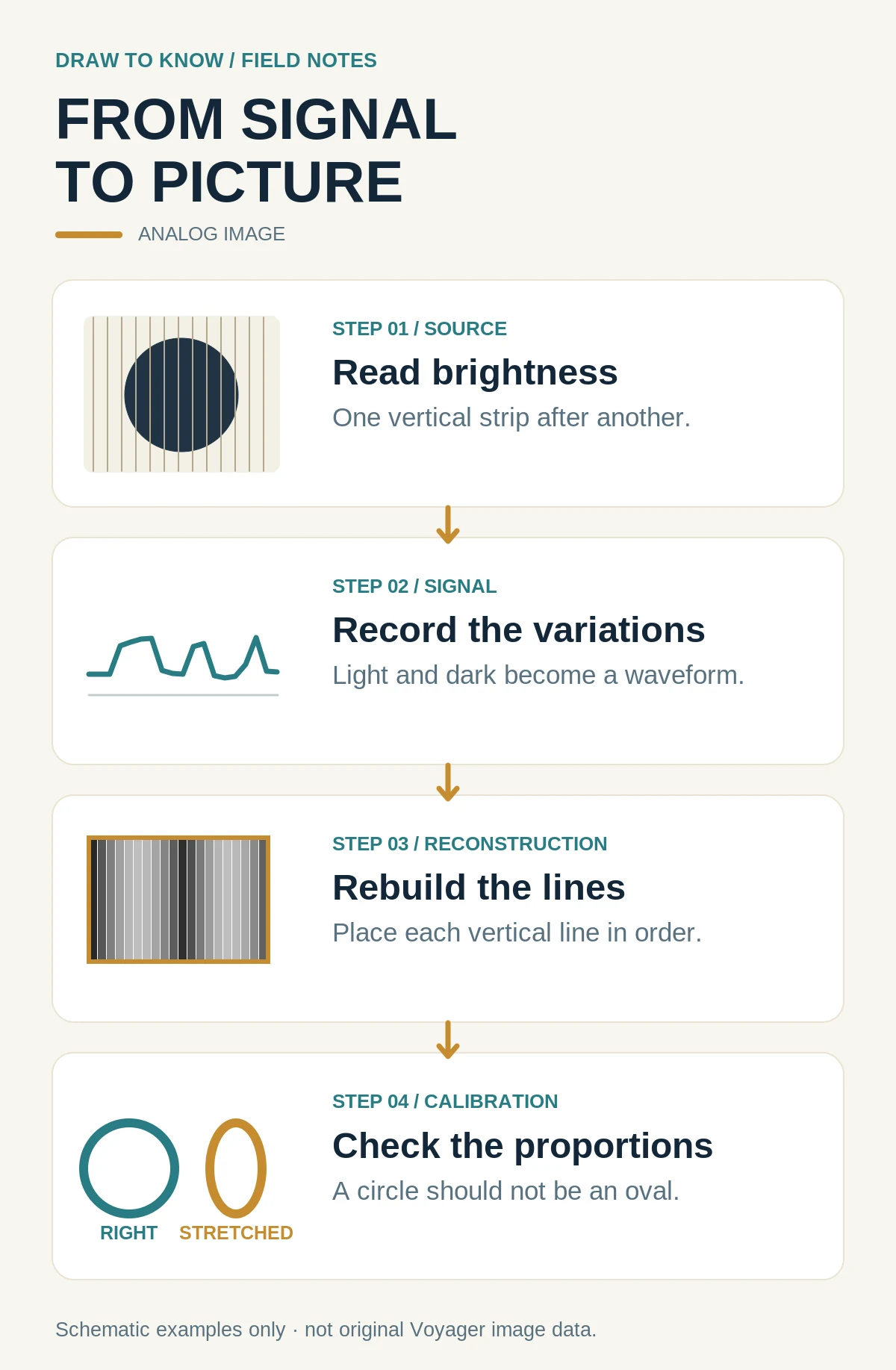
Image unavailable.
Four-panel diagram of image brightness read in vertical lines, a made-up analog waveform, vertical picture reconstruction, and a circular calibration mark.
Why does the first decoded picture show a circle?#
The opening calibration picture is a circle so a recipient can check whether the reconstructed image has the right proportions. If the lines are displayed with the wrong timing or spacing, a circle becomes an oval. The viewer can adjust the reconstruction until the shape looks right.
This makes the first picture a test rather than a photograph of a celestial body. Geometry is a useful opening move: the idea of a circle can be described through relationships among distances, without assuming the recipient recognizes a human face, a landscape, or the printed word “Earth.” The circle cannot solve every problem, but it offers an immediate way to spot one common kind of decoding error.
What do the engraved instructions on the cover explain?#
The protective cover is an attempt to explain how to play the disc without using a human instruction manual. Its engravings show a record and stylus, describe the timing of rotation and playback, set out an image-reconstruction method, introduce a physical unit of time, and provide clues about the origin of the spacecraft.
In the upper left is a plan view of the disc with the stylus positioned near the outer edge, indicating that playback should proceed inward. A nearby side view conveys the relationship between stylus and record. The binary numbers—numbers represented with two symbols rather than our familiar ten digits—encode intervals related to playback.
The upper right concentrates on images. It sketches a signal boundary, line order, and the full picture raster. The small circle beneath is the test image. In the lower regions are a map based on pulsars and a drawing of hydrogen in two states. None of these parts is a map of the Voyager’s future route.
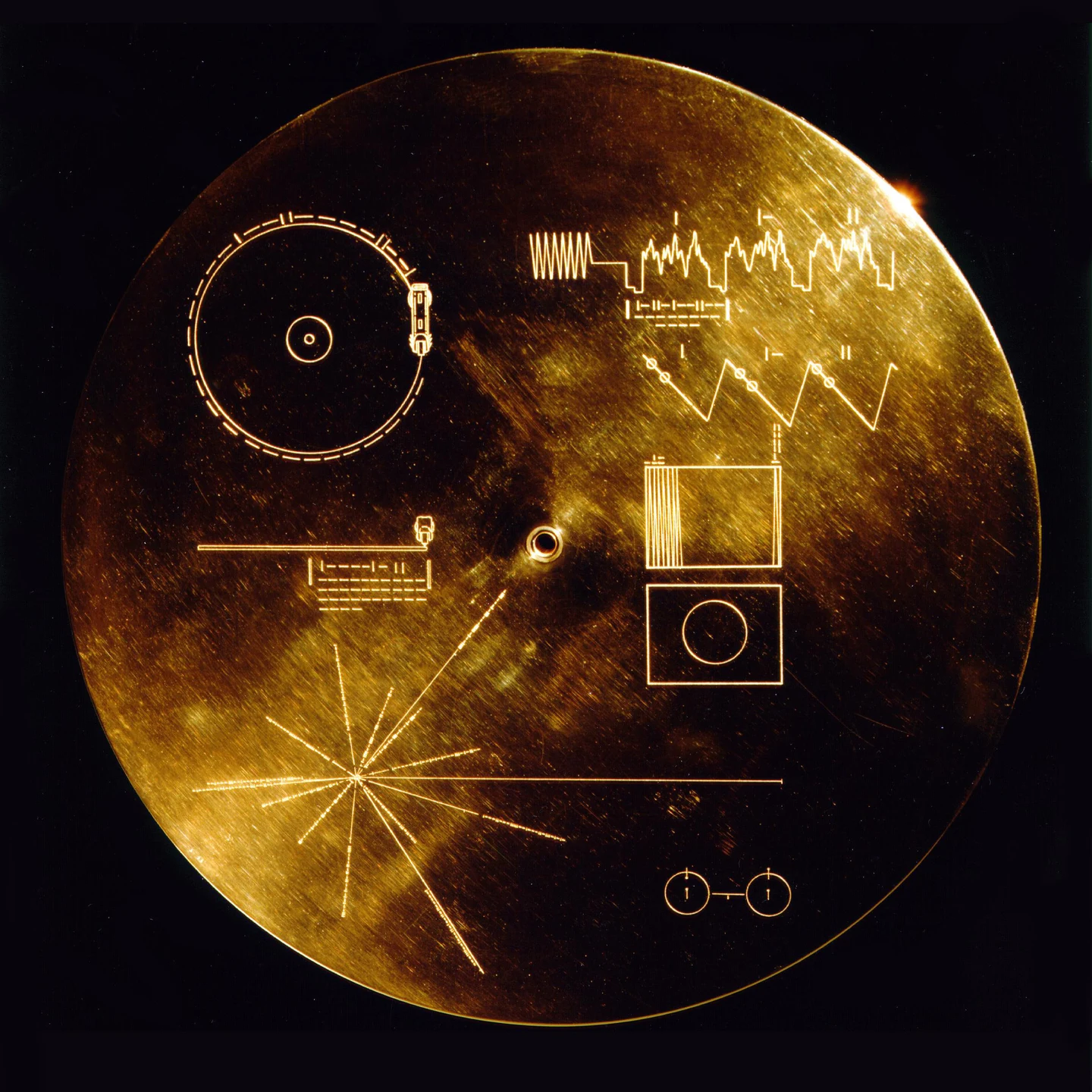
Image unavailable.
Original Golden Record protective cover, engraved with playback and image diagrams, radial pulsar lines and a hydrogen-atom symbol.
How can a hydrogen atom tell a stranger how long a second is?#
The cover uses a property of hydrogen as a time reference. It depicts the atom’s two lowest hyperfine energy states: states that differ in the relative orientation of the electron’s and proton’s spins. The transition between them corresponds to radio radiation at about 1.42 billion cycles per second. One cycle takes about 0.70 nanoseconds, or billionths of a second.
The unit is the period of that radio wave, not the waiting time before an individual atom changes state. Because the reference comes from atomic physics, a finder who recognizes it could reproduce the unit without knowing our words for seconds or minutes. The cover’s binary numbers express the record’s rotation and image timing in multiples of this interval.
For example, one 3.6-second turn lasts roughly five billion of those tiny periods. This connects a physical reference to the speed of a machine. The physics can be shared; recognizing the drawing, the numerical notation, and what the numbers measure still requires interpretation.
How can a pulsar map point back toward the Sun?#
The radial drawing on the cover uses the directions and rotation periods of 14 pulsars as landmarks for locating the Sun’s neighborhood. Pulsars are rapidly spinning neutron stars that emit pulses in remarkably regular patterns. Their measured periods provide an identifying feature, while the directions help establish a position in space.
A person looking at the drawing might see a starburst. The intended reader, however, is invited to treat the rays as spatial relationships. Each ray refers to a particular pulsar, with its period marked in a notation using the hydrogen time reference. A sufficiently capable finder could try matching those observations to the pulsars known in its own sky and solve for a place of origin.
It is not a modern map with GPS coordinates, and it does not show the path taken by either Voyager. Pulsars also change their periods gradually; their positions and observability are not permanent. For that reason the cover’s information has a time dimension as well as a spatial one. It is better understood as a 1977 identification scheme than as an eternal address label.
The radioactive material on the cover was conceived as another rough way to investigate age. NASA says a small deposit of uranium-238 could, in principle, be compared with its decay products to estimate the time since preparation. Both ideas depend on measurements, preservation, and assumptions. Neither promises that a finder could determine exactly where or when the spacecraft began its journey.
Sources: [3]
Is the Golden Record broadcasting music into space?#
No. The Golden Record is a passive object, like an extraordinarily durable record stored in a box. It does not transmit its music, greetings, or pictures through an antenna, and nothing nearby can hear the messages simply by being close to the Voyager spacecraft.
Voyager’s radio communications are a separate scientific and engineering system. The spacecraft send information to Earth using their radio transmitters and large dish antennas, with NASA’s Deep Space Network receiving extremely weak signals across immense distances. Those transmissions carry spacecraft and scientific data. They are not a continuous broadcast of the disc’s musical program.
The difference changes what an encounter would look like. An observer could detect a radio signal from a functioning spacecraft without ever noticing its Golden Record. Conversely, the disc could remain physically present long after the spacecraft has run out of electrical power and fallen radio-silent. In that distant future, there would be no musical beam to follow toward it.
Where are the Voyagers going, and could anybody realistically find them?#
Both Voyager probes have crossed the heliopause, the boundary of the Sun’s solar-wind bubble: Voyager 1 in 2012 and Voyager 2 in 2018. That puts them in interstellar space, but not beyond every possible boundary of the Solar System. The much farther Oort Cloud is generally considered part of its extended outer domain.
NASA’s long-range estimates suggest that Voyager 1 will pass roughly 1.7 light-years from the star Gliese 445 in about 40,000 years, and Voyager 2 will pass at a similar distance from Ross 248 on a comparable timescale. These are passages through a broad stellar neighborhood, not visits to a planet or deliveries to a particular civilization. A light-year is about 9.46 trillion kilometers.
The size mismatch is the central obstacle. Each probe is only meters across; interstellar distances run to trillions of kilometers. A future spacefaring society would need extraordinary luck, purposeful detection, or some retrieval method we cannot presently specify to encounter one. There is no defensible percentage chance, known recipient, or date on which the record will be discovered.
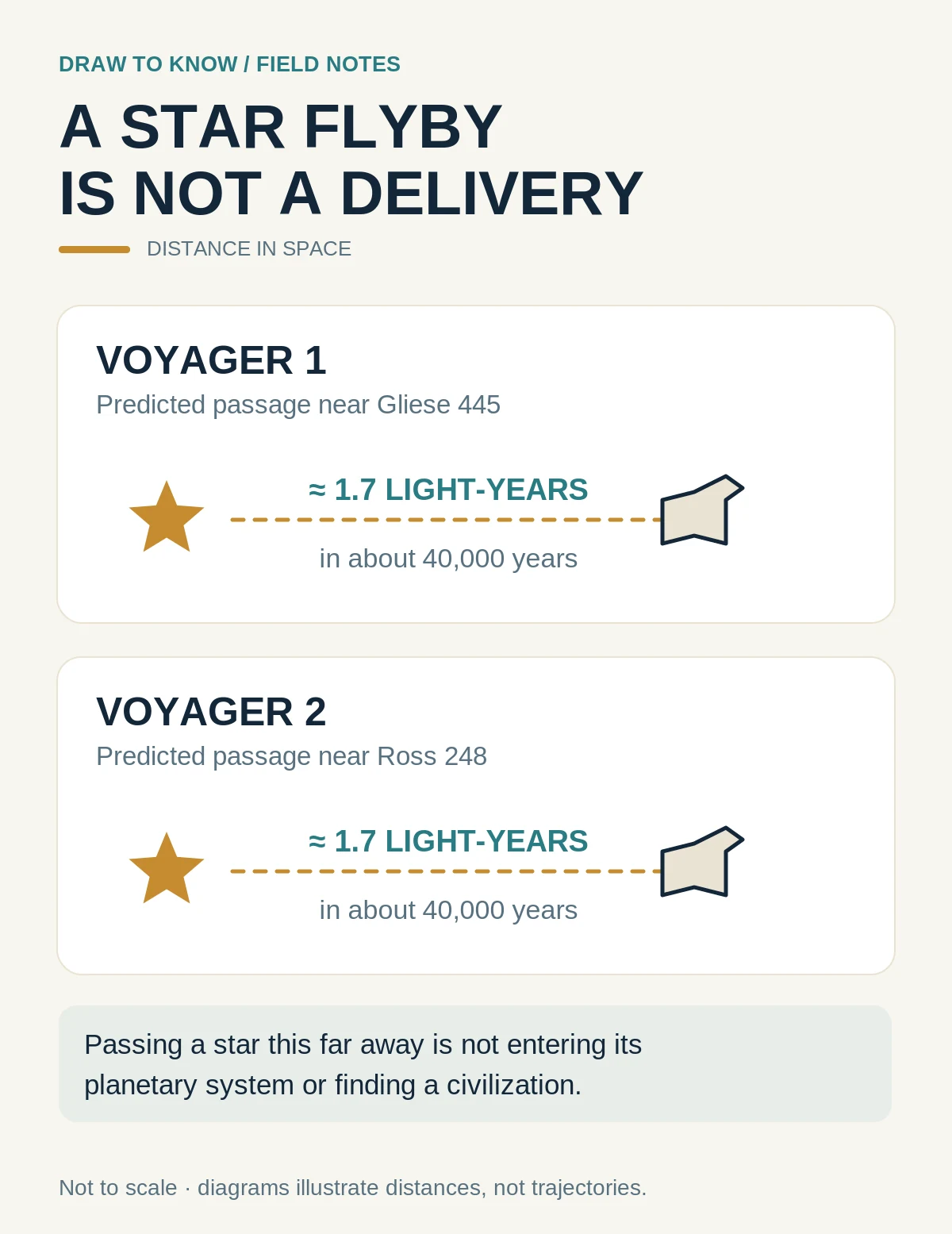
Image unavailable.
Two schematic cards show Voyager 1 passing about 1.7 light-years from Gliese 445 and Voyager 2 similarly near Ross 248 in about 40,000 years.
How long could the record survive, and would survival be enough?#
The Golden Record may remain an object long after the Voyagers stop working, but no one can guarantee that its information will stay playable for a particular number of years. Its gold-plated copper, protective cover, and journey through largely empty space make long survival conceivable. Microscopic damage, impacts, material degradation, and the unknown circumstances of an eventual encounter make an exact expiration date impossible to establish.
Even in a universe full of spacefaring civilizations, survival would not be synonymous with discovery. A disc drifting among stars has no beacon advertising the contents it carries. Discovery would not guarantee playback; playback would not guarantee decoding; and decoding would not guarantee recognition of a human kiss, a whale song, or a child’s greeting.
This is why the message can be understood on two levels. For an imaginary finder, it is an engineering problem assembled from grooves, pictures, atomic clocks, and a star map. For the people who made it—and for people reading its story now—it is a record of what some humans wanted to say about Earth during an anxious moment in the Cold War.
There is no answer coming back from the record itself. The two spacecraft will continue following their trajectories whether or not anyone ever hears them. But the attempt remains remarkable: we built an object meant to communicate beyond its makers’ lifetimes, equipped it with what we hoped were understandable clues, and sent it away without knowing whether the universe contained a listener.
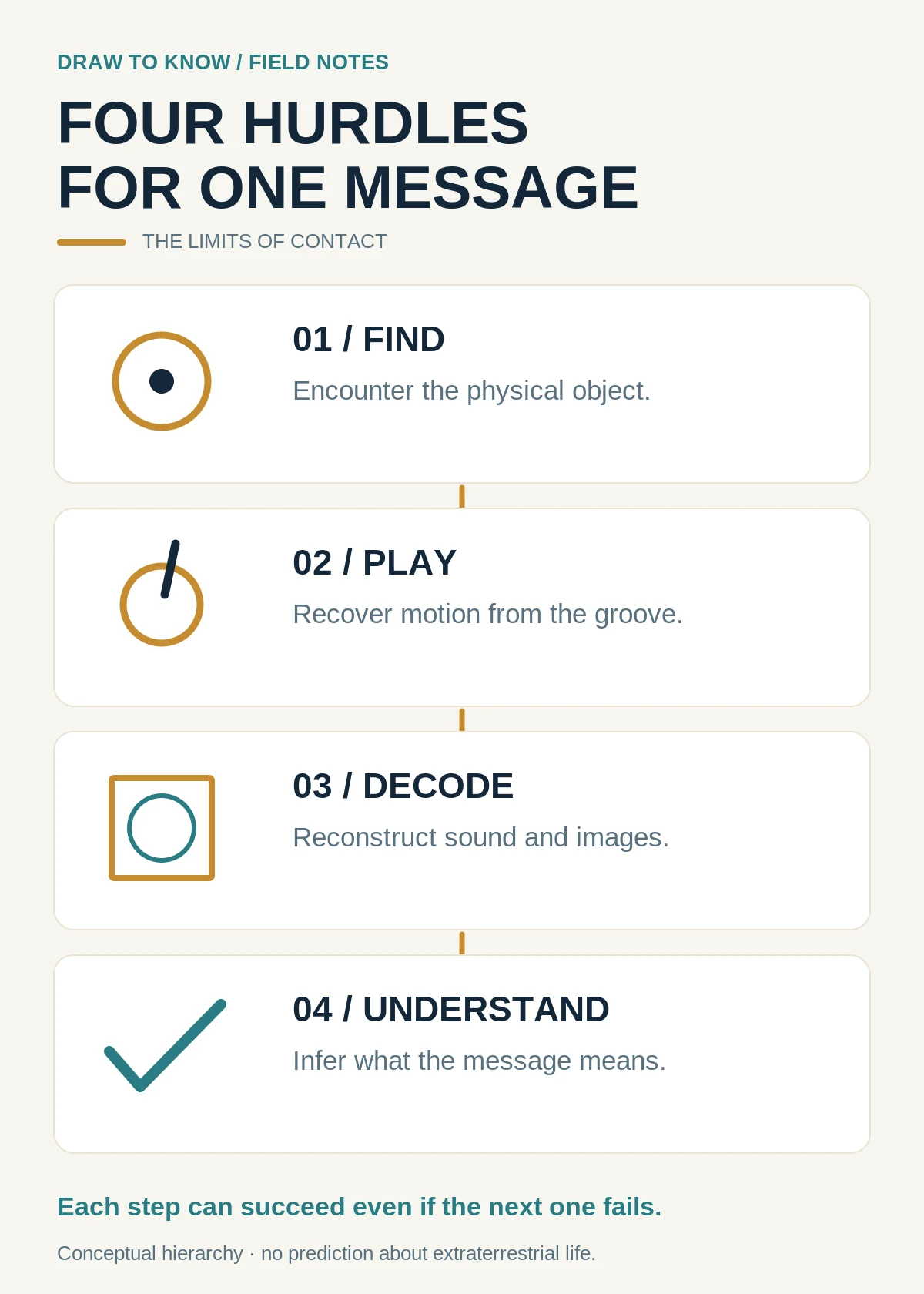
Image unavailable.
Four large stacked cards labeled Find, Play, Decode, and Understand, showing that each stage can succeed while the next fails.
Keep exploring
Sources & further reading
Follow the original research, records, and explanations behind this story.
- Golden Record Overview NASA
Voyager time capsule, 12-inch gold-plated copper record, and context of earlier Pioneer plaques.
- Golden Record Contents NASA
115 selected images, sounds and greetings, analog storage, playback speed, and accompanying stylus and cartridge.
- Golden Record Cover NASA
Historical playback schematic, 16 2/3 rpm, hydrogen reference, 512 image lines, circle calibration, 14 pulsars, uranium-238 marker.
- Voyager’s Special Cargo — The Golden Record (PIA14113) NASA/JPL-Caltech
Official composite distinguishes the record, engraved lid, and artist rendering showing approximate spacecraft location.
- Voyager at 30: The Golden Record NASA
Carl Sagan team, six-year-old Nick Sagan, Ann Druyan recollection of kiss and mother greeting her newborn.
- Mission Overview NASA
Launch dates, respective giant-planet encounters, and heliopause crossings.
- Greetings from Earth NASA
Linda Salzman Sagan account of greetings and the choice of 55 languages over a simplified decipherable message.
- Sounds of Earth NASA
Official track listing, natural sounds, and named music examples; third-party audio rights are not inferred.
- Images on the Golden Record NASA
115 images and explicit NASA warning that original images on the record are copyright-protected.
- Making of the Golden Record NASA
Manufacturing chain: master and metal copies, cutting center, processing facility, package and cover.
- Voyager Golden Record Inscription, 1977 NASA/JPL-Caltech
Behind-the-scenes account of inscription to makers of music on the record case.
- Where Are Voyager 1 and Voyager 2 Now? NASA
Official mission location and status reference; current distance counters change. This article uses the established heliopause crossings rather than an unverified future milestone.
- 10 Things: Going Interstellar NASA
Difference between heliopause and Oort Cloud, roughly 1.7-light-year flybys of Gliese 445 and Ross 248 in about 40,000 years.
- Mounting the Golden Record NASA/JPL-Caltech
Official archival photograph of technicians installing the record package.
- Voyager Golden Record Production Machine NASA/JPL-Caltech
Archival production/pressing photographs, suitable for a production section with attribution.
- Voyager Record Cover NASA/JPL-Caltech
Official close-up of historical instruction engravings; use original marks and avoid creative redraw.
- Riding With Voyager IEEE Spectrum
Direct later recollection by Nick Sagan on saying the child’s greeting at Cornell.
- Howdy, Strangers NASA/JPL-Caltech
2002 retrospective with conflicting image count (116 versus 115) and preparation duration; use to document discrepancy.
- Research and development for a ground-based hydrogen-maser system National Bureau of Standards / IEEE, via NASA Technical Reports Server
Primary frequency measurement, about 1.4204 GHz. The reciprocal is about 0.704 nanoseconds; this wave period is distinct from an atom’s transition waiting time.
Follow the thread