
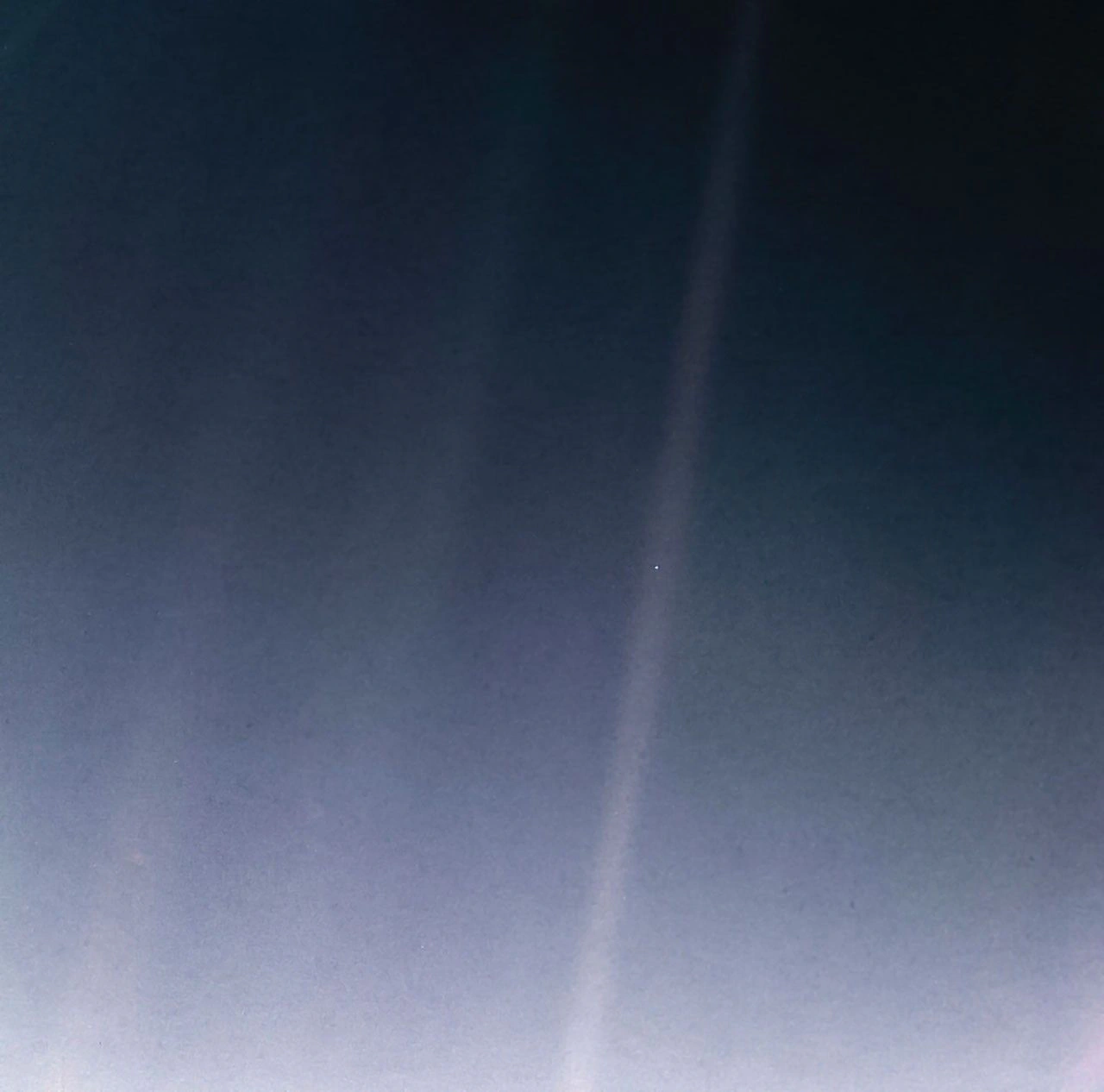
Voyager 1 took the Pale Blue Dot photograph on February 14, 1990, looking back toward Earth from far beyond Neptune. Our planet was too small for its camera to resolve as a disk. Yet enough reflected sunlight reached the instrument to register a tiny point against the darkness.
The image is real, but reading it takes care. The bright streak comes from scattered light inside the camera, and the familiar color view combines several exposures. The clearer version released in 2020 uses the same 1990 observations.
Where was Voyager when it photographed Earth?#
NASA places Voyager 1 about 6 billion kilometers from the Sun when it made the portrait. That is a rounded distance from the Sun, rather than a precise measurement from the spacecraft to Earth. From this viewpoint, Earth appeared only a few degrees away from the Sun in the sky.
The photograph belonged to a sequence of 60 frames assembled into a solar-system family portrait. Six planets appeared: Venus, Earth, Jupiter, Saturn, Uranus and Neptune. Mars was lost in scattered sunlight, Mercury lay too close to the Sun, and Pluto was too small and faint to detect at that distance.
Those missing worlds help explain the challenge. A camera can point in the right direction and still fail to separate a faint target from glare.
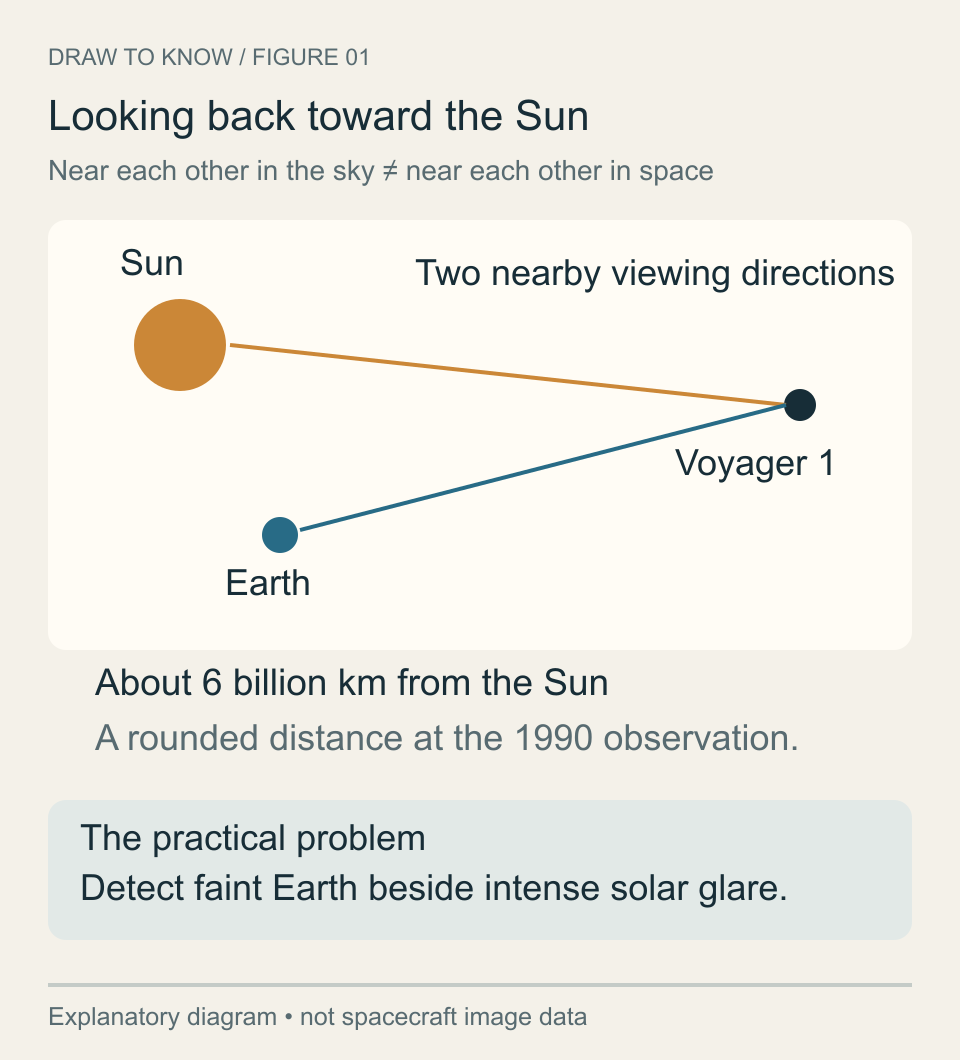
Image unavailable.
Conceptual geometry: Voyager looks toward Earth and the Sun along two nearby directions. Sizes, distances and angles are exaggerated.
What kind of camera could make this picture?#
Voyager carried both wide-angle and narrow-angle cameras. The narrow-angle instrument used telescope optics with a nominal 1,500-millimeter focal length and an f/8.5 aperture ratio. The f-number is focal length divided by entrance-aperture diameter: 1,500 / 8.5 gives an opening about 176 millimeters across. The optics collected light and concentrated a small patch of sky onto a detector. The wide-angle camera supplied the wider setting for the family portrait.
The detector was a vidicon camera tube, rather than a modern digital-camera sensor. A frame was read as 800 lines with 800 samples per line: 640,000 brightness measurements. Each sample used 8 bits, allowing 256 numerical levels. That grid describes the recorded data; it does not guarantee 640,000 independently resolved pieces of planetary detail.
The standard electronic readout took 48 seconds. Readout is the process of extracting the stored image, and must not be confused with the time the shutter was open. Sending the data back by radio was another step altogether. The camera diagram separates these functions so that the numbers describe the right part of the process.
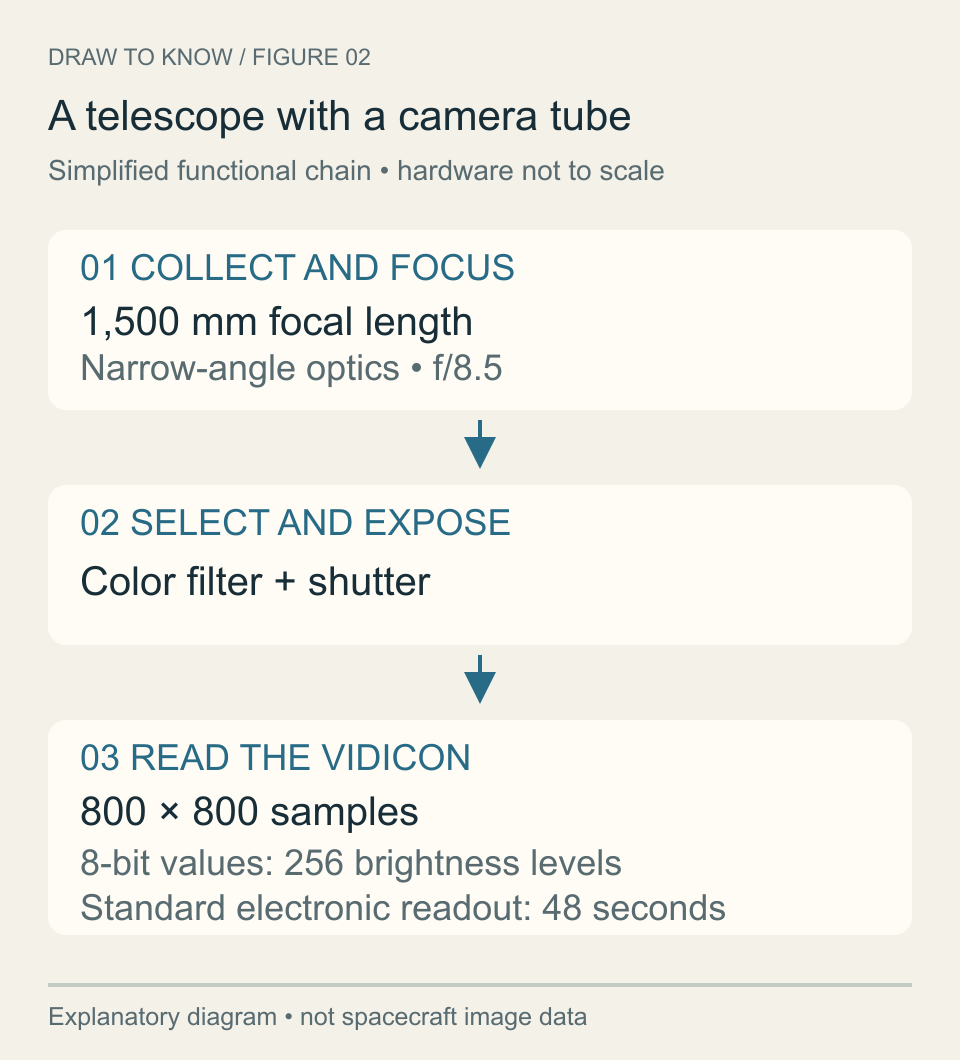
Image unavailable.
Three stages: a narrow-angle telescope focuses light, a filter and shutter select an exposure, and a vidicon camera reads an 800 by 800 sample frame.
Sources: [4]
How can Earth be smaller than one pixel?#
The original image description puts Earth's apparent size at only 0.12 pixel. This describes how small the planet appeared to the instrument. It does not mean the camera drew a detailed globe inside a fraction of a screen pixel.
Detecting light and resolving a shape are different tasks. A distant object can contribute light to an image even when its outline is too small to distinguish. In this case, Voyager recorded Earth's presence without recording recognizable continents, oceans or cloud systems.
The camera's nominal field was about 0.424 degrees across 800 samples. Dividing those numbers gives roughly 0.00053 degrees, or 1.9 arcseconds, per sample. An arcsecond is one three-thousand-six-hundredth of a degree. This is an angular sampling scale, not a promise that the optics can distinguish every feature that small.
An ideal point also does not have to appear as an infinitely sharp point in a real image. Optics, detector response and processing spread its recorded signal. The teaching diagram below illustrates that distinction without claiming to reproduce Voyager's measured spot shape.
For a different example of light concentrated into a core and spread into a halo, see why Hubble's first images were blurred.
Enlarging the published picture makes that signal easier to find. It does not reveal new surface detail. The visible spot should therefore be read as the image of an unresolved planet, rather than as a miniature map of Earth.
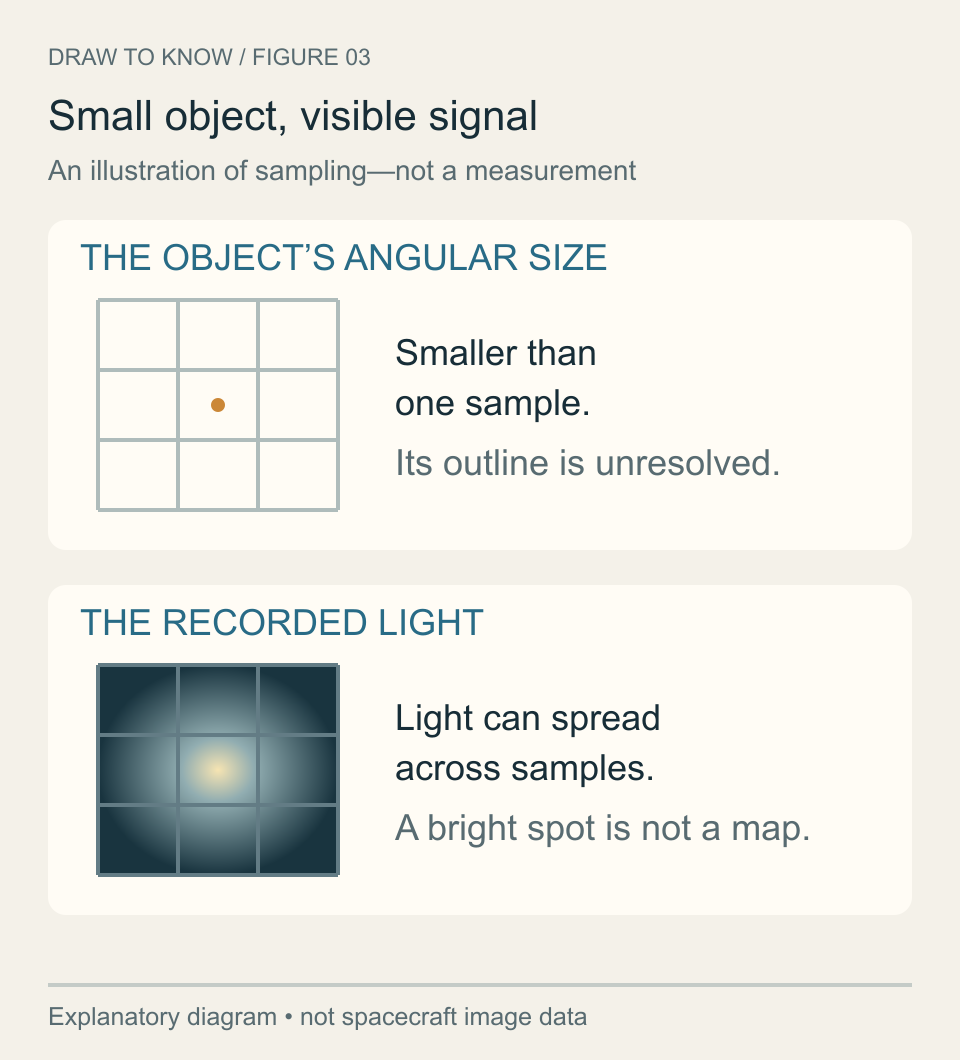
Image unavailable.
An idealized tiny object sits inside one sampling square; a second grid shows its light spread over a broader spot. Detection does not resolve the object’s outline.
Why does Earth sit in a beam of light?#
The streak crossing Earth is sunlight scattered within Voyager's camera optics. Looking close to the Sun created these bands across the scene; one happened to overlap our planet.
JPL's account of the family portrait shows how demanding this contrast was. Even at Voyager's distance, the Sun was almost eight million times brighter than Sirius, the brightest star in Earth's sky. The wide-angle image aimed at the Sun used a very dark filter and a five-millisecond exposure. Those are settings for the Sun frame, not for the narrow-angle Earth exposures.
Longer exposures have their own cost. They collect more light, but movement during an exposure can smear a faint target. JPL attributes the elongated appearances of Uranus and Neptune in the portrait to spacecraft motion during their 15-second exposures. A larger-looking spot is therefore not automatically a larger planet.
That distinction changes what the picture tells us. Earth really was in the camera's field of view, but the band is an optical artifact. It does not trace a physical corridor through space containing the planet. Nor does its width tell us Earth's size or the distance between Earth and the Sun.
How do separate exposures become a color picture?#
Voyager's narrow-angle camera recorded separate exposures through violet, blue and green filters. Combining those measurements produced the color view. NASA describes the result as false color because the filter measurements were assigned to display color channels rather than reproducing an ordinary color photograph directly.
For the 2020 view, NASA describes mapping the green-filter measurement to the red display channel, blue to green, and violet to blue. A filter selects a range of incoming wavelengths; a display channel determines how that measurement appears on a screen. Those are different operations. The diagram shows the mapping explicitly.
This does not make Earth an invented object. It means the visible color is part of a documented representation of real measurements. It is unsafe to use a color picked from the web image as a precise measurement of Earth's average ocean color.
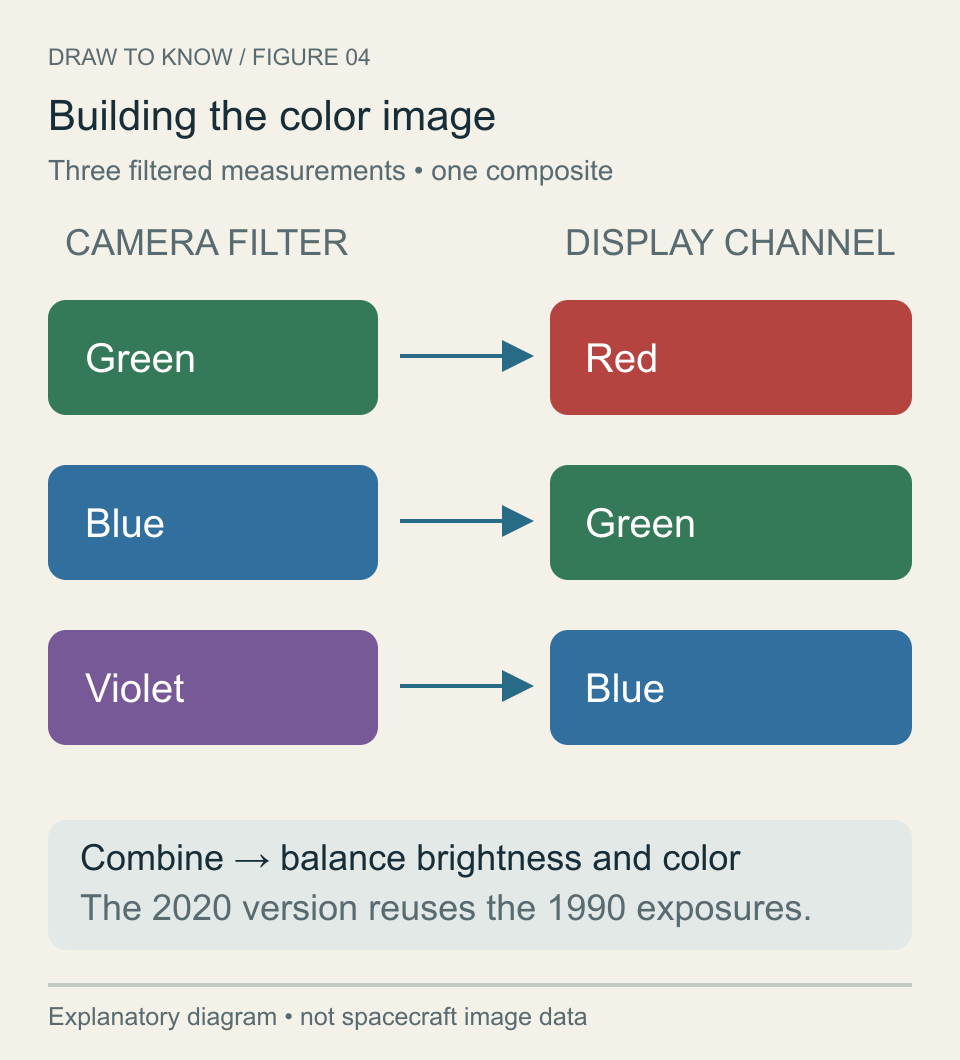
Image unavailable.
Green-filter measurements map to the red display channel, blue-filter measurements to green, and violet-filter measurements to blue, then the channels are combined.
Sources: [3]
What changed in the 2020 version?#
For the thirtieth anniversary, image processor Kevin M. Gill revisited the observations with input from original planners Candy Hansen and William Kosmann. The processing balanced brightness and color, including making the main streak appear white. It made the scene easier to read without adding a new observation of Earth.
Compare the original release below with the reprocessed view at the top. Differences in brightness, grain and framing are presentation differences. Neither image resolves Earth's surface, and the 2020 release date is not a second capture date.
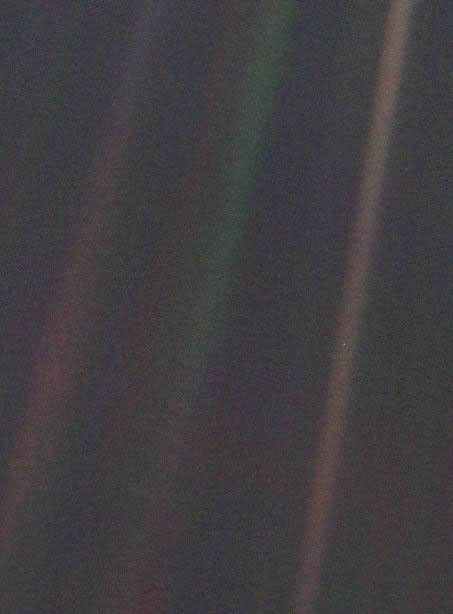
Image unavailable.
The original Pale Blue Dot view, with a tiny Earth near the middle of the rightmost bright streak in a grainy dark image.
Why did the picture take time to reach Earth?#
Light and radio signals travel at the same speed in vacuum. For a rough sense of the delay, divide 6 billion kilometers by approximately 300,000 kilometers per second. The result is about 20,000 seconds, or five and a half hours. This is an illustrative scale calculation, using a rounded distance from the Sun; it is not the exact Voyager-to-Earth signal time on that date.
A signal's travel time is only one part of delivering an image. The spacecraft also has to transmit the stored measurements, and ground antennas must be available to receive them. NASA records that the full portrait data arrived by May 1, 1990, over four Deep Space Network communications passes. The weeks between the observation and completion of delivery therefore cannot be interpreted as the time a radio wave spent crossing space.
Sources: [1]
Why was this one of Voyager's last photographs?#
Carl Sagan had proposed photographing Earth from afar years before the portrait was taken. The view offered little planetary detail, but it could place our home in the wider setting of the solar system.
The Earth exposures were taken at 04:48 GMT on February 14, 1990. Voyager 1 shut down its cameras 34 minutes later. With no further close encounters planned, turning them off conserved power for the mission ahead.
The image's force comes partly from what it cannot show. Every place familiar to us fits inside a point whose outline the camera could not resolve. Understanding the optics leaves that perspective intact—and makes clear exactly what Voyager managed to record.
Keep exploring
Sources & further reading
Follow the original research, records, and explanations behind this story.
- Voyager 1’s Pale Blue Dot NASA Science
Capture date, distance from the Sun, family portrait, missing planets, Sagan’s role and camera shutdown.
- Solar System Portrait – Earth as Pale Blue Dot NASA Science / JPL
Original image, the 0.12-pixel apparent size, filter combination and magnification artifacts. Its distance wording differs from the mission overview; the article uses the overview’s rounded distance from the Sun.
- Pale Blue Dot Revisited NASA Science / JPL
Camera optics, color-channel mapping, 2020 processing and image credit.
- Voyager 1 Narrow Angle Camera Description NASA Planetary Data System / Ring-Moon Systems Node
Instrument design, vidicon sampling, 8-bit values, nominal field of view and standard 48-second readout. These instrument specifications are distinct from an individual exposure time.
- Solar System Portrait — 60 Frame Mosaic NASA/JPL
Wide- and narrow-angle roles, solar glare, relative brightness and motion smear during long exposures.
See the story in motion
Watch our illustrated video, then explore another question below.
Watch on YouTubeFollow the thread