
Apollo 12 survived two lightning-related electrical disturbances during launch because the Saturn V kept flying, the spacecraft retained backup power, and the crew and controllers recovered the systems they needed. John Aaron’s instruction to switch SCE to AUX restored useful telemetry; it was one crucial step in a longer recovery.
The launch took place on 14 November 1969. Charles “Pete” Conrad, Richard Gordon and Alan Bean were heading for the second crewed Moon landing when the electrical problems began less than a minute after liftoff.
When did lightning strike Apollo 12?#
NASA’s mission chronology places the disturbances at 36.5 seconds and 52 seconds after launch. The first produced a cluster of electrical warnings. The astronauts reported disconnected fuel cells and problems with the spacecraft’s power indications; the second event disrupted its primary attitude reference.
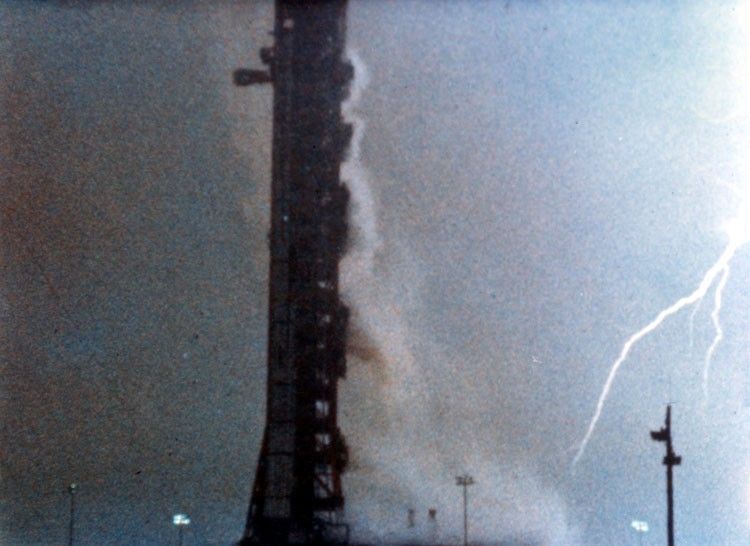
The photograph above records lightning near the launch complex during the first event. The dark vertical structure is the mobile launch tower, not the rocket. By then, the vehicle was already climbing through the clouds.
The crew did not initially have a complete diagnosis. Warning lights describe what a system detects, and several lights can share one underlying cause. Reports from the cabin, ground measurements and the later investigation were needed to reconstruct the sequence.
Did the rocket trigger lightning?#
The investigation concluded that a vehicle and its exhaust plume can trigger a discharge in an electric field that would not otherwise produce natural lightning. The long conducting path changes the electrical conditions in and around the cloud.
That is different from a rocket merely being unlucky enough to cross an independently forming bolt. It also explains why the absence of visible lightning before launch cannot, by itself, establish that flight through a cloud is safe.
Apollo 12’s report connected the hazard to the charged cloud conditions associated with the cold front at launch. Rain was part of the observed weather, but the relevant physical issue was atmospheric electricity. Rainfall alone is not a complete measurement of the electric field through which a rocket will travel.
Sources: [2]
What does SCE to AUX mean?#
SCE means Signal Conditioning Equipment. It prepared instrument signals for the spacecraft’s measurement system. AUX selected its auxiliary operating configuration, allowing the ground to recover meaningful readings after the electrical upset.
Telemetry is information sent from a vehicle to a remote observer. If the circuitry preparing that information is not working properly, an alarming display can reflect a problem in the measurement path as well as a problem in the equipment being measured. Controllers need to know which they are seeing.
NASA’s flight-control account by Eugene Kranz and James Otis Covington separates the steps clearly: switching the signal-conditioning equipment restored telemetry; Aaron then used the recovered information to identify the disconnected fuel cells and request their reset. The switch did not itself reconnect every electrical source or realign the navigation platform.
Why did John Aaron recognise the problem?#
Aaron had encountered a similar pattern of unusual readings during earlier testing and investigated its cause. That experience gave him a specific explanation for the confusing data, rather than a general instruction to restart everything.
The recorded communications show the recommendation reaching the spacecraft through capsule communicator Gerald Carr. Alan Bean selected the switch. Conrad and Gordon were also assessing the vehicle and its displays; restoring the flight depended on coordinated work in the cabin and Mission Control.
The transcript places Carr’s SCE instruction at 1 minute 36 seconds after launch and a later request to reset the fuel cells at 2 minutes 19 seconds. These are recorded call times, not a claim that every piece of hardware changed state at precisely the instant the words were spoken.
Why did Saturn V keep flying while Apollo had problems?#
The Saturn launch vehicle and the Apollo spacecraft did not depend on one shared guidance unit. The spacecraft’s disturbed indications and primary attitude reference were therefore not proof that the booster had lost its own ability to fly the planned ascent.
NASA’s statistical mission summary reports no significant effect on the launch vehicle’s hardware and software, and the vehicle reached the intended Earth orbit. Meanwhile, backup batteries supported spacecraft loads while the fuel cells were disconnected.
This separation gave the team time to diagnose the electrical failure. It does not mean the situation was harmless or that continuing is always the right response to lightning. The decision concerned the actual remaining capabilities and trajectory of this vehicle, under its mission procedures.
Was everything repaired before the crew headed for the Moon?#
The crew and ground checked the spacecraft carefully in Earth orbit before committing to the burn toward the Moon. They also inspected the lunar module earlier than originally planned to look for consequences of the launch disturbances. Recovering readable telemetry made those decisions better informed, but was not the same as demonstrating that every component was undamaged.
The incident report records the permanent loss of nine non-essential instrumentation sensors. That qualification matters: the mission continued with some failed measurements, rather than returning every sensor to its prelaunch state.
Apollo 12 ultimately landed near Surveyor 3 and returned to Earth. Its successful completion followed the electrical recovery and subsequent checks. For the earlier landing’s surface work, see our account of Apollo 11’s first moonwalk.
What changed after the lightning incident?#
NASA tightened launch-weather restrictions to address conditions favourable to lightning. The lesson was broader than avoiding a visible thunderbolt: the launch vehicle could help initiate a discharge, so the environment had to be assessed with that possibility in mind.
The recovery also illustrates why measurements need their own diagnosis. When many readings become implausible together, investigators must consider a common power or signal-processing fault while still checking whether the underlying equipment has failed. That is an explanation drawn from this case, not a universal instruction to ignore warning lights.
Apollo 12 is often remembered through a short switch command. The documented sequence includes a functioning booster, backup electrical capacity, recognition of a measurement fault, crew action, fuel-cell recovery and checks before leaving Earth orbit. The switch restored a measurement system; the remaining hardware and procedures supported the recovery.
Keep exploring
Sources & further reading
Follow the original research, records, and explanations behind this story.
- Apollo 12 mission summary NASA SP-4029
Disturbance times, launch-vehicle performance and extra systems checks.
- Analysis of Apollo 12 Lightning Incident NASA MSC-01540 / MSFC, KSC and MSC
Primary investigation: triggered lightning mechanism and nine failed non-essential sensors.
- Flight Control in the Apollo Program NASA SP-287 / Eugene F. Kranz and James Otis Covington
Separate telemetry recovery and fuel-cell reset; backup batteries.
- Apollo 12: Launch and Reaching Earth Orbit Apollo Flight Journal / NASA mission records
Recorded instructions and first-person recollection of earlier test pattern.
- Intrepid Seeks Out Surveyor III NASA SP-4214 / William David Compton
Mission continuation, alignment and tighter launch-weather restrictions.
- 55 Years Ago: Apollo 12 Makes a Pinpoint Landing on the Moon NASA / John Uri
Bean switch action, subsequent checks and successful lunar mission.
- Lightning Strikes Twice NASA
First-event lightning at launch complex; foreground structure is mobile launch tower.
Follow the thread