


On 16 November 1974, the Arecibo radio telescope in Puerto Rico sent a brief message toward a distant cluster of stars. Its 1,679 binary digits could be laid out as a small picture: numbers, chemistry, DNA, a person, the Solar System and the telescope that sent it.
That familiar picture hides two separate problems. How do you turn a radio signal into something another intelligence might understand? And who gets to decide that Earth should introduce itself? Following the message from transmitter to imagined reader shows where the engineering ends and the assumptions begin.
What happened at Arecibo in 1974?#
The broadcast was a demonstration at a ceremony marking a major upgrade to the observatory. It was aimed at Messier 13, or M13, a globular cluster: a dense, roughly spherical collection of stars in our galaxy. The occasion was real; the imagined extraterrestrial audience was hypothetical.
Cornell's 1999 account, drawing on people involved, describes the message as a symbolic demonstration of the telescope's capabilities. Frank Drake led the design, with contributions from others including Richard Isaacman, Linda May, James Walker and Carl Sagan. Calling it simply a message by Drake and Sagan leaves out that collaborative work.
The small group could use a powerful transmitter and choose a representation of Earth. That did not make its selection a worldwide agreement about what humanity should say.
Was a picture actually sent through space?#
What left Arecibo was a changing radio signal carrying a sequence of two symbols. The picture appears when someone assigns those symbols to filled and empty cells on a grid.
The carrier frequency was 2,380 megahertz: about 2.38 billion wave cycles each second. Slight frequency shifts distinguished the binary values, 0 and 1. This is frequency-shift encoding. The tiny changes carried the information; the much higher carrier frequency determined where a receiver would have to listen on the radio dial.
The SETI Institute describes a rate of 10 bits per second. At that rate, 1,679 bits take 167.9 seconds, or about two minutes and 48 seconds. That calculation explains the usual description of a broadcast lasting less than three minutes. It does not imply a timing measurement more precise than the reported rate.
There were no colored panels in the radio transmission. Colors in familiar published versions help human readers separate the content. A recipient would first have to detect the signal, recover the sequence and discover an arrangement that made sense.
Why do 1,679 bits make a rectangle?#
The useful clue is that 1,679 equals 23 multiplied by 73. Both factors are prime numbers, so the nontrivial rectangular choices are unusually limited: 23 cells across and 73 down, or the reverse.
In the intended arrangement, the bits form a tall picture. Trying the other orientation produces a much less suggestive pattern. This gives a patient decoder something to test without first knowing an Earth language. It still assumes the decoder recognizes a bounded message, treats the two states as binary symbols and experiments with a two-dimensional display.
Even a recognizable grid is only the start. Mathematics can help recover the layout; it cannot by itself establish that a shape means a human, that a small group of marks means a chemical formula, or that one displaced planet identifies the sender's home. Those meanings come from relationships across the message and from assumptions about what the reader might recognize.
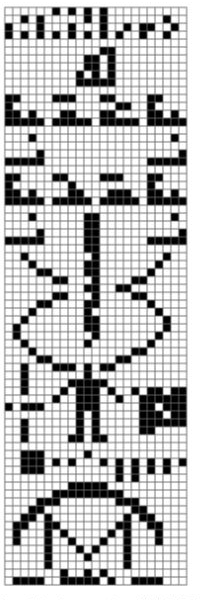
Image unavailable.
Monochrome grid of the Arecibo message, with numerical marks at top, a DNA helix, a human figure, the Solar System and a telescope symbol below.

Sources: [2]
What does the intended picture say?#
The intended picture presents humanity through biology, a place in the Solar System and the instrument sending the message. The SETI Institute identifies its principal content as earthly biochemicals, DNA, a human figure, the Solar System and the Arecibo telescope.
These subjects serve different explanatory purposes. The chemical and DNA material concerns what earthly life is made from and how biological information is carried. The person supplies a representation of an organism. The Solar System supplies astronomical context; the antenna identifies the kind of instrument responsible for the signal. Reading those panels together suggests a connection between life, a planetary home and radio technology.
That description is the creators' intended reading. A stick figure is recognizable to us because we know human bodies and the conventions of drawing them. The same marks, encountered without that background, do not come with a label explaining whether they depict a sender, a machine or something else. A stylized molecule likewise depends on the reader recognizing how a diagram relates to matter.
The message therefore supplies a compact selection of information, with clues that can reinforce one another. It provides no evidence that a nonhuman reader would infer every intended meaning. Recovering the pattern would be an engineering success; interpreting its contents would remain another problem.
What made the signal powerful?#
Arecibo combined a powerful transmitter with a very large antenna that concentrated the radiation into a small part of the sky. Concentration, rather than transmitter wattage alone, is what made the broadcast exceptional.
The SETI Institute describes a megawatt transmitter coupled to the 305-meter antenna. A megawatt is one million watts of actual transmitter power. The dish directed that power into a narrow beam. Its quoted equivalent of a 20-trillion-watt omnidirectional broadcast describes how strong the signal was in the beam compared with a transmitter spreading energy in all directions. It does not mean that Arecibo generated 20 trillion watts.
For a distant observer, receiving the signal would depend on being in the illuminated direction at the right time, listening near the right frequency and having a sufficiently sensitive instrument. A three-minute transmission also offers a much shorter opportunity than a beacon that repeats for years. Detecting an artificial narrowband signal and successfully decoding its picture are separate achievements.
This is why ordinary television leakage cannot settle the argument about deliberate messaging. Some radio emissions escape Earth, but their strength, direction, frequency and repetition differ. The SETI Institute's discussion of detection distinguishes weak everyday transmissions from powerful radar signals. Saying that Earth already emits radio waves does not establish that every additional transmission makes Earth equally detectable.
Why aim at M13 if a reply would take so long?#
M13 offered a concentration of stars in one direction, and it was available to the telescope during the ceremony. It was a useful target for a demonstration, not a destination from which the organizers expected a conversation within their lifetimes.
The sources use different approximate distances. The SETI Institute's Arecibo account gives about 21,000 light-years; Cornell's anniversary account and the Institute's broader FAQ use about 25,000. These are rounded historical or explanatory estimates, not a basis for calculating an exact arrival year. On either scale, the one-way journey takes tens of thousands of years.
A light-year is a distance: the distance light travels in one year. Radio waves travel at the same speed as light in space. At roughly 25,000 light-years, even an immediate reply would take roughly 50,000 years for the outward and return journeys together. Finding and interpreting the message would add its own unknown delay.
The time scale changes the meaning of the act. It is possible to transmit something whose imagined reception lies far beyond the lives of its designers, their institutions and their descendants. Whether any suitable listener exists in the beam remains unknown.
What did Martin Ryle actually object to?#
Ryle questioned both the possible consequences of attracting attention and the authority of a small group to make that choice. The surviving evidence spans several years; it should not be compressed into a single precisely dated protest immediately after the 1974 broadcast.
Alan Penny's archival study reproduces remarks from Ryle's 1971 lecture about the earlier discovery of pulsars. Before astronomers understood those signals as natural, the possibility of extraterrestrial intelligence had briefly raised the question of what contact might mean. Those remarks predate the Arecibo message.
Penny also quotes a letter Ryle sent to a member of the public on 19 January 1977. Ryle objected to scientists in one country planning powerful contact signals without proper international discussion. That is dated documentary evidence for the question of representation. Penny reports a complaint to Drake as well, but the passage does not establish its exact date.
The institutional route also needs care. Penny identifies a 1976 approach to the International Astronomical Union through Bernard Lovell and reports that the IAU decided no action was needed after consulting Drake. He says no letter from Ryle himself to the IAU was found in the relevant archives. These details support a history of disagreement. They do not supply a measured probability of danger or prove how an extraterrestrial civilization would behave.
Sources: [3]
Who gets to speak for Earth?#
The Arecibo team made the operational choice to send this message. The harder question is what kind of consultation should precede such choices when their intended audience lies beyond Earth.
Receiving SETI listens for evidence of other intelligence. Active messaging deliberately transmits something intended to be recognized. The Voyager Golden Record makes a related choice through a different medium: a physical object carried aboard a spacecraft, which would need to be encountered and examined. Arecibo's radio message travels much faster, but a receiver still has to intercept a fleeting signal.
The case for sending, the case for restraint and the practical chances of reception depend on the actual method. Existing radio leakage is relevant evidence about Earth's visibility; it does not remove the need to examine a proposed beam. Concern about possible harm is an ethical argument under uncertainty; it is not evidence that harm will occur.
The small picture made the first problem tangible: what could people encode with a few bits? The history of Ryle's objection preserves a second problem that the picture cannot answer. Technical access to a transmitter and a mandate to represent humanity are different kinds of authority.
Keep exploring
Sources & further reading
Follow the original research, records, and explanations behind this story.
- It's the 25th anniversary of Earth's first attempt to phone E.T. Cornell Chronicle
Participant recollection of the 16 November 1974 ceremony, contributors, transmission and target. Its first/only and target-miss claims are not adopted.
- Arecibo SETI Institute
The Arecibo Message subsection: radio encoding, bit count/grid/rate, antenna/transmitter, approximate target distance and generic picture contents.
- The SETI Episode in the 1967 Discovery of Pulsars Alan Penny / arXiv; European Physical Journal H
Section 4 and references: Ryle 1971 remarks, dated 1977 Brough letter, later Drake complaint and Lovell/IAU correspondence. Historical analysis quoting archived primary documents; original letters not independently inspected.
- Frequently Asked Questions SETI Institute
Answers on sending signals and detecting Earth distinguish the 1974 transmission, approximate M13 distance and leakage detectability assumptions.
See the story in motion
Watch our illustrated video, then explore another question below.
Watch on YouTubeFollow the thread