
On April 6, 2026, the four Artemis II astronauts reached 252,756 miles from Earth, about 4,100 miles beyond the Apollo 13 record. Orion was already rounding the far side of the Moon. Its closest approach to the lunar surface came around 7 p.m. EDT, with its farthest point from Earth following shortly after.
Those two moments tell you something the record alone misses. A spacecraft can be moving away from the Moon and still be getting farther from Earth. To see how, follow Orion from its last orbit around Earth through the turn that sent it home.
Why did Orion spend a day in Earth orbit first?#
Reid Wiseman, Victor Glover, Christina Koch and Jeremy Hansen launched on April 1, 2026, from Florida. The Space Launch System put Orion in orbit, where the crew and mission control had a day to check the spacecraft before committing to the lunar leg. After Orion separated from the upper stage, the astronauts also took manual control for a proximity operations demonstration. They used the spent stage as a nearby reference to practice how Orion could maneuver around another spacecraft.
On the second flight day, the main engine on the European Service Module fired for 350 seconds. The maneuver, called translunar injection, changed Orion's speed and direction so it could meet the Moon after roughly four days of travel. The Moon was moving throughout that journey. The burn had to aim Orion toward a place the Moon would occupy days later. ESA reported that the departure was precise enough to cancel two of the three planned outbound course corrections.
How did a flyby put Orion on the way home?#
As Orion passed the Moon, lunar gravity changed the direction of the spacecraft's motion. The departure from Earth had been chosen so that the path leaving this encounter brought Orion back toward Earth. This is a free-return trajectory. It lets the spacecraft round the Moon without braking into lunar orbit and without a large departure burn on the way out.
A free return brings the spacecraft into Earth's vicinity. The crew still has to arrive at a carefully chosen angle for atmospheric entry and at the right place for recovery. The service module made three course corrections after the flyby. Those burns adjusted where the returning trajectory would meet Earth. The Moon had already bent the path toward home.
Why did the record come after the closest pass over the Moon?#
Closest approach to the Moon measures the gap between Orion and the lunar surface. Around 7 p.m. EDT, NASA put that gap at about 4,067 miles. Earth distance follows a different line, stretching back past the Moon to the planet. As Orion rounded the far side, it could start pulling away from the lunar surface while its motion still carried it outward along that second line. By 7:02 p.m. NASA's reported distance from Earth had reached 252,756 miles.
Apollo 13 also went around the Moon. In 1970 its crew had to abandon a planned landing after an oxygen tank failed, and used the lunar module's engine to return to a free-return trajectory. NASA's history puts its maximum Earth distance at 248,655 miles. Both the position of the Moon in its elliptical orbit and how far the spacecraft swings beyond it affect that number. A distance record tells you how far the crew got from Earth. The separate altitude figure tells you how close they flew to the ground below.
What happened to the radio link behind the Moon?#
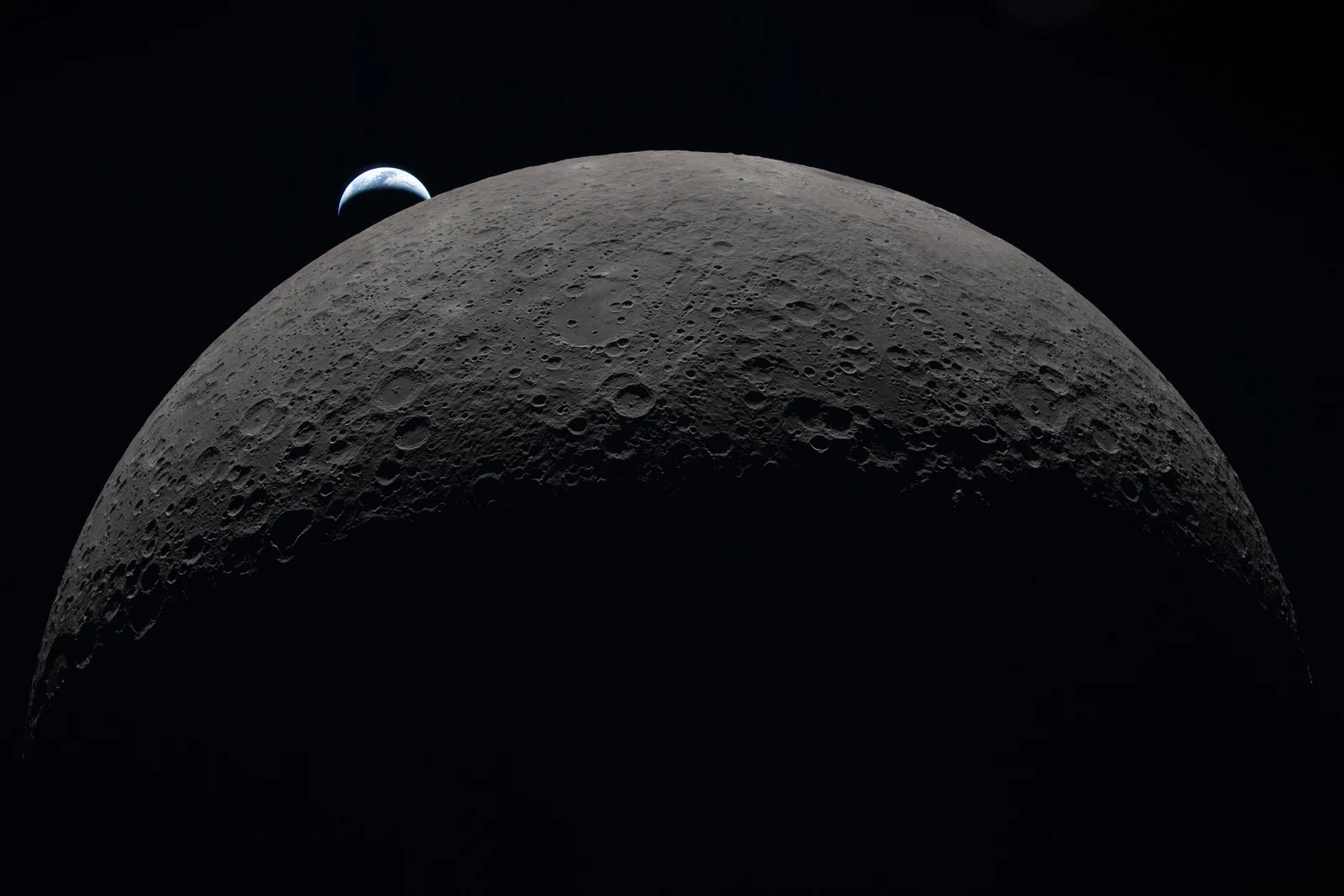
In the cover photograph, the Moon's edge is about to hide the crescent Earth. The Artemis II crew took that picture at 6:41 p.m. EDT, before the brief passage during which the Moon blocked Orion's line of sight to Earth. The loss of radio contact lasted about 40 minutes. Both the closest lunar approach and the maximum Earth distance fell within that interval.
While Orion was out of contact, the astronauts photographed and described the terrain. The crew's spoken observations preserved judgments about color, brightness and texture alongside the images. By the time Earth came back into view, Orion was already heading home.
What did Artemis II test on the way back?#
Near Earth, Orion's crew module separated from the European Service Module. The crew module entered the atmosphere on its own and then descended by parachute into the Pacific off Southern California on April 10. For the first time, Orion had carried people out of Earth orbit, around the Moon and through the return.
Keep exploring
Sources & further reading
Follow the original research, records, and explanations behind this story.
- Artemis II Flight Day 6: Crew Wraps Historic Lunar Flyby NASA
Post-flyby record of both distance milestones, the radio outage and observations.
- NASA Welcomes Record-Setting Artemis II Moonfarers Back to Earth NASA
NASA’s postflight announcement of the maximum distance, launch, splashdown and crew.
- Artemis II: splashdown European Space Agency
ESA’s postflight account of the maneuvering demonstration, departure burn, course corrections and module separation.
- Artemis II Press Kit NASA
Explains translunar injection, the free-return path, the approach to Earth and parachute sequence.
- “Houston, We’ve Had a Problem” NASA History
Explains why Apollo 13 swung around the Moon and gives the former record and its geometry.
- Earthset From the Lunar Far Side NASA Earth Observatory
Identifies the cover photo and puts its April 6 timestamp before the far-side pass.
- Artemis II Preliminary Lunar Science Operations Report NASA
Later mission report gives the time and altitude of the closest pass and describes the far-side science observations.
Follow the thread