
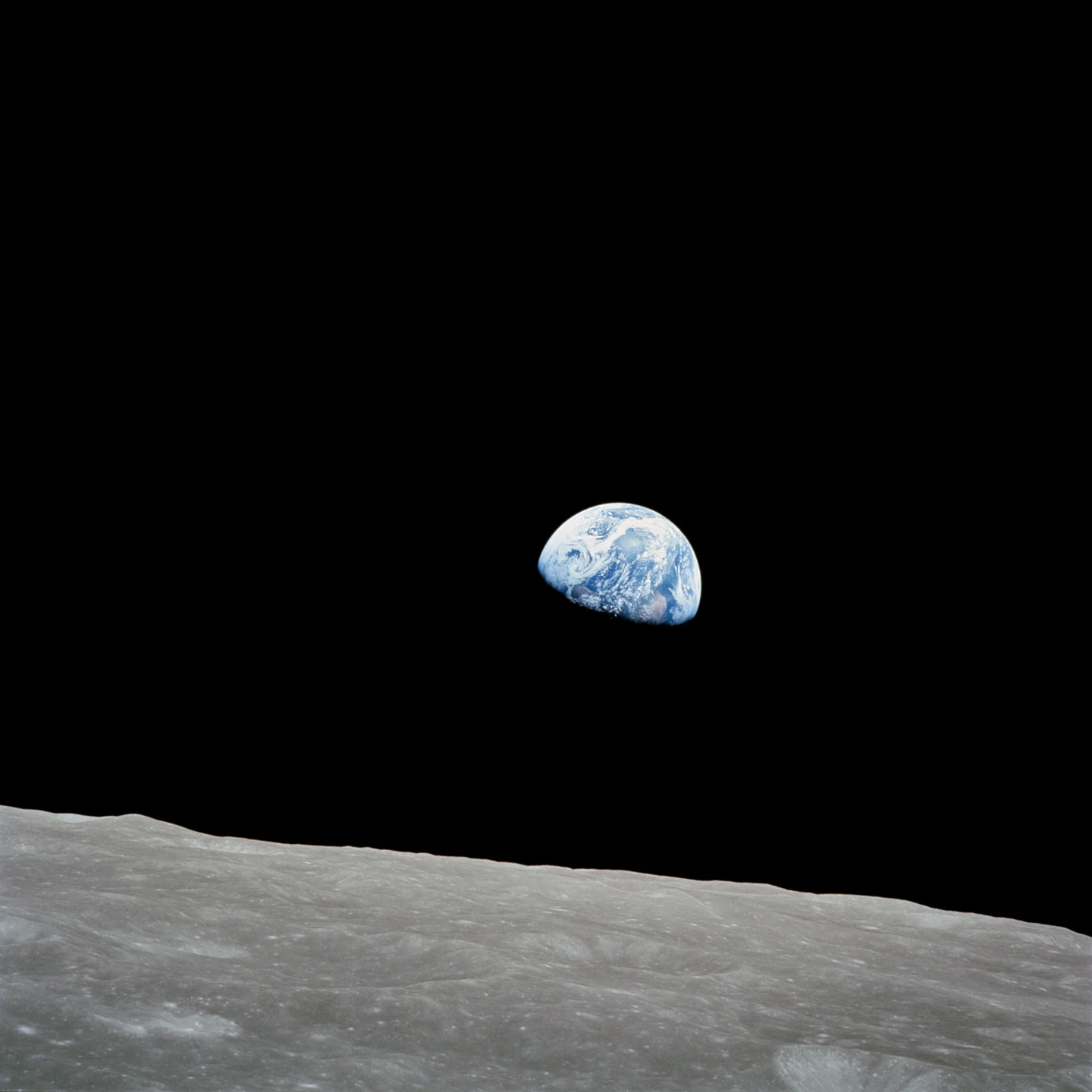
Apollo 8 carried Frank Borman, Jim Lovell and Bill Anders around the Moon in December 1968. They did not land. They tested whether a crew could travel to lunar orbit, work there and return to Earth. Along the way, Anders photographed a blue-and-white Earth above a gray lunar horizon. Understanding that picture means following the moving spacecraft, the camera in its window and the decisions that put three people so far from home.
What did Apollo 8 accomplish before the first Moon landing?#
Apollo 8 was the first mission to carry people to the Moon, the first to put them into lunar orbit and the first to bring them home from that journey. It launched on December 21, 1968, entered lunar orbit on December 24 and splashed down in the Pacific on December 27. The crew completed ten lunar orbits over about twenty hours. Apollo 11's landing still lay seven months ahead.
An orbit is already a demanding destination. The spacecraft must arrive with the right position and velocity, reduce its speed enough to remain near the Moon, support its crew and later accelerate onto a route home. A flyby and an orbital mission therefore test different things. Passing the Moon does not by itself demonstrate that a spacecraft can enter and leave lunar orbit.
Apollo 8 also tested an entire working arrangement: the Saturn V launcher, the command and service modules, deep-space communications, navigation, flight controllers and a crew making decisions beyond immediate ground contact. Photographs of lunar terrain and observations of possible landing areas served later missions. The famous view of Earth emerged from this practical work.
Its achievement is easier to appreciate when the remaining tasks stay visible. Apollo 8 did not demonstrate a lunar descent, a takeoff from the surface or a reunion with a returning lunar module. Those were separate problems. The mission established that the larger journey around those operations could work with people aboard.
Why did NASA send Apollo 8 to the Moon without a lunar module?#
The mission grew from a schedule problem and a change in the order of testing. NASA had planned an Earth-orbit flight involving the command and service modules and a lunar module. But the lander was running late. Waiting for it would delay experience with hardware that was closer to readiness, including the Saturn V carrying a crew.
In August 1968, Apollo Spacecraft Program Manager George Low helped advance a different proposal: fly the command and service modules to lunar orbit without the lander. NASA's August announcement removed lunar-module operations from Apollo 8 but did not yet make the lunar destination final. Planning and training proceeded while approval remained dependent on a successful Apollo 7 flight.
That sequence matters. The decision was bold, but it was not a last-minute impulse to put an untested spacecraft on a rocket. Apollo 7 tested the crewed command and service modules in Earth orbit in October. Meanwhile, engineers addressed problems exposed by the uncrewed Apollo 6 Saturn V flight, including damaging oscillations known as pogo. The December mission followed that preparation.
The absence of a lunar module also defined the mission's limits. There was no vehicle for landing and no second habitable spacecraft attached to serve as a refuge. A lunar-module test article provided launch ballast; it was not a functioning lander. The plan saved a place in the development schedule by moving lunar-orbit experience earlier, while leaving the lander's crewed tests for Apollo 9.
Who were the astronauts, and what did they do?#
Frank Borman commanded Apollo 8. Jim Lovell was command module pilot, with a central role in navigation. Bill Anders held the title lunar module pilot, even though this flight carried no operational lunar module. His work included photography and observations. Job titles described positions in the Apollo crew structure; they did not mean that each astronaut flew a separate vehicle on every mission.
The crew's work combined planned procedures with observation and judgment. Instruments provided spacecraft information, optical sightings supported navigation, and the ground supplied tracking and calculations. Looking through a window could mean identifying a lunar landmark, checking a star or composing a photograph. The same small cabin had to support all those tasks, along with meals, rest and equipment changes.
During lunar orbit, there was little room in the schedule. NASA's mission summary lists landmark tracking, possible landing-site observations, several kinds of photography and sextant navigation. These activities overlapped with engine maneuvers, communications passes and television broadcasts. The twenty hours around the Moon were a work period rather than a sightseeing cruise.
The Earthrise sequence makes that cooperation tangible. Borman was controlling the spacecraft's orientation. Anders was photographing the terrain. Lovell helped locate the color-film magazine when the new view appeared. Anders made the celebrated exposure, but the opportunity depended on the flight path, the spacecraft's attitude and the other people inside it.
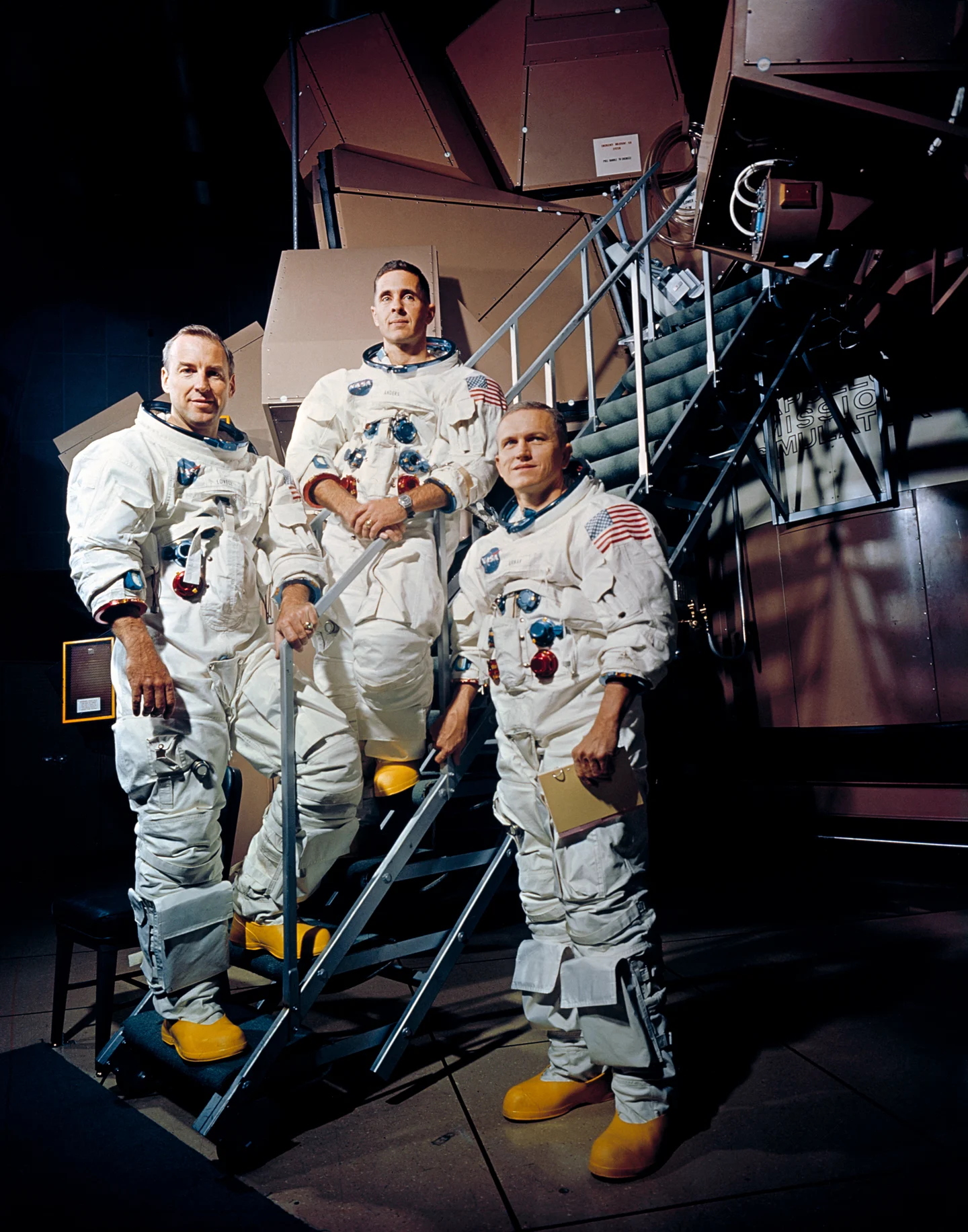
Image unavailable.
Jim Lovell, Bill Anders and Frank Borman pose in spacesuits beside an Apollo simulator.
How did Apollo 8 leave Earth without firing its engine all the way?#
The Saturn V first placed Apollo 8 into an Earth parking orbit. That gave the crew and controllers time to check the spacecraft before committing to the much longer journey. Near the end of the second Earth revolution, the rocket's S-IVB third stage restarted for the maneuver called translunar injection, usually shortened to TLI.
The burn lasted a little over five minutes. It changed the spacecraft's velocity enough to place it on a trajectory that would reach the Moon's vicinity. Afterward, the command and service modules separated from the third stage. Their main task for much of the outward trip was to coast, with small corrections when required.
Coasting does not mean that gravity has stopped acting. Away from atmospheric drag, a spacecraft does not need continuous thrust just to keep moving. Earth's gravity continued to affect Apollo 8 as it traveled outward; the Moon's influence became increasingly important as it approached. The trajectory was a changing gravitational motion, not a straight road through an empty region where gravity had disappeared.
A correction burn changes that motion. A small adjustment made early can change where the spacecraft will arrive much later, which is why navigation matters during a seemingly quiet coast. NASA records that the first major midcourse correction used the service module's main engine for only 2.4 seconds. The enormous launch burn and the brief correction did different jobs: one began the journey; the other refined its aim.
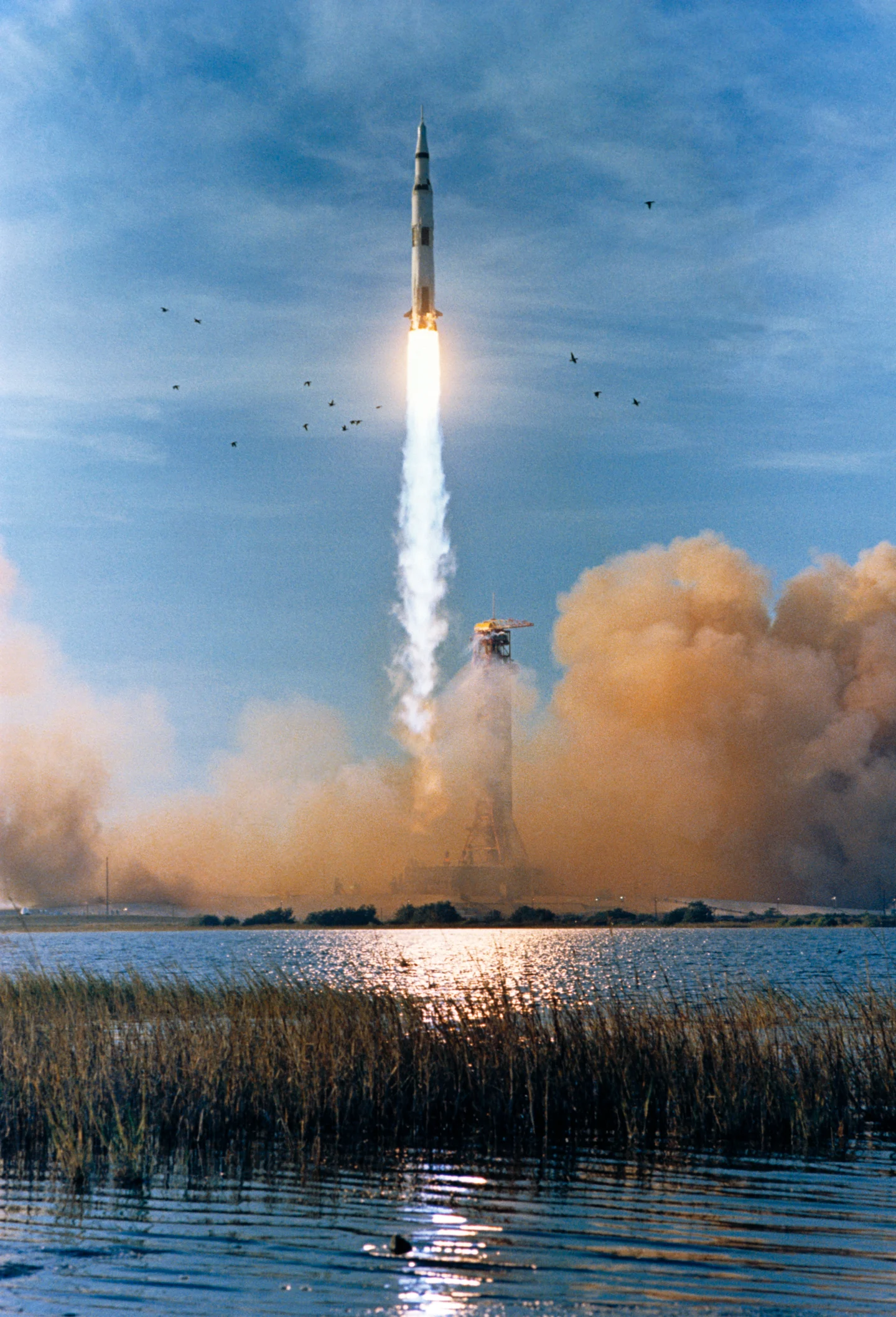
Image unavailable.
The Saturn V carrying Apollo 8 rises above Launch Complex 39A, with water and birds in the foreground.
Sources: [6]
Why did the spacecraft have to slow down to orbit the Moon?#
Arriving near the Moon was not enough to stay there. Apollo 8 approached on a trajectory that, without the planned capture maneuver, would carry it around and away from the Moon. To enter a closed lunar orbit, it had to reduce its speed relative to the Moon at the appropriate point.
The service module's main engine supplied that change. The spacecraft turned so the thrust opposed its motion, and the first lunar-orbit-insertion burn lasted about four minutes. The result was an elongated orbit. A later, shorter burn made it nearly circular, at roughly 70 miles, or 113 kilometers, above the lunar surface.
There is no contradiction between slowing down and remaining in motion. An orbit is continuous falling around a body: gravity bends the path while sideways velocity prevents an immediate collision with the surface. Too much energy on the incoming path lets the spacecraft depart again. Removing the right amount allows capture. Removing the wrong amount, at the wrong time or in the wrong direction can produce a dangerous trajectory.
The return required the reverse kind of energy change. After ten orbits, the engine added velocity in a carefully chosen direction to send Apollo 8 away from the Moon toward Earth. That departure maneuver is called trans-Earth injection, or TEI. The engines were essential at particular transitions, while gravity governed the long stretches between them. The diagram shows those roles, not the exact shape or scale of the flight.
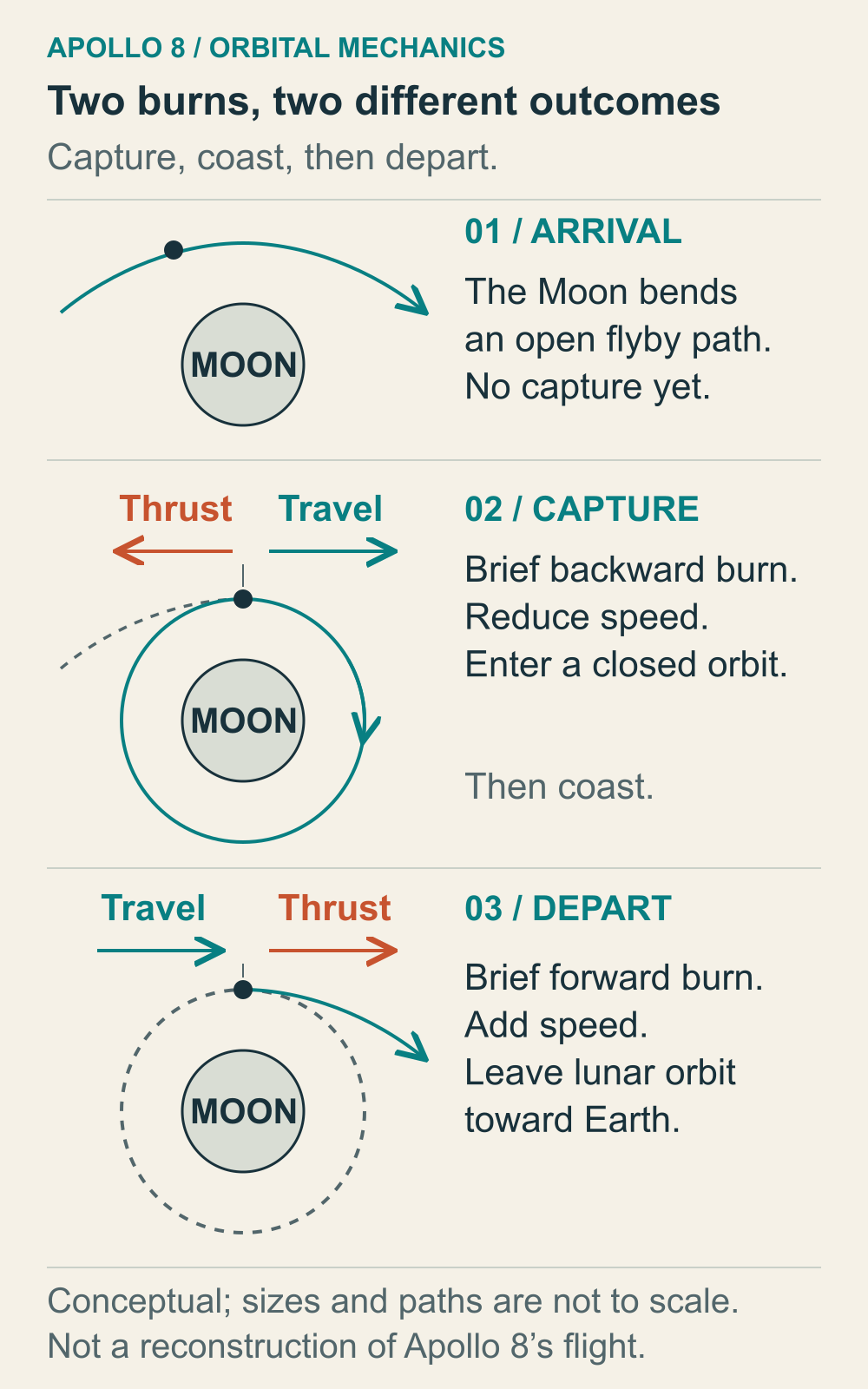
Image unavailable.
Conceptual panels distinguish an incoming lunar flyby, a braking maneuver that captures the spacecraft into orbit, and a later accelerating burn for departure.
Why did Mission Control lose contact behind the Moon?#
The Moon blocked the direct radio path between Apollo 8 and Earth. When the spacecraft moved behind the lunar disk as seen from Earth, its signals could no longer reach the ground through that path. This loss of signal was expected. It did not imply that the radio had broken or that the spacecraft had stopped operating.
The first lunar-orbit-insertion burn took place during such an interval. The crew could use onboard systems and carry out the procedure, but controllers could not watch the engine data arriving live. They had to wait for the spacecraft to emerge from behind the Moon and reestablish contact.
The expected return time itself contained information. NASA's historical account gives predicted intervals of about 22 minutes without capture-engine ignition and 32 minutes 37 seconds with the planned orbital capture. Those were predictions for particular paths, not an exact measurement of the actual silence. They were not a guarantee that any engine malfunction would automatically put the crew on a safe course home.
Later lunar orbits brought repeated periods out of contact. This forced a clear division of work: the ground could prepare instructions and evaluate data while communication was available, but the crew and spacecraft had to function through the gaps. Apollo 8's silence behind the Moon was therefore both a tense moment and a planned operating condition. It also differs physically from the later reentry blackout, caused by ionized gas around the descending capsule.
When was Earthrise taken, and who took the photograph?#
Bill Anders took the famous color Earthrise photographs on December 24, during Apollo 8's fourth lunar orbit. The spacecraft was not on the surface. It was moving around the Moon, with the horizon changing beneath it. Borman began a roll maneuver that brought Earth into view through the windows.
Anders had been using a Hasselblad camera with a 250-millimeter lens to photograph lunar terrain. He first captured the unexpected scene in black and white, then asked for color film. Lovell helped find the magazine. The onboard recording preserves the hurried coordination as Earth moved relative to their field of view.
NASA's reconstruction puts Borman in the left seat, Anders at the right window and Lovell at the lower navigation station when the sequence began. Those positions explain why the crew did not all have the same view at the same instant. A spacecraft can be beside a spectacular scene while its windows face elsewhere.
The archived photograph at the top of this article is the familiar color frame AS08-14-2383, credited to NASA and Anders. It records a small, partly illuminated Earth over a much closer lunar foreground. The visual scale comes from that enormous difference in distance. Earth was not physically hovering just above the nearby mountains; it lay far beyond the Moon, along the camera's line of sight.
Why does Earth rise from a spacecraft but stay almost still in the lunar sky?#
Apollo 8's orbital motion carried the camera around the Moon's curved edge. At one position, the Moon blocked the line of sight to Earth. Farther along the orbit, that line cleared the lunar surface. Earth then appeared to emerge above the horizon. The observer was moving, which is enough to create a rise even without a rapidly rotating landscape below.
A person standing on the Moon faces a different geometry. The Moon rotates once in approximately the same time that it orbits Earth. This synchronous rotation keeps broadly the same lunar hemisphere facing our planet. From much of the near side, Earth therefore stays in approximately the same part of the sky rather than rising and setting every day as the Sun does on Earth.
“Approximately” is essential. Small apparent motions called libration shift Earth's position in the lunar sky, and locations near the boundary of visibility can experience rises and sets. Local terrain also changes the visible horizon. The useful distinction is between those limited motions for a surface observer and the much faster change of viewpoint from an orbiting spacecraft.
Camera direction adds another layer. NASA's reconstruction found that Earth had geometrically risen on the previous three Apollo 8 orbits, but the windows were not facing the event. The fourth-orbit roll made it visible to the crew. Orbital position explains when Earth clears the Moon; spacecraft attitude explains whether a particular window can see it.
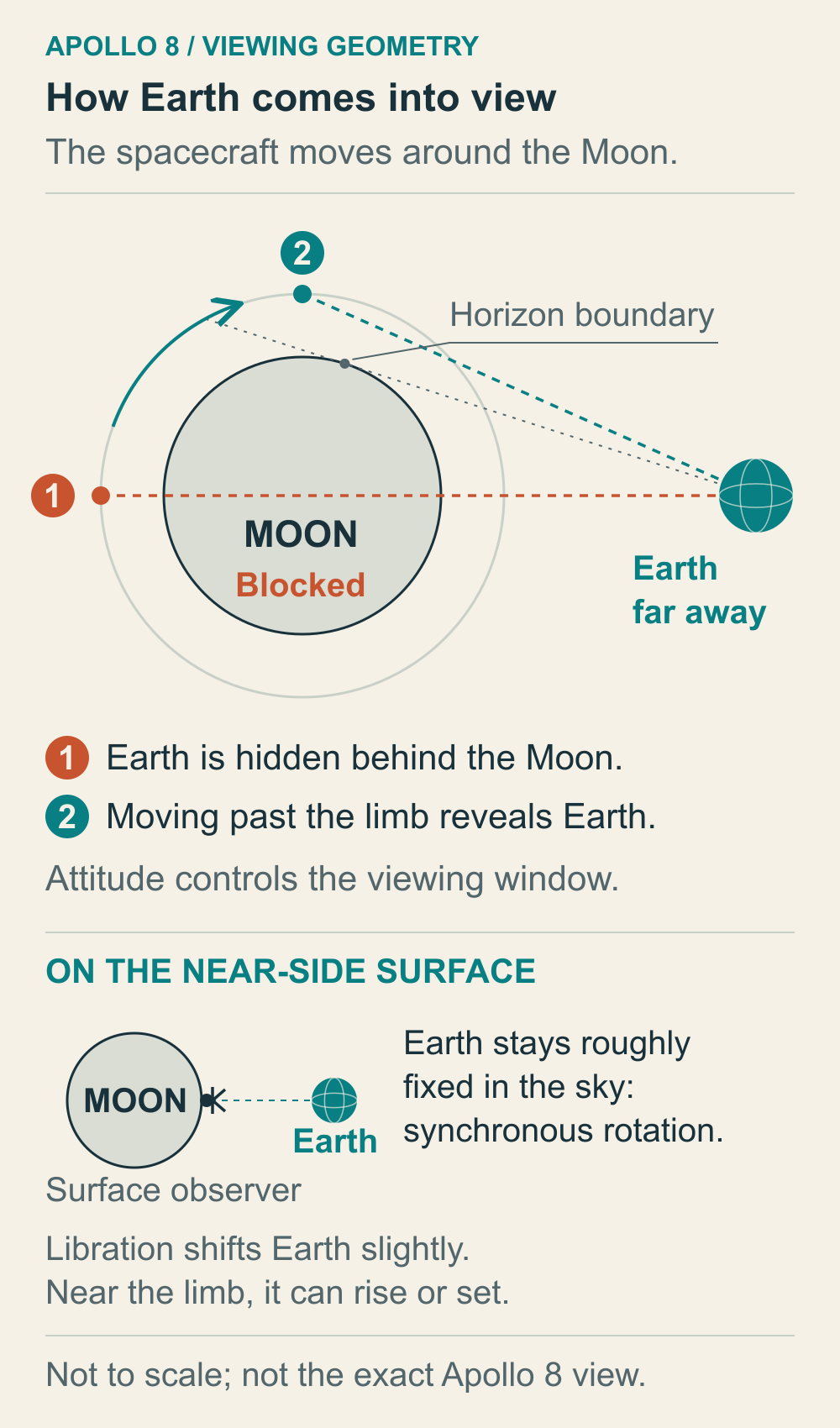
Image unavailable.
Two spacecraft positions show Earth’s line of sight first blocked by the Moon and then clear of it; a surface observer has a different view.
Does the far side of the Moon always face darkness?#
No. The far side is the hemisphere generally turned away from Earth. It is not permanently turned away from the Sun. Over the lunar day-night cycle, both the near and far sides receive sunlight. Calling the far side the “dark side” mixes up visibility from Earth with illumination.
The distinction matters when following Apollo 8. Passing behind the Moon could cut off radio contact even while the spacecraft flew over sunlit terrain. Conversely, a region visible from Earth could be in lunar night. Earth visibility, solar illumination and the spacecraft's own path are separate geometrical questions.
The Moon's synchronous rotation is also easy to misread as “the Moon does not rotate.” It does rotate relative to distant stars. That rotation is what allows the same side to keep facing Earth as the Moon moves around its orbit. If it maintained a fixed orientation relative to the stars instead, different lunar faces would turn toward Earth over the month.
Apollo 8's crew became the first people to see the far side directly. Robotic spacecraft had already photographed it. Their experience was a human first within a longer sequence of exploration, and it did not require the landscape to be dark. These distinctions make the mission easier to picture without treating familiar shorthand as a literal description.
Was Earthrise a live television image?#
The famous color photograph was recorded on film. Apollo 8 also carried television equipment, but a film exposure and a live broadcast are different products. The color still was not instantly transmitted from the Hasselblad to viewers on Earth. The film had to come home for processing.
That physical separation shaped the photographic work. The crew had to choose a film magazine, aim through a window, focus and set an exposure. A missed frame could not simply be recovered from an unlimited digital recording. Meanwhile, the spacecraft continued moving and the scene could pass beyond a window.
The television transmissions provided a different kind of immediacy. NASA describes black-and-white views from the cabin and attempts to show Earth during the outward trip. Those attempts improved as the crew adjusted the camera setup. Viewers could hear astronauts describe colors that the television signal did not reproduce.
The surviving material therefore needs careful labels. An original still photograph is one kind of evidence; onboard sound is another; a television recording is another. A modern animation can combine them to explain what happened, but it remains a reconstruction. Keeping those categories clear preserves the remarkable part of the story: people in a moving spacecraft captured a brief view using the equipment they had, and the original exposure survived the trip home.
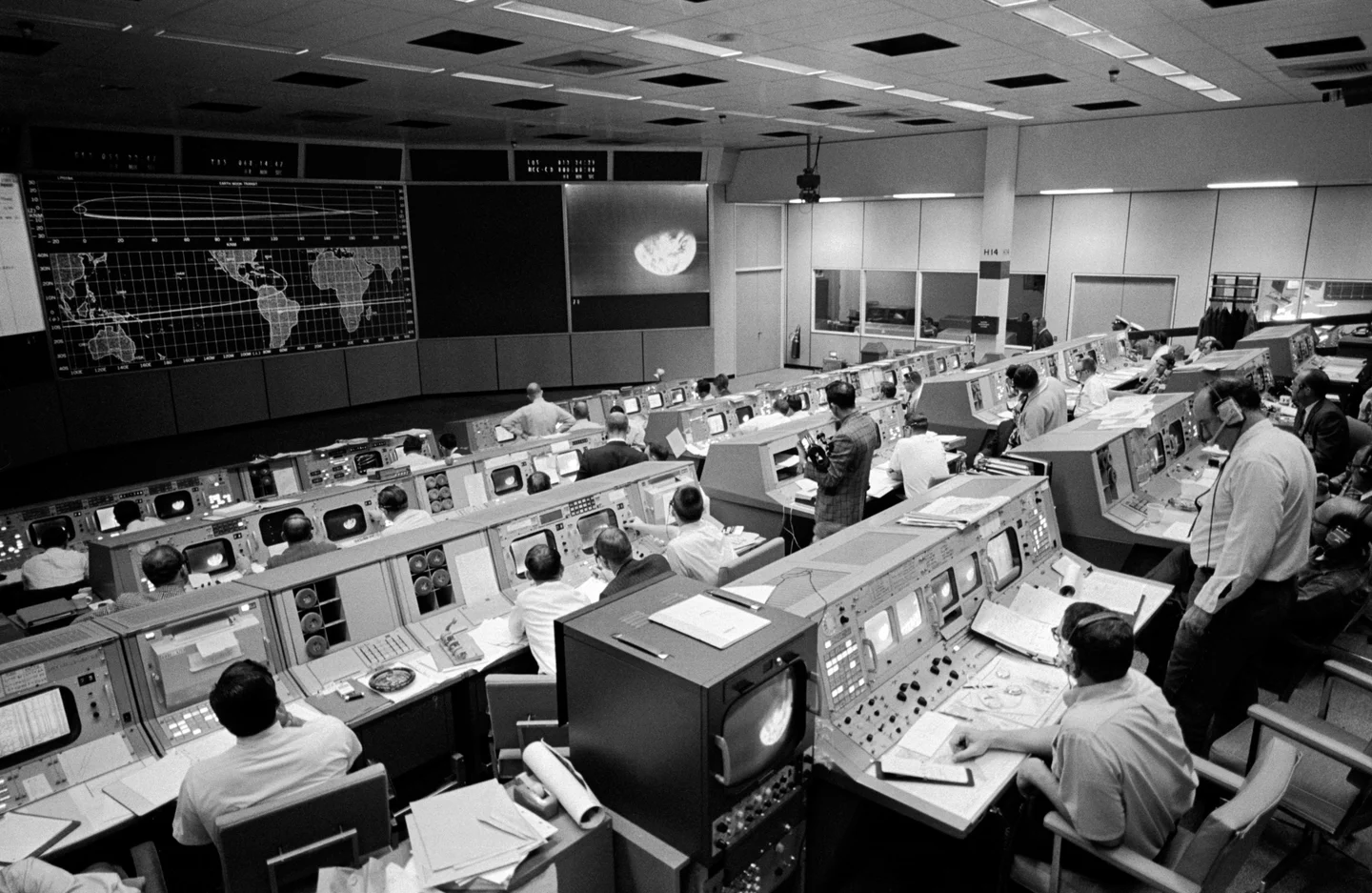
Image unavailable.
Flight controllers watch a large screen showing Earth in an Apollo 8 television transmission.
Why are there no stars in the Earthrise photograph?#
The exposure was set for bright, sunlit subjects: Earth and the lunar foreground. Stars were much fainter in the same field. An exposure short enough to preserve detail in the illuminated surfaces did not collect enough starlight to make the stars visible on the film.
The black background can be misleading because people associate a black sky with nighttime photography. But the Moon has no substantial atmosphere to scatter sunlight into a bright blue sky. A surface in full sunlight can sit beside a black sky. The camera still needs an exposure appropriate to the bright subject.
A longer exposure could record fainter objects, but it would change the problem. Bright surfaces could lose detail through overexposure, and movement of the spacecraft or camera could blur the image. Photographers choose settings for what they want to show; a photograph cannot automatically preserve every brightness level in a scene.
NASA explains the same effect in other spacecraft images: stars disappear when exposure settings favor a much brighter planet or moon. This does not mean stars are absent from space or impossible to photograph there. It means that this particular frame was not a star-field exposure. Its empty-looking background is consistent with the bright Earth and lunar surface it was made to record.
How did modern researchers reconstruct the Earthrise moment?#
A second camera supplied an unusually useful record. While the astronauts reacted to Earth, a camera with an 80-millimeter lens continued taking lunar photographs through a forward-facing window at twenty-second intervals. Those frames recorded the terrain and how its appearance changed as Apollo 8 moved and rolled.
Researchers could match that sequence to detailed lunar topography from the Lunar Reconnaissance Orbiter. Identifiable craters and the changing view constrained the spacecraft's position and orientation. The recorded crew conversation then helped connect the geometry to the sequence of photographs.
NASA's 2013 visualization used these ingredients to recreate the event. It clarified why Earth had not appeared in the crew's windows on earlier orbits and how the roll exposed the view on the fourth. This is a useful example of old observations becoming more informative when compared with a newer map.
The animation is not newly discovered motion-picture footage from outside Apollo 8. Its external viewpoints and continuous camera movements are explanatory constructions. The evidence consists of the original photographs, the recording, mission information and the measured lunar terrain used to align them. A convincing reconstruction earns its value from those constraints, not merely from looking realistic. Readers can compare the still image and NASA's reconstruction through the linked source for this section.
Was Apollo 8 the first spacecraft to photograph Earth from the Moon?#
No. Lunar Orbiter 1 photographed Earth from lunar orbit in August 1966, more than two years before Apollo 8. The robotic Lunar Orbiter program surveyed the Moon, including potential landing areas. Its pictures were part of the information that made later human exploration possible.
The black-and-white Earthrise shown here comes from that earlier mission. A narrow, illuminated Earth appears above the lunar landscape. It demonstrates that the basic viewpoint was available to a robot before a crew saw it directly. Apollo 8's distinction was the human journey and the enduring color photographs made by Anders, not the invention of photographing Earth from lunar orbit.
The version reproduced here also has a second date in its history. The Lunar Orbiter Image Recovery Project recovered information from the original magnetic tapes and released a restored image in 2008. The observing event occurred in 1966; the later work improved access to what the archived data contained.
That distinction is important when encountering unusually clear historical space images. A modern publication date need not mean a new observation, and a restored scan need not mean an invented scene. The relevant questions are where the underlying data came from and what processing was performed. Here the caption identifies both the original mission and the recovery project, so the photograph can be understood as evidence with a documented history.
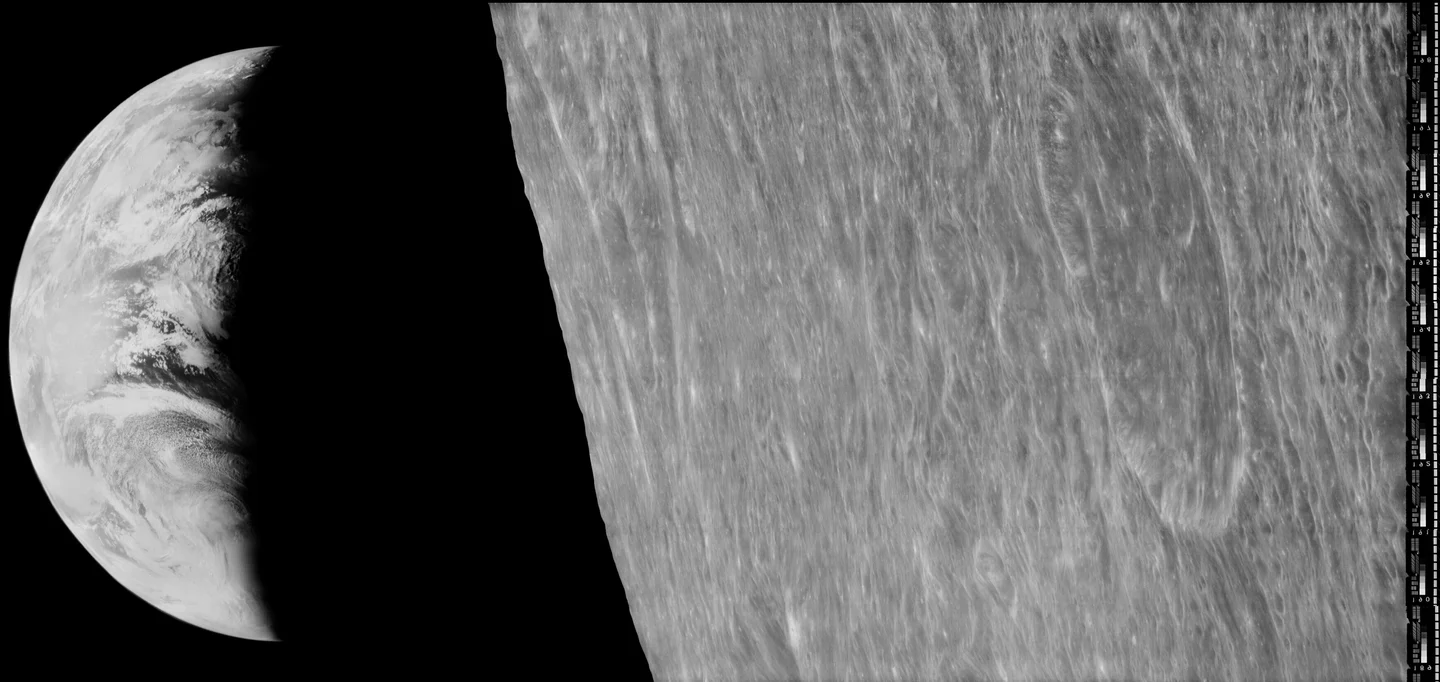
Image unavailable.
A narrow sunlit Earth appears at left beside the lunar landscape at right in a black-and-white Lunar Orbiter 1 image.
What happened during the Christmas Eve broadcast?#
During the ninth lunar orbit, the Apollo 8 crew made a television broadcast showing the lunar landscape and describing the view. Near its end, Anders, Lovell and Borman took turns reading the opening ten verses of Genesis. Borman closed with a Christmas greeting to people on Earth.
The broadcast brought the voices of a crew at the Moon into homes far below. Its impact depended partly on that immediacy: the speakers were working in lunar orbit while listeners knew their return was still ahead. It was a public encounter with the mission, distinct from the color photograph that would be processed after recovery.
NASA's later history describes an enormous international audience. Precise audience totals should be treated as estimates, rather than a count of every person who watched or listened. Nor does a large audience mean that everyone interpreted a religious reading or a national space achievement in the same way.
For the crew, the next critical task remained departure. The familiar radio message about Santa Claus came after the return-engine burn, when communication resumed on Christmas morning in Houston. It signaled that the spacecraft was on its way home. Keeping that message separate from the Christmas Eve reading helps preserve the actual sequence: broadcast, further orbital work, departure burn and then confirmation to the waiting ground team.
Why did someone tell Apollo 8 that it had “saved 1968”?#
NASA's historical account records a telegram to Borman from an unknown well-wisher: “Thank you Apollo 8. You saved 1968.” It was an expression of relief and gratitude, not a claim that a spaceflight had repaired the year's losses. Borman later recalled the message as especially memorable among the responses to the mission.
The United States had lived through the assassinations of Martin Luther King Jr. and Robert Kennedy, continuing war in Vietnam and bitter political conflict. In testimony collected by PBS, Walter Cronkite recalled the divisions surrounding the mission. Valerie Anders described the flight as a welcome example of what technology could accomplish beyond warfare.
Those recollections help explain the phrase without turning it into a universal verdict. They describe how particular people experienced a successful return at the end of a painful year. The mission did not end the war, remove political divisions or erase bereavement. It offered an event whose outcome people could follow and, when the crew returned, celebrate.
Earthrise became part of that memory because it placed the home planet in a startling setting. The photograph showed a world that looked small against space and visibly different from the bare foreground. Its emotional force was real, but claims about what it caused require more care. An image can become a shared symbol without producing the same response in every viewer.
How did Apollo 8 get home and survive reentry?#
The main engine's departure burn lasted about three minutes twenty-three seconds. After leaving lunar orbit, Apollo 8 coasted toward Earth, with a correction to refine the atmospheric entry path. The goal was not simply to hit the planet. It was to arrive within a suitable corridor, at an angle the capsule and its crew could survive.
Before entry, the command module separated from the service module. The compact crew capsule returned with its broad heat shield facing the oncoming flow. Atmospheric drag removed the enormous kinetic energy accumulated during the journey. Thermal protection, controlled attitude and the entry trajectory all contributed to keeping that process survivable.
NASA's return account describes aerodynamic lift changing the capsule's descent and a short radio blackout associated with the surrounding ionized gas. This blackout had a different cause from the Moon blocking the radio path. Only after the atmosphere had done most of the slowing did the parachute sequence take over. Parachutes were the final stage of deceleration, not the means of braking directly from lunar-return speed.
Apollo 8 splashed down on December 27, and the crew was recovered by the USS Yorktown operation. The service module and launch stages did not return with them. The small command module carried the astronauts, records and exposed film back to Earth. Recovery completed the engineering test and made the photographs available for the much longer public life that followed.
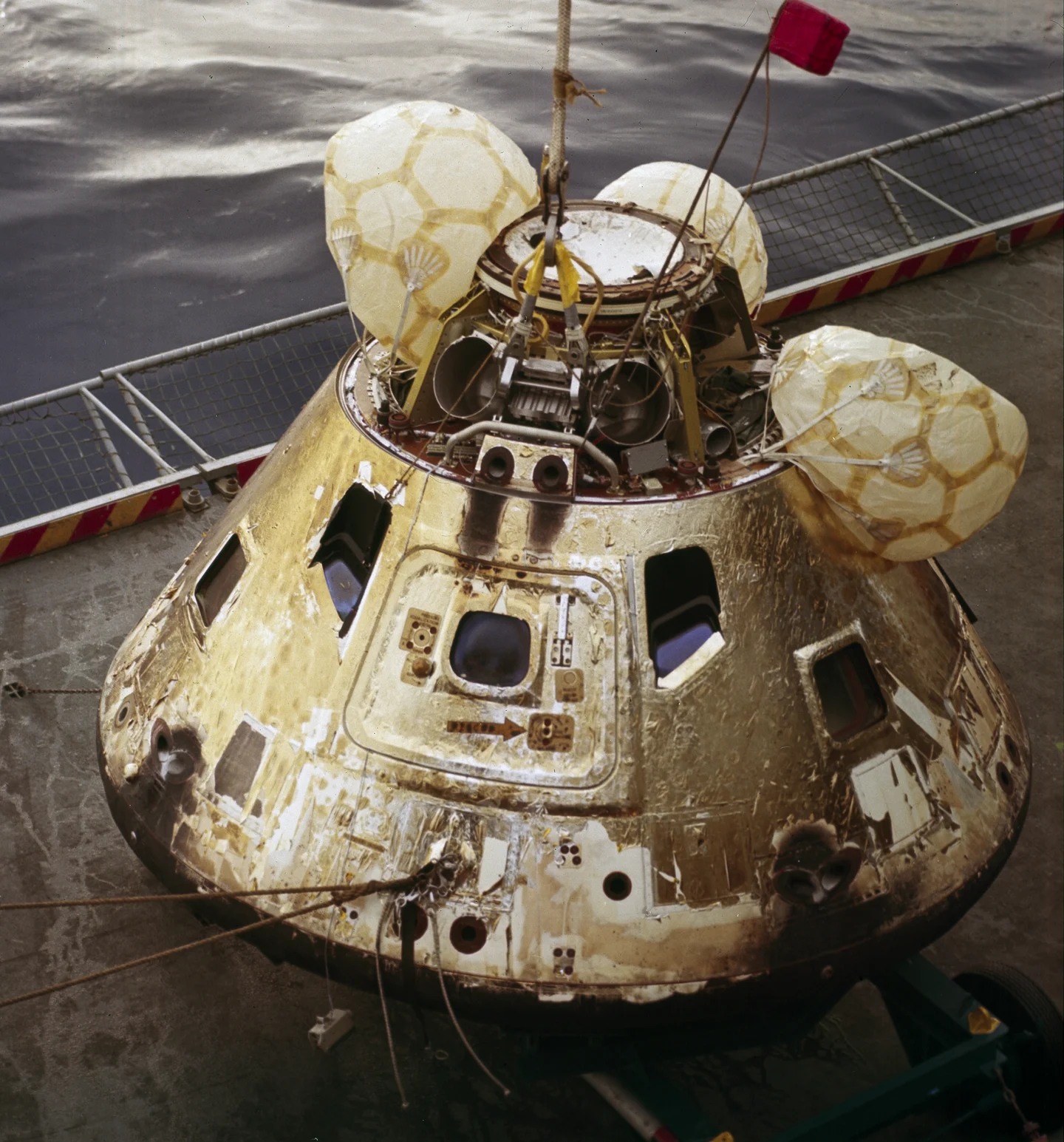
Image unavailable.
The returned Apollo 8 command module hangs from a lifting cable beside the recovery ship, with flotation bags still attached.
What did Apollo 8 leave for later missions—and for people on Earth?#
Apollo 8 demonstrated the crewed lunar journey, but the landing program still had to prove its missing pieces. Apollo 9 tested the lunar module with a crew in Earth orbit in March 1969, including rendezvous and docking. Apollo 10 rehearsed lunar-module operations near the Moon in May. Apollo 11 followed with the first landing in July.
The sequence shows why Apollo 8's limits were useful. By separating the lunar-orbit journey from the lander's tests, NASA gained experience sooner with some parts of the mission while continuing to test others. A successful flight did not make every later risk disappear. It answered a substantial set of questions that subsequent crews could build on.
Earthrise had a different afterlife. It became associated with environmental awareness and the idea of Earth as a shared, finite home. NASA's history describes its influence on that movement, but a single photograph cannot account for the full history of environmental science, organizing or policy. Its contribution was as an unusually powerful image through which people could express those concerns.
The photograph rewards a second look after the mechanics are understood. The horizon is lunar because the camera was at the Moon. Earth is rising because the observer was moving. The scene is visible because the spacecraft turned. The colors survived because a crew member changed film, made an exposure and brought it home. Each part of that explanation adds something to the view rather than taking its wonder away.
Keep exploring
Sources & further reading
Follow the original research, records, and explanations behind this story.
- Apollo 8 NASA
Mission identity, crew and chronology.
- Apollo 8: Mission Details NASA
Engine burns, lunar orbit and the observation program.
- 50 Years Ago: NASA HQ Considers Apollo 8 Options NASA
August planning, lunar-module delay and conditional approval.
- 50 Years Ago: NASA Announces Changes to Apollo 8 NASA
The August 19 announcement, crew roles and the planned Apollo 9 lander test.
- 50 Years Ago: Apollo 8 Rolls Out to the Pad NASA
Saturn V preparation and changes following Apollo 6.
- 50 Years Ago: Apollo 8, You are Go for TLI! NASA
Parking orbit, TLI, LTA-B ballast, coast, corrections and television.
- 50 Years Ago: Apollo 8 in Lunar Orbit NASA
Orbital operations and predicted signal-return scenarios; predicted times are not treated as exact measurements of silence.
- The Story Behind Apollo 8’s Famous Earthrise Photo NASA
NASA visualization transcript: fourth orbit, roll, crew positions, cameras and photographic sequence.
- Earthrise by NASA Astronaut Bill Anders NASA
Original color photograph AS08-14-2383 and attribution.
- Moon Facts NASA
Synchronous rotation, near and far sides, and illumination.
- If you are on the Moon, does the Earth move in the sky? NASA
Earth’s approximate position in the lunar sky and the effects of libration.
- Where are the stars? NASA
Why exposure for bright surfaces does not reveal faint background stars.
- How to Photograph the Moon NASA
Reflected sunlight and exposure tradeoffs; not exact metadata for the Anders frame.
- Earthrise Revisited NASA
2013 reconstruction from timed photographs and LRO terrain.
- Earthrise 1966 NASA
Lunar Orbiter 1 image and 2008 recovery from original tape data.
- Lunar Orbiter 1 NASA
1966 robotic mission and Earth photography before Apollo 8.
- Apollo 8: Christmas at the Moon NASA
Genesis broadcast, later departure message and mission sequence.
- Dec. 27, 1968: Apollo 8 Returns from the Moon NASA
Return, entry, recovery, unknown telegram sender and environmental legacy.
- The Event that Saved 1968 PBS American Experience
Participant recollections from Borman, Cronkite and Valerie Anders; individual testimony, not a universal response.
- Apollo 9: Mission Details NASA
Crewed lunar-module tests in Earth orbit, March 1969.
- Apollo 10 NASA
Lunar rehearsal in May 1969 before Apollo 11.
See the story in motion
Watch our illustrated video, then explore another question below.
Watch on YouTubeFollow the thread