
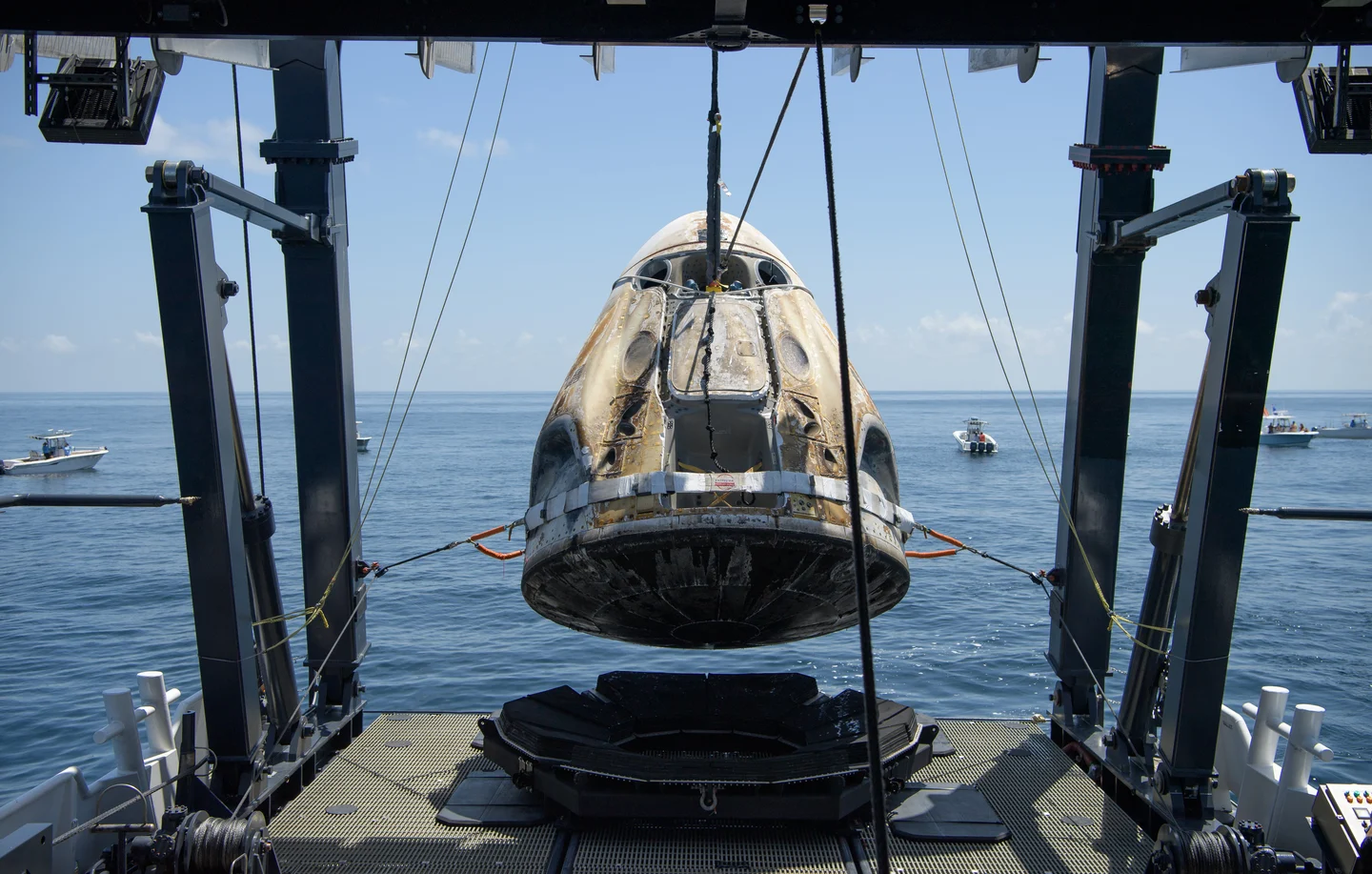
The Space Shuttle returned from orbit with wings, a tail and wheels. Crew Dragon comes back as a compact capsule under parachutes. Put the two images next to each other and the newer spacecraft can look like a retreat into the Apollo era. Why build an aircraft-shaped spaceship and then stop giving the next crew transport wings?
The answer begins with the job. Shuttle combined a crew cabin, a large payload bay, satellite servicing, substantial cargo return and a runway landing in one vehicle. A spacecraft taking astronauts to an already assembled space station faces a different set of requirements. Removing a capability can be a deliberate engineering choice when that capability no longer earns the mass, complexity and maintenance it requires.
But the familiar story also hides a false assumption: wingless does not mean unsteerable, expendable or primitive. Capsules can generate lift. Reusable vehicles can land at sea. Winged spacecraft still exist. To understand the change, we need to compare complete missions and return systems, not just silhouettes.
Did spacecraft really lose their wings?#
Only some spacecraft had them in the first place. Mercury, Gemini and Apollo used capsules. Soyuz continued using a capsule while the Shuttle was operating. NASA’s winged orbiters did not replace every other approach to returning from space, and their retirement did not eliminate winged return. The uncrewed X-37B provides a clear counterexample: it returns orbital experiments to a runway.
The narrower historical question is why NASA’s station-crew transportation after Shuttle adopted a smaller capsule architecture. Crew Dragon supplies a documented example: its first astronaut mission launched in May 2020, nine years after the Shuttle’s final flight. It carried people to the International Space Station without reproducing the orbiter’s enormous external shape or payload bay.
That is a change of mission architecture as well as vehicle design. Asking a capsule to do every job Shuttle once performed would make the capsule look incomplete, because it is incomplete by that definition. Asking whether it can carry a crew and critical cargo to the station, remain available for their return and recover them on Earth is a different comparison.
The shape is the result of those choices. It is not a reliable scoreboard of technical progress. A vehicle can have more capable computers, improved manufacturing and different safety provisions while retaining a broadly familiar outline.
What was the Space Shuttle designed to do that a crew capsule cannot?#
Shuttle was a working spacecraft as well as transportation. Its payload bay could carry large satellites, laboratory equipment and space-station hardware. Astronauts could work outside, use a robotic arm, deploy payloads and, on appropriate missions, bring large objects back. Hubble servicing is a particularly clear example: the astronauts’ workshop, tools, arm, living space and transport were brought together in one orbiter.
NASA’s technical description places the crew compartment in the forward fuselage, the payload bay in the middle and the main engines and maneuvering equipment aft. This layout explains much of the vehicle’s size before we even consider the wings. It was not a seven-person cabin with an unnecessarily large aerodynamic shell around it. The space behind the cabin supported missions that a compact crew ferry could not simply inherit.
During International Space Station assembly, that capability became important for delivering and installing major structures. Shuttle also carried supplies, experiments and replacement equipment, but cargo mass alone does not capture its role. The dimensions of a payload, how it is handled in orbit and whether it must come home can matter as much as its weight.
A capsule can carry valuable cargo without being a substitute for a payload bay. A returned biological sample, a replacement electronic unit and a large satellite are all “cargo,” yet they create very different design requirements. This is why comparing two spacecraft only by crew capacity can be misleading.
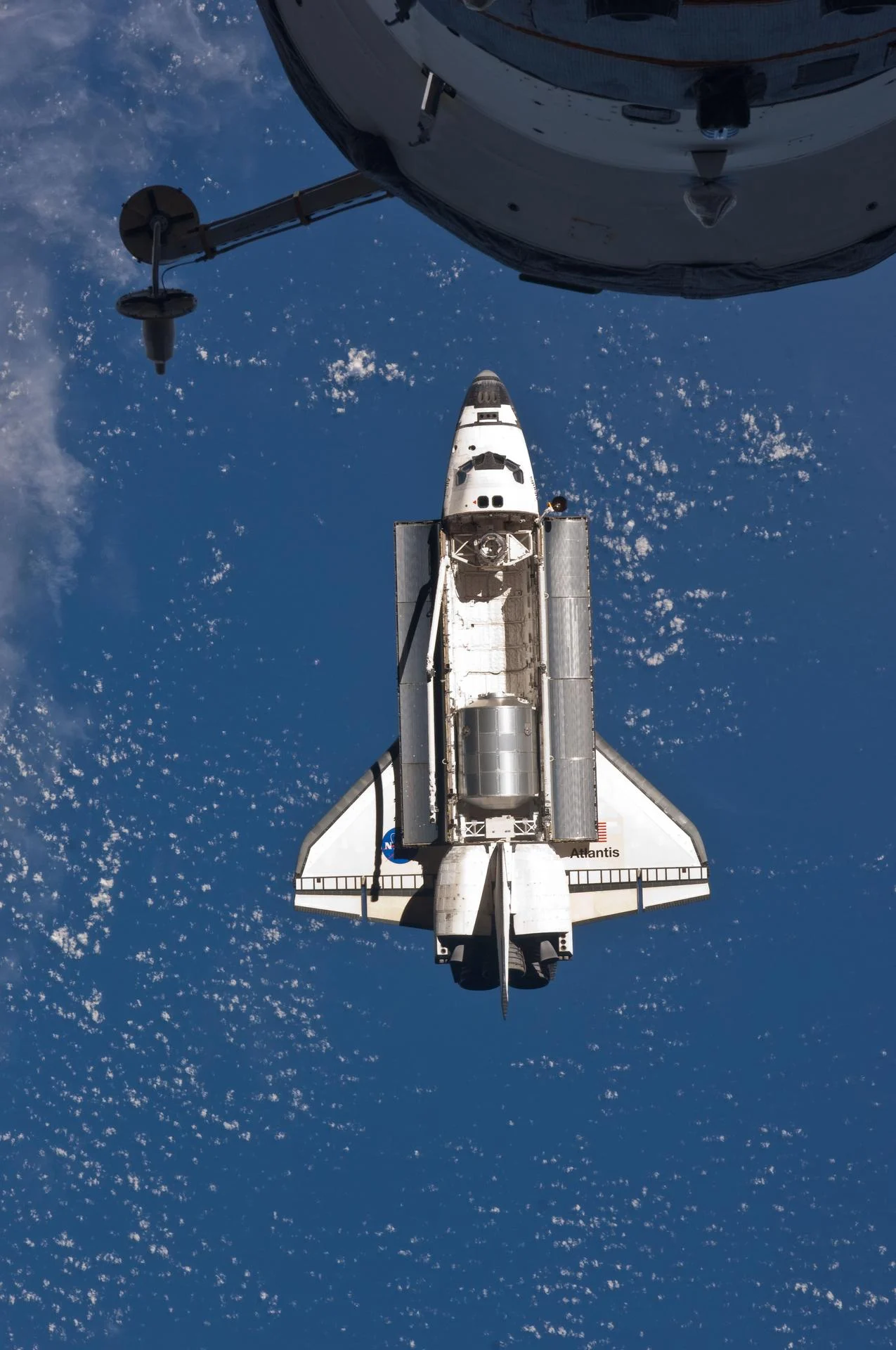
Image unavailable.
Atlantis approaches the space station with its payload bay open and its broad wings visible; part of a docked Progress vehicle fills the foreground.
What did the Shuttle’s wings actually do?#
They helped shape the atmospheric return and supported a runway landing. In orbit, there is too little air for an airplane’s ordinary aerodynamic controls to work. Shuttle used propulsion and reaction-control thrusters there. As it descended into denser air, aerodynamic forces became useful, and control surfaces increasingly supplied the means of steering.
NASA describes the orbiter’s double-delta wing and its elevons, which combined functions normally divided between elevators and ailerons. The tail carried a rudder that could also split to act as a speed brake. These were parts of a vehicle designed to remain controllable across an enormous range of speeds and atmospheric densities. The wings were not simply decorative reminders of an airplane.
Lift also allowed the returning orbiter to influence its flight path before reaching the immediate neighborhood of a runway. The relevant measure is not just whether the vehicle can turn, but how much path control it can obtain for the drag and other constraints it experiences. The same shape must survive high-speed heating and still produce a manageable landing approach later.
The last approach was unpowered. Shuttle’s main engines were not aircraft engines waiting to provide a go-around; the external tank that supplied their ascent propellants had already been discarded. Its final energy came from its remaining speed and altitude. The wings helped use that energy, but did not create more of it.
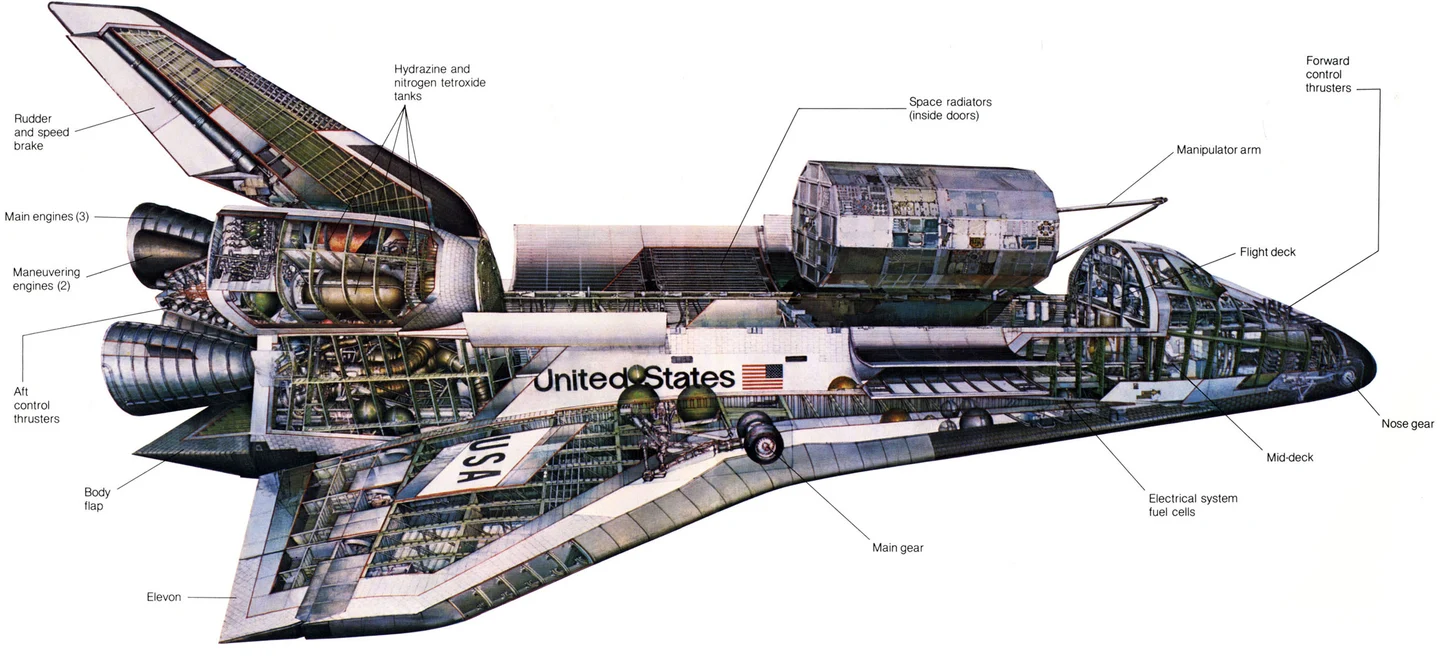
Image unavailable.
Cutaway of the Shuttle orbiter identifies the forward crew cabin, central payload bay, aft engines, landing gear and aerodynamic control surfaces.
Why are returning capsules blunt instead of sharp?#
A sharp shape seems like an obvious choice if the aim is to slip through air. Reentry changes the problem. The spacecraft must slow from extremely high speed without transferring too much heat into its structure. Minimizing resistance is not the only objective, and often is not the most useful starting point.
NASA Ames researchers helped establish the blunt-body approach. A broad leading surface produces a detached bow shock ahead of the vehicle. Air passing through that shock becomes very hot, but the flow geometry keeps much of the energy in the surrounding gas, which moves around the body. The capsule still needs a heat shield; the shock is not an invisible barrier that eliminates heating. The design changes the heat-transfer problem into one that protective materials can manage.
NASA’s history connects this research with the shapes selected for Mercury, Gemini and Apollo. That heritage helps explain why a modern capsule can resemble an older one. Physical requirements did not become obsolete when computing power increased. A useful aerodynamic shape can remain useful while the structure, avionics, manufacturing methods and operational requirements evolve.
The broad end must face the appropriate direction during high-speed entry. Returning heat-shield-first is an actively prepared condition, not something operators leave to chance. The vehicle must separate the hardware that is not returning, orient correctly and follow an entry path compatible with its protection and control capabilities.
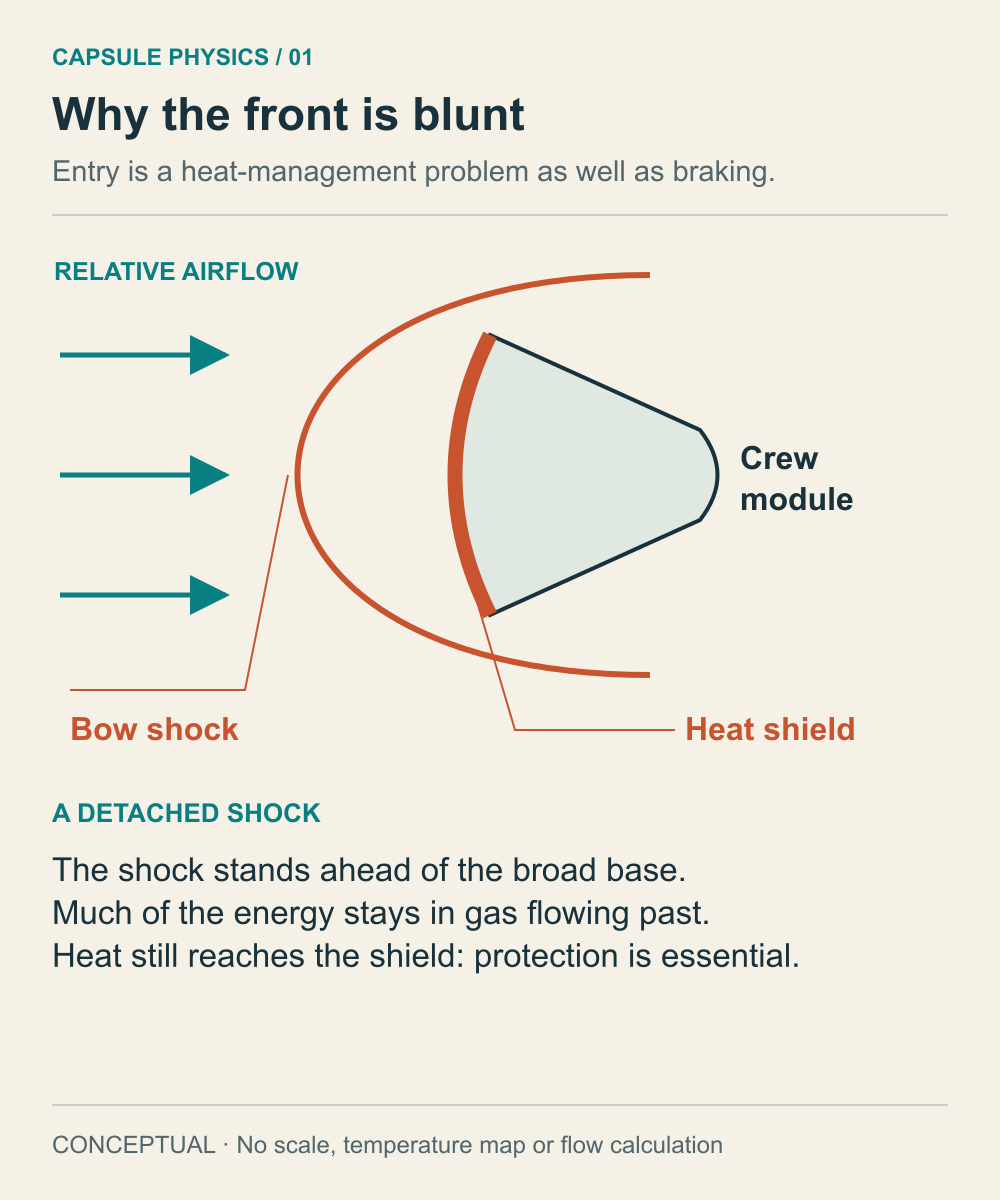
Image unavailable.
A broad heat-shielded capsule faces incoming airflow with a detached bow shock standing ahead of its base.
Sources: [3]
Can a capsule steer without wings?#
Yes. A capsule can generate aerodynamic lift when its shape and attitude produce a suitable pressure distribution. One technique is to place its center of gravity away from its axis of symmetry. In the airflow, the capsule then settles at a tilted, or trimmed, attitude rather than presenting an exactly symmetric face to the flow.
A NASA/Draper paper on Orion’s early design explains how that tilt creates lift and how changing the bank angle changes the direction of the lift vector. That gives guidance a way to influence descent and range. This is a physical explanation from a documented capsule study; the paper’s preliminary design targets should not be mistaken for the final specification of every later Orion mission or for Crew Dragon’s internal control design.
Lift does not mean the capsule has become a conventional glider. Its ratio of lift to drag and its possible maneuvers differ from those of a winged orbiter. It still needs a separate means of slowing for touchdown, such as parachutes. The useful distinction is between having some control over an entry trajectory and being capable of an airplane-style runway approach.
It also matters that steering and propulsion are different ideas. Thrusters can change a capsule’s orientation, and the resulting aerodynamic forces can change its path. The thrusters need not cancel the entire orbital velocity themselves. The atmosphere performs much of the braking while the spacecraft manages how it encounters it.
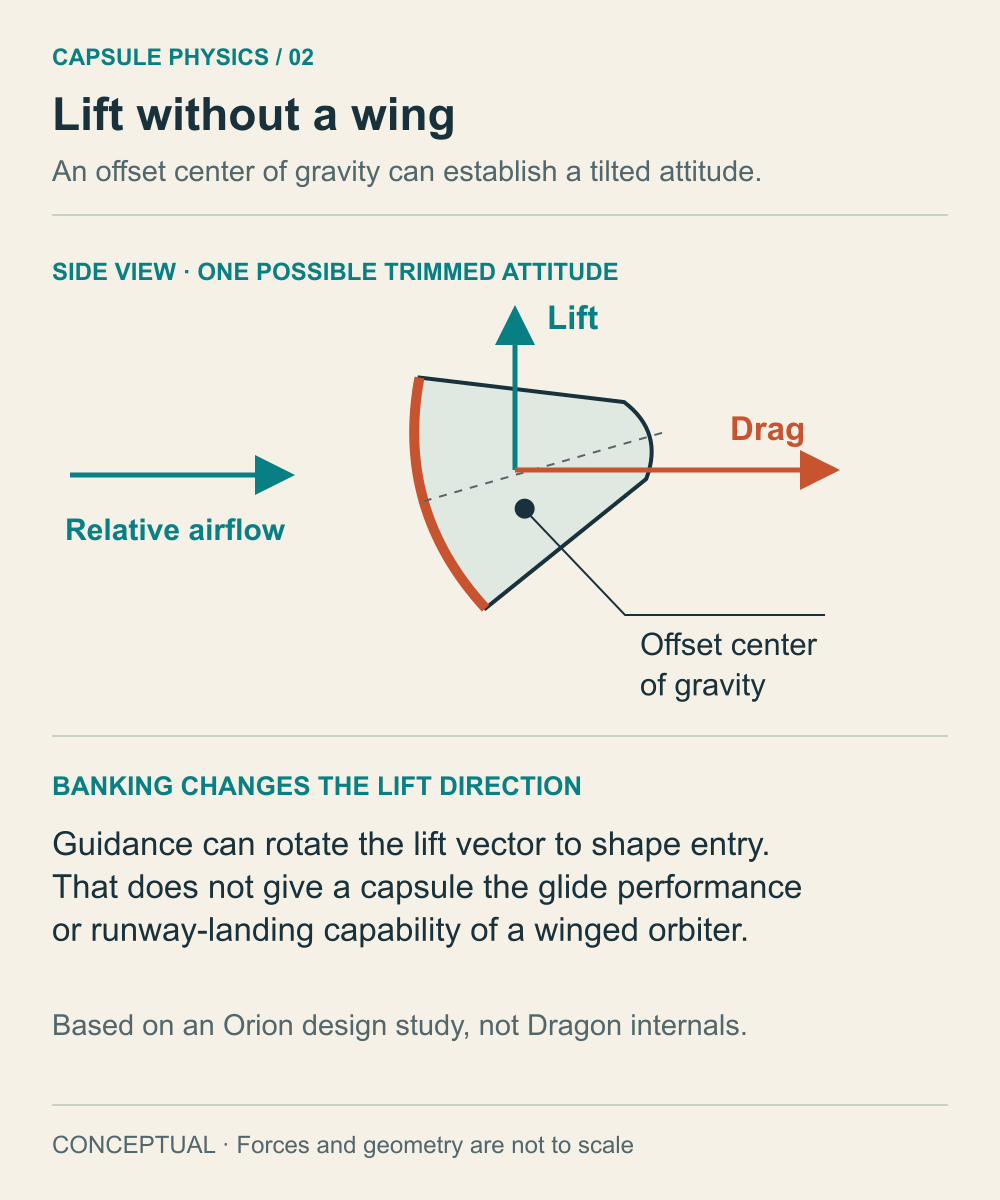
Image unavailable.
A tilted capsule with an offset center of gravity experiences lift perpendicular to the incoming airflow and drag along it.
Sources: [4]
How do capsule heat shields differ from Shuttle tiles?#
Thermal protection has to keep the load-bearing structure and cabin within acceptable temperatures while the exterior experiences a much harsher environment. Different regions of a vehicle face different conditions, so even a single spacecraft can use more than one protective material. “The heat shield” is a useful shorthand, but can conceal a complicated system.
Shuttle used heat-resistant tiles across much of its surface, with reinforced carbon-carbon components in particularly demanding locations such as wing leading edges. A photograph of the black tiled underside should not be used as though it showed the same material as the curved leading-edge panels. Both were thermal protection, but their construction, roles and inspection needs differed.
Ablative protection takes another approach. Some material is deliberately consumed or transformed as it handles heat. NASA describes Orion’s Avcoat blocks as an ablative system derived from Apollo heritage. The protection is designed around controlled material response, rather than an expectation that every exposed surface will emerge looking new. Orion also uses other protection on its backshell, so “capsules ablate, shuttles insulate” would still be too simple as a complete classification.
Reuse is therefore a question about the recovered vehicle and its preparation for another mission, not a promise that every heat-protection component survives indefinitely. Engineers must inspect the returning structure and determine which parts can fly again, need repair or must be replaced. The public image of a reusable spacecraft arriving intact hides that subsequent work.
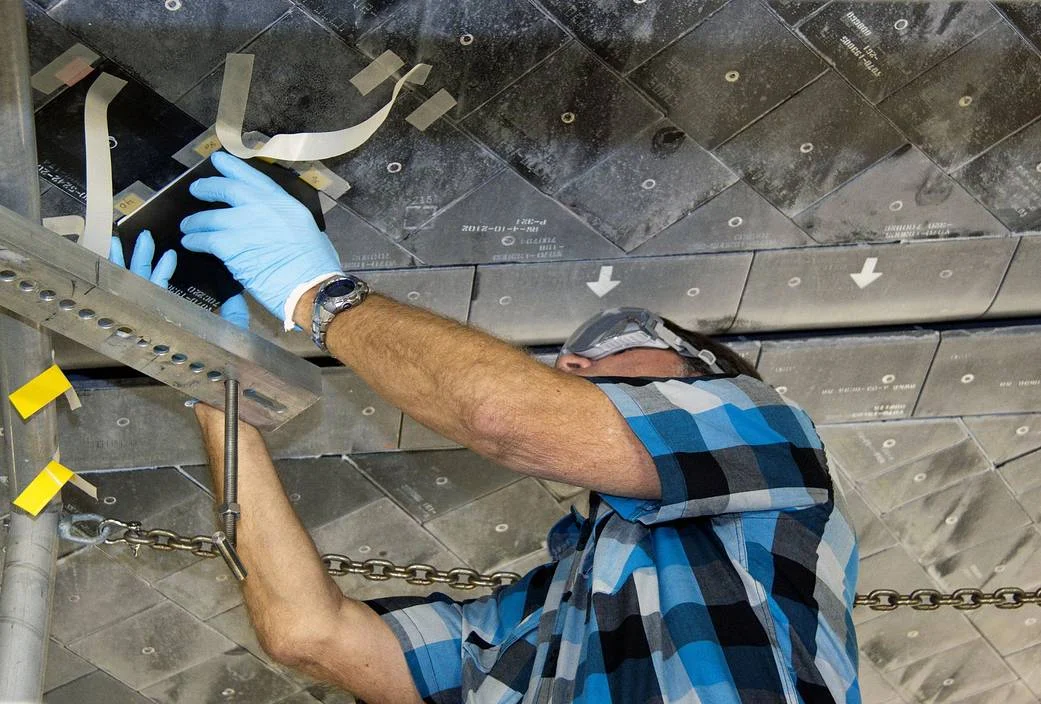
Image unavailable.
A technician reaches into an opening among the black thermal-protection tiles on Atlantis’s underside.
Why does carrying wings to orbit cost so much?#
Anything that returns with a spacecraft first has to be accelerated as part of the mission. Wings, landing gear, control surfaces and their supporting structure are useful equipment, but also mass that the launch system must carry. Thermal protection and mechanisms add further obligations. The issue is whether the mission benefits justify carrying and maintaining them.
This is a trade rather than a calculation that can be completed by weighing one detached wing. Removing wings changes the whole vehicle: its aerodynamic shape, landing system, internal arrangement, recovery method and possibly the payloads it can accommodate. A parachute system and ocean recovery operation also have mass, cost and failure modes. They do not appear for free when the wings disappear.
Mass also creates secondary effects. A heavier returning capsule may need different parachutes, landing-load provisions or escape performance. The Orion design-trades paper explicitly connects crew-module mass with several such requirements. That is why aerospace designers speak of coupled decisions: changing one part can alter what several other parts must do.
For Shuttle, the challenge extended into operations. A 2009 NASA-hosted assessment by Edgar Zapata and colleagues examined shortfalls in the program’s affordability goals through design, management and strategy together. Its lesson is broader than “wings are heavy.” A system designed for many demanding roles can impose a large continuing workload even when its individual technologies work as intended.
Did wings cause the Challenger and Columbia accidents?#
The two losses had different physical causes. Challenger was lost during launch on January 28, 1986, after a joint in its right solid rocket booster failed to seal properly. Cold conditions were central to the behavior of the O-ring seals. This was not a failure of aerodynamic wings during landing.
Columbia was lost during reentry on February 1, 2003. Insulating foam shed from the external tank during launch struck the left wing’s leading edge. The resulting damage allowed hot gas into the wing during the return. The launch event and the later entry failure belong to the same causal chain; moving the foam strike to the reentry scene would tell the story incorrectly.
All seven astronauts aboard each spacecraft died. The investigations addressed more than the immediate hardware faults. They identified serious weaknesses in how concerns, evidence and safety decisions were handled. The Columbia investigation also made recommendations about inspection, imagery, thermal-protection repair capability and independent technical authority.
These histories show why a vehicle cannot be judged only by the shape of its returning cabin. Shuttle’s side-mounted orbiter, tank, boosters, thermal protection and operating organization interacted. A capsule mounted above a launcher creates a different configuration, but does not remove every launch or entry hazard. Avoiding a known failure mechanism is valuable; demonstrating a safe overall system still requires testing, analysis and sound decisions throughout its life.
Why did NASA retire the Shuttle in 2011?#
Retirement was a policy and program decision shaped by safety, operating demands, national priorities and the future of human spaceflight. It was not an automatic engineering conclusion that wings should never fly again. The distinction matters because a one-cause explanation cannot account for the mission planning and transition that followed.
NASA’s historical account records the January 2004 Vision for Space Exploration, which called for ending Shuttle flights after completing the planned station-assembly work. Atlantis flew the final mission, STS-135, in July 2011. That last flight delivered equipment and supplies to the International Space Station rather than introducing a new airplane-shaped successor.
After retirement, NASA astronauts traveled to the station on Soyuz. Crew Dragon’s Demo-2 mission restored astronaut launches from American soil in 2020. This did not mean humans had stopped flying to space during the interval, or that cooperation using Soyuz ended as soon as Dragon began flying.
The transition separated several ambitions that Shuttle had combined. Station transportation, commercial cargo services and deep-space exploration did not all require the same vehicle. Once those requirements were assigned to different systems, reproducing the orbiter’s entire capability set on every crew trip became less compelling. That is an interpretation of the documented change in mission roles, not a claim that one design feature alone caused the retirement.
How does a capsule help with launch escape?#
A relatively compact crew compartment can be designed to separate rapidly from a failing launch vehicle. Crew Dragon has an integrated launch-escape system powered by eight SuperDraco thrusters. NASA and SpaceX demonstrated an in-flight abort with an uncrewed capsule in January 2020, before its first astronaut launch.
The purpose of those engines is easy to confuse with the landing method. In the escape sequence they move the capsule away from the rocket; parachutes subsequently support the water landing. Their presence does not mean the ordinary station-return flight ends with a propulsive touchdown, or that the same system protects against every kind of problem during the entire mission.
Escape also requires a complete recovery plan. The capsule needs a survivable path after separation, suitable conditions where it may land and people able to reach the crew. NASA’s current description of launch operations discusses downrange weather, possible abort locations and coordination among several agencies. Moving away from the launcher is an essential event, but not the end of the safety problem.
The broader design advantage is the possibility of isolating a smaller returning crew vehicle from other hardware. It remains a specific, tested capability with operating limits. A rounded cabin does not become safe merely because an escape engine is attached to it; the entire sequence has to work under the conditions for which it is intended.
Why do parachutes open only near the end of reentry?#
Parachutes are the final braking system, not the primary means of shedding orbital speed. Deploying a large fabric canopy into the high-speed entry flow would expose it to conditions very different from those it is designed to survive. The vehicle first uses atmospheric drag while protected by its heat shield. Only after sufficient deceleration can its parachute sequence begin.
The steps have different purposes. Smaller stabilizing parachutes help establish the conditions for the main parachutes. The main canopies then slow the descending capsule for touchdown. Deployment order, speed, loading and separation of covers or other hardware are part of a carefully designed sequence; “it falls under parachutes” omits most of the return.
The astronauts’ deceleration is also spread across the flight rather than concentrated at splashdown. The entry trajectory influences how aerodynamic loads build and how long they last. A longer, gentler-looking path is not automatically the best answer, because heating, range, vehicle control and crew loads have to be considered together.
The right comparison with Shuttle is therefore not wings versus fabric in isolation. Shuttle used its aerodynamic shape to make a runway arrival; a capsule uses its shape and guidance for high-speed entry, then a different system for the final descent. Both architectures must connect the end of one phase to a condition the next phase can safely accept.
Is an ocean splashdown easier than landing on a runway?#
It removes the need for the returning capsule to fly an unpowered aircraft approach, deploy wheels and roll to a stop on a particular strip of pavement. But it adds a marine operation. A spacecraft floating intact is not yet the same as a crew safely out of the vehicle and receiving assistance.
NASA’s description of Dragon recovery includes selecting suitable primary and alternate locations, reviewing weather and waves, clearing the area of other traffic, and placing recovery personnel nearby. Teams approach the capsule, check for hazards including propellant vapors, secure it and bring it aboard a recovery vessel. These are mission requirements, not optional conveniences after the exciting part is over.
Historical photographs can also mislead if their geography is treated as permanent. The images in this article show Demo-2 recovery in the Gulf of Mexico in August 2020. They document that mission. NASA’s later operational guidance describes California-coast recovery sites, so an old Florida map should not be presented as the enduring rule for every Dragon return.
Runway recovery has its own infrastructure and weather constraints. The decision between sea and runway depends on the vehicle, payload, crew needs, available sites and recovery organization. One approach can be preferable for a given mission without making the other a mistake. The landing surface is part of the spacecraft system even though it is not carried into orbit.
Can a capsule be reusable if its heat shield is damaged or replaced?#
Yes. Reusability can apply to a substantial recovered assembly even when some components require replacement. The meaningful questions are which hardware flies again, what inspection or refurbishment is needed, how much labor that requires and whether the resulting operation meets its goals.
NASA’s account of Crew-2 in April 2021 provides a concrete example: the mission used a previously flown Crew Dragon spacecraft and a previously flown Falcon 9 first stage. These were two separate recovered vehicles with different jobs and return methods. The capsule came back under parachutes. The rocket first stage used its engines for landing. Showing a booster touchdown as if it explained capsule recovery mixes two distinct engineering solutions.
Nor did this make the entire launch system reusable. Identifying a reused first stage does not establish that its upper stage was recovered. A useful discussion must name the component instead of applying a single yes-or-no label to everything launched together.
Shuttle likewise combined recovered and discarded hardware. The orbiter returned, while the external tank did not. Different degrees of reuse can make sense in different architectures. The economic question is whether the reuse saves useful work and resources after accounting for recovery and preparation; appearance at touchdown alone cannot answer it. That is one reason a small returned capsule should not be dismissed as a disposable relic of the 1960s.
Who carries cargo when the crew spacecraft has no large payload bay?#
Dedicated cargo spacecraft carry supplies and experiments to the station alongside crew-transport services. NASA’s Commercial Resupply Services program documents the roles of Dragon cargo missions and Cygnus. Crew Dragon also carries critical cargo, so separating mission roles does not mean astronauts travel in an otherwise empty ship or that every item of equipment must be launched separately.
Uncrewed resupply was not invented after Shuttle retired. NASA’s history of Progress traces the first such Soviet station-resupply mission to 1978. What changed in the American station-transportation program was the particular combination of providers, vehicles and responsibilities, not the discovery that a supply ship could fly without passengers.
Different cargo systems also provide different return capabilities. Delivering food or a replacement component is not the same problem as bringing a temperature-sensitive experiment back to a laboratory. A mission plan has to match the cargo to the vehicle and its recovery method. The word “resupply” should not make these differences disappear.
This division of work helps explain why a crew capsule need not carry a Shuttle-sized bay on every flight. It does not prove that all former Shuttle capabilities have been replaced one for one. Large satellite retrieval and a crewed servicing workshop are much more demanding requirements than transporting a crew and several bags of supplies. An architecture can satisfy current transportation needs while leaving particular historical capabilities unavailable.
Why use a capsule for returning from the Moon?#
Returning from the Moon presents a different energy problem from returning from low Earth orbit. NASA describes Orion’s lunar-return entry speed as about 25,000 miles per hour, roughly 11 kilometres per second. An illustrative low-orbit speed is about 7.8 kilometres per second. Since kinetic energy scales with the square of speed, those example values imply about twice as much kinetic energy per kilogram for the faster arrival.
That ratio is an energy comparison, not a prediction that every surface will reach twice the temperature. Heating depends on the trajectory, atmosphere, geometry and material response. Engineers must consider both how rapidly heat arrives and the total heat exposure, alongside structural loads and the desired landing region.
A compact blunt capsule offers a way to organize that problem around a broad protective base and a controlled entry. NASA’s Orion description includes an ablative heat shield, a protected backshell, attitude-control propulsion and parachutes. These systems support the mission together; the familiar Apollo-like outline does not mean every detail is inherited unchanged.
Carrying the entire Shuttle orbiter on a lunar mission would also mean taking hardware designed for a very different job far beyond its normal operating environment. A returning crew module can leave other mission hardware behind. The engineering argument is about how much must travel, what must return and how it survives the return, rather than about choosing whichever vehicle looks most futuristic.
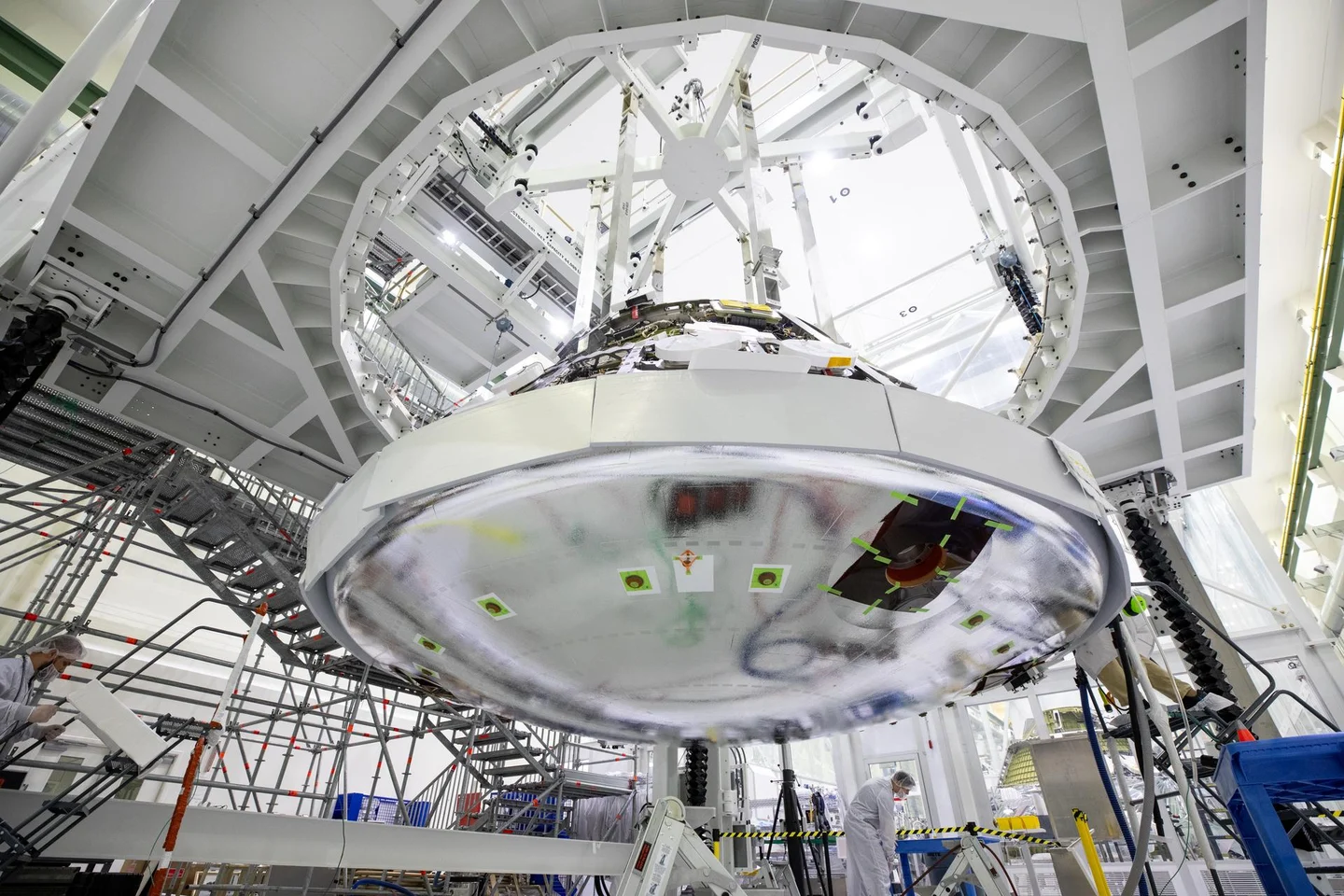
Image unavailable.
Orion’s broad circular heat shield is seen from below during installation in a high assembly fixture.
Can a wingless vehicle still land like an aircraft?#
NASA’s lifting-body experiments showed that it can. These vehicles generated lift primarily from their body shapes rather than conventional wings. They still had fins and control surfaces; “wingless” did not mean featureless, and it did not mean the pilot had no influence over the flight.
The research program included the M2-F1, M2-F2, M2-F3, HL-10, X-24A and X-24B. The lightweight M2-F1 was first tested using ground tows before progressing to releases from a tow aircraft. Later vehicles explored more demanding flight conditions. These were atmospheric research aircraft intended to develop knowledge relevant to space return, not a fleet of orbital spaceships repeatedly arriving from space.
Their odd shapes are a useful antidote to a common assumption: that a runway landing must require the outline of a conventional airliner. Lift is generated by the interaction between shape, attitude and flow. A broad lifting body, a capsule at a trimmed angle and a large winged orbiter can all produce lift while offering very different performance and landing options.
The photographs also place the Shuttle in a longer history of experimentation. Its design did not appear fully formed when a rocket program decided to add airplane wings. Wind-tunnel work, aerodynamic theory and actual flight research helped establish which configurations could be controlled and landed. The final shape was one answer within that larger field of possibilities.
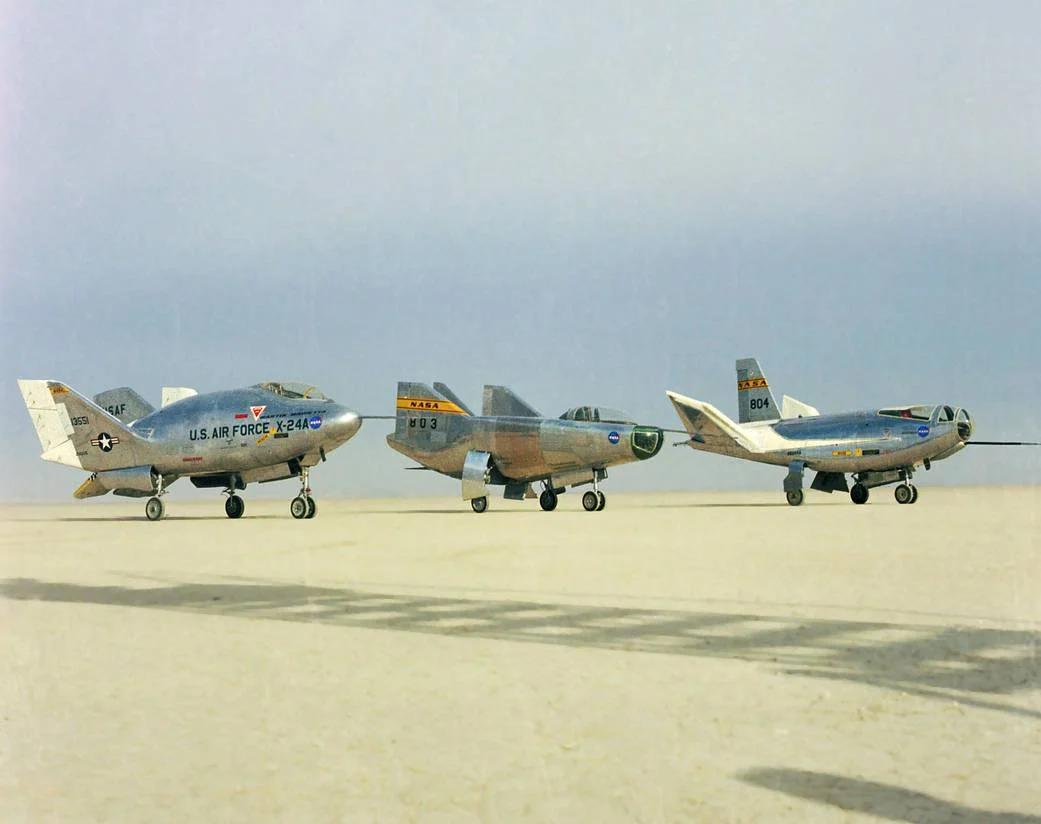
Image unavailable.
Three compact research aircraft stand side by side on a dry lakebed, with broad bodies, fins and wheels but no conventional large wings.
Sources: [18]
How should we compare future spacecraft designs?#
Start with a mission, then ask what each design makes possible and what it costs to provide. A station crew ferry, a satellite-servicing workshop, a lunar-return capsule and an uncrewed experiment carrier are solving related but different problems. The shared need to survive reentry does not make their best overall configurations identical.
Useful comparisons include the size and condition of the payload returned, available landing sites, crew escape options, thermal-protection demands, preparation between flights and the resources required on the ground. A design that simplifies one part of the mission may move work elsewhere. Ocean recovery moves work to ships and marine teams; runway recovery requires aerodynamic capability and suitable landing infrastructure.
The main lesson of the Shuttle-to-capsule transition is therefore a practical one. A modern crew transport can omit wings because its mission can be accomplished without carrying the entire collection of capabilities that justified Shuttle’s architecture. Reuse, controlled entry and sophisticated flight software can remain.
And where a mission still benefits from winged recovery, the option remains. X-37B demonstrates that the runway-return idea did not disappear with Shuttle. The better question is not which shape won, but which requirements each vehicle was built to satisfy. That question makes both the large winged orbiter and the compact capsule easier to understand.
Keep exploring
Sources & further reading
Follow the original research, records, and explanations behind this story.
- The Space Shuttle NASA
Orbiter anatomy, mission roles and aerodynamic surfaces; historical technical material, not a current fleet-status source.
- The Aeronautics of the Space Shuttle NASA
Atmospheric flight, control and the unpowered approach.
- Ames Contributions to Apollo NASA
Blunt-body research, detached shocks and Apollo thermal-protection heritage.
- Orion Flight Performance Design Trades NASA
Mark C. Jackson and Timothy W. Straube, 2010. Preliminary design study; capsule trim, lift, bank control and coupled mass trades. Not final mission specifications.
- Orion Crew Module NASA
Heat shield, backshell, propulsion, parachutes and illustrative lunar-return speed.
- Shuttle Tile Installation NASA
Photograph and description of thermal-protection work on Atlantis in February 2011.
- An Assessment of the Space Shuttle’s Costs, Operations, and Shortfalls Through the Perspective of Three Different Programs NASA
Zapata and colleagues, 2009. Repository abstract consulted for its design, management and strategy framing; no cost-per-launch figure inferred.
- Challenger NASA
NASA safety account of the booster-joint failure and organizational lessons.
- Columbia Accident Investigation Board Synopsis NASA
Foam strike, wing damage, entry failure and investigation recommendations.
- 20 Years Ago: Remembering Columbia and Her Crew NASA
Retirement policy and the subsequent Soyuz/Commercial Crew transition.
- 10 Years Ago: STS-135, the Space Shuttle’s Grand Finale NASA
July 2011 final mission and its station-support role.
- Commercial Crew Spacecraft NASA
Crew Dragon’s mission and integrated launch-escape system.
- NASA’s SpaceX Crew Launch and Return Operations NASA
Launch escape, weather and later California-coast recovery operations.
- NASA’s SpaceX Crew Rescue and Recovery NASA
2021 operational account and 2020 recovery photograph. Historical Florida geography is not treated as current.
- NASA’s SpaceX Crew-2 Astronauts Headed to International Space Station NASA
2021 reuse of the Crew Dragon capsule and Falcon 9 first stage.
- Commercial Resupply Services Overview NASA
Separate station cargo services and their role.
- 45 Years Ago: Progress 1 Begins the Era of Space Station Resupply NASA
The first Progress resupply mission in January 1978.
- Lifting Bodies NASA
Wingless research aircraft, program history and archive photograph.
- X-37B Orbital Test Vehicle concludes sixth successful mission U.S. Space Force
A documented example of winged orbital return continuing after Shuttle.
See the story in motion
Watch our illustrated video, then explore another question below.
Watch on YouTubeFollow the thread