
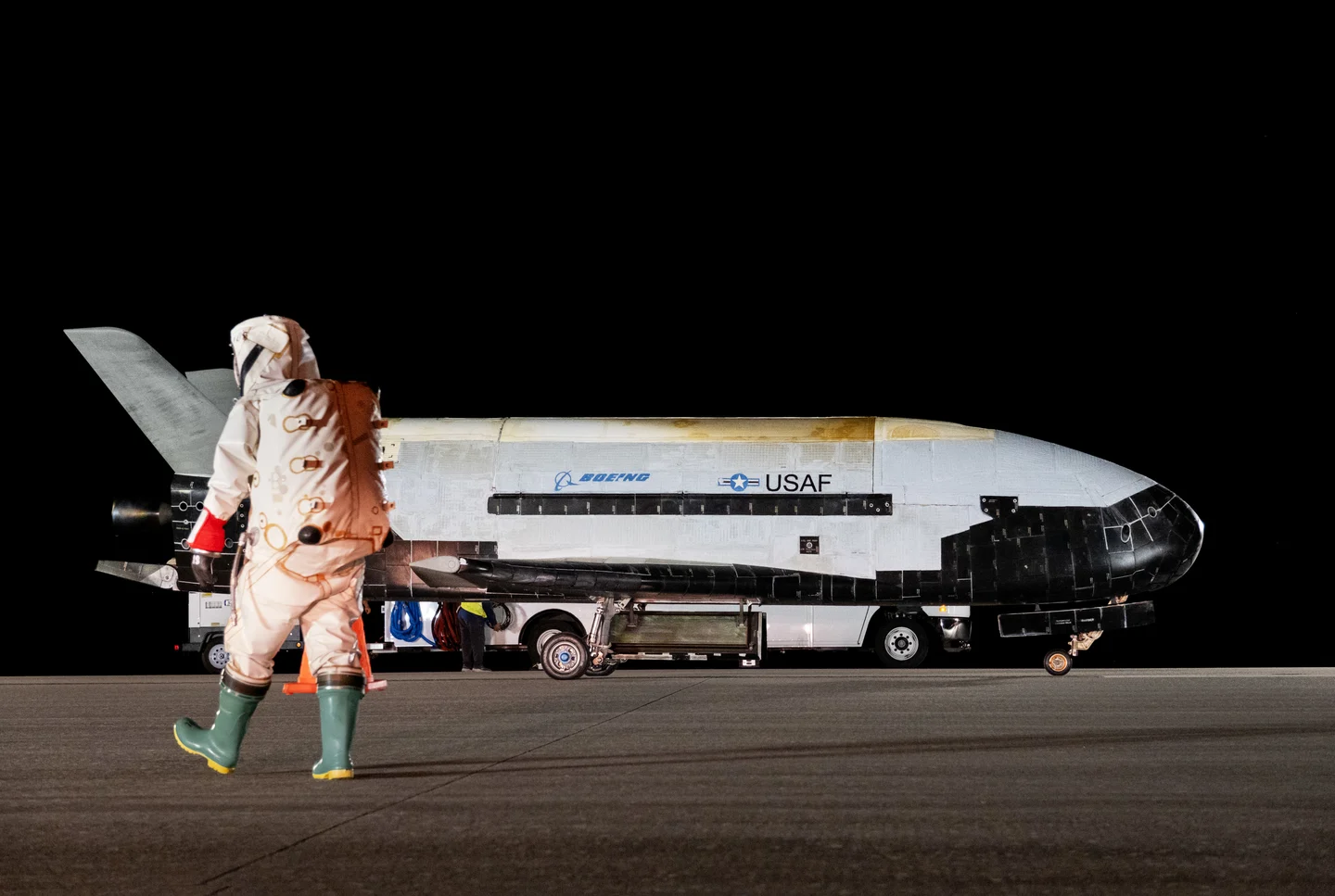
The runway arrival looks familiar: a winged vehicle descends, levels out and touches down. But nobody is sitting behind its windows. For the X-37B, the journey to that runway may have begun years earlier. For the Soviet Buran orbiter, the only spaceflight ended with an automatic landing in 1988, long before today’s language models and self-driving-car demonstrations.
Both machines had to solve a problem that an ordinary aircraft rarely faces. They approached Earth with orbital energy, passed through an atmosphere that changed enormously with altitude, and finished as gliders with no engine-powered second attempt. Their computers needed to connect all those conditions to one small, fixed destination.
The interesting question is not whether a computer can move a control surface. It is how engineers turn a return from space into something a machine can measure, predict and correct. That leads through orbital mechanics, navigation, thermal protection, flight testing and the meaning of autonomy itself.
What did X-37B and Buran actually achieve?#
X-37B is an uncrewed orbital test vehicle that launches on a rocket and returns to a runway. On November 12, 2022, its sixth mission ended at NASA’s Kennedy Space Center after 908 days in orbit. That duration belongs to this particular flight; it is not the definition of the vehicle or a claim about its latest mission. The long stay illustrates why automatic recovery matters: an experimental spacecraft can return physical equipment after years in the space environment without carrying people throughout the experiment.
Buran’s achievement came on November 15, 1988. The Soviet orbiter flew two Earth orbits and landed automatically. The program was intended to include crewed operations, but this first orbital flight carried no crew. It was also the program’s only orbital mission. The Gagarin Cosmonaut Training Center’s history describes a substantial preparation program for future crews, followed by the termination of the program in 1993.
These were different programs with different purposes, sizes, political settings and lifetimes. Their common engineering challenge was the transition from space vehicle to atmospheric aircraft to runway arrival. Comparing that challenge is useful; treating one as a miniature copy of the other obscures it. Public information about Buran’s landing design is also much more detailed than the public description of X-37B’s present flight software. Where the evidence concerns Buran, it should stay attached to Buran.
Does “autonomous” mean nobody on the ground is involved?#
No. Autonomy describes which decisions and actions a system can perform without continuous outside direction. A ground team can choose a return opportunity, check conditions and send an initiating command while onboard systems execute the subsequent flight. That is different from a remote pilot continuously steering through a camera feed. It is also different from a spacecraft deciding its entire mission without people.
The U.S. Air Force’s account of the first X-37B orbital landing in December 2010 makes the distinction unusually clear. Controllers issued the return command. The spacecraft prepared for reentry and performed its descent and landing automatically. According to that account, operators could not take over and fly the landing remotely; range-safety provisions were a separate matter. This describes that mission’s documented operation, not a complete specification of every later X-37B flight.
Think of the division of responsibility in layers. People authorize an operation and define acceptable conditions. Flight software estimates the vehicle’s state, follows guidance and sends commands to its actuators. Safety systems deal with unacceptable deviations. None of those layers removes the need for the others.
This helps explain a misleading image: the solitary machine returning from space. The cockpit may be empty, but the flight rests on years of human design, maintenance, testing and operational planning. A successful automatic landing is the visible endpoint of that distributed work.
Sources: [1]
Why must a spacecraft lose so much energy before landing?#
A spacecraft in low Earth orbit is not hovering above the atmosphere. It is moving sideways fast enough to keep falling around the planet. Returning therefore requires much more than pointing the nose toward a runway. The vehicle must change its orbit and dispose of an enormous amount of energy while keeping its structure and contents within survivable conditions.
The useful relationship is kinetic energy per unit mass: one-half of speed squared. At an illustrative orbital speed of 7.8 kilometres per second, this is about 30 megajoules per kilogram. At 100 metres per second, it is only 5 kilojoules per kilogram. Those figures are a teaching comparison, not a measured X-37B or Buran landing profile. They show why the high-speed part dominates the energy problem: doubling speed multiplies kinetic energy by four.
A deorbit burn does not cancel all that sideways motion. It changes the orbit so that the vehicle reaches denser atmosphere. Aerodynamic forces then remove much of the remaining orbital energy. The surrounding gas is compressed, heated and disturbed; some heat enters the vehicle, whose thermal protection must limit the damage. Calling this only “rubbing against air” misses the importance of the high-speed flow and shock system around the spacecraft.
The landing computer is therefore managing a path through several constraints at once. It cannot simply choose the shortest line to the runway. A path that solves the geographic problem might violate heating, acceleration or aerodynamic limits along the way.
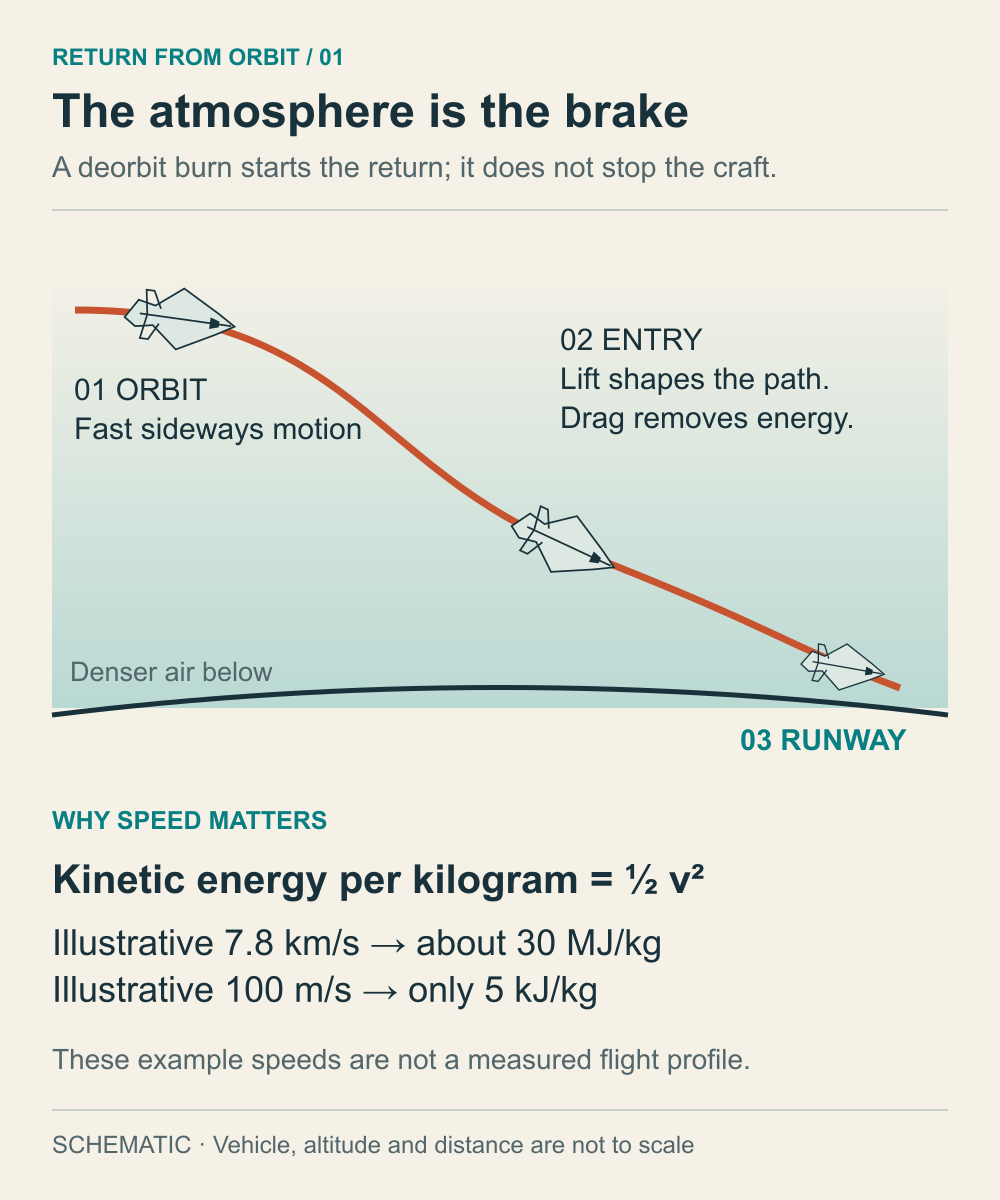
Image unavailable.
A conceptual return path connects orbit, atmospheric entry and a runway. Example energy values contrast orbital speed with a much lower atmospheric speed.
How can wings help in space if there is no air?#
Wings do not provide ordinary aerodynamic lift in the vacuum of orbit. Their value appears during atmospheric return. Once the surrounding air becomes dense enough, a suitable vehicle shape can generate lift and drag. Lift changes the flight path; drag removes energy. The available aerodynamic forces grow and change as speed, density and attitude change.
“Lift” does not mean an object is necessarily climbing. It is a force approximately perpendicular to the relative airflow. A descending glider can produce substantial lift while losing altitude. Nor does a spacecraft need a conventional large wing to produce any lift at all. NASA’s lifting-body program explored vehicles whose body shape supplied useful aerodynamic lift. That distinction matters when comparing winged orbiters with returning capsules: the choices form a range of possible designs, rather than a simple division between steering and falling.
For a runway-landing spacecraft, aerodynamic capability buys control over where and how it arrives. It also brings costs: structure, surface area, thermal protection, landing gear and the need to reach a suitable runway. Those costs must earn their place in the mission. Recovering delicate experiments on a runway may justify a different design from returning a small crew capsule to an ocean recovery area.
During the transition into the atmosphere, the relative usefulness of reaction-control thrusters and aerodynamic controls changes. A description of “the autopilot” can hide that transition. The guidance objective remains continuous, but the physical tools available to achieve it are not constant throughout the descent.
What is the difference between navigation, guidance and control?#
Navigation estimates the present state. Guidance chooses the path or desired motion. Control makes the vehicle follow that choice by commanding physical hardware. These functions interact continuously, but separating them makes the problem much easier to understand.
Imagine a glider approaching too high and slightly to one side of its intended path. Navigation identifies the position, speed and attitude. Guidance determines how to spend the excess energy and correct the lateral error without breaking constraints. Control moves the available aerodynamic surfaces to obtain the requested response. New sensor measurements then reveal what actually happened, and the process repeats.
The distinction also explains why a correct control movement can still belong to a bad overall decision. A vehicle might faithfully execute a guidance command based on an incorrect navigation estimate. Alternatively, its position estimate might be accurate while a failed actuator prevents the requested maneuver. Reliable flight requires attention to the connections among these functions, not just accuracy within one isolated component.
Buran’s participant accounts describe guidance phases and feedback mechanisms suited to different parts of return. A 2026 Keldysh Institute paper by B. I. Zhukov and A. S. Samotokhin discusses the development and verification of its algorithms. These accounts show organized engineering around a difficult but bounded physical task. They do not require a computer with general human judgment, and they do not imply that the software could improvise safely outside every condition its designers anticipated.
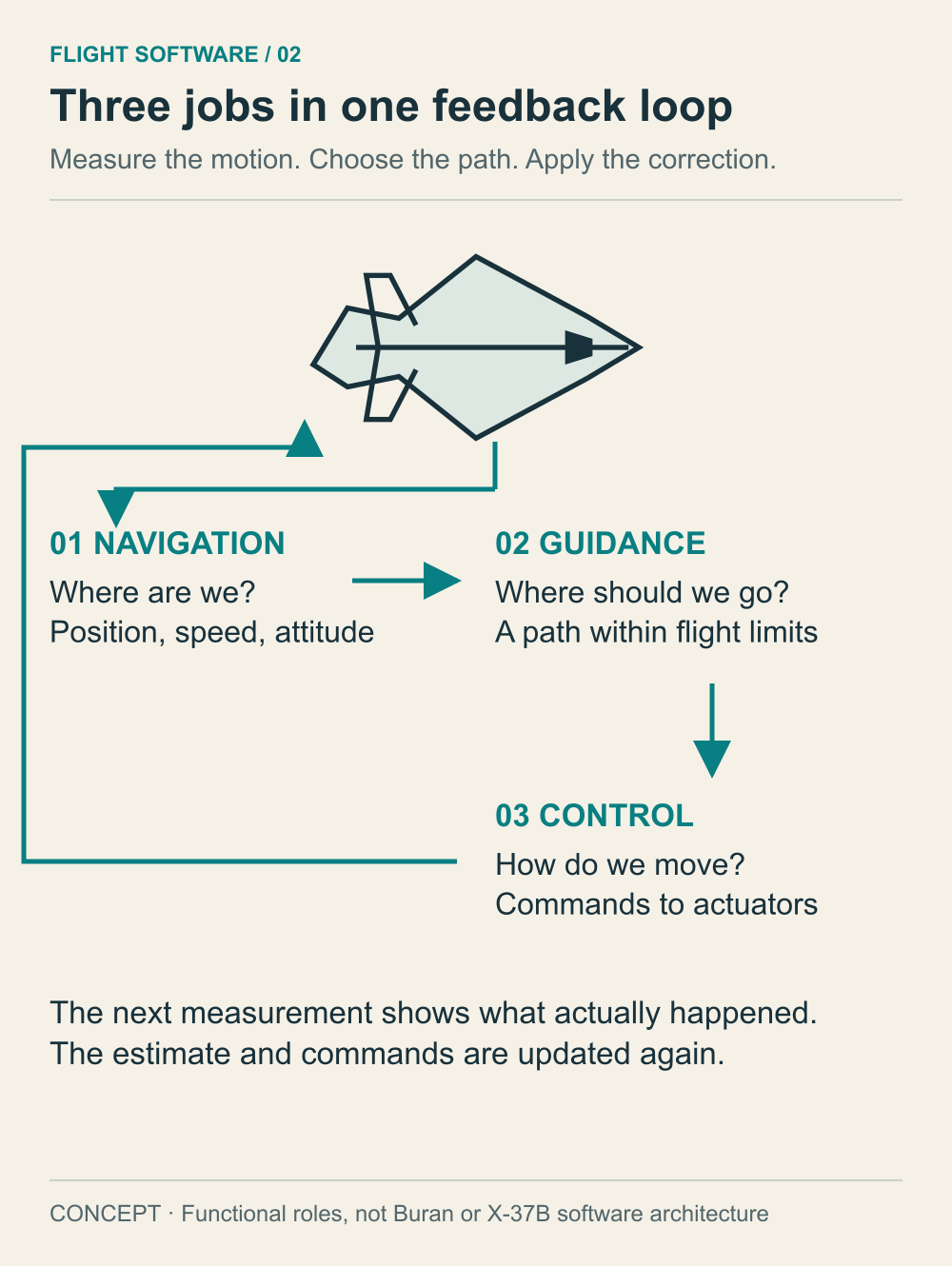
Image unavailable.
A feedback loop connects a generic spacecraft to navigation, guidance and control, then returns control commands to the vehicle.
How does banking help a spacecraft reach the runway?#
Banking rotates the direction of aerodynamic lift. In a simple wings-level picture, much of that lift acts upward relative to the local horizon. When the vehicle rolls into a bank, the lift vector tilts. The change affects both its vertical contribution and the sideways turning effect. Guidance can use this to shape the descent and the track across the ground.
This is particularly valuable during high-speed return, when energy removal and geographic targeting are inseparable. The vehicle is not merely turning as a car turns. It is arranging how long it spends in different atmospheric conditions, how its altitude changes and where its ground track leads. The solution has to respect thermal, load and pressure limits as well as the eventual landing location.
The Buran guidance account by V. P. Kirpishchikov describes bank control during descent and a later approach strategy that selected among candidate paths according to the vehicle’s energy state. This gives a physical explanation for a trajectory that can look indirect from the ground. A curved route may be the appropriate way to arrive at the right place with the right speed and height.
An aircraft can often add engine power if it is low or extend a powered approach if needed. An unpowered orbiter has a more restrictive budget. Its route is partly a way of allocating the energy it still possesses. Distance, altitude and speed cannot be planned independently and reconciled at the runway threshold.
Did Buran “disobey” its controllers during landing?#
The more useful account is that its guidance selected an anticipated alternative. The published participant description distinguishes candidate approach paths and reports that the northern branch used on the actual flight had been assigned a much smaller expected probability than the southern branch. The often-repeated 3 percent figure concerns that branch selection in the account; it is not a 3 percent chance of surviving the landing.
This difference matters because a surprising motion is not automatically an unprogrammed motion. Engineers can deliberately provide several solutions and let software choose among them using current measurements. Observers who expect the most common solution may then be surprised by a correct selection of the less common one.
Nor does that choice demonstrate human-like intelligence or a modern learning model. A program can evaluate alternatives with deterministic calculations. The impressive part is that the designers anticipated uncertainty, provided feasible options and integrated selection with the rest of the descent. Describing the spacecraft as “changing its mind” can be a convenient metaphor, but it should not replace that mechanism.
There is a broader lesson for interpreting demonstrations of autonomous machines. First ask which alternatives existed in the design, which measurements triggered the choice and which limits constrained it. Those questions reveal far more than deciding whether a maneuver looked clever. They also distinguish a system responding as intended from one exhibiting an actual fault.
Sources: [6]
Why was the final approach steep, and why was there no go-around?#
A returning orbiter has to arrive with enough energy to reach the runway and enough control authority to complete its flare. Carrying too little energy can leave the runway unreachable. Carrying too much can produce excessive speed or an unsuitable touchdown. A steep initial approach, followed by a transition to a shallower path, is one way to organize that final energy conversion.
The Buran landing-system accounts describe a steep approach segment, a transition, a shallow final segment and a flare close to the ground. The flare changes the flight path to reduce the downward speed at touchdown. It does not make gravity disappear or eliminate the need for forward speed. Timing, height and speed estimates all matter because the vehicle is exchanging its remaining altitude and motion under tight geometric constraints.
The orbital Buran did not have the four air-breathing jet engines visible on the frequently photographed OK-GLI atmospheric test vehicle. Confusing those two machines creates a false escape option. The test aircraft needed its engines for its test role; their presence does not mean the spacecraft could apply jet power and fly another circuit after a missed approach.
For an unpowered runway return, the commitment begins well before the final seconds. Earlier guidance must deliver a usable state to later guidance. A successful touchdown is evidence that this chain worked, not proof that the last moment alone was easy to automate.
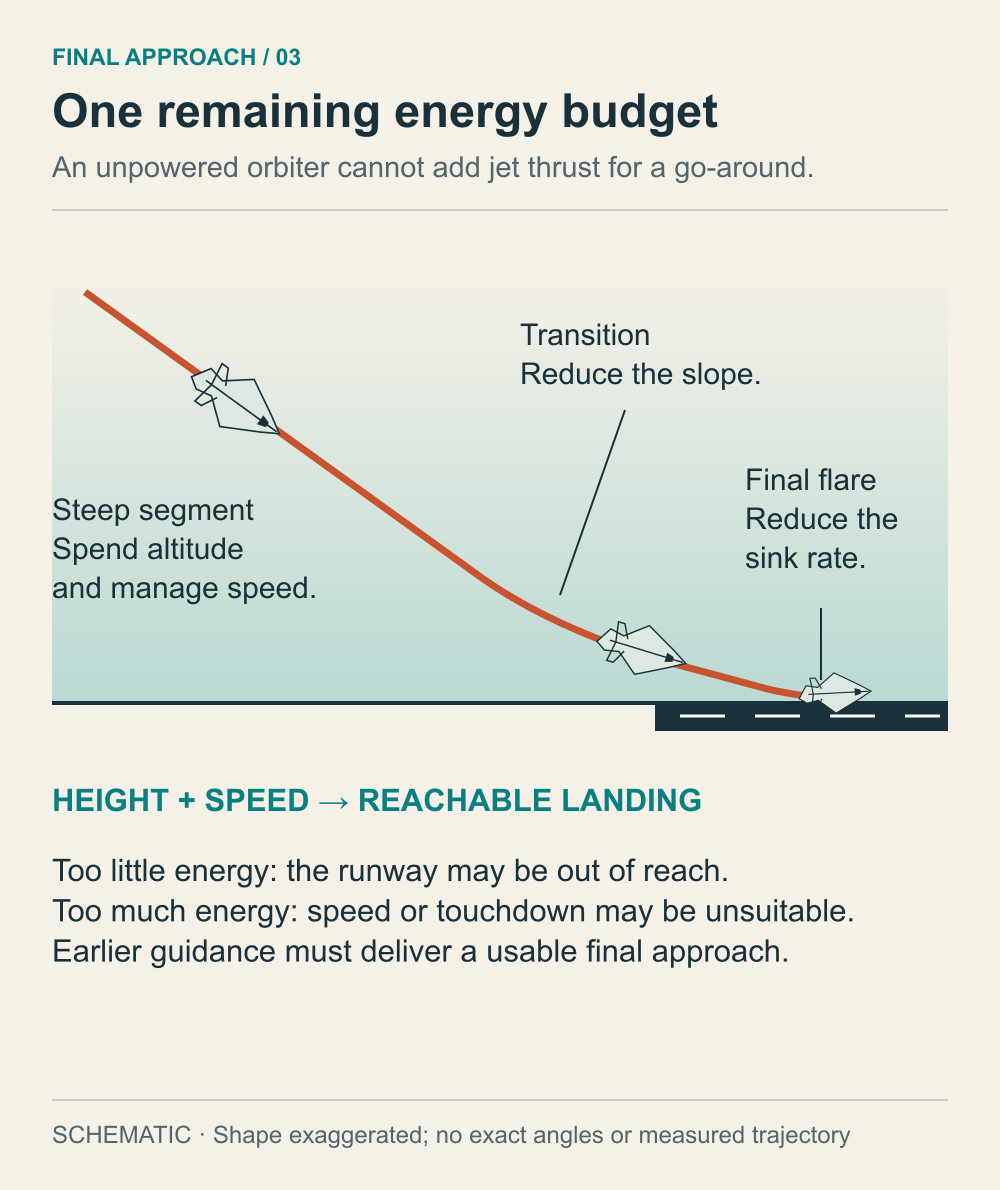
Image unavailable.
An exaggerated descent profile shows a steep approach, a transition to a shallow path and a final flare above a runway.
Why do some photographs of Buran show jet engines?#
The large white vehicle displayed at the Technik Museum Speyer is the OK-GLI, also known as the BTS-02 atmospheric test analogue. It was built to investigate atmospheric flight and landing, rather than to complete an orbital mission. The Gagarin Cosmonaut Training Center describes its four turbojet engines and its place in a larger sequence of airborne testing.
A test analogue is useful because engineers need realistic aerodynamic and control behavior without paying the cost and accepting the risk of a space launch on every trial. Repeated atmospheric flights let teams investigate handling, procedures and automatic landing equipment under conditions that a ground simulation can only approximate. The analogue’s engines made such flights practical, but they also meant that the aircraft was not identical to the returning orbiter.
The preparation program also used other aircraft, including flying laboratories, to test equipment and procedures. Different vehicles could answer different questions. A full-size analogue was not necessarily the cheapest or most revealing tool for every instrument test; an existing aircraft could carry equipment through representative operating conditions sooner.
Photographs therefore need precise captions. “Buran at a museum” is insufficient when the visible engines would change the reader’s understanding of the landing. This image shows a test machine that helped establish confidence in the system. The orbital achievement took place with a different vehicle and a different propulsion situation.
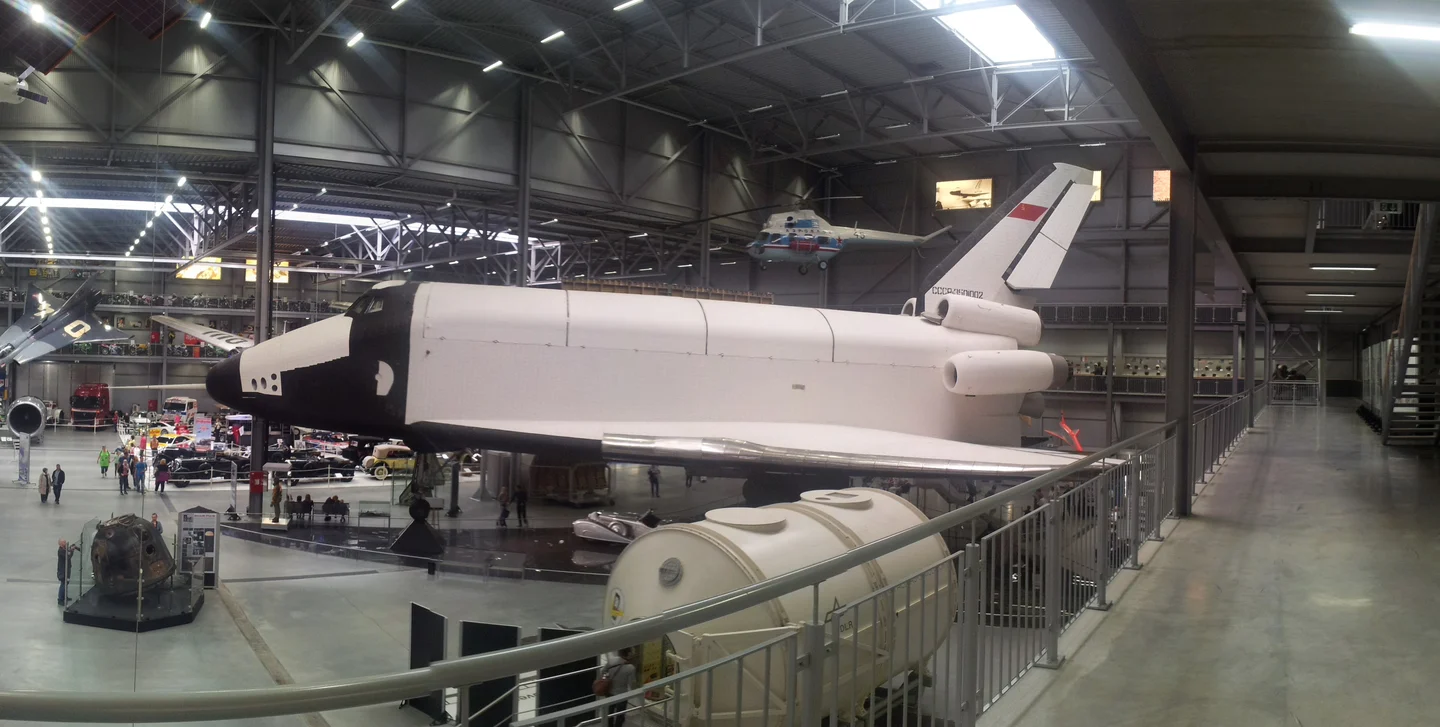
Image unavailable.
The white OK-GLI atmospheric test analogue at Technik Museum Speyer, with its wing, landing gear and rear jet-engine nacelles visible.

How can engineers test a landing that has never happened?#
They divide the uncertainty into problems that can be investigated before the first orbital return. Mathematical simulation explores the predicted vehicle and environment. Hardware tests examine real components and interfaces. Flying laboratories exercise equipment in motion. Atmospheric test vehicles bring more of the aerodynamic and operational problem together. Each method contributes evidence while leaving some questions for the others.
Testing also has to go beyond the nominal trajectory. Winds vary; measurements contain errors; aerodynamic predictions are imperfect; hardware has limits. A useful test asks whether the system still works when several plausible deviations occur together. Running the same ideal case thousands of times would not provide the same information as sampling the relevant uncertainties.
The Keldysh retrospective describes a practical computing constraint in Buran’s development: high-detail simulation was expensive, so reduced models supported extensive statistical investigation, while selected disturbed trajectories received fuller treatment. It also records independent examination of code. This is a recognizable engineering compromise: spend detailed computation where it is most informative, rather than confuse model complexity with guaranteed truth.
X-37’s atmospheric demonstrator likewise preceded the operational orbital vehicle. A U.S. Air Force Test Center history records the April 2006 release from the White Knight carrier aircraft and notes a runway overrun after landing. That was a test event involving the earlier demonstrator, not an X-37B orbital return. Including the imperfect result matters: test programs create knowledge by exposing problems, not merely by collecting successful photographs.
How could 1980s computers handle such a difficult flight?#
They did not need to solve every possible problem. They needed to execute carefully prepared algorithms quickly and reliably enough for a specified vehicle and mission. That is a very different requirement from running a modern consumer application, recognizing arbitrary objects or generating fluent conversation.
The Keldysh history describes four Biser-4 onboard computers, each with a mass above 33 kilograms. Their physical size is striking today, but comparing that mass with a phone tells us little about flight reliability. Hardware must operate in its intended environment, connect to specialized instruments and actuators, and support predictable timing. A faster general-purpose device does not automatically inherit those properties.
Redundancy can help a system continue when a component fails, but duplicating computers is not a universal cure. Identical machines can receive the same bad measurement or execute the same erroneous software. The general reliability problem therefore includes monitoring, fault handling, sensor behavior, independent verification and the limits of the assumed failure cases. These are principles of spacecraft engineering, not a claim that every redundancy arrangement is documented identically for Buran and X-37B.
The historical achievement is clearer when judged against the actual task. Engineers combined modest computing resources with physical models, extensive preparation and specialized software to produce a successful automatic return. Raw computing power was one constraint among many. Knowing what had to be calculated, and proving enough about that calculation, mattered at least as much.
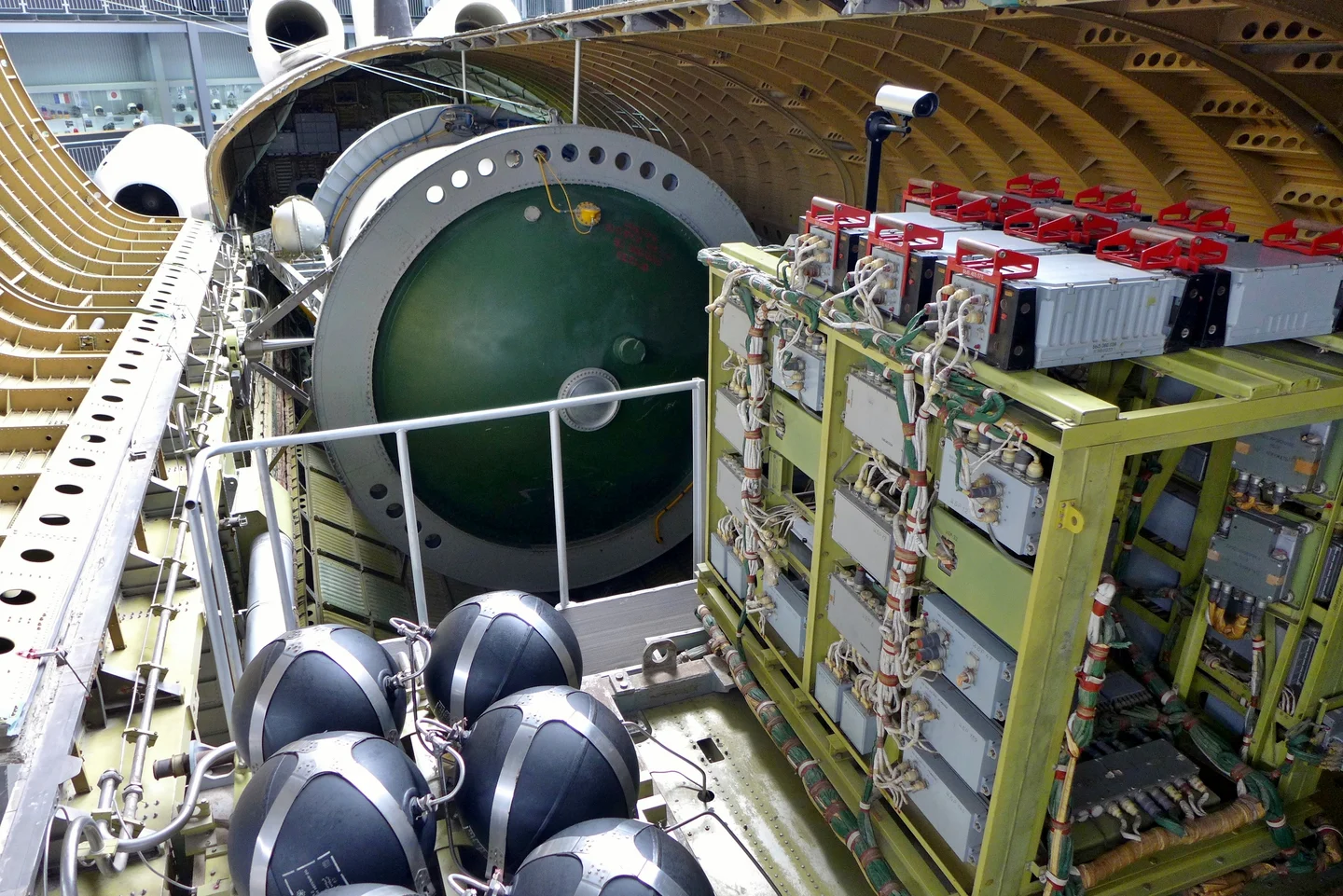
Image unavailable.
An open compartment in the Buran OK-GLI test analogue shows racks of equipment, bundled wiring, spherical tanks and the cabin bulkhead.

Does autonomous landing require artificial intelligence?#
Not in the sense usually implied by today’s neural-network products. Feedback control, state estimation and rule-based or model-based guidance can produce autonomous behavior without a system learning to fly during the mission. Buran’s automatic landing should not be retroactively described as a demonstration of a contemporary machine-learning architecture.
The vocabulary is also historically slippery. Artificial intelligence has included planning, reasoning and other approaches besides neural networks. NASA’s Deep Space 1 Remote Agent experiment investigated onboard planning and execution in the 1990s. More recent spacecraft-autonomy demonstrations have explored coordination and decision-making among multiple satellites. Those projects help explain that autonomy comes in different forms; they do not reveal which algorithms operate inside X-37B.
The useful questions are operational. What can the system decide? What information does it use? What conditions were included in its design and testing? What happens when its estimate becomes unreliable or the expected plan is no longer feasible? Calling something “AI” answers none of those questions by itself.
There is room for increasingly capable autonomy in space because communication is limited and some decisions cannot wait for Earth. But capability must be matched to evidence. A successful runway landing demonstrates the performance of a particular vehicle, software version and flight under particular conditions. It does not establish that the same machine can safely handle any unfamiliar task merely because both tasks are described as autonomous.
What did X-37B carry during its 908-day mission?#
The publicly described sixth mission carried experiments, including NASA investigations involving materials and seeds. It also used a service module to expand payload capacity; the U.S. Space Force’s mission account states that the module separated before reentry. Publicly documented experiments provide concrete reasons for a recoverable orbital test vehicle, even though they are not a complete disclosure of every activity in the program.
NASA’s RAD-SEED investigation studied the effects of long exposure in space on seeds. Its description includes model organisms and crop candidates, with questions about germination, viability, abnormalities and molecular changes. Those are research objectives and measurements, not an automatic finding that a future Mars farm will succeed. Seeds carried as experimental samples are also different from crops grown and harvested aboard the spacecraft.
Ground controls are essential. If returned seeds behave differently, investigators need to distinguish space-exposure effects from storage, handling and the natural variation of the samples. NASA describes complementary radiation work on Earth as part of the investigation. A long orbital exposure can answer useful questions without reproducing every feature of a journey beyond Earth’s magnetic environment.
The ability to recover a sample changes the science. Investigators can inspect physical changes with laboratory equipment that would be impractical to launch, repeat measurements and compare techniques. A telemetry stream is valuable, but it is not always a substitute for the material itself. The long wait in orbit and the precision of the final landing are therefore connected parts of one experimental capability.

Image unavailable.
A laboratory germination test contains small seedlings with visible white roots and green leaves on a rectangular growth medium.
What do these flights tell us about reusable spacecraft?#
Returning intact is a prerequisite for reuse, but it is not the whole achievement. A vehicle must also be inspected, repaired where necessary, prepared for another mission and operated within acceptable cost and risk. A single successful return cannot establish the maintenance burden of a long-running service. Buran’s one orbital flight and X-37B’s repeated missions consequently provide different kinds of evidence.
Winged recovery also answers a particular set of requirements. It can bring hardware to a runway and shape the atmospheric flight path, while adding systems that another mission might avoid. A capsule, lifting body or winged vehicle should be judged against what it must carry, where it must return and how its operators intend to recover it. Appearance alone cannot decide which design is “more advanced.”
The strongest connection between X-37B and Buran is the chain of reasoning behind an automatic return. Estimate the motion. Select a feasible path. Spend energy within physical limits. Control the vehicle through changing flight conditions. Verify the pieces before asking them to work together over a runway.
That chain makes the final image more interesting. The empty cockpit does not mean an absence of decision-making; it means decisions have been divided between people, mathematical models, software and hardware in advance. Understanding that division is a better guide to the future of spacecraft than treating every successful machine as a human pilot in electronic form.
Keep exploring
Sources & further reading
Follow the original research, records, and explanations behind this story.
- Air Force’s X-37B historical landing advances space vehicle technologies U.S. Air Force
Primary 2010 operational account: ground return command, automatic flight and the absence of remote-pilot takeover for that landing.
- X-37B Orbital Test Vehicle concludes sixth successful mission U.S. Space Force
November 12, 2022 landing, 908-day flight, experiments and service-module separation. Historical mission, not a live status claim.
- Effect of Long Duration Space Exposure on Seeds NASA Science
RAD-SEED objectives, experimental samples and complementary ground investigations. Objectives are not presented as final results.
- Buran program, 1976–1993 Gagarin Cosmonaut Training Center
Official program history: crew preparation, flying laboratories, four-engine BTS-02, uncrewed orbital flight and termination. Russian-language source.
- Automatic landing complex for Buran M. P. Balashov; Buran-Energia archive
Participant account of navigation instruments, ground facilities, approach phases and testing; an English translation of the technical account.
- Guidance and control system for descent and landing V. P. Kirpishchikov; Buran-Energia archive
Participant account of bank control, energy-based approach selection and landing phases. The 3 percent figure refers to a candidate path probability, not survival odds.
- Development of Buran motion-control algorithms and programs B. I. Zhukov and A. S. Samotokhin; Keldysh Institute, 2026, No. 1
Technical retrospective, especially pp. 24–25: computational limits, reduced and detailed simulations, independent code examination, four Biser-4 computers above 33 kg each. Russian-language PDF.
- April 7, 2006: White Knight air-dropped the X-37 at 37,000 feet Air Force Test Center
History of the atmospheric demonstrator test, including the runway overrun. This was not an X-37B orbital mission.
- Lifting Bodies NASA Armstrong Flight Research Center
Aerodynamic return using body lift and the history of flight experiments; wings are not the only way to obtain lift.
- The Aeronautics of the Space Shuttle NASA Langley Research Center
Re-entry and Landing explains the de-orbit burn, atmospheric return and transition to aerodynamic controls. The energy values in this article are independently calculated teaching examples, not measured mission values.
- Entry Systems Modeling (ESM) NASA Langley Research Center
Atmospheric-entry deceleration, heating, thermal protection and shock-layer gas physics; general principles, not a reconstruction of X-37B or Buran flight software.
- Remote Agent: frequently asked questions NASA Jet Propulsion Laboratory
Deep Space 1 autonomy and model-based planning: historical context for distinguishing autonomy from modern neural-network systems.
- What Is NASA’s Distributed Spacecraft Autonomy? NASA Ames Research Center
An example of autonomous planning and coordination in a satellite swarm; no implication that X-37B uses these algorithms.
- Basics of Space Flight: Spacecraft Reliability NASA Science
General spacecraft reliability and redundancy principles, separated from claims about the internal architecture of particular vehicles.
- Boeing’s X-37B Completes Sixth Mission, Sets New Endurance Record Boeing, November 12, 2022
Manufacturer’s historical mission-six account, including NASA materials and seed experiments.
Follow the thread