
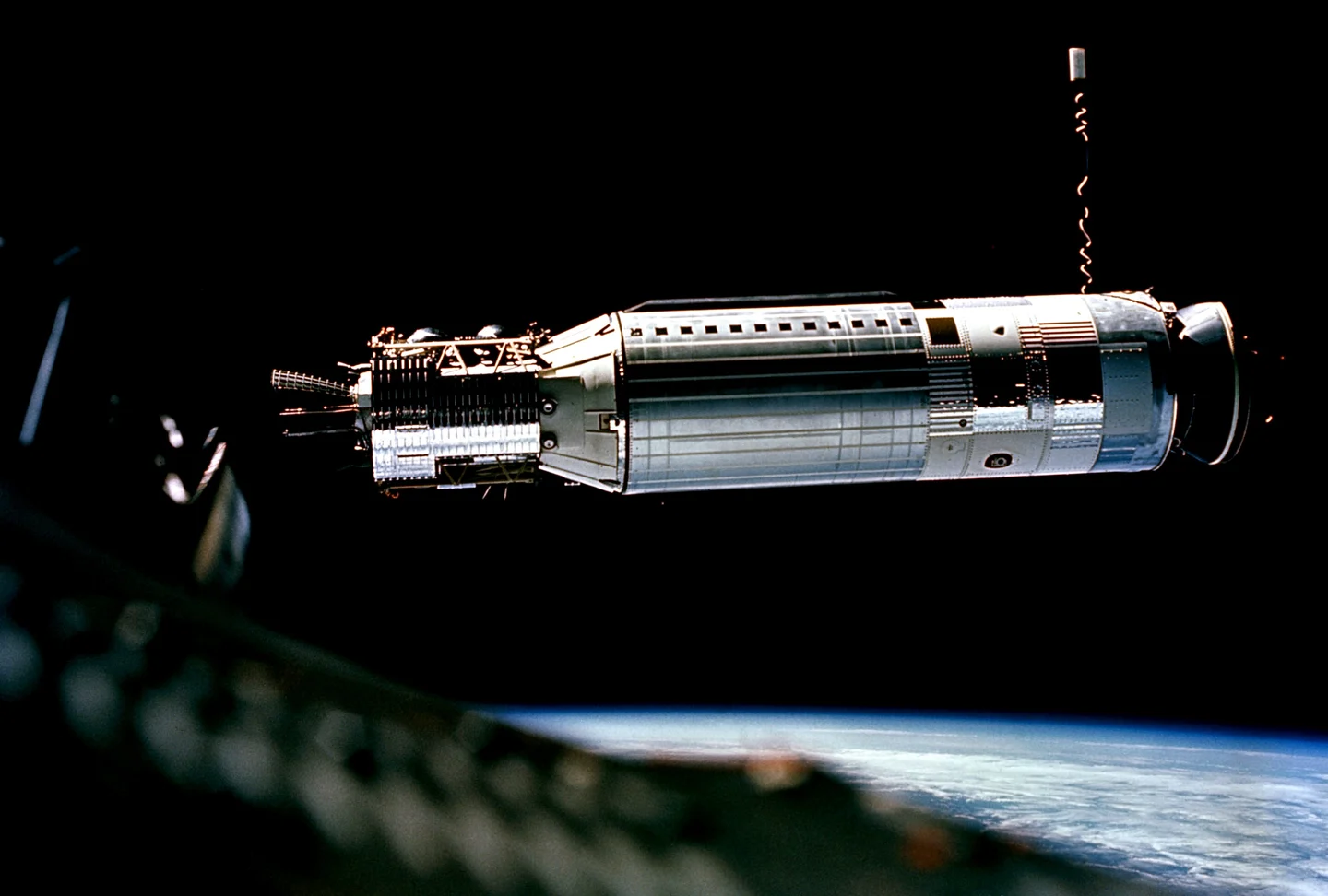
Gemini 8 made the first docking between two spacecraft in orbit on March 16, 1966. Neil Armstrong and David Scott brought their capsule together with an uncrewed Agena target, proving a technique that future Moon crews would need. About 27 minutes later, an unwanted thruster firing turned the successful test into an emergency. After the astronauts separated the vehicles, Gemini’s rotation accelerated. They recovered control using a separate propulsion system and returned to Earth early.
The mission is often reduced to a story about Armstrong stopping a spin. Its deeper significance lies in how several engineering problems met in one small spacecraft: finding another vehicle in orbit, connecting two control systems, diagnosing a failure without continuous ground contact, and preserving enough capability to get home. The original flight report also tells a more precise story than some familiar summaries, especially about the electrical fault, the spin rate and the fuel remaining after the emergency.
Why did Gemini 8 need to dock in space?#
Docking was a practical requirement of NASA’s chosen route to the Moon. Under lunar-orbit rendezvous, a command and service module would remain above the Moon while a smaller lunar module carried two astronauts to the surface. The lander’s ascent stage would then have to find and reconnect with the orbiting spacecraft. Without that reunion, the landing crew could not transfer back to the vehicle that would take them home.
NASA selected this approach in July 1962 after a substantial debate over competing mission designs. Langley engineer John Houbolt was a persistent advocate of lunar-orbit rendezvous. Its attraction was that the entire Earth-return spacecraft did not have to descend to the lunar surface and climb back out of the Moon’s gravity. A smaller landing vehicle reduced the mass that had to be landed and relaunched. The price was dependence on a meeting between two spacecraft far from Earth.
Gemini provided a place to learn those operations in Earth orbit. Its crews tested long-duration flight, maneuvering, rendezvous and work outside a spacecraft before Apollo attempted them farther away. Gemini 8 was therefore a rehearsal for a capability, rather than a miniature Moon mission. It did not carry a lunar lander or travel to the Moon.
That distinction explains why a brief physical connection mattered so much. NASA already knew how to launch a crew into orbit. It still needed experience bringing separately launched vehicles together, making contact without damage and controlling the combined spacecraft afterward. A successful approach was only one part of that chain.
Was this the first rendezvous, or the first docking?#
Gemini 8 achieved the first docking of two spacecraft in orbit. The first successful space rendezvous had already occurred in December 1965, when Gemini VI-A met Gemini VII. Those crews brought their vehicles close together and maintained formation, but the two Gemini capsules were not equipped to dock with each other.
Rendezvous means reaching the same neighborhood in space with relative motion small enough for controlled operations. Docking adds a physical connection. Two spacecraft can pass close to one another at high speed without accomplishing a useful rendezvous; they can also fly beside one another for a long time without ever docking. Proximity, matched motion and mechanical attachment are separate achievements.
For Gemini 8, rendezvous ended with the spacecraft about 150 feet, or 46 meters, from Agena and with the approach stopped. The crew then inspected the target and performed close-range maneuvers before making contact. The mission report records docking contact at 6 hours, 33 minutes and 16 seconds after launch, followed by completion of the rigid connection six seconds later.
The difference remains useful when reading about modern missions. A photograph of two spacecraft near each other does not establish that they are connected. Likewise, a docking headline says little by itself about whether people can pass through a tunnel, whether electrical connections are available, or which vehicle controls the pair. Those capabilities depend on the particular interface.
Who flew Gemini 8, and what was the original plan?#
Neil Armstrong was the command pilot and David Scott the pilot. Both were making their first spaceflight, although neither was new to demanding flight operations. Armstrong had been a naval aviator and an experimental research pilot, including flights in the X-15 rocket aircraft. Scott was an Air Force pilot selected in NASA’s 1963 astronaut group. Their later lunar careers can obscure the fact that this was their first opportunity to operate a spacecraft in orbit.
Their planned flight lasted three days. Docking was the central milestone, but the schedule also included repeated undocking and redocking, experiments and an ambitious spacewalk by Scott. He was to use a tether and a hand-held maneuvering device while Armstrong operated the spacecraft nearby. Practicing work outside the cabin was another part of preparing for Apollo.
The workload was shared. During the approach, Armstrong flew the spacecraft while Scott supplied radar ranges and closing rates and helped inspect Agena. During the emergency, Scott operated target-vehicle controls, worked through procedures and communicated their condition to the ground. Describing the recovery as a single-pilot trick loses the crew coordination on which it depended.
Armstrong later commanded Apollo 11, and Scott flew Apollo 9 before commanding Apollo 15. Those later missions give Gemini 8 an unusual historical connection: both men eventually walked on the Moon. But the value of their earlier flight does not depend on knowing that ending. In March 1966 they were testing a new operational capability, with a program of work that the emergency would leave unfinished.
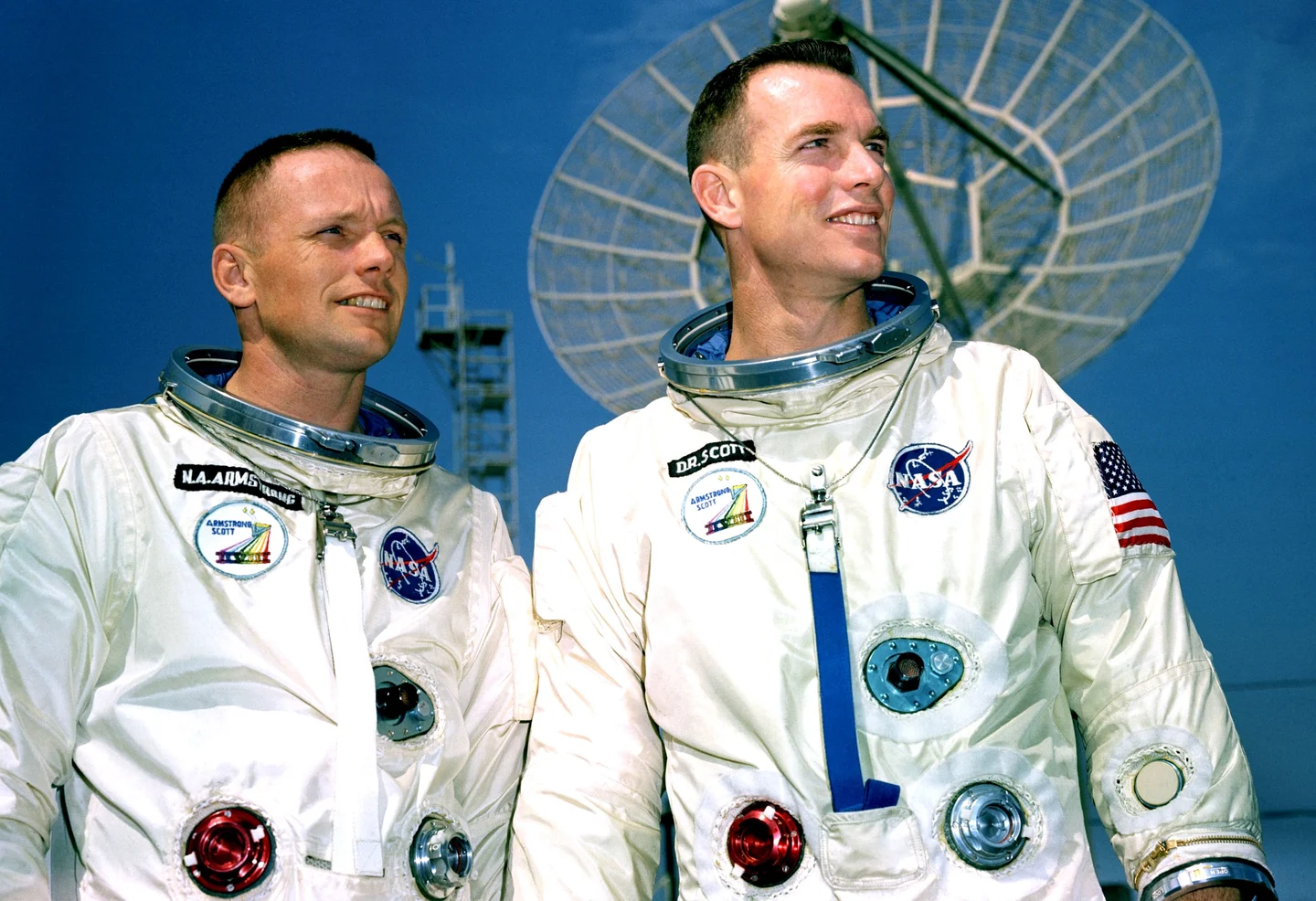
Image unavailable.
Neil Armstrong on the left and David Scott on the right in spacesuits, standing in front of a radar antenna.
What was Agena, and how did the docking work?#
Agena was an uncrewed target vehicle launched separately on an Atlas rocket. It was more than a passive object to aim at: it had propulsion, attitude control, communications and equipment that allowed it to respond to commands. A docking adapter at its forward end accepted Gemini’s nose. The astronauts could inspect the target before committing to the connection.
The two vehicles left neighboring launch complexes at Cape Kennedy on March 16. Agena launched first; Gemini followed about 101 minutes later on a Titan II. Starting with the target already in orbit meant the crew had a real destination to pursue, with its orbit measured and checked. The operation required coordination between two launch teams, the tracking network and Mission Control in Houston.
At final approach, the mission report describes a separation of about two feet and a contact speed of approximately three-quarters of a foot per second, or 0.23 meters per second. That is slow on the scale of ordinary walking. Both spacecraft were still traveling around Earth at orbital speed, but their motion relative to each other had become gentle enough for docking.
Gemini’s nose entered the docking adapter, and the mechanism captured and rigidized the connection. This was not a passageway into another inhabited cabin: Agena had no crew compartment waiting on the other side. The purpose was to connect vehicles and test their joint operation. Once linked, forces and torques from either spacecraft could affect the whole assembly, which made the control problem different from flying Gemini alone.
How do you catch another spacecraft in orbit?#
You cannot treat an orbital rendezvous like chasing a car down a road. A spacecraft’s speed, altitude and orbital period are connected. Firing a thruster changes its orbit, so an apparently simple push toward a target also changes where the spacecraft will be later. Successful rendezvous requires matching both position and velocity at the appropriate time.
For circular orbits around the same body, a lower orbit has a shorter period. A vehicle below a target can gradually gain on it as it goes around Earth more quickly. It must then maneuver into the target’s neighborhood and remove the remaining relative motion. This is a useful first model, not a complete description of Gemini 8’s trajectory, which involved elliptical orbits and multiple corrections.
Matching height, phase and orbital plane#
The flight report lists nine rendezvous maneuvers, including changes to height and orbital phase, a plane change, a coelliptic maneuver, terminal approach corrections and braking. Height controls the size and shape of the orbit. Phase describes where each spacecraft is along its path. A plane change addresses a sideways mismatch between the orbital planes. Fixing only the distance between the vehicles would not fix all three problems.
Guiding and braking the final approach#
Radar supplied range and closing-rate information, while onboard guidance and the crew turned those measurements into maneuvers. Near the target, visual inspection became useful too. The report states that the terminal phase used onboard-computer solutions and displays. The encounter was neither a purely manual chase nor a spacecraft simply following a line drawn from the ground.
The final task was to reduce the closing rate. Arriving at the right location with too much relative speed would create a flyby or a collision. That is why rendezvous contains an apparent paradox: the crew spent hours catching Agena, then deliberately braked before reaching it. Removing relative motion was part of the achievement, not a delay before the interesting part.
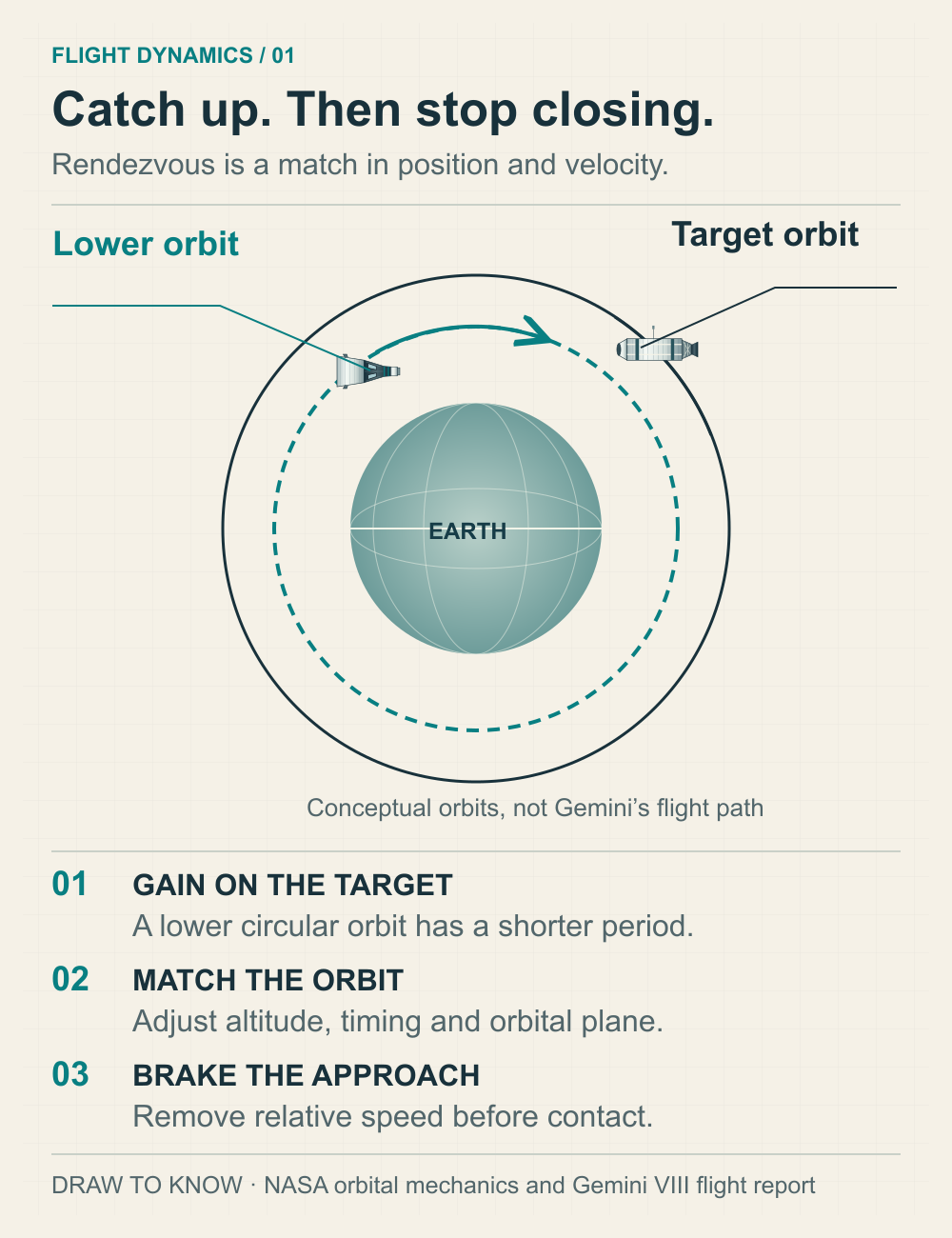
Image unavailable.
Two conceptual circular orbits show a lower chaser orbit with a shorter period and a higher target orbit. Three steps distinguish gaining on the target, matching the orbit and braking the approach.
What happened between docking and the emergency landing?#
The flight report uses ground elapsed time: hours, minutes and seconds measured from Gemini’s launch. This keeps the sequence clear without mixing Florida clock time, universal time and the local date in the western Pacific. Gemini launched on March 16; splashdown was already March 17 at the recovery location.
The spacecraft operated well together for about 27 minutes after the rigid connection was completed. The report’s event table places the start of the thruster anomaly at roughly 7 hours into the mission. Undocking followed about 15 minutes later. Reentry-control activation, electrical isolation and the eventual removal of rotation were distinct steps rather than one instantaneous event.
The timeline below rounds the report’s entries to the nearest second. It shows that the crew spent time identifying and countering the problem before separation, and that stabilizing the vehicle did not immediately place it in the ocean. They still had to prepare for a controlled return and reach the planned retrofire point.
- 00:00:00 — Gemini launches; Agena is already in orbit.
- 05:58:00 — Rendezvous is complete at about 150 feet from the target.
- 06:33:22 — The docked vehicles are rigidly connected.
- 07:00:27 — The event table records the onset of the thruster anomaly.
- 07:15:12 — Gemini separates from Agena.
- 07:16:25 — The crew activates the reentry control system.
- 07:18:16 — The event table records the No. 8 thruster circuit breaker off.
- 07:25:30 — Rotation rates are under control.
- 10:04:47 — Retrofire begins for the return to Earth.
- 10:41:26 — Gemini splashes down in the western Pacific.
Sources: [1]
What caused Gemini 8 to start spinning?#
The immediate cause was an unwanted firing of Gemini’s No. 8 attitude-control thruster. It belonged to the Orbit Attitude and Maneuver System, or OAMS, used to orient and maneuver the spacecraft in orbit. The mission report identifies it as a yaw-left/roll-left thruster: its force could contribute to rotation about more than one spacecraft axis.
A thruster pushes by expelling propellant. When the thrust acts away from the spacecraft’s center of mass, it produces a turning effect called torque. A short, commanded pulse can make a controlled adjustment. A persistent unwanted firing keeps changing the rotation unless another force counters it. Releasing a hand controller cannot solve the problem if the electrical system continues to energize the thruster anyway.
The crew initially suspected Agena, whose control system could also turn the joined vehicles. Scott switched off its attitude-control system while Armstrong countered the motion with Gemini’s thrusters. They temporarily reduced the rotation, but it returned. Gemini’s rapidly falling maneuvering-propellant supply, down to about 30 percent in NASA’s historical account, was another clue that the problem involved Gemini.
The detailed report complicates the familiar phrase “stuck on.” Electrical readings and spacecraft motion indicate that the malfunction changed during the episode; the thrust was not a perfectly constant, uninterrupted push from beginning to end. The phrase is useful for the central failure, but it should not be mistaken for a measured thrust history. Nor does the timing prove that the docking mechanism itself caused the fault. The vehicles had already demonstrated stable joint operation before the anomaly began.
Why did the spin get worse after undocking?#
Undocking removed Agena from the assembly, but it did not remove the faulty thruster from Gemini. The unwanted turning force traveled with the crew. Once separated, Gemini’s resistance to changes in rotation was different, and the same continuing fault could drive a more rapid buildup of rotation.
That resistance is called rotational inertia, or moment of inertia. It depends on both mass and how that mass is distributed around an axis. In a simplified single-axis model, angular acceleration equals torque divided by rotational inertia. A smaller rotational inertia therefore gives a larger change in rotation rate for the same applied torque. The diagram illustrates this relationship; it is not a numerical reconstruction of the real spacecraft’s coupled motion.
This is more precise than saying “a lighter spacecraft spins faster.” Low mass does not make an object spin by itself. The important combination was the continuing torque and the changed configuration. The actual event involved roll, pitch and yaw, a changing control response, and incomplete knowledge of some valve operations. A simple one-axis drawing cannot reproduce all of that.
It is also misleading to treat separation as an obvious blunder. The crew needed to isolate the fault, stop excessive propellant consumption and avoid an uncontrolled combined vehicle. The flight report explicitly describes isolation and fuel loss as reasons for undocking. The worsening motion then provided strong evidence that Gemini carried the fault.
The report describes rates of about 300 degrees per second when the crew switched to the emergency response. That corresponds to about 50 revolutions per minute, or one turn in 1.2 seconds. Later NASA accounts summarize the motion as approaching one revolution per second. These are approximate descriptions, not a basis for asserting a precisely measured peak of exactly 60 rpm.
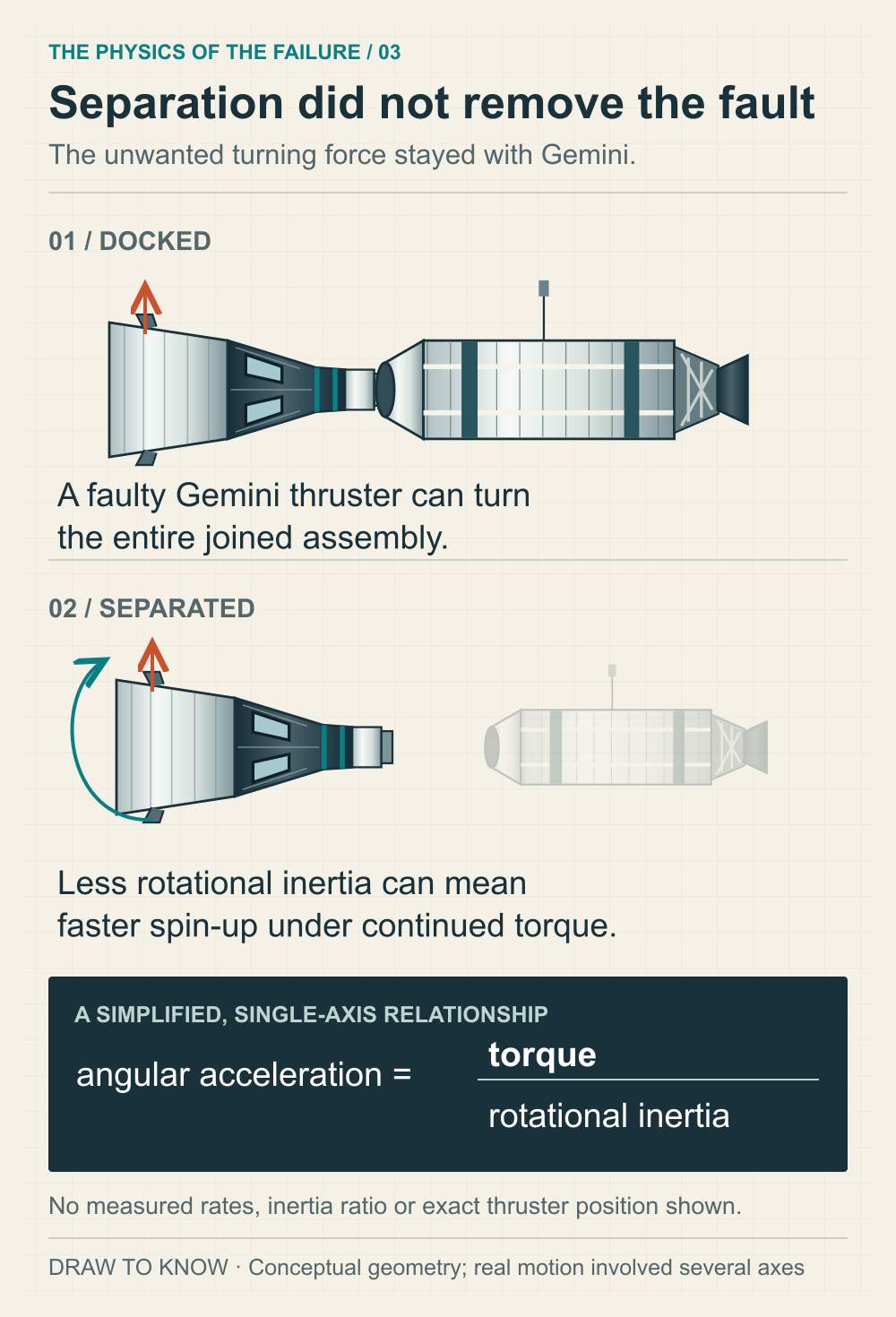
Image unavailable.
Docked and separated spacecraft show that the faulty Gemini thruster stays with Gemini after undocking. A simplified equation relates angular acceleration to torque divided by rotational inertia.
How were Gemini’s two control systems different?#
Gemini carried separate systems for orbital maneuvering and reentry attitude control. Their locations reflected their jobs. The OAMS equipment was in the adapter behind the crew’s reentry module. The Reentry Control System, or RCS, was mounted forward of the crew compartment, where it would remain with the capsule after the adapter was discarded.
OAMS could change both the spacecraft’s orientation and its motion through space. It supplied the small pushes needed during rendezvous and stationkeeping as well as the torques used to point the vehicle. The reentry system’s job was to control the capsule’s attitude during the return through the atmosphere. It had two independent rings of thrusters, providing another source of control when the orbital system could no longer be trusted.
The systems were physically and functionally distinct. Switching to RCS was not merely selecting another software mode for the same malfunctioning engine. It gave the crew access to different thrusters and propellant supplies. That separation was crucial: a backup that depended on the same failed hardware would not have provided the same escape from the problem.
There was also a third function that is easy to confuse with these systems. Gemini’s retrorockets supplied the braking impulse that lowered its orbit for reentry. RCS controlled orientation; the retrorockets initiated the departure from orbit. Armstrong did not stop the emergency spin by firing a large deorbit engine. The crew first had to regain control, then prepare and execute the later retrofire sequence.
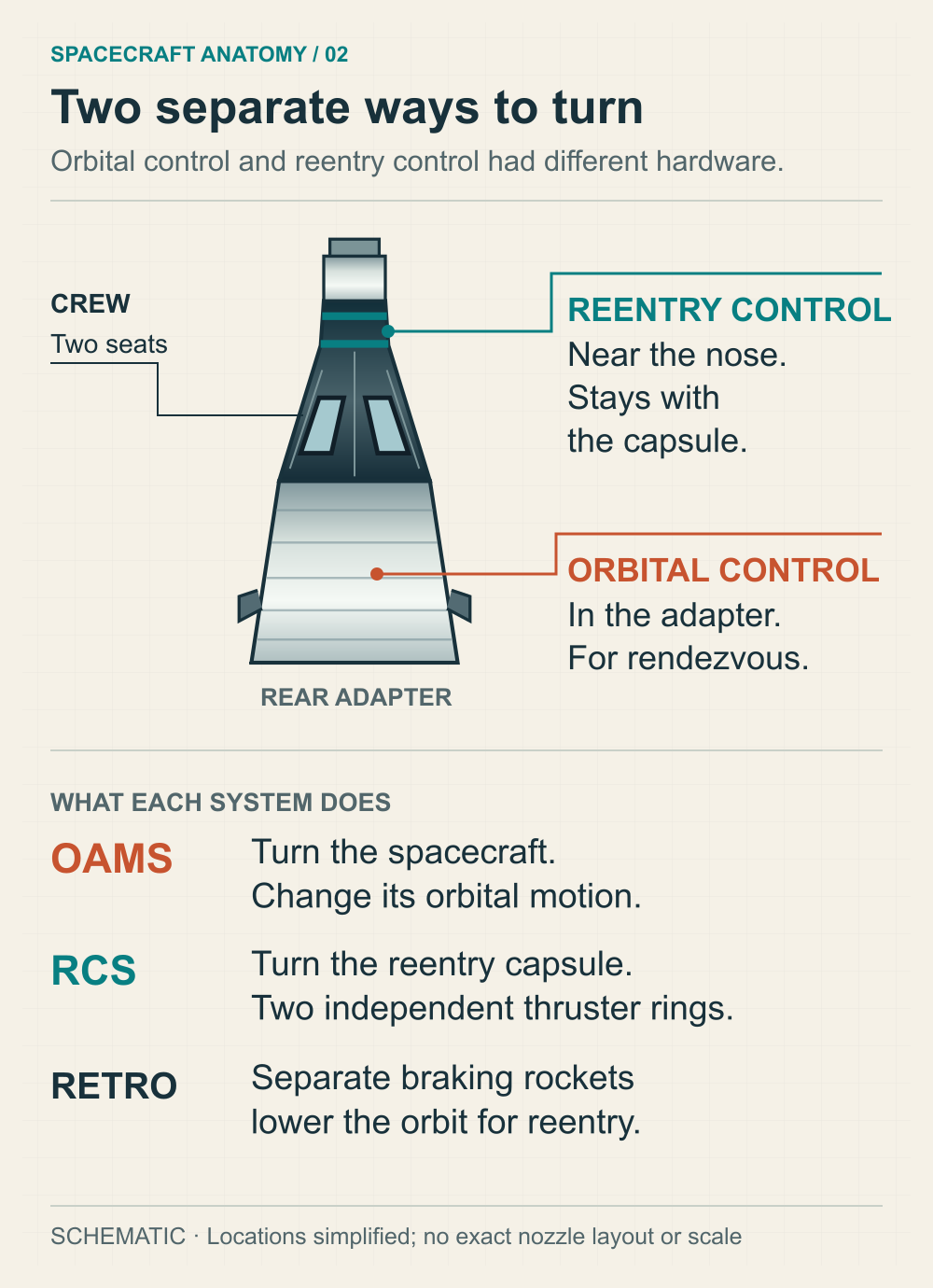
Image unavailable.
A simplified Gemini spacecraft identifies reentry controls near the nose and orbital controls in the rear adapter. A legend distinguishes OAMS, RCS and the separate retrorockets.
How did Armstrong and Scott regain control?#
The recovery required two things: stop the unwanted turning force and use healthy thrusters to remove the rotation already present. Cutting power to a faulty thruster can stop further acceleration, but it does not magically cancel the spacecraft’s existing motion. With little atmospheric resistance at orbital altitude, an opposing torque is still needed to slow the rotation.
The crew activated both RCS rings in direct control. Once they established that the reentry thrusters could reduce the rates, they shut down one ring to conserve its propellant and continued with the other. They also worked through the orbital system’s electrical isolation. The detailed event record places RCS activation before the recorded opening of the No. 8 thruster circuit breaker; recovery was an overlapping process of control and diagnosis.
NASA’s public histories often compress this into “switch off OAMS, use RCS.” That is a fair account of the solution, but the report shows why it should not be imagined as a single clean switch followed by an immediate stop. Some valve positions were not telemetered, and investigators could not reconstruct every action with equal confidence. By 7 hours, 25 minutes and 30 seconds, the recorded rotation rates were under control.
The astronauts were dealing with blurred vision as the motion intensified. They remained capable of operating the spacecraft, communicating and applying procedures, but the physical difficulty was real. The sources do not justify inventing a precise countdown to unconsciousness. The documented achievement is already substantial: two people recognized that their normal control system had become part of the problem and recovered the vehicle with an independent system.
Why was the mission aborted after the spin stopped?#
A stable spacecraft was not the same as a spacecraft ready to continue a three-day test program. The crew had activated and consumed propellant from the system reserved for controlling reentry. They also had an unresolved failure in the orbital control system. Continuing with spacewalks and more docking tests would have required accepting a different level of risk from the original plan.
Mission Control applied the flight rules and chose an early return to a contingency recovery area. Those rules existed so that a crew and its controllers would not have to invent acceptable safety margins during a crisis. The important remaining task was to preserve the capability to orient the capsule and return the astronauts safely.
Fuel figures deserve particular care. Many later accounts say that stopping the spin used about 75 percent of the reentry propellant. The original report’s mission-control discussion records an in-flight indication that roughly two-thirds had been used, then adds a postflight correction: approximately half the total remained just before retrofire. Cooling of pressurant gas had affected the real-time quantity indication. Those values describe different estimates and moments, not a single unambiguous gauge reading.
The correction does not mean the abort was unnecessary. Controllers had to act on the information available, both RCS rings had been activated, and a significant reserve had already been spent. The report’s corrected fuel calculation is a useful reminder that a historical decision must be judged using the evidence people had at the time, rather than only the improved measurements available afterward.
Why couldn’t Mission Control help continuously?#
Gemini 8 depended on a worldwide network of ground stations and tracking ships. A low-orbiting spacecraft moved into and out of their radio coverage. Losing contact between passes was a normal operational condition; it did not necessarily mean that the radio had failed. The unexpected motion developed during a gap in that coverage.
This placed immediate responsibility on the crew. They could not wait for a continuous conversation with Houston before countering a rapidly developing rotation. When contact became available through the tracking ship Coastal Sentry Quebec, Scott reported the emergency. The Hawaiian station later received confirmation that the spacecraft had been stabilized.
Ground support then became essential to the return. Controllers removed the planned maneuvers, updated the spacecraft mass used in their calculations, checked the possibility of recontact with Agena, selected a recovery area and sent the crew new reentry information. Recovery forces also had to move toward a landing zone different from the original Atlantic destination.
The photograph of Mission Control captures one part of this larger operation. The visible consoles were connected to a distributed system of tracking, communications, computing, aircraft and ships. Gemini 8 demonstrated why crews needed enough autonomy to survive a communications gap and why that autonomy did not make the ground organization dispensable. The cockpit response and the recovery network solved different parts of the same emergency.
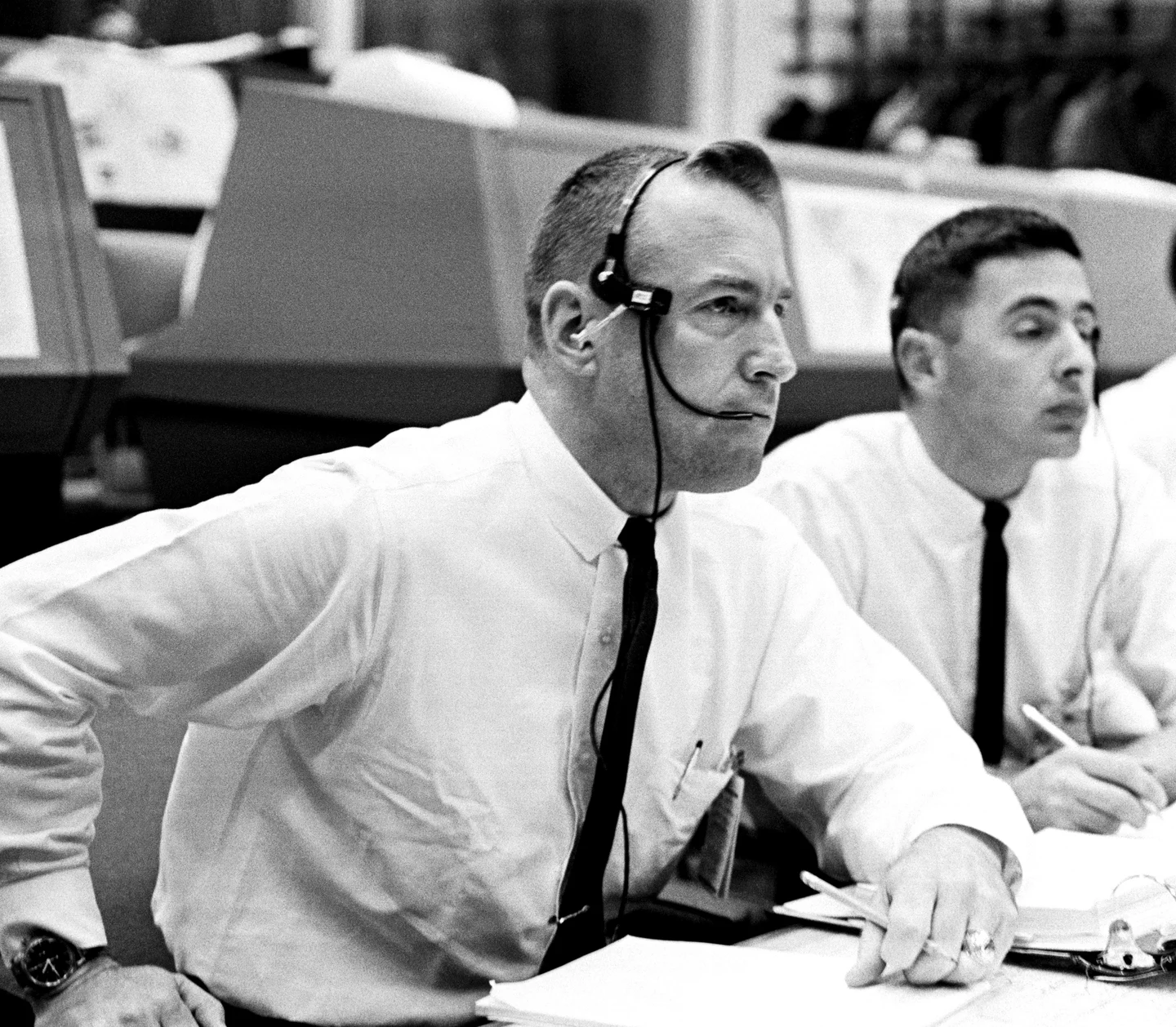
Image unavailable.
Jim Lovell and Bill Anders at Mission Control consoles during the Gemini 8 mission.
Where did Gemini 8 land, and how were the astronauts rescued?#
Gemini 8 splashed down in the western Pacific, east of Okinawa, after 10 hours, 41 minutes and 26 seconds of flight. It had been scheduled to finish a much longer mission in the Atlantic. The contingency landing was an early return to a prepared recovery region, not an uncontrolled fall to an arbitrary point on Earth.
After stabilization, the crew still had work to do: prepare the cabin, configure the spacecraft, receive updated guidance information and orient for retrofire. The equipment adapter was separated before the retrorockets fired. During reentry the capsule had to maintain an appropriate attitude, slow in the atmosphere and deploy its parachutes in sequence. A successful rescue therefore depended on more than ending the spin.
Recovery aircraft reached the area, and U.S. Air Force pararescuemen entered the water to assist. They attached a flotation collar to the capsule, helping secure it while the crew waited for the destroyer USS Leonard F. Mason. In the archival photograph, the bright collar and the rescuers around the open hatches show that the recovery operation was still in progress after landing.
Sea conditions made the wait uncomfortable. The crew’s report describes substantial swells and difficulty getting out of the bobbing capsule when the destroyer arrived. Armstrong and Scott were recovered after roughly three hours in the water. Their survival depended on a chain of successful operations: restoring control, navigating the return, landing with functioning parachutes, keeping the capsule afloat and reaching it with trained people and suitable equipment.
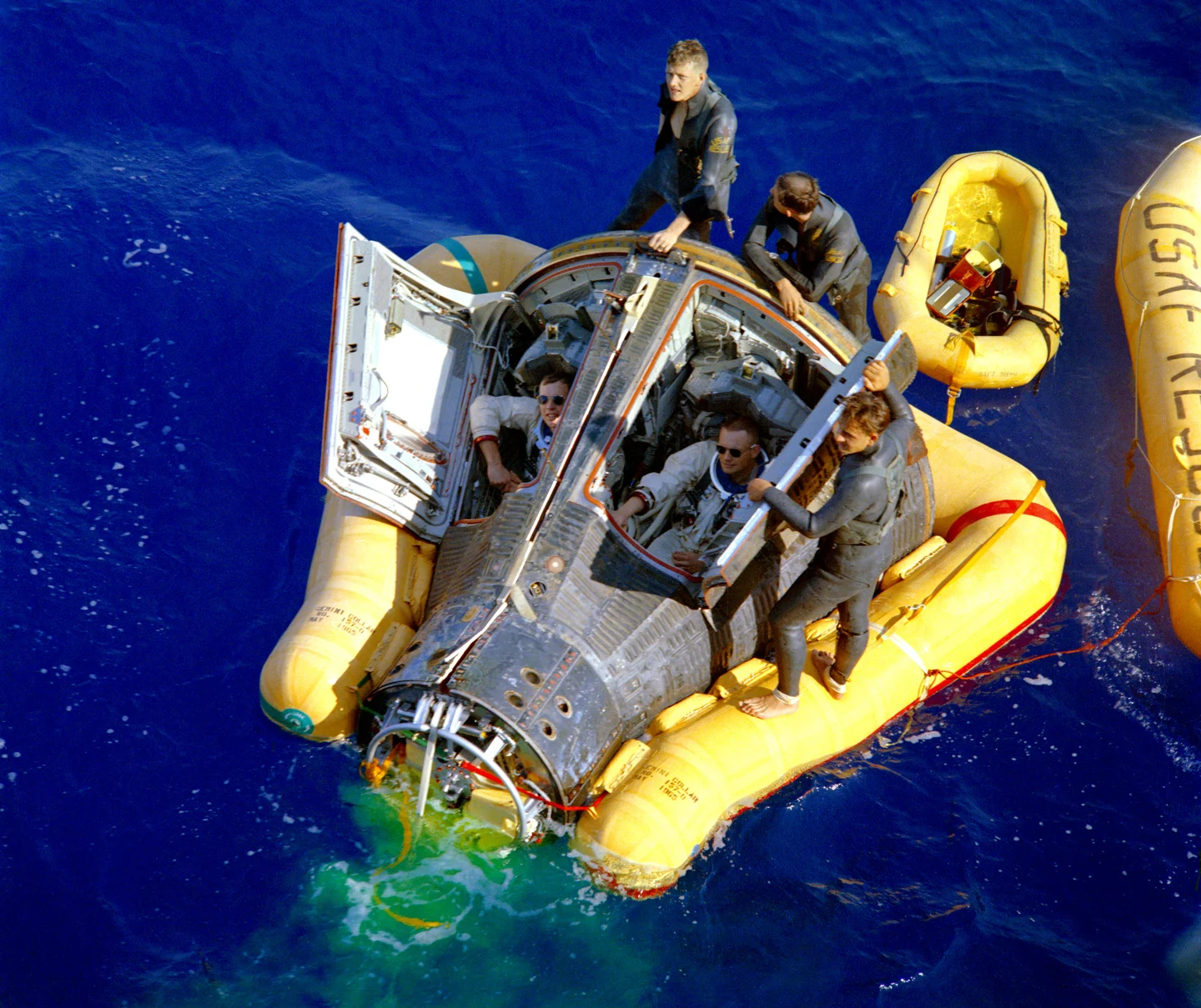
Image unavailable.
Armstrong and Scott sit in Gemini’s open hatches while three pararescuemen work around a bright yellow flotation collar in the Pacific.
What did investigators learn about the electrical fault?#
The report concluded that the uncommanded firing resulted from a short to ground in the thruster’s valve-control circuitry. It did not identify a fully proven physical defect at one exact location. The electrical analysis narrowed the failure to the solenoids or associated spacecraft wiring and stated that further isolation had met with little success. A broad electrical diagnosis and uncertainty about the initiating defect can both be true.
This matters because “stuck thruster” can suggest a mechanically jammed nozzle or valve. Gemini’s valves were operated electrically. An unintended electrical path could energize a valve even when the crew was not commanding a firing. Investigators compared voltage changes, command signals, telemetry and the spacecraft’s motion to distinguish between possible failures.
A telling observation came after stabilization: No. 8 would fire when its circuit breaker was closed even with the hand controller neutral. That helped separate the hardware fault from a pilot command. The crew did not need to discover the exact damaged wire in orbit to establish that this part of the system could not be trusted.
The report describes a concrete change for Spacecraft 9 and later vehicles: OAMS thrusters would receive power through a separate bus that could be armed or disarmed with a single switch. The purpose was rapid removal of power from the entire orbital thruster system before unwanted rotation built up. Recommendations also called for revised procedures and better records of unexpected switch positions and circuit-breaker behavior.
The engineering lesson is specific. Independent control hardware gave the crew a recovery path; fast and unambiguous isolation of the failed system needed improvement. Redundancy alone is not enough if a malfunctioning component continues to fight the healthy system or if disabling it takes too long.
Sources: [1]
What happened to Agena, and was Gemini 8 a success?#
Agena remained in orbit after the astronauts returned. Ground controllers continued testing it, and it later became a rendezvous target for Gemini X in July 1966. Michael Collins retrieved a micrometeorite collector from the older vehicle during a spacewalk. The object that had first appeared to be the likely source of Gemini 8’s trouble thus contributed to another mission’s work.
Gemini 8 was successful in accomplishing the first orbital docking, but it did not complete its planned mission. Scott’s spacewalk, further docking exercises and much of the experimental program were lost. Calling it a complete success would erase those unfinished objectives; calling it only a failure would erase the demonstrated rendezvous and docking capability and the controlled emergency return.
Its relationship to Apollo was equally concrete. The flight helped establish that two separately launched spacecraft could find each other and make a stable connection. Later missions still had to develop the procedures, experience and reliability needed for lunar operations. One successful docking did not certify every future docking system, and the Gemini–Agena interface was not the Apollo interface.
Compare that task with the different interfaces and pressure systems of Apollo–Soyuz.
For a reader coming to the story through the dramatic spin, the lasting explanation is broader than individual nerve. The crew brought flight skill and judgment; the spacecraft supplied an independent recovery system; the ground network organized a return; and the investigation converted an emergency into hardware and procedural changes. The mission ended early, but the knowledge gained continued into the flights that followed.
Keep exploring
Sources & further reading
Follow the original research, records, and explanations behind this story.
- Gemini Program Mission Report: Gemini VIII (April 1966) NASA Manned Spacecraft Center; archival copy at Apollo Journals
Primary flight evaluation. See pp. 1-2–1-3 for docking and recovery; Table 4.2-I, p. 4-11 for elapsed times; pp. 5-71–5-74 for electrical evidence; p. 6-8 for the corrected propellant estimate; pp. 9-2 and 10-1 for conclusions and changes.
- 55 Years Ago: Gemini VIII, the First Docking in Space NASA / John Uri
Crew, planned activities, historical context, recovery and later use of Agena. The primary mission report takes precedence for detailed contact speed, timestamps and fuel accounting.
- Gemini’s First Docking Turns to Wild Ride in Orbit NASA / Bob Granath
Crew coordination, radio contacts, public account of the emergency and archival photographs. Precise electrical diagnosis and postflight fuel corrections are taken from the mission report.
- The Spirit of 76: The First Rendezvous in Space NASA / John Uri
Gemini VI-A and VII in December 1965: rendezvous and formation flying without docking.
- The First Step: Langley’s Contributions to Apollo NASA
The July 1962 selection of lunar-orbit rendezvous and John Houbolt’s advocacy.
- Project Gemini: A Chronology — Concept and Design, Part 1B NASA SP-4002
February 24, 1962 entry and Figure 15 explain the different locations and purposes of OAMS and RCS. The illustration here is a new simplified schematic, not a production drawing.
- Basics of Space Flight: Gravity and Mechanics — Kepler’s Laws NASA Science
Orbital period and orbit size. The circular-orbit illustration is conceptual, not Gemini VIII’s actual trajectory.
- Basics of Space Flight: Gravity and Mechanics — The Key to Space Flight NASA Science
How propulsion changes orbital energy, periapsis and apoapsis, rather than producing a straight-line chase.
- Rocket Rotations NASA Glenn Research Center
Roll, pitch, yaw, center of gravity and the turning effect of an offset force.
- Newton’s Second Law for Rotation OpenStax / Rice University
The general fixed-axis relationship between net torque, rotational inertia and angular acceleration. No textbook text, example or illustration is reproduced.
- Gemini X Set Records for Rendezvous, Altitude Above Earth NASA / Bob Granath
The later rendezvous with Gemini VIII’s Agena and Michael Collins’s retrieval of the micrometeorite experiment.
See the story in motion
Watch our illustrated video, then explore another question below.
Watch on YouTubeFollow the thread