
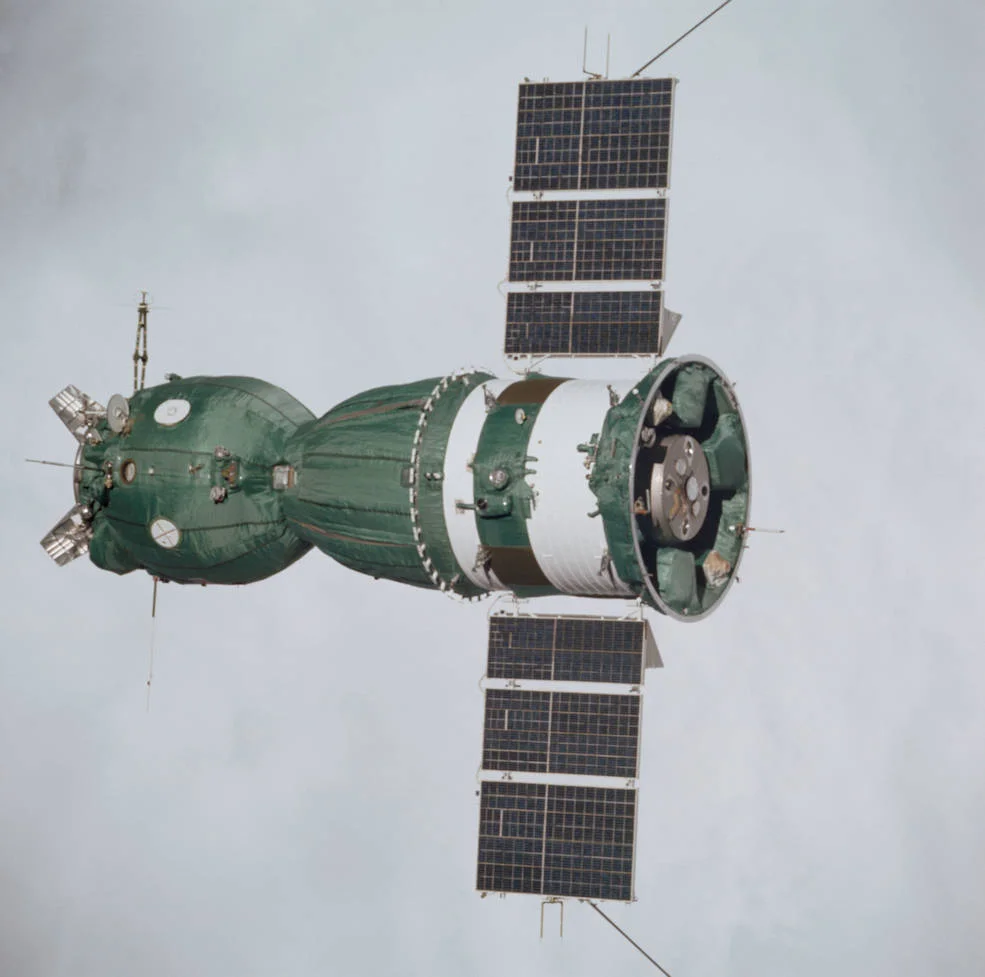
On July 17, 1975, Thomas Stafford and Alexei Leonov met at the doorway between their joined spacecraft and shook hands. It was an unusually simple image from an unusually complicated mission. Apollo and Soyuz had been developed separately, by countries competing in space, and neither could simply open a hatch into the other.
The Apollo–Soyuz Test Project made that meeting possible by solving several compatibility problems together. The famous photograph shows the people. The less familiar story is the equipment and preparation that made their encounter safe.
A practical question inside a political opening#
How could one country’s spacecraft help another country’s crew if the vehicles could not connect? Discussions of a joint rescue capability helped bring American and Soviet officials together around docking compatibility. By 1972, a formal agreement committed the two countries to an Apollo–Soyuz mission in 1975.
That goal was narrower and more concrete than ending the Cold War. It required teams to exchange enough information to make real machinery work together. A successful rendezvous would bring the vehicles close, but a successful rescue or crew exchange would also require a secure connection, compatible procedures and a passage that people could use. Politics created the opportunity; the engineering work had to make the opportunity usable.
Sources: [1]
A new doorway between existing spacecraft#
Apollo’s familiar docking hardware could not directly mate with the Soyuz system. The solution placed a separate docking module between them. On the Apollo side it used the probe-and-drogue arrangement inherited from lunar missions. On the Soyuz side it carried a new compatible interface.
The jointly selected docking concept was androgynous and peripheral. In this context, androgynous means that matching docking units could perform the active or passive role, rather than requiring two fundamentally different mating halves. Peripheral describes a connection arranged around the passage. Those terms concern the mechanism, not the nationality or rank of the crews. The design created an agreed interface between two spacecraft while allowing much of each spacecraft’s existing design to remain.
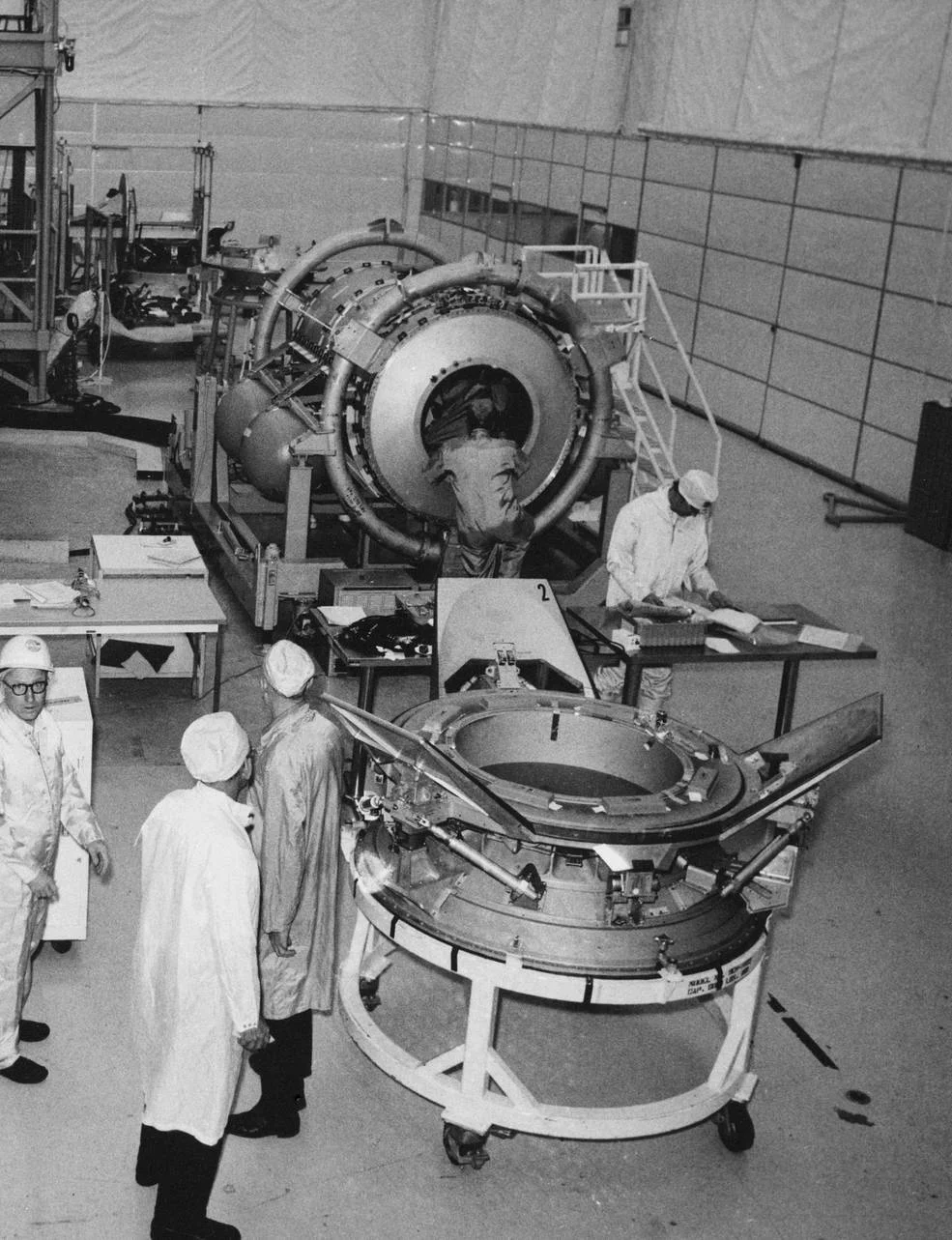
Image unavailable.
The Apollo–Soyuz docking module and its docking mechanism photographed during preparation at a ground facility.
How the adapter reached its place between the spacecraft#
The docking module did not launch already sitting between Apollo and Soyuz. NASA describes it riding beneath Apollo in the adapter above the rocket's upper stage, in the position that the lunar module occupied on Moon missions. After reaching orbit, Apollo separated, turned around, docked with the module and extracted it.
That sequence put Apollo's existing docking hardware at one end of the bridge and the compatible Apollo–Soyuz interface at the other. The drawing is a functional arrangement of the connected compartments, not a scale cutaway. Its two marked interfaces represent different hardware families. Calling the whole connection a single universal docking port hides the job the module actually performed.
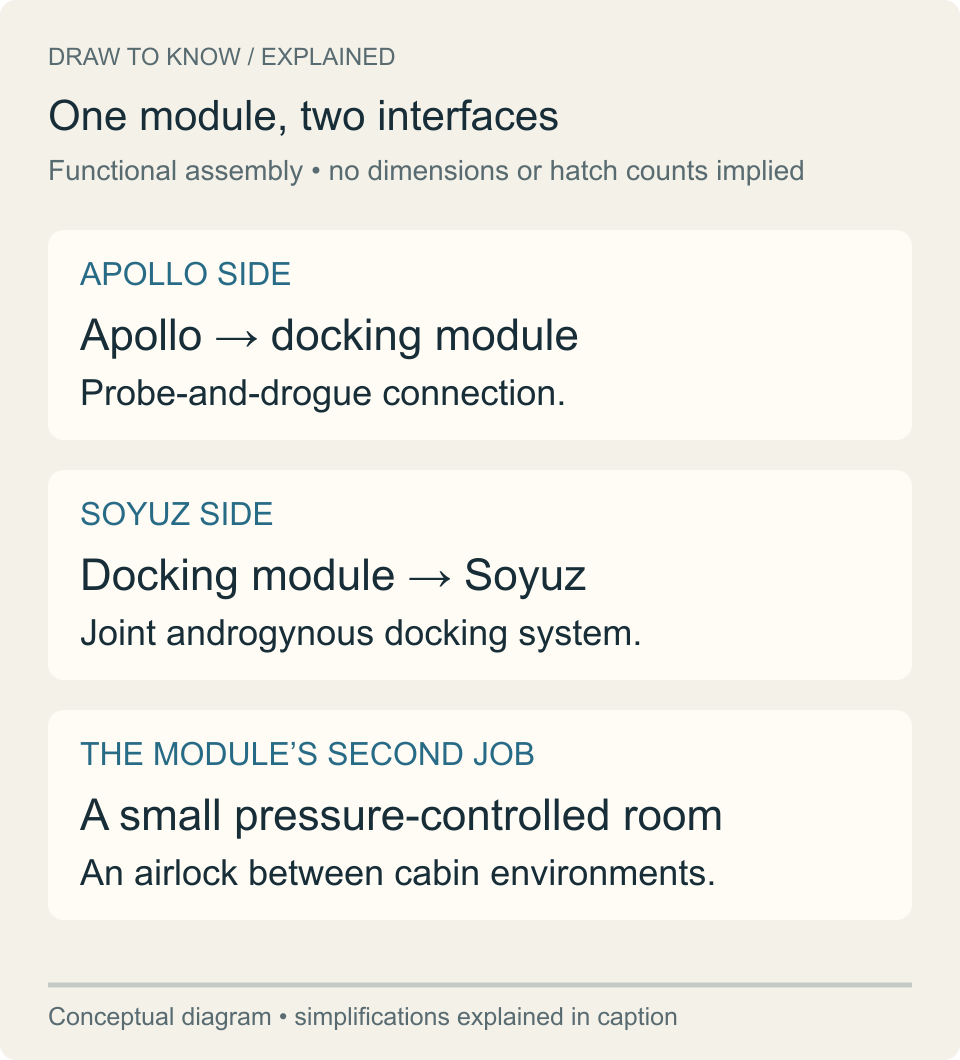
Image unavailable.
The docking module connects to Apollo through a probe-and-drogue interface and to Soyuz through the joint docking system, while also functioning as an airlock.
Sources: [2]
The cabins did not contain the same air#
Connection solved only half the problem. Apollo operated in orbit with essentially pure oxygen at about 5 pounds per square inch. Soyuz normally used an oxygen–nitrogen mixture at about 14.7 psi. For the joint mission, the Soyuz pressure was lowered to about 10 psi before docking, reducing the burden of preparing cosmonauts to transfer to Apollo’s lower-pressure environment.
The docking module therefore also acted as an airlock. Its atmosphere could be changed while hatches isolated it from the other cabins. Calling it a tunnel is correct but incomplete: a tunnel alone would not manage the pressure and gas differences. The module supplied a small, controllable transition space. The December 1975 mission evaluation treats its environmental-control functions and its structural role as parts of the same flight system.
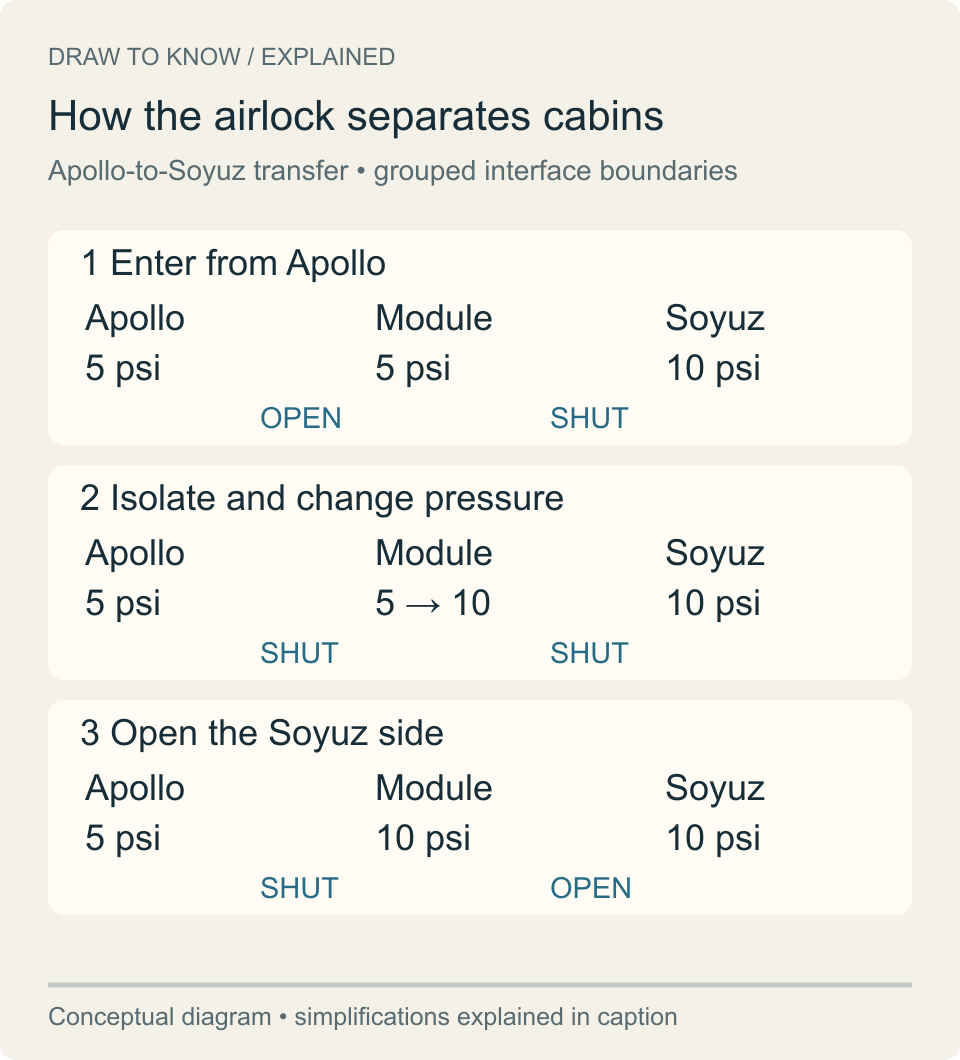
Image unavailable.
Three pressure states: Apollo and module at 5 psi with the Soyuz boundary shut; both boundaries shut while module pressure rises; module and Soyuz at 10 psi with Apollo isolated.
Why pressure across a hatch matters#
Pressure is force per unit area. A gas pushes on the surfaces around it; when two compartments have different pressures, a closed barrier between them experiences a net load. Equalizing the pressure reduces that load as well as avoiding an abrupt flow of air when a passage is opened.
For a scale example, consider a hypothetical flat barrier with an area of 0.10 square meter and a pressure difference of 5 psi, approximately 34.5 kilopascals. Force equals pressure difference times area, giving about 3,450 newtons. This is an illustrative calculation, not the area or certified load of an Apollo–Soyuz hatch. The actual hardware and transfer procedures were more complex.
The numerical example explains why a hatch is part of a pressure system rather than just a door handle. It also explains the value of a small intermediate compartment: its atmosphere can be adjusted while the other cabin remains isolated. The simplified transfer sequence in the preceding section groups hatches by the boundary they protect; it is not an operational checklist or a literal hatch count.
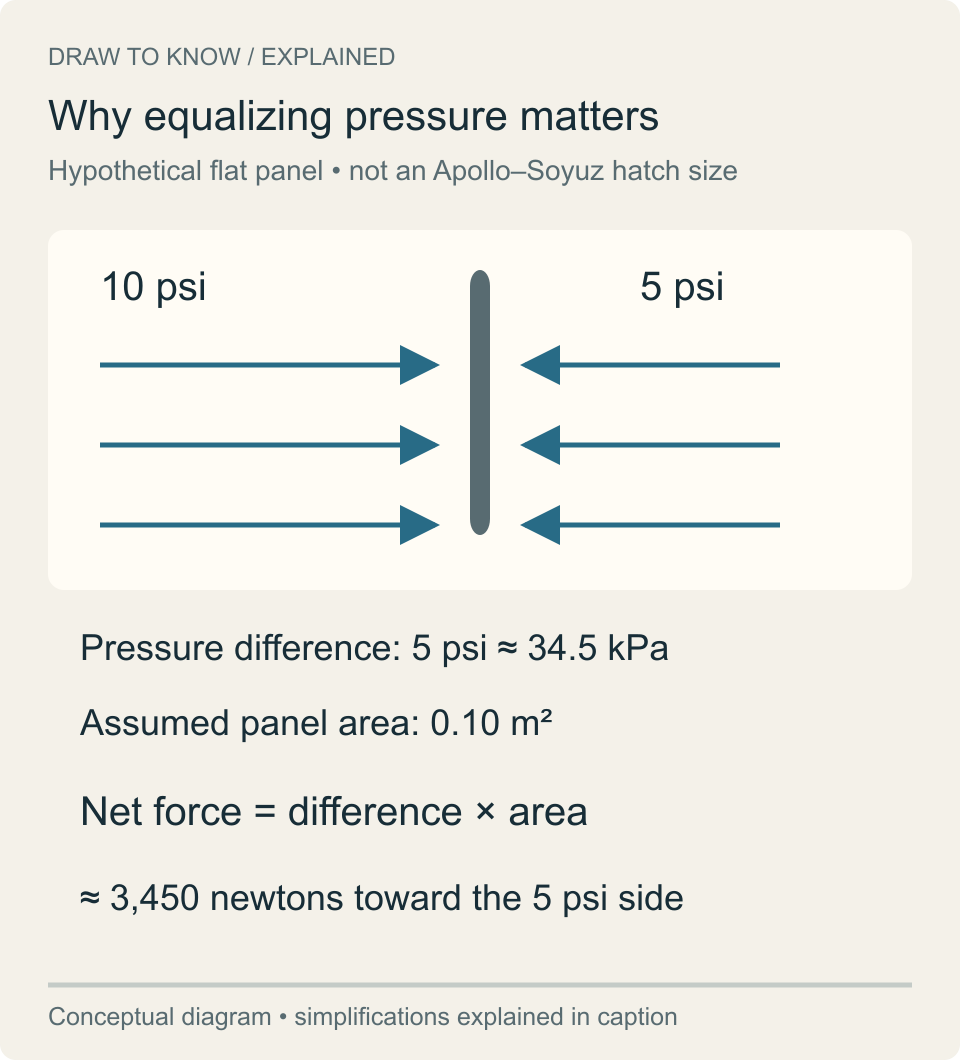
Image unavailable.
Opposing pressures act on a hypothetical panel. The difference of 5 psi over 0.10 square meter produces about 3450 newtons toward the lower-pressure side.
The crews practised the connection, too#
Stafford, Vance Brand and Deke Slayton flew aboard Apollo; Leonov and Valeri Kubasov flew aboard Soyuz. Their preparation included visiting one another’s training facilities and working with equipment that had not been designed around their own habits.
During joint training in Houston in February 1975, the crews used Apollo, docking-module and Soyuz simulators and mockups. They practised spacecraft-to-spacecraft communications in one another’s languages and reviewed the planned experiments. This was another form of compatibility work. A switch label, an instruction and a radio call all needed a shared meaning at the moment they were used. Rehearsing together made the boundary between the two spacecraft a familiar workplace before it became a doorway in orbit.
The handshake came after the checks#
After docking, the crews still had to prepare the passage. Stafford and Slayton entered the docking module, shut the hatches toward Apollo and raised the module’s pressure to match Soyuz. Only then could the last barrier between the visitors and their hosts be opened.
The module's intermediate pressure did not mean Apollo and Soyuz had to become one permanently uniform cabin. The closed Apollo-side boundary allowed the module to match Soyuz for that stage of the visit. Returning through the airlock required the corresponding preparation for the other side. Mechanical docking, atmosphere management and crew transfer were related achievements, but they were not the same event.
Stafford and Leonov greeted one another at the interface. In the surviving film image, the framing is tight and the moment is personal. Outside that frame were the module, its valves and seals, two spacecraft, and two control organizations. The sequence explains the photograph’s meaning more clearly than a claim that the crews simply opened their doors. Their meeting was the final human action in a prepared chain of mechanical and atmospheric transitions.
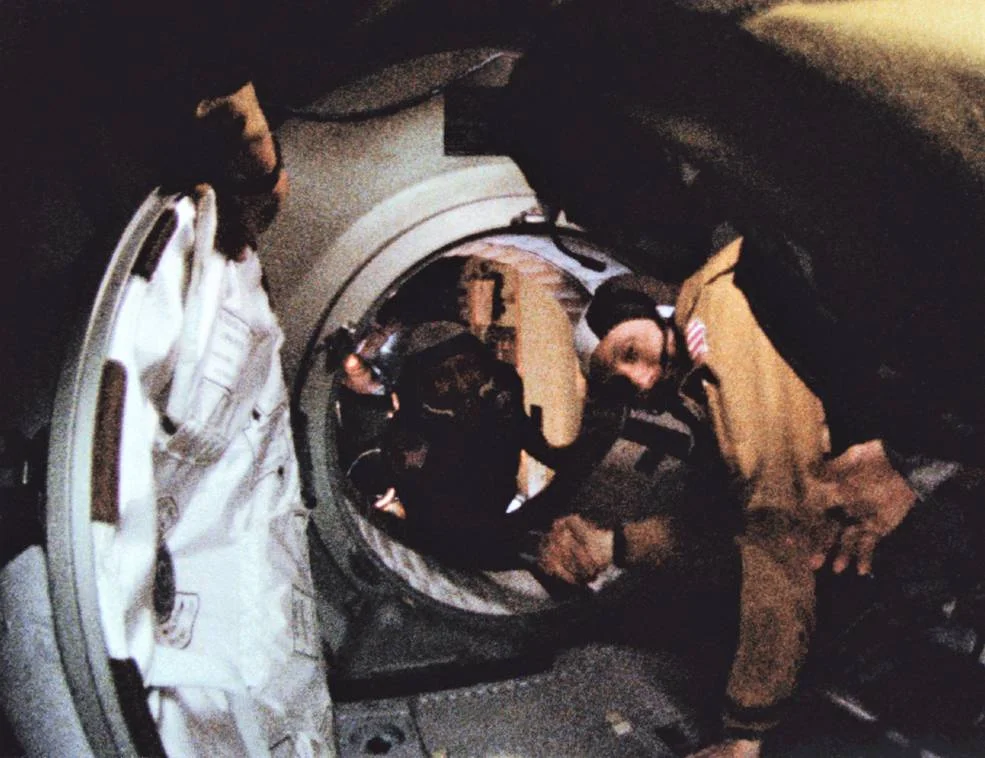
Image unavailable.
Alexei Leonov and Thomas Stafford reaching toward each other through the open spacecraft interface.
Sources: [3]
What the mission demonstrated#
The joint phase included crew visits, meals and experiments, as well as another docking after the first separation. The repeat maneuver mattered because a test project had to demonstrate operations beyond the first successful contact. NASA’s postflight evaluation documented the performance of the spacecraft, docking module and docking system.
It is tempting to draw a straight line from that handshake to permanent cooperation. The actual timeline is less tidy. American astronauts and Russian cosmonauts next flew together in 1994, and American and Russian spacecraft next docked in 1995. Apollo–Soyuz did not erase political conflict. It left something more specific: flight experience and a working example of how separate programs could agree on interfaces, train together and carry out a shared mission. The handshake endures partly because the doorway behind it was real.
Keep exploring
Sources & further reading
Follow the original research, records, and explanations behind this story.
- Apollo–Soyuz Test Project: Overview NASA History
Origins, cooperation agreement, mission chronology and the long gap before the next joint flights.
- 45 Years Ago: Six Months to ASTP Joint Mission NASA / John Uri
Docking-module architecture, atmospheric pressures and ground testing.
- 45 Years Ago: Historic Handshake in Space NASA / John Uri
Docking-day sequence, airlock operation, archival photographs and joint activities.
- 45 Years Ago: Apollo–Soyuz Test Project Crews Train in the US NASA / John Uri
Joint simulator exercises, language practice and science preparation in February 1975.
- Engineering principles to assure compatible docking between future spacecraft of USA and USSR NASA Technical Reports Server
Contemporary 1975 technical description of the jointly selected androgynous peripheral docking concept.
- Apollo Soyuz, mission evaluation report NASA Technical Reports Server
December 1975 engineering evaluation; docking-module and docking-system performance.
- The Apollo–Soyuz Mission NASA
Mission overview, crew identity and archival context.
- Gas Pressure NASA Glenn Research Center
Pressure as force per unit area. The example panel area in this article is hypothetical.
See the story in motion
Watch our illustrated video, then explore another question below.
Watch on YouTubeFollow the thread