
Astronauts train in freezing forests because a spacecraft can bring its crew back to Earth somewhere rescue teams cannot immediately reach. For crews preparing to fly in Russia's Soyuz spacecraft, winter survival training has rehearsed the interval between an unexpected landing and the arrival of help. Getting through re-entry and keeping people alive on the ground are different parts of the same journey.
The forest belongs to a much wider preparation. Underwater rehearsals teach spacewalk tasks. Spacecraft simulators exercise procedures and decisions. Cave expeditions make a team live with the consequences of its planning. Each setting provides something that is difficult to practise in a classroom, while leaving other parts of spaceflight unrepresented.
Training differs by agency, spacecraft, crew role and mission era.
Why would a returning spacecraft leave its crew in a forest?#
A landing outside the planned recovery area can separate a crew from the people and equipment waiting to meet it. Soyuz normally returns to land in Kazakhstan, but its crews also prepare for an unexpected landing in difficult terrain. The Canadian Space Agency's account of Soyuz training explains that a search-and-rescue team might take hours or even days to arrive after an off-target landing.
This is the reason for practising survival before launch. A successful descent does not guarantee an easy route for a helicopter, a vehicle or a person carrying medical equipment. The landing environment creates another set of problems: shelter, exposure, communication and the condition of the crewmembers. A crew needs procedures for that interval as well as procedures for flying the spacecraft.
NASA astronaut Mark Vande Hei described the connection in a 2017 interview before his first flight. He distinguished the land survival work done during astronaut candidacy from winter survival training associated with assignment to a Soyuz crew. The latter prepared him for a landing where rescuers could not reach the crew quickly.
The Soyuz exercise near Star City, Russia, belongs to preparation for that spacecraft. Other crews and agencies follow different programmes.
What do astronauts actually do during winter survival training?#
They practise using the equipment and materials available after landing to keep a small crew functioning until recovery. Vande Hei recalled leaving a training capsule in the forest, putting on cold-weather gear and using removable seat liners as sleds for equipment. His group built a lean-to with wood and parachute material, then adapted its shelter the following day. Maintaining the fire required a continuing supply of wood.
The practical lesson is about work as well as equipment. A shelter and a fire create jobs that have to be shared. Moving supplies, gathering fuel and resting all compete for the same people's time and energy.
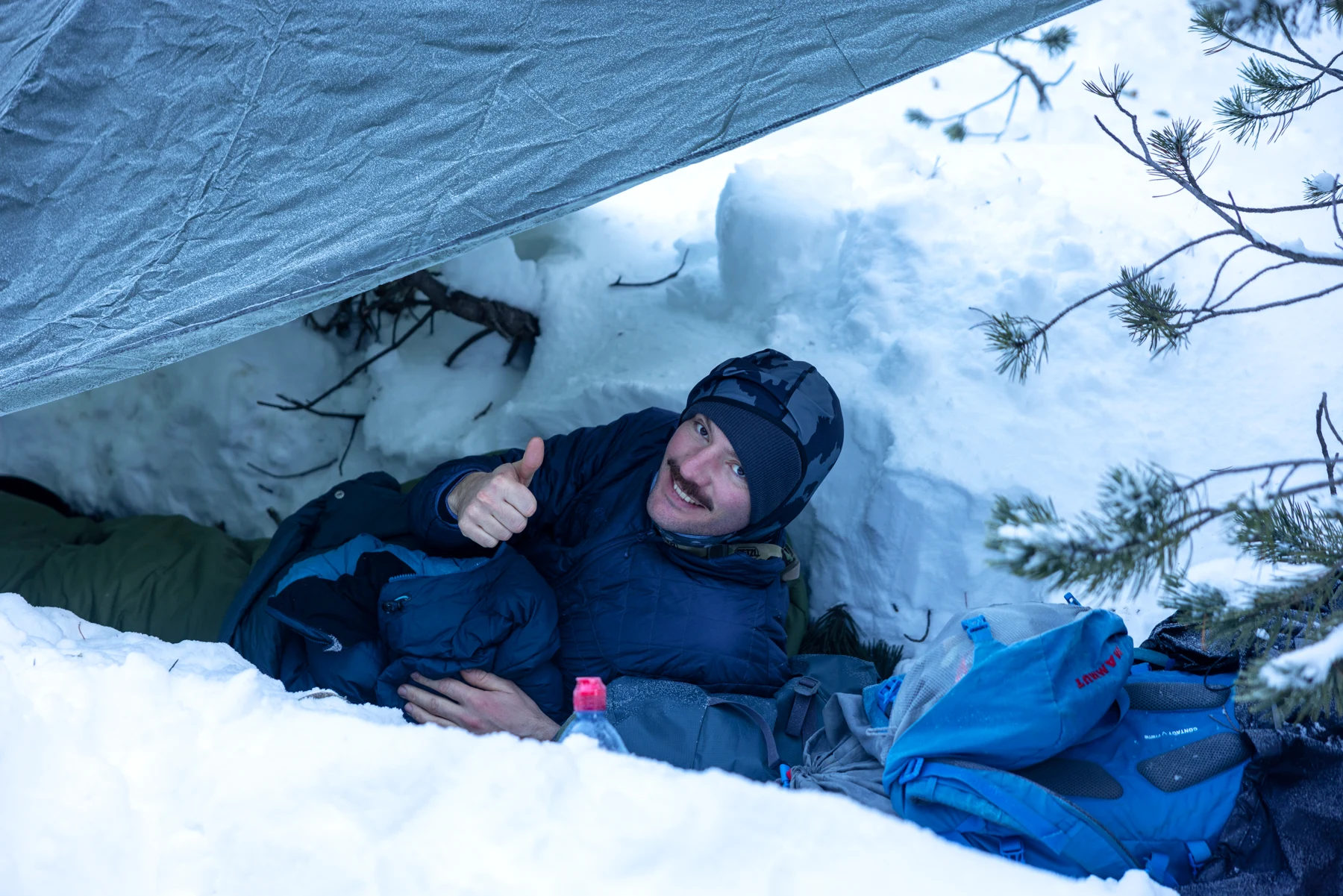
Other winter courses have different settings and activities. In 2024, ESA documented its astronaut candidates training in the Spanish Pyrenees. Their course included fire-making, snow shelters, improvised stretchers and instruction on cold injuries and hypothermia, the dangerous cooling of the body. The photograph above shows Marco Sieber in that Spanish training environment. It is not a photograph of a Soyuz crew stranded near Moscow.
The setting changes, but the connection to spaceflight is direct: the people who leave a spacecraft may have to become their own first source of shelter and assistance.
Why train people who are already experienced professionals?#
Selection identifies people with strong existing abilities; basic training gives them a shared foundation for a different job. A physician, an engineer and a test pilot arrive with valuable expertise, but none of those backgrounds automatically provides the full set of spacecraft skills.
NASA's selection guidance describes leadership, teamwork and communication alongside professional qualifications. Selected candidates enter a training programme at Johnson Space Center that includes station operations, spacewalking, aircraft flying and robotic-arm operation. Being selected begins the preparation for those tasks.
The Canadian Space Agency explains the purpose of its approximately two-year basic programme as bringing recruits with varied backgrounds to a common level of knowledge. Its subjects range from spacecraft operations and robotics to first aid, human behaviour, languages and photography. This breadth makes sense when a crew must operate equipment, document scientific work and help one another in a small workplace.
ESA's account of its 2024 winter course places that activity within a one-year basic training programme, followed by pre-assignment and mission-specific phases. NASA and Canada describe longer programmes. These timelines describe agency training, not a universal countdown to launch.
What does learning spacecraft systems mean in practice?#
It means learning to operate the systems that make the spacecraft habitable and controllable, then practising the tasks assigned to one's crew position. Knowing the name of a subsystem is a start. The crew also has to understand the controls, indications and procedures relevant to its work.
For station missions, the Canadian Space Agency describes training in full-scale models of the partners' modules. Scientific facilities bring their own systems: data management, electrical power, environmental control, thermal control and communications. An astronaut preparing to run an experiment needs to know how its equipment works within that larger environment.
Soyuz training adds the spacecraft's propulsion, electrical, thermal and communication systems. Its simulations include rendezvous and docking, manual flying and contingency manoeuvres during re-entry. Rendezvous means bringing two vehicles together in space; docking is the physical connection that follows. These are operational tasks with sequences to learn and crew responsibilities to coordinate.
The language used to carry out those sequences matters too. Canadian astronauts preparing for Soyuz have trained to communicate in Russian with mission control in Moscow. Language lessons therefore belong beside technical lessons: a correct observation is of limited use if the people who need it cannot understand it promptly.
The Soyuz TMA trainer photographed here is training hardware at Star City. Its presence illustrates the physical infrastructure behind the lessons. A photograph of a simulator cannot tell us which failure, if any, the instructors were introducing during a particular session.
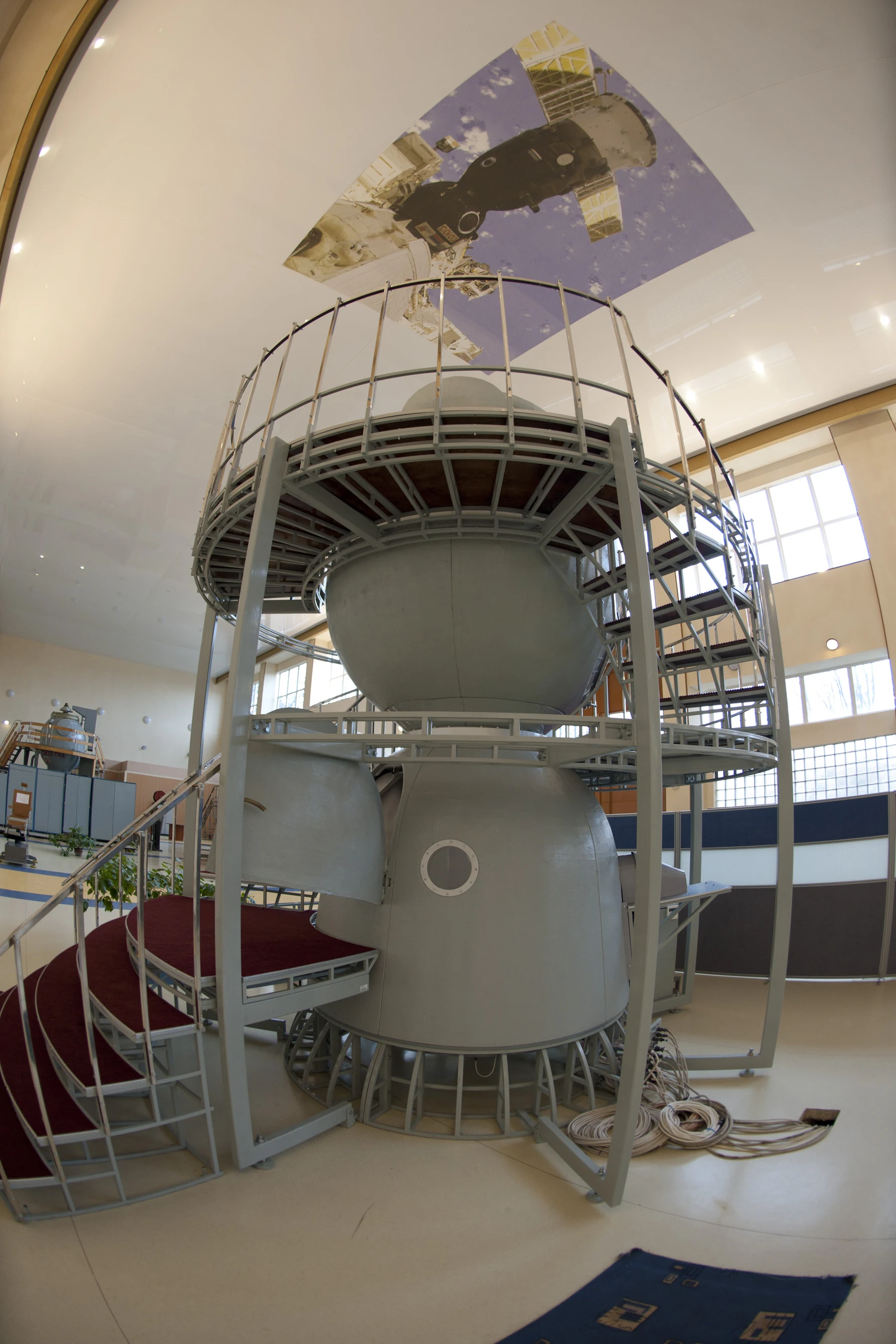
Image unavailable.
A Soyuz TMA simulator surrounded by access platforms at Star City.
How does a swimming pool prepare someone for a spacewalk?#
A large pool lets astronauts rehearse work around life-size spacecraft hardware while buoyancy supports their equipment. They can practise reaching a worksite, positioning themselves and handling tools in a suit, rather than trying to imagine the whole task from a drawing.
NASA's 1999 Hubble training photograph shows the value of this arrangement. Suited astronauts and supporting divers work around a full-scale telescope mockup in the Neutral Buoyancy Laboratory, or NBL, near Houston. Hubble servicing involved work at particular instruments and access points. A realistic mockup gave that work a physical setting before it had to be performed in orbit.
The NBL's 2006 fact sheet describes a pool 202 feet long, 102 feet wide and 40 feet deep, approximately 62 by 31 by 12 metres. Those dimensions accommodate substantial spacecraft mockups and extended tasks. They do not mean that the complete International Space Station fits inside: the same document explicitly says it does not.
A rehearsal also involves more people than the astronauts visible underwater. NASA lists suit technicians, support divers, medical personnel, trainers, communications staff and technical observers among the teams supporting NBL sessions. The facility helps develop procedures and check hardware compatibility as well as train people. Discovering an awkward reach or an unsuitable arrangement on Earth is part of its purpose.
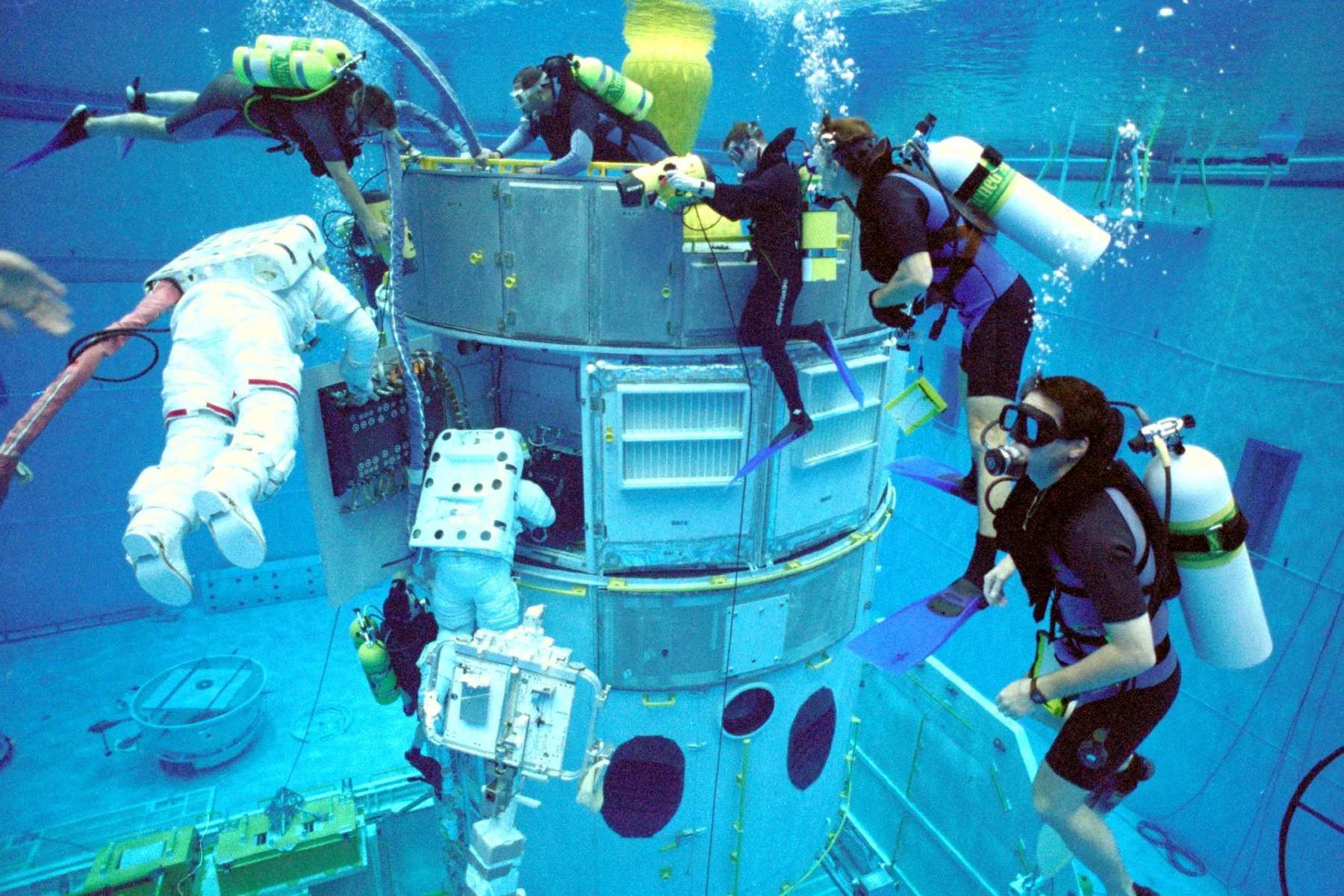
Image unavailable.
A suited astronaut and several divers work around an underwater Hubble telescope mockup.
Is neutral buoyancy the same as weightlessness?#
No. Neutral buoyancy balances an object's downward weight with the upward force exerted by the water. Weights and flotation devices are adjusted so that the suited astronaut can remain suspended instead of continuously rising or sinking. Earth's gravity is still acting.
An orbiting astronaut floats for a different reason. The astronaut and spacecraft are falling together around Earth. Gravity supplies the acceleration that keeps them in orbit, while neither needs a floor to hold them up in the way a person standing in a room does. NASA's explanation of microgravity stresses that gravity remains strong at space-station altitudes.
NASA identifies two important limits of pool training. The person inside the suit still feels their weight, even when the suit-and-equipment arrangement is neutrally buoyant. Water also resists motion. That drag can make a task easier or harder than it would be outside the station. A movement that slows because of water resistance is not a faithful demonstration of how the same movement will develop in orbit.
The distinction between weight and mass matters here. Making equipment float does not remove its mass, its resistance to changes in motion. In orbit, a large object may require no support against a floor, yet starting, stopping or turning it still requires forces. A trainee must learn the relevant handling behaviour without assuming that everything felt in the pool will carry over unchanged.
Neutral buoyancy is therefore useful for a defined set of tasks. The mockup and suit make the work physically recognisable; instructors account for the parts of the environment that water changes.
What can virtual reality add to a physical rehearsal?#
Virtual reality can supply a changing spacecraft scene and simulated motion without requiring a new physical set for every situation. NASA's Virtual Reality Laboratory combines computer graphics with controls and, for some tasks, robotic hardware that provides forces to the trainee. It can bring spacewalkers and robotic-arm operators into the same simulated operation.
One application is SAFER, the Simplified Aid for EVA Rescue. EVA means extravehicular activity: work outside a spacecraft. SAFER is a small propulsion unit carried for the unlikely event that a spacewalker becomes untethered. A virtual trainer lets an astronaut practise the manoeuvring involved in returning to the station. The photograph shows Bob Behnken working with such a trainer in NASA's lab.
This preparation can continue after launch. On 10 May 2018, NASA reported that station astronauts Ricky Arnold and Drew Feustel were using virtual reality to practise SAFER manoeuvring while preparing for a spacewalk. Training was part of the working mission schedule.
Different facilities answer different needs. A pool provides a suited person with real hardware to work around. A virtual environment can represent a broader scene and motions that would be difficult to reproduce safely in that pool. Neither exercise, by itself, recreates every sensation or hazard of a spacewalk.
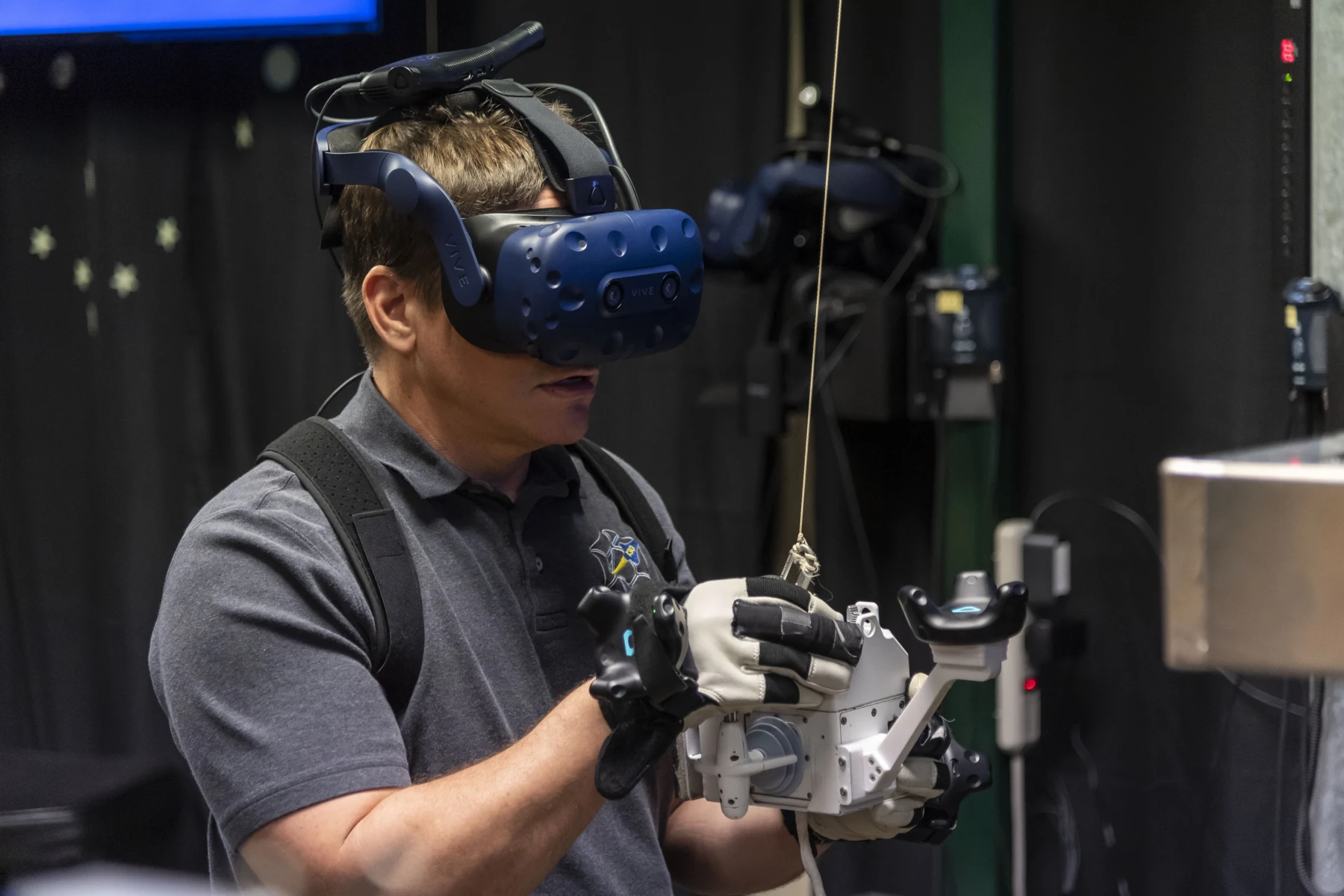
Image unavailable.
Bob Behnken wears a virtual-reality headset and holds the controls of a SAFER trainer.
Why send astronauts underground?#
ESA's CAVES course gives a team a real expedition to manage in an unfamiliar environment. The name stands for Cooperative Adventure for Valuing and Exercising human behaviour and performance Skills. Participants learn caving techniques, then use them while exploring, documenting their surroundings and carrying out scientific work together.
Caves offer several conditions relevant to a space mission: confinement, isolation from everyday life, limited comfort and supplies, no normal daylight cycle and tasks where safety depends on procedures and equipment. These are useful pressures on a team even though the cave retains Earth's gravity and is not a spacecraft.
ESA describes a daily routine organised around timelines and activity lists. A debrief gives participants a chance to examine decisions and errors while they can still change how they work the next day. Experienced spacefarers and people who have not yet flown can take part together, bringing different experience to the discussion.
The 2019 course involved six astronauts from five agencies. ESA's advance account described a week of preparation followed by six days living and working in a Slovenian cave; its 2019 science-training description called the complete course three weeks long. Read together, these accounts indicate that six days was the underground component of a longer course. Neither source itemises every day of the programme. These numbers describe that edition, rather than a requirement that all astronauts complete the same cave expedition.
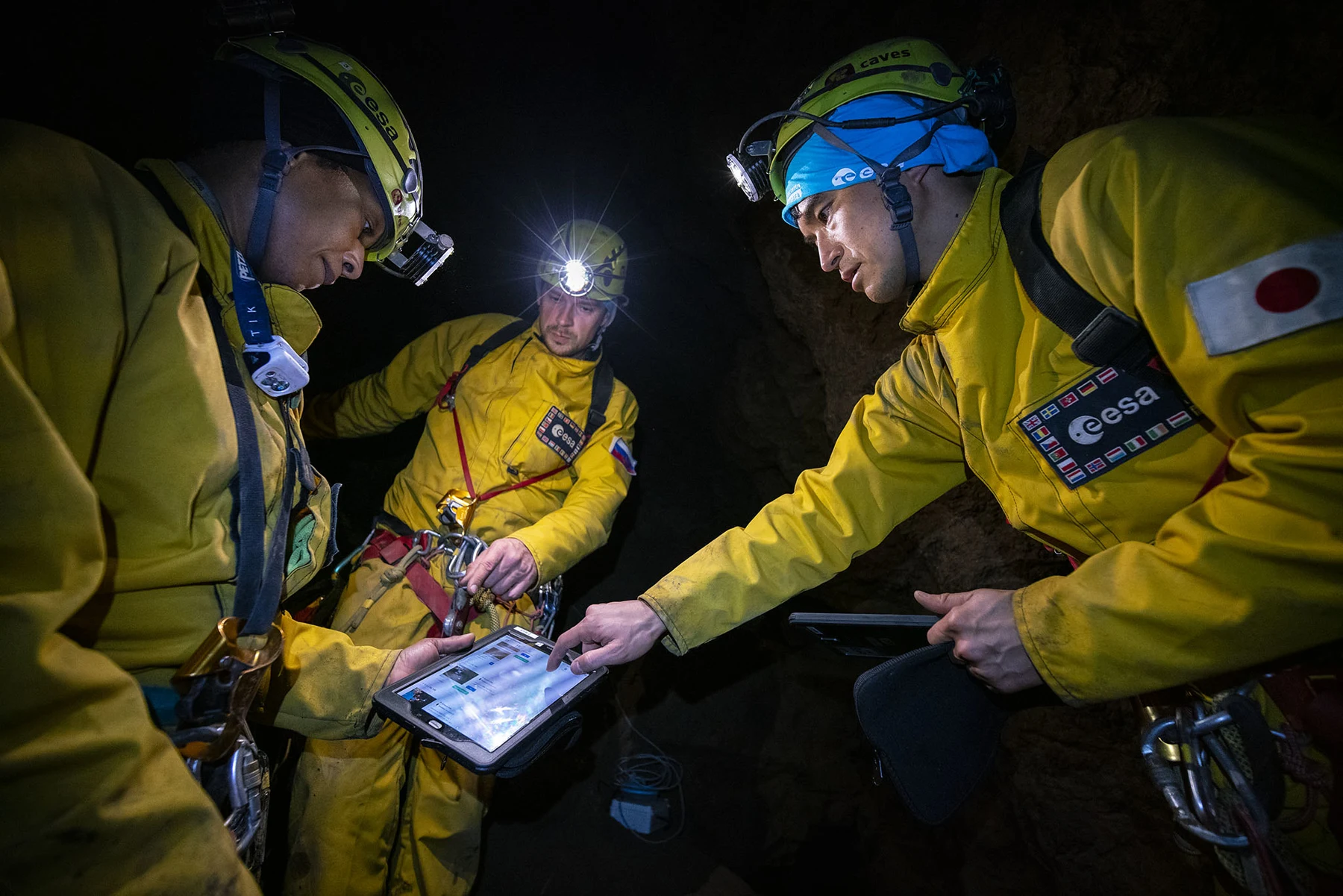
Image unavailable.
Three helmeted CAVES participants examine a shared tablet in a dark cave.
Is the science in a training cave real?#
Yes. The expedition is a spaceflight analogue, but the cave is a real environment that can be investigated. For the 2019 course, ESA described planned work on the cave's climate, fauna and water, including air and water quality and pollution. Scientific tasks gave the crew work that required care beyond getting from one place to another.
The water-sampling photograph shows a training step in that process. People gather around an actual water source, with equipment in use at the edge. Its archive caption identifies it as learning to take water samples during CAVES 2019. The image documents the lesson; it is not evidence of a particular laboratory result.
The course also connected field observations to colleagues elsewhere. ESA described an Electronic Field Book for procedures, scientific records and video logs. A surface mission-control team could follow observations paired with photographs and send comments back. This resembles an important division of work in space: the person beside the instrument is one member of a larger scientific team.
That arrangement makes documentation an operational skill. A sample or observation has to remain understandable to someone who was not standing beside the astronaut. It provides real objects to observe and real records to make, within the constraints of a shared expedition.
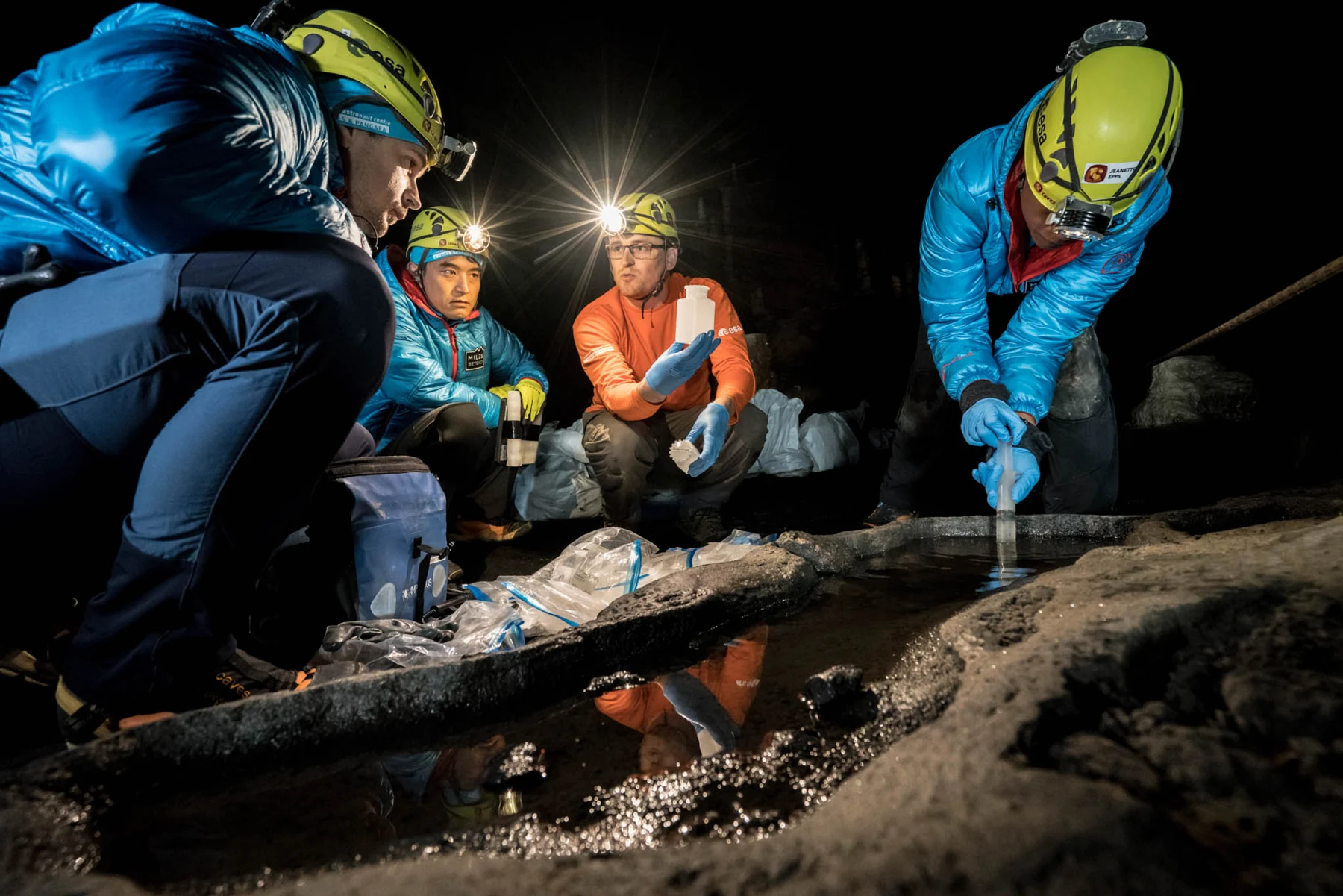
Image unavailable.
Helmeted CAVES participants gather around a water source while one uses sampling equipment.
Does every crew need a doctor?#
A crew's designated medical officer can be a trained astronaut who is not a physician. NASA's human-spaceflight standard explicitly allows this. It describes general medical training for crewmembers, with additional, specific preparation for those assigned as Crew Medical Officers.
The general preparation includes first aid, cardiopulmonary resuscitation and familiarity with medical equipment and spaceflight health issues. More specialised training addresses the role assigned to the person and the needs of the mission. The standard says that the training depends on factors including mission duration, crew size and existing expertise.
Ground support is part of the arrangement. NASA's medical-operations material describes the use of telemedicine and clinical support from Earth, alongside the crew's own skills. Training prepares people to take useful action and work with that support. It does not give a small spacecraft the facilities of a hospital.
This also helps explain why technical competence and teamwork are taught together. When a crewmember needs assistance, another crewmember must be able to use the relevant equipment and communicate clearly. The training prepares the people actually aboard to work within the capabilities of their mission.
How do crews practise emergencies without creating one?#
They rehearse recognisable signs of a failure and the response to it in controlled simulations. On the station, major emergency categories include fire, loss of cabin pressure and a toxic atmosphere. A training exercise can give the crew and ground controllers simulated data that must be interpreted before the appropriate procedures are carried out.
A NASA account of the development of onboard emergency training describes instructors choosing the emergency type and initial conditions to meet particular learning objectives. Ground personnel could see simulated telemetry at their consoles and communicate information to the crew. This trained the connection between the spacecraft and mission control, as well as the people inside the spacecraft.
The work includes equipment and decisions. A crewmember must know how to use protective gear, understand the relevant indications and coordinate the response. Procedures turn those actions into a sequence that a crew can practise together. A simulator allows an instructor to introduce complications while keeping the hazard simulated.
From qualification to practice in orbit#
The Canadian Space Agency records an example from Robert Thirsk's 2005 qualification exam: the scenario included several spacecraft failures and ended with a simulated fire. His group had to put on masks, respond to the fire and close hatches to limit smoke spread. This is a historical example of a demanding examination, rather than a list of failures encountered on a real flight.
Rehearsal continues in orbit. NASA's station report for 19 May 2020 records the crew and ground controllers using simulator data for fire and rapid-depressurization exercises. Launch does not end the need to practise with the team that would handle the event.
Why can the first flight come years after selection?#
Completing basic training makes an astronaut available for further duties and preparation; it does not put a launch date on the calendar. The Canadian Space Agency separates basic, pre-assignment and mission-specific training. During the middle phase, astronauts maintain skills and support spaceflight from the ground. Their work can include communications with crews, testing robotic procedures and developing spacewalk choreography.
Once a mission is assigned, preparation becomes more specific. The crew needs familiarity with the spacecraft, station facilities, planned experiments and responsibilities of that flight. Training also takes place at the centres of different partner agencies. A qualification in one area is part of that preparation, rather than proof that every task for every mission has already been mastered.
Thomas Pesquet's early career provides a documented example. ESA selected him in May 2009; he completed basic training in November 2010. Subsequent preparation included spacecraft systems, survival work, CAVES, spacewalking and underwater expedition training. ESA announced his Proxima assignment in March 2014, marking the start of mission-specific training. His first launch followed in November 2016.
Those dates describe Pesquet's route to one mission. They do not establish a seven-year minimum or an average waiting time. The interval contains work as well as waiting, and it differs between people and programmes.
The pool, cave, simulator and winter camp each prepare a different part of that work. An astronaut needs to operate spacecraft equipment, cooperate with colleagues, carry out research and cope with an interrupted plan. The freezing forest belongs in the preparation because the crew's responsibilities may continue after the spacecraft has reached the ground.
Keep exploring
Sources & further reading
Follow the original research, records, and explanations behind this story.
- Training and Operations NASA
Survival Training: emergency Soyuz landings; the Shuttle–Mir historical context only.
- Before His First Flight NASA
Mark Vande Hei’s 2017 account of Soyuz winter survival and its relation to crew assignment.
- Astronaut basic training: winter survival ESA
Marco Sieber and the 2024 ESA basic-training winter course in the Spanish Pyrenees.
- Become An Astronaut NASA
Selection, candidacy and breadth of NASA basic training.
- Basic training Canadian Space Agency
Purpose and subjects of Canadian basic training; approximately two years in the programme described.
- Mission-specific training Canadian Space Agency
Full-scale module training, scientific-facility systems, mission-specific preparation.
- Pre-assignment training Canadian Space Agency
Maintaining skills, ground duties and Russian-language preparation before a flight assignment.
- Flight training and simulations Canadian Space Agency
Soyuz tasks and systems, remote-landing contingency and Thirsk’s 2005 simulated qualification exam.
- Sonny Carter Training Facility: The Neutral Buoyancy Laboratory NASA
Neutral buoyancy, limits, pool dimensions, mockups and the supporting training team.
- Building on a Mission: Neutral Buoyancy Facilities for Spacewalk Training NASA
Historical context and dimensions of the NBL, established use for Hubble and station work.
- Water Walk: Training for a Hubble Mission (1999) NASA
Underwater Hubble mockup, suited training, archive image identity and 1999 release.
- What is Microgravity? NASA
Free fall in orbit, substantial gravity at station altitudes, and unchanged mass.
- Virtual Reality Training Lab NASA
Integrated EVA/robotics training, force-feedback hardware and Bob Behnken SAFER trainer image.
- Virtual Reality Training and Global Robotics Work Before Spacewalk NASA
Documented SAFER practice aboard the station on 10 May 2018.
- What is CAVES? ESA
Course purpose, skills, environmental analogies and daily debriefing.
- A new journey into Earth for space exploration ESA
2019 participants, preparation and underground duration; science operations and Electronic Field Book.
- Science in the cave ESA
Published description of the CAVES 2019 science programme and three-week course.
- Learning how to take water samples during CAVES ESA
Archive caption identifies water-sampling training during CAVES 2019.
- Underground organisation during a CAVES expedition ESA
Archive image of expedition organisation and shared work.
- Soyuz TMA simulator ESA
Exterior view of a Soyuz TMA simulator at Star City; archival identity and credit.
- 5.0 Training NASA
General medical training and additional Crew Medical Officer preparation.
- Autonomous Medical Operations NASA
Role of telemedicine and ground clinical support; limits of onboard medical resources.
- The Evolution of On-Board Emergency Training for the International Space Station Crew NASA Technical Reports Server
Instructors choose simulated emergency conditions; ground teams receive simulated telemetry.
- ISS Daily Summary Report – 5/19/2020 NASA
Actual onboard emergency rehearsal with the crew and mission control.
- Thomas training highlights ESA
Documented sequence of training between selection and Proxima; March 2014 assignment.
- Thomas Pesquet ESA
May 2009 selection, November 2010 basic graduation, March 2014 assignment and first launch in November 2016.
Follow the thread