
A source can be present in a telescope’s data and still escape a search. Chandra’s newly recognized hypersoft X-ray sources emit photons in a part of the recorded energy range that earlier searches could largely miss.
In results announced in September 2026, astronomers reported 84 such sources across six nearby galaxies. Their positions are measured; their physical identities remain uncertain. A possible connection to exploding white dwarfs is still a hypothesis.
How can a new discovery come from old observations?#
An archive search can ask a different question of photons that a telescope recorded years earlier. Chandra’s Advanced CCD Imaging Spectrometer, or ACIS, makes images while measuring the energy of incoming X-rays. Researchers can therefore construct different images from different energy selections within the same observations.
Mustafa Muhibullah, Jimmy Irwin and Rosanne Di Stefano searched publicly available Chandra data for sources concentrated at the lowest accessible X-ray energies. Sources appeared in the low-energy images and became weak or absent in images made from more energetic photons. A search that starts above that low-energy window can overlook them even when the underlying observation contains useful evidence.
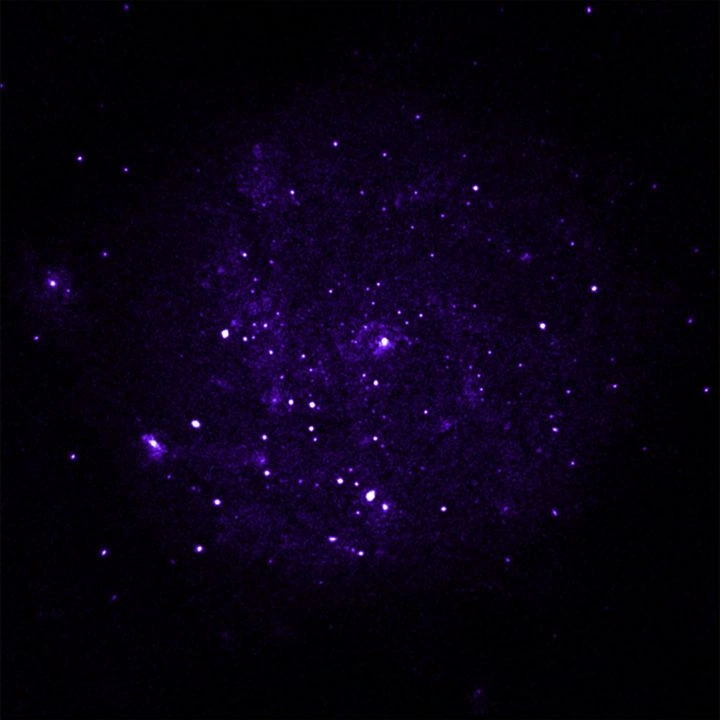
The announcement date describes when the result was presented, rather than when all the light was collected. The Chandra image of M101 accompanying the release combines 25 observations made from March 2000 to January 2005, totaling 274 hours of observing time. The official science release is dated September 9, 2026; the paper’s arXiv record also preserves earlier versions, beginning in February 2026. Those are different milestones in the same investigation.
What does “hypersoft” mean?#
“Soft” describes the energy of an X-ray photon. It does not describe a blurry picture or a gentle physical environment. X-rays are electromagnetic radiation, like visible light, but with much more energy per photon. Within X-rays, lower-energy photons are called soft and higher-energy photons hard.
Astronomers often express these energies in kiloelectronvolts, abbreviated keV. One keV is 1,000 electronvolts. The comparison shown here uses photons with measured energies of 0.15–0.3 keV in one image and 0.3–1.0 keV in the other: 150–300 electronvolts compared with 300–1,000 electronvolts.
In this study, “hypersoft” names sources detected primarily or exclusively below 0.3 keV. It is an observational description of an unusually low-energy spectrum, not a confirmed type of star. The word “supersoft” was already used for luminous sources dominated by low-energy X-rays, including systems involving white dwarfs. The new label draws attention to emission pushed toward an even lower-energy observing window. It does not establish that every hypersoft source shares one mechanism, or that every previously known supersoft source belongs in this sample.
What does the two-band comparison actually show?#
It shows that some positions contain a detectable concentration of very low-energy X-ray events without a comparable detection in the higher-energy image. The research team’s example is the central region of the elliptical galaxy NGC 3379. White ellipses mark positions that stand out in the 0.15–0.3 keV panel and fade in the 0.3–1.0 keV panel.
ACIS records events from which astronomers estimate photon positions and energies. Counting events in energy intervals produces a spectrum: a distribution of detected photons by energy. An image made from one interval is a spatial view of that selection. Both representations carry information that a single broad-band picture can hide.
A missing dot in the higher-energy panel does not prove that the object emits absolutely no higher-energy photons. A finite exposure has a detection limit; background events and detector response also matter. The defensible observation is a strong preference for the lowest-energy detections, with little or no detected emission at higher energies. The image comparison illustrates the evidence, rather than supplying a complete physical diagnosis by itself.
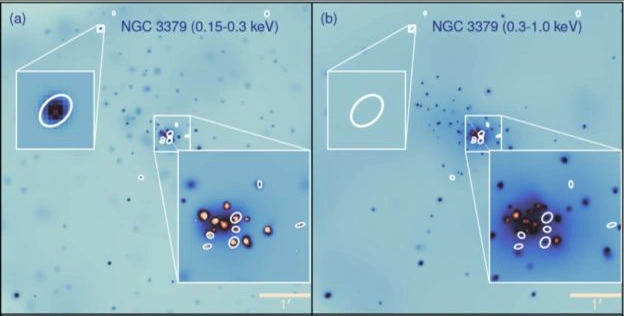
Image unavailable.
Side-by-side X-ray maps of NGC 3379 with enlarged insets and white ellipses; marked spots appear in the 0.15–0.3 keV panel and fade in the 0.3–1.0 keV panel.
Were all 84 sources found in the Pinwheel galaxy?#
No. The 84-source sample spans six searched galaxies: the spirals M101 and M31, plus four elliptical galaxies. The team found examples in regions of active star formation and in environments with older stars. The population therefore extends beyond one spectacular spiral image or one kind of stellar neighborhood.
M101, the Pinwheel galaxy, is the subject of the release image. Its annotated version marks seven newly identified objects. The cover used here is the Chandra X-ray layer alone, displayed in purple; it contains many X-ray sources and does not identify all of them as hypersoft. The release’s separate composite adds Hubble optical light in red, green and blue. Those colors communicate different data layers. X-rays themselves are invisible to human eyes.
The number 84 is the result of this search, not a census of every hypersoft source in the Universe. The paper describes the objects as point-like and away from galactic nuclei. “Point-like” means unresolved at the telescope’s angular resolution; it does not mean that the emitting system has zero physical size. Recognizing this population also does not establish that every one of its objects was wholly unknown at every wavelength before the study.
Why can bright sources be so difficult to detect?#
Brightness at the source and the number of photons reaching a detector are different quantities. These systems may emit much of their radiation in the extreme ultraviolet, or EUV, just beyond the lowest-energy X-rays. Neutral hydrogen and helium between stars readily absorb EUV photons, blocking our direct view of much of that emission from distant sources.
Chandra can detect a surviving X-ray signature on the higher-energy side of that radiation distribution. That is an indirect route to an otherwise difficult observing window. Absorption, however, remains part of the problem: the spectrum arriving at the telescope has been altered by intervening material. A source can be intrinsically powerful while giving the detector relatively few useful events.
Instrument sensitivity and observing time impose further limits. The team’s explanation identifies Chandra’s declining low-energy sensitivity and large apparent brightness changes among the reasons these sources escaped attention. Long exposures collect more photons from a faint source, but they do not remove absorption or make every source detectable. A later failure to detect one could reflect a changed source, a less favorable observation, or both.
Which properties are measured, and which are inferred?#
The direct evidence consists of detected events, their estimated energies and positions, and how their numbers vary between observations. Temperature, total emitted power and the nature of the central object require interpretation of those measurements.
A spectral model predicts how a source would emit at different energies, how gas would absorb the light, and what the instrument would record. Researchers compare that prediction with the counts. For these exceptionally soft sources, much of the proposed output lies outside the narrow X-ray window that is actually detected. Estimates of total power, called bolometric luminosity, therefore depend on extrapolating a model into the EUV.
That distinction is especially important here. The paper’s abstract separates luminosity in the observed narrow X-ray band from larger bolometric luminosities suggested by spectral models. A claim that Chandra directly measured all of that EUV power would overstate the evidence. Different assumptions about temperature and absorption can change what is inferred about radiation we cannot readily see.
Could these be white dwarfs preparing to explode?#
Some could involve white dwarfs, and a connection to some future Type Ia supernovae is plausible. The observations have not established that identity for the whole sample or predicted an explosion for a particular source.
A white dwarf is a dense stellar remnant. In a close binary, it can pull material from a companion, a process called accretion. Falling material releases energy as it heats up. Hydrogen accumulating on the white dwarf can also undergo nuclear burning. These are distinct ways of supplying radiation, and a soft spectrum alone does not decide between them.
There is a useful clue in M31: the team associates several of its less luminous hypersoft sources with novae. A nova occurs when accumulated material undergoes a thermonuclear runaway on a white dwarf. The white dwarf survives such an outburst; a nova is a different event from the Type Ia explosion that destroys a white dwarf.
For more luminous sources, the researchers consider sustained nuclear burning on white dwarfs. An expanded photosphere, the outer region from which radiation escapes, could have a lower effective temperature and shift more output toward the EUV. If some such systems retain enough accreted material to grow toward an unstable mass, they could be part of a route to Type Ia supernovae. Establishing growth and eventual explosion requires much more than identifying a very soft X-ray spectrum. The team also considers accreting black holes, while the official release includes neutron-star systems among the possible identities. The observational class may contain several physical classes.
What would help identify the sources?#
Observations that connect the soft X-ray behavior to an independently identified system would narrow the possibilities. The M31 nova associations already show why information beyond a single X-ray image matters. Repeated observations can test whether brightness and spectral shape change together; optical counterparts and spectroscopy could test whether a plausible companion or surrounding gas is present. These are ways to distinguish the proposed mechanisms, rather than a claim that one scheduled observation will settle them all.
The possible importance extends beyond explosions. Energetic EUV photons can remove electrons from atoms, a process called ionization. If a substantial population of these sources emits strongly in the EUV, it could contribute to ionizing gas between stars. The team presents that as a possible answer to a missing-energy problem in some galaxies. Counting detected X-ray sources alone does not establish their full contribution to that gas.
The lasting result is a more precise observing question: what populations appear when astronomers search the lowest-energy events that earlier selections could discard? Chandra’s archive provides evidence for such a population. Its spectra, changing brightness and associations with other objects will determine how many different kinds of systems lie behind the name.
Keep exploring
Sources & further reading
Follow the original research, records, and explanations behind this story.
- NASA's Chandra Unveils Mysterious X-ray Objects Chandra X-ray Center
September 9, 2026 release; 84 sources in six galaxies, energy selection, candidate identities and possible implications.
- Hypersoft X-ray Sources as a Low-Energy Class of Luminous Cosmic Emitters arXiv; Mustafa Muhibullah, Jimmy A. Irwin and R. Di Stefano
Abstract and submission history: below-0.3 keV emission, point-like non-nuclear sources, and observed-band versus model-inferred bolometric luminosity.
- M101 — September 9, 2026 Chandra X-ray Center
M101 image origin, seven objects, ACIS, observation dates/time and false-color layers.
- Science Instruments Chandra X-ray Center
Advanced CCD Imaging Spectrometer measures incoming X-ray energies while making images.
- X-Rays — Another Form of Light Chandra X-ray Center
Photons, electromagnetic radiation and energy spectra.
- Double Trouble: A White Dwarf Surprises Astronomers Chandra X-ray Center
Established supersoft terminology; why nuclear burning and accretion cannot be equated from softness alone.
- White Dwarfs & Planetary Nebulas Chandra X-ray Center
Dense remnants, accretion heating, nova outbursts; used for stable basic mechanism only.
See the story in motion
Watch our illustrated video, then explore another question below.
Watch on YouTubeFollow the thread