
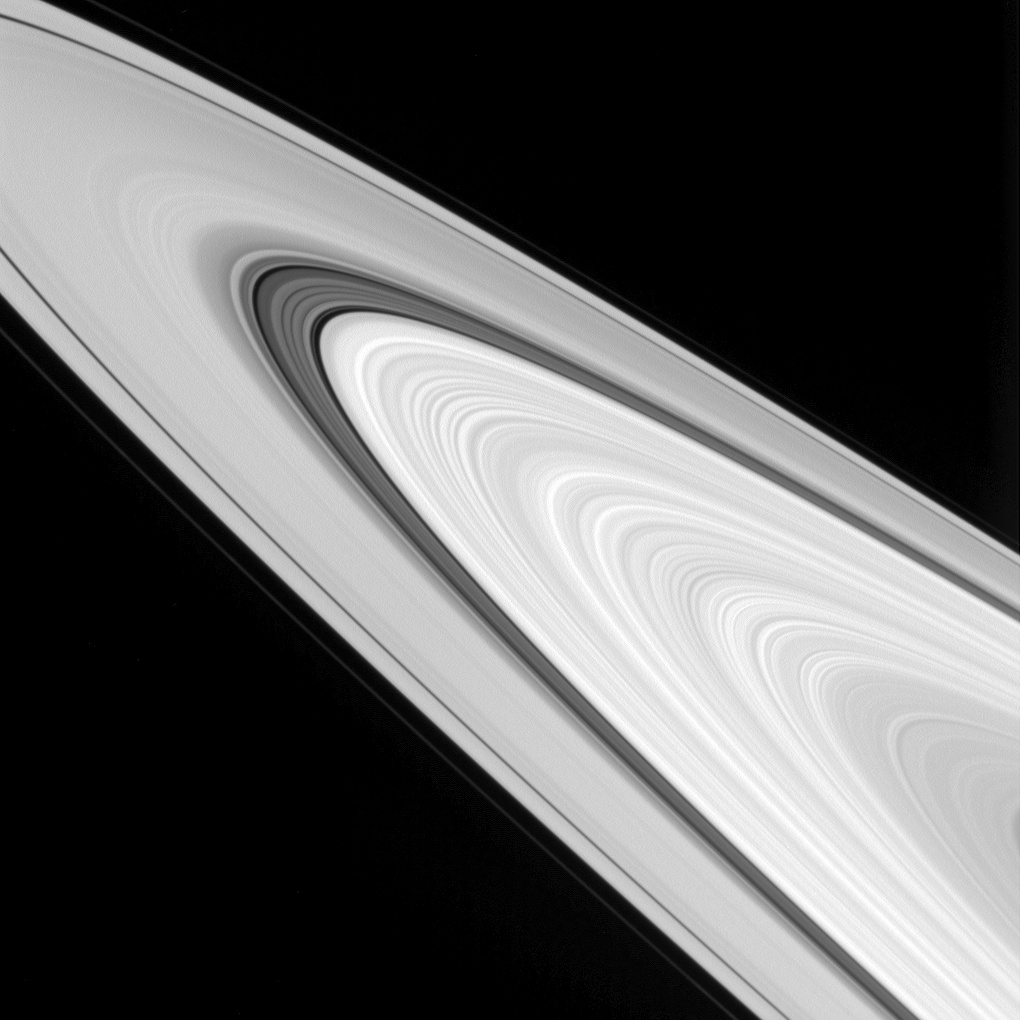
Saturn’s rings look like a broad, continuous platform in distant photographs. Up close, they are an enormous population of separate orbiting particles. A city among them would have to function as a collection of spacecraft, with its own pressure vessels, power supply and life-support systems.
The settlement imagined here is a thought experiment. Observations of Saturn and experience with spacecraft let us identify some requirements, but they do not establish that a ring city would be safe, affordable or practical to build.
Could buildings stand on the rings?#
There is no continuous surface to stand on. The main rings contain vast numbers of icy particles, with dust and rocky material mixed in. Each particle follows its own path around Saturn.
A structure placed among them would need an orbit, just as a spacecraft does. Connecting buildings would not give the collection a foundation. The connections would carry forces, while the whole settlement still moved through Saturn’s gravitational field.
The photograph above shows ring structure observed by Cassini. Even that detailed view combines the light from countless particles within each image pixel. The bright bands should not be read as solid lanes or as evidence of open construction sites between them.
Why can’t a city simply follow one ring around Saturn?#
For approximately circular paths, particles closer to Saturn orbit faster than particles farther out. A wide settlement extending across the rings would therefore span locations whose natural orbital motions differ.
An imagined rigid bridge between those locations would have to resist the tendency of its parts to follow different paths. A fleet of separate habitats would instead need a plan for their relative motion, transfers and collision avoidance. Neither arrangement becomes stable merely because it is drawn as a smooth ring.
This does not prove that every small structure in the region is impossible. It identifies a missing calculation: the orbit and forces for a particular design. A credible proposal would specify where it sits and how it responds to Saturn, nearby moons and surrounding material.
Sources: [2]
Would every ring particle hit at enormous speed?#
Orbital speed and collision speed are different quantities. Nearby particles travelling on similar paths can have relatively small speeds compared with one another. NASA’s Cassini explanations distinguish these encounters from more energetic impacts involving material arriving on a different trajectory.
That distinction prevents an exaggerated picture of every neighbouring grain acting like a head-on projectile. It does not make the environment harmless. A habitat would still have to account for particles of different sizes and for trajectories that cross its own.
The practical questions concern relative speed, impact frequency, shielding and the reliability of detection. A dark gap in a photograph supplies none of those answers by itself. Selecting an orbit away from dense material would be a different proposal from living within it, and would require its own hazard assessment.
Sources: [3]
Could ring ice supply drinking water and oxygen?#
Water ice is a potential resource, but its presence is only the beginning of the argument. Collecting moving material, processing it and checking its purity would require equipment and energy. An ice-rich environment is not automatically a working water supply.
Spacecraft already demonstrate parts of the necessary chemistry. The International Space Station recovers water, removes carbon dioxide from cabin air and produces oxygen by splitting water through electrolysis. These systems need pumps, filters, sensors and maintenance.
For an imagined settlement, resource collection would have to work alongside recycling and stored reserves. A failed collector or purifier must not immediately leave residents without water or breathable air. The station provides examples of functions to perform, not a ready-made system certified for a city near Saturn.
Where would the electricity come from?#
Saturn orbits roughly 9.5 times farther from the Sun than Earth does. Solar energy is much more diffuse there. A power design would have to account for that distance as well as local shadowing, storage and the demand from life support and industry.
Cassini used radioisotope thermoelectric generators, which converted heat from radioactive decay into electricity. That is a demonstrated solution for a robotic spacecraft. It does not establish that the same hardware could supply a settlement’s much larger and differently distributed needs.
An engineering study would start with a power budget: continuous loads, short peaks, backup capacity and the consequences of losing a source. Naming a power technology without those numbers leaves the central question unanswered.
Would a habitat freeze because it is far from the Sun?#
A habitat’s temperature would depend on its heat balance. People, electronics and power equipment produce heat; surfaces absorb and emit radiation. Vacuum prevents the surrounding environment from carrying heat away through ordinary air convection.
Spacecraft therefore use insulation and controlled heat paths, including radiators that emit energy into space. A settlement could need to retain heat in one system while removing it from another. Distance from the Sun does not replace a thermal design.
This also links temperature control to the rest of the habitat. Equipment that loses cooling can fail even while the exterior is cold. Adding more insulation is not a universal answer when an operating machine needs to reject heat.
Sources: [6]
Could Earth handle emergencies remotely?#
Cassini’s archived mission description gives a one-way radio travel time of roughly 68 to 84 minutes, depending on the Earth–Saturn geometry. That delay concerns signals alone. It excludes the time people need to interpret a problem and prepare a response.
A hypothetical crew could not wait for an immediate conversation with Earth during a rapidly developing leak or equipment failure. Local procedures, spare parts, repair capability and independent decision-making would be essential parts of the concept. Transporting replacement hardware would be a separate, much slower problem.
Feasibility remains unresolved until a design connects orbital dynamics, protection, life support, power, heat rejection and logistics, with evidence that the systems can work together. The separate question of how Saturn loses ring material concerns the natural system, not a timetable for building there.
Sources: [5]
Keep exploring
Sources & further reading
Follow the original research, records, and explanations behind this story.
- Saturn Facts NASA
Average distance of 9.5 AU and the particulate structure of the rings.
- Hubble Views Saturn Ring-Plane Crossing NASA / Hubble
Differential orbital speeds; habitat implications explicitly inference.
- Cassini FAQ NASA
Similar local velocities and external high-velocity impacts; no safe orbital zone is established.
- Environmental Control and Life Support Systems NASA Marshall
Demonstrated life-support functions; no current water-recovery percentage is used.
- Cassini Spacecraft NASA Goddard archived mission page
Radioisotope power and 68–84-minute one-way light time; a historical spacecraft example.
- Heat, Temperature, and the Electromagnetic Spectrum NASA Goddard Cosmicopia
Radiative exchange and insulation; space has no single ambient temperature that determines spacecraft temperature.
- Ring Details on Display NASA/JPL-Caltech/Space Science Institute
Visible-light Cassini image from September 24, 2016, at about 27 km per pixel; individual particles are not resolved.
Follow the thread