

On 24 January 1978, the Soviet surveillance satellite Cosmos 954 broke apart as it returned through Earth’s atmosphere. Radioactive debris reached northern Canada. Its reactor had supplied power in orbit; its remains now presented a problem on the ground.
The difficult question was how to turn a predicted fall region into evidence about particular pieces of material. Operation Morning Light brought Canadian and American specialists into that search. Its history also shows why finding debris, measuring radiation and estimating exposure are different tasks.
Why did a surveillance satellite carry a reactor?#
The reactor supplied electrical energy for the spacecraft’s equipment. Nuclear fission releases heat, which a power system converts into electricity. NASA’s historical account describes thermoelectric conversion in the earlier Soviet space reactors: a temperature difference produces electricity. This is an energy-flow explanation, not a drawing of Cosmos 954’s internal hardware.
A reactor’s power describes how quickly it supplies energy. It does not describe an explosive yield. Cosmos 954’s accident involved a failed spacecraft carrying radioactive material, with no nuclear detonation. The hazard followed from where that material went after reentry. A deliberate nuclear explosion in space, such as Starfish Prime, poses a different physical question.
The Canadian nuclear regulator’s history says a malfunction prevented safe separation of the reactor. That establishes the failure of a safety function. Its short account does not establish which component failed or provide a complete engineering reconstruction, so identifying a particular broken switch or command would go beyond this evidence.
How could a satellite leave fragments across a landscape?#
Atmospheric drag removes orbital energy. As an object descends into denser air, aerodynamic heating and mechanical loads can destroy its structure. Destruction of the spacecraft does not guarantee destruction of every constituent part: some material can survive to reach the surface. These are general reentry processes; they do not supply a frame-by-frame reconstruction of Cosmos 954.
The IAEA’s account records that the satellite broke up on reentry and that recovered debris included fission products and activation products. Fission products are nuclei created when fuel atoms split. Activation products form when neutron irradiation changes nuclei in surrounding material. Radioactivity can therefore accompany more than an identifiable lump of reactor fuel.
This distinction matters for the search. A spacecraft can lose its recognizable shape while leaving radioactive remnants. The IAEA records both airborne detection of debris and the later location of individual pieces with portable instruments. The evidence is of dispersed material, rather than a single intact machine waiting at an impact crater.
How did searchers distinguish debris from natural radiation?#
Airborne gamma-ray measurements identified targets; portable instruments then helped locate individual pieces. Gamma rays are ionizing electromagnetic radiation. A spectrometer sorts detected rays by energy, adding information beyond a simple count.
Geological Survey of Canada scientist R. L. Grasty describes how naturally radioactive rocks complicated the search. Comparing counts in different energy bands helped distinguish satellite material from that background.
Grasty reports that the Canadian system detected a source on Great Slave Lake’s ice during 26–27 January. Subsequent analysis identified gamma rays characteristic of fission products. Detection and identification were separate steps.
Sparse landmarks also made sources difficult to pinpoint. Microwave ranging systems supported systematic coverage. The archival photograph shows the placement of a ranging transponder beneath a landmark: equipment for establishing position, rather than a radiation measurement.
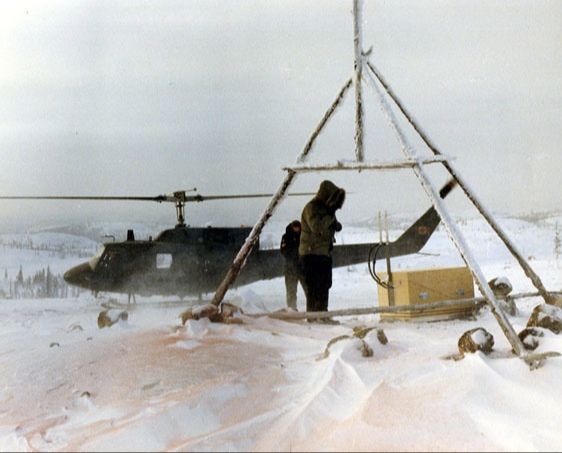
Image unavailable.
A worker stands under a triangular wooden landmark beside equipment, with a helicopter behind in the snow.

Did the whole search region have the same danger?#
A broad affected region does not establish uniform exposure. Health Canada describes an area of 124,000 square kilometres stretching from Great Slave Lake toward northern Alberta and Saskatchewan. A square kilometre is an area, not a radiation measurement. That historical regional figure cannot tell a reader the dose at a particular place.
Absorbed dose measures energy deposited by radiation per unit mass. Assessing exposure therefore requires more than a boundary on a map: the material, radiation field and circumstances of exposure matter. The IAEA says a few recovered pieces were sufficiently radioactive to have potentially serious health effects in certain circumstances. It does not assign that condition to every location within the region.
Nor did an empty airborne reading prove that no material was present. Grasty describes small radioactive sources found by a low-flying helicopter on 10 February outside the original search area. They had been too weak to detect at the Hercules aircraft’s survey altitude. The search’s evolving picture reflected its instruments’ limits as well as the debris distribution.

Image unavailable.
Three evidence levels distinguish a regional boundary, an airborne signal and recovered material.
What did the recovery establish—and leave uncertain?#
The operation established that radioactive satellite material had reached the ground and that specialists could locate and recover some of it. The Atomic Energy Control Board’s remit included retrieving and handling radioactive material, plus environmental and health assessments. Recovering an object addressed only part of that responsibility.
Health Canada reports that cleanup continued into October 1978 and attributes an estimated recovery of about 0.1 percent of the satellite’s power source to the AECB. Read that as a historical estimate about the power source. It is not the percentage of the entire spacecraft recovered, the proportion of the region made safe, or a measurement of anyone’s radiation dose.
A small recovery fraction also cannot, by itself, locate all the remaining material. A recovery total records what was recovered; turning it into a complete inventory would require additional evidence about what remained.
For Cosmos 954, a failure in orbit left months of search, recovery and assessment below. Planning for a nuclear power source has to include that possible end of its journey.
Keep exploring
Sources & further reading
Follow the original research, records, and explanations behind this story.
- Previous nuclear incidents and accidents: COSMOS 954 Health Canada
Reentry date, broad affected region, October cleanup and historical recovery estimate.
- History of the Canadian Nuclear Safety Commission Canadian Nuclear Safety Commission
1978 milestone and A. Alan Prince biography: failed reactor separation, joint operation, AECB responsibilities.
- A look at the Soviet space nuclear power program NASA Technical Reports Server
Gary L. Bennett (1989), abstract: Soviet reactor power and thermoelectric conversion; only abstract read.
- NASA’s Fission Surface Power Project Energizes Lunar Exploration NASA
General heat-to-electricity distinction; modern reactor hardware is not attributed to Cosmos 954.
- Space Debris FAQ: Frequently asked questions European Space Agency
Q6: drag, orbital decay, atmospheric heating and survival of some material; general mechanism only.
- Environmental monitoring by airborne gamma ray spectrometry, experience at the Geological Survey of Canada IAEA / Geological Survey of Canada
R. L. Grasty, IAEA-TECDOC-827, printed pp. 93–95, section 2: background discrimination, discovery and detection limits.
- Guidelines for radioelement mapping using gamma ray spectrometry data International Atomic Energy Agency
Section 10.3, printed pp. 142–143: reentry, fission/activation products, airborne search and portable follow-up; glossary p. 15: dose.
- Cosmos 954 - Recovery 002.jpg Wikimedia Commons; original credited to U.S. federal government, DOE/NV1198
Image provenance, unknown date, description of microwave ranging transponder, and explicit public-domain DOE notice. Used for visual attribution only.
Follow the thread