
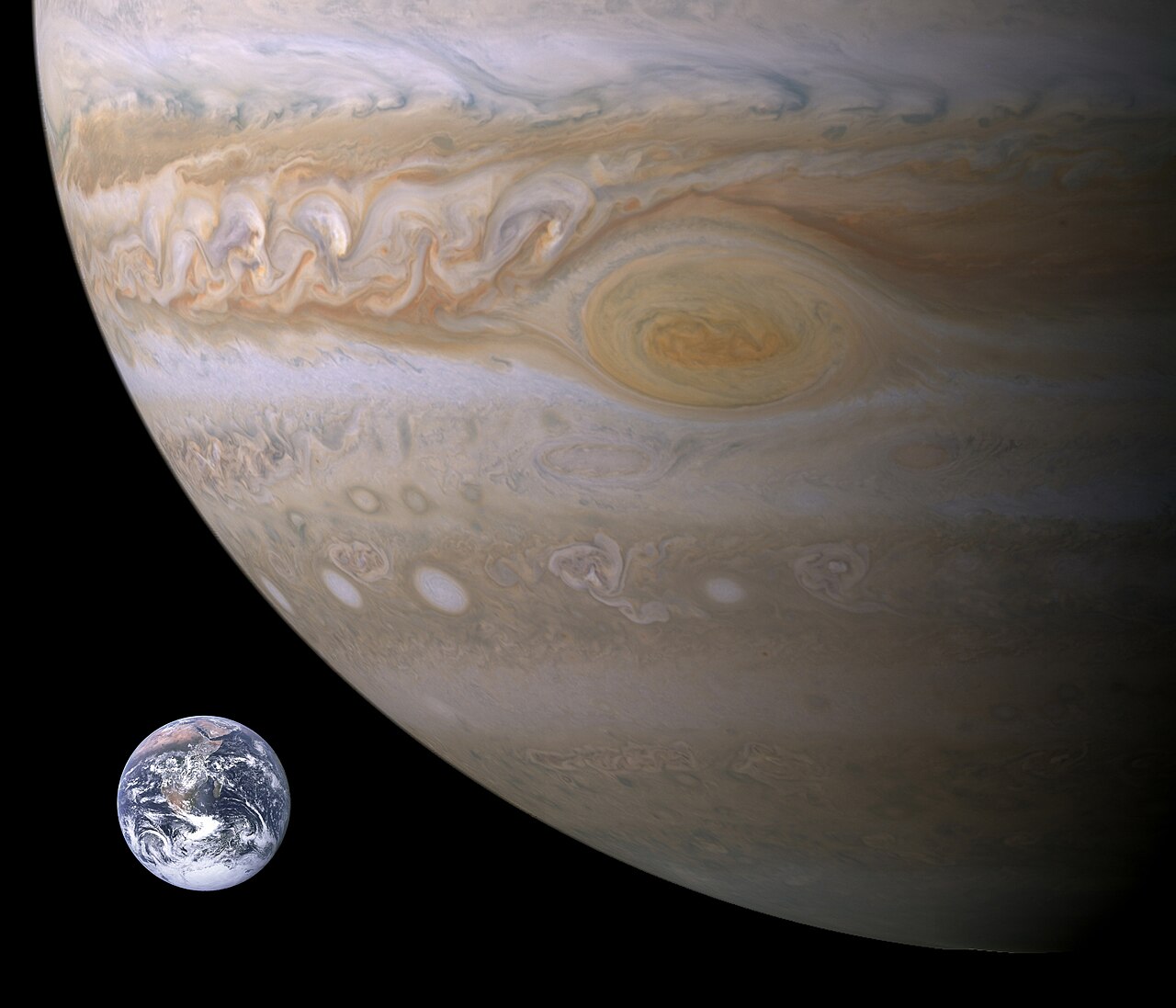

Jupiter is roughly 11 times as wide as Earth, has about 1,320 times Earth’s volume, and contains about 318 times its mass. Those numbers answer three different questions. Width measures a distance across a planet, volume measures how much space it occupies, and mass measures how much matter it contains.
A size comparison becomes easier to understand when the chosen quantity stays consistent. Enlarging Earth’s picture elevenfold gives a rough diameter comparison; it does not mean Jupiter contains only eleven Earth volumes.
How much wider is Jupiter than Earth?#
Using rounded mean diameters, Earth is about 12,700 kilometres across and Jupiter about 140,000 kilometres across. Dividing the second number by the first gives approximately eleven.
Radius and diameter give the same ratio when used consistently, because diameter is twice radius. Comparing Jupiter’s radius with Earth’s diameter would halve the answer by mistake. Likewise, a comparison should not quietly switch between a planet’s mean size and its equatorial width.
The cover is an existing composite made from separate NASA photographs. Earth and Jupiter were not photographed beside each other. Their close placement helps compare their apparent widths in the illustration; it does not represent the separation between their orbits.
Why do some sources say 11.2 instead of 11?#
Jupiter is flattened at the poles and broader around its equator. NASA’s reference table distinguishes equatorial, polar and volumetric mean radii. The equatorial comparison is about 11.2 Earths, while the mean-radius comparison rounds to eleven.
For a gas giant, the reference level also matters. There is no rocky shoreline defining the edge. Planetary dimensions are commonly quoted at an atmospheric pressure of one bar. That is a measurement convention, not a surface on which someone could stand.
Measurements improve as new spacecraft data become available. A 2026 Juno analysis refined Jupiter’s shape using radio occultations, which track how radio signals change as they pass through the atmosphere. It found slightly smaller dimensions than earlier estimates. The revision matters for precise planetary models, but leaves the broad eleven-to-one comparison intact.
Why is the volume ratio so much larger?#
For spheres, volume grows with the cube of the radius. If one sphere has eleven times another’s radius, its volume is eleven times eleven times eleven, or 1,331 times as large.
That calculation uses a deliberately rounded size ratio. Applying more precise reference dimensions gives the familiar figure of about 1,320 Earth volumes. It is not an inconsistency that cubing the rounded number produces a slightly different result: rounding the input is magnified when it is multiplied three times.
The same idea works with an imaginary model. Double a ball’s radius and you double its width, but its volume becomes eight times larger. Three dimensions contribute to volume, so a modest-looking change in width can correspond to a much greater change in occupied space.
Could 1,320 Earths literally fit inside Jupiter?#
The statement compares volumes. It imagines the amount of space occupied by Earth, not a practical attempt to pack intact rocky planets into a container.
Separate spheres leave gaps when packed together. A physical packing problem would therefore be different from simply dividing one volume by another. Jupiter is also filled with matter; it is not an empty shell waiting to be filled.
Use “about 1,320 Earth volumes” when precision of meaning matters. It communicates the intended scale without implying that the surfaces of thousands of whole Earths could be arranged inside Jupiter with no unused space.
Sources: [4]
Why is Jupiter only about 318 Earth masses?#
Jupiter’s average density is much lower than Earth’s. Its large volume contains mostly hydrogen and helium, with material becoming strongly compressed at depth. Earth contains a much greater proportion of dense rock and metal.
Density is mass divided by volume. Using the rounded comparison numbers, 318 divided by 1,320 is about 0.24. Jupiter’s average density is therefore roughly one quarter of Earth’s. This does not mean its deep interior is a thin gas: average density combines all the material throughout the planet.
Astronomers infer planetary masses from gravity, including the motion of moons and spacecraft. The orbital time and distance help reveal the gravitational pull. A large-looking disk in a photograph does not by itself establish the planet’s mass.
If Earth were a football, how big would Jupiter be?#
Choose an Earth model 22 centimetres across. Multiplying by eleven gives a Jupiter model about 242 centimetres across, or roughly 2.4 metres. The choice of 22 centimetres is an illustration, not a claim that all footballs have one exact diameter.
On that same scale, the Sun would be about 24 metres across. This follows from its approximately 1.4-million-kilometre diameter compared with Earth’s roughly 12,700 kilometres. The model Sun would extend well beyond an ordinary room.
These objects can sit beside each other in a size display because the display is comparing diameters. Their real separations require a different amount of space. Moving the models close together for a picture must not be mistaken for preserving orbital distances too.
Does a bigger planet always mean stronger gravity where you stand?#
Size alone is insufficient. Gravitational acceleration depends on mass and distance from the centre. A planet with more mass can also have a much larger radius, so its pull at a chosen level does not increase in direct proportion to its total mass.
There is an additional problem with the phrase “stand on Jupiter”: it has no solid surface comparable to Earth’s ground. A quoted gravity value for Jupiter needs a reference level, and detailed values also depend on latitude and rotation.
For comparing an object’s mass with the force it experiences, see why weight changes between Earth, Mars and the Moon. For planet size, keep the three quantities separate: diameter, volume and mass.
Keep exploring
Sources & further reading
Follow the original research, records, and explanations behind this story.
- Jupiter Fact Sheet NASA NSSDCA
Reference dimensions and ratios; later Juno refinement is described separately.
- Earth Fact Sheet NASA NSSDCA
Earth mean radius of 6,371 km; rounded diameter used for the model.
- Jupiter Facts NASA Science
Hydrogen and helium, compressed interior and absence of a solid surface.
- Facts about Jupiter ESA
318 Earth masses and about 1,321 Earth volumes. Other numerical fields are not used.
- NASA’s Juno Mission Redefines Size, Shape of Jupiter NASA Science
New shape determination from Juno; no exact revised radius adopted for this rounded comparison.
- How Do We Weigh Planets? NASA Space Place
Orbit-based mass inference and distance dependence of gravity.
- Sun: Facts NASA Science
Rounded 1.4-million-kilometre solar diameter.
- Jupiter, Earth size comparison NASA / Brian0918, Wikimedia Commons
Existing approximate composite of Apollo 17 Earth and Cassini Jupiter photographs; not a joint observation.
Follow the thread