

Take the same 50-kilogram object from Earth to Mars and then to the Moon. Its mass remains 50 kilograms, assuming none of its material is added or lost. Its weight changes because the gravitational pull at each surface is different.
A familiar scale can make this distinction confusing. If a force-sensitive scale keeps its Earth calibration, that object would produce a reading of about 19 kilograms on Mars and 8 kilograms on the Moon. Those numbers describe what the scale displays, not a change in the object’s mass.
What is the difference between mass and weight?#
Mass describes an object’s inertia, its resistance to a change in motion. In ordinary comparisons like this one, it also measures how much matter the object contains. The SI unit is the kilogram, abbreviated kg.
Weight is a force associated with gravity. Here, “weight” means the local gravitational force on the object, measured in newtons, abbreviated N. It depends on both the object’s mass and the local gravitational acceleration.
Everyday language uses “weight” for both quantities. Saying that a suitcase weighs 20 kilograms is familiar and useful at an airport, but a physics calculation must distinguish kilograms from newtons. Without that distinction, a lower number on a lunar scale can look like missing material.
How much would the 50-kilogram object weigh?#
The calculation is weight equals mass multiplied by gravitational acceleration: W = m × g. For a simple comparison, use NASA’s rounded surface values of 9.8 metres per second squared on Earth, 3.7 on Mars and 1.6 on the Moon.
Multiplying each by 50 kilograms gives approximately 490 newtons on Earth, 185 newtons on Mars and 80 newtons on the Moon. The object has the same mass in all three calculations. The changing input is g.
These are rounded examples, not precision predictions for every landing site. Local gravity depends on location, and different reference tables may use more digits or different surface conventions. Reporting the lunar result as roughly 80 newtons is appropriate for the rounded value used here.
Why would an Earth scale display 19 or 8 kilograms?#
Imagine an ideal force-sensitive scale whose display converts force to kilograms by dividing by an Earth calibration value of 9.8. On Earth, the object presses on it with approximately 490 newtons, so the display reports 50 kilograms.
On Mars, the same conversion gives 185 divided by 9.8, or about 18.9 kilograms. On the Moon, it gives 80 divided by 9.8, or about 8.2 kilograms. Rounded to whole kilograms, these become 19 and 8.
This thought experiment assumes that the scale works in the new environment and retains its calibration. It is not a promise about what an ordinary bathroom scale would do in lunar vacuum. A properly calibrated instrument could instead account for local gravity and report the object’s actual 50-kilogram mass.
Would every kind of balance give the wrong mass?#
No. An ideal equal-arm balance compares the object with known reference masses. If both pans experience the same local gravity, the gravitational factor acts on both sides. Equal masses balance on Earth and would also balance in a suitable stationary setup on the Moon.
That follows directly from the force equation. On one side is the unknown mass multiplied by g; on the other is the reference mass multiplied by the same g. Changing g changes both forces together, leaving their ratio unchanged.
The distinction is between comparing masses and inferring mass from a force using a calibration. Real instruments have operating limits, and a conventional balance needs a gravitational direction to work as intended. This argument does not describe a balance freely floating inside an orbiting spacecraft.
Sources: [3]
Would the object become easier to move?#
It would require less force to support it against gravity on Mars or the Moon. Holding it stationary is different from changing its motion, however. Its inertia remains associated with the same 50-kilogram mass.
For an ideal example with other forces neglected, a net horizontal force of 10 newtons gives the object an acceleration of 0.2 metres per second squared. That follows from Newton’s second law, acceleration equals net force divided by mass. Changing planets does not change that calculation.
In practice, friction, footing, terrain and equipment affect a person trying to move a load. Less gravitational weight can change those conditions. It does not make a moving object harmless or eliminate the force needed to stop it.
Why did a hammer and a feather fall together on the Moon?#
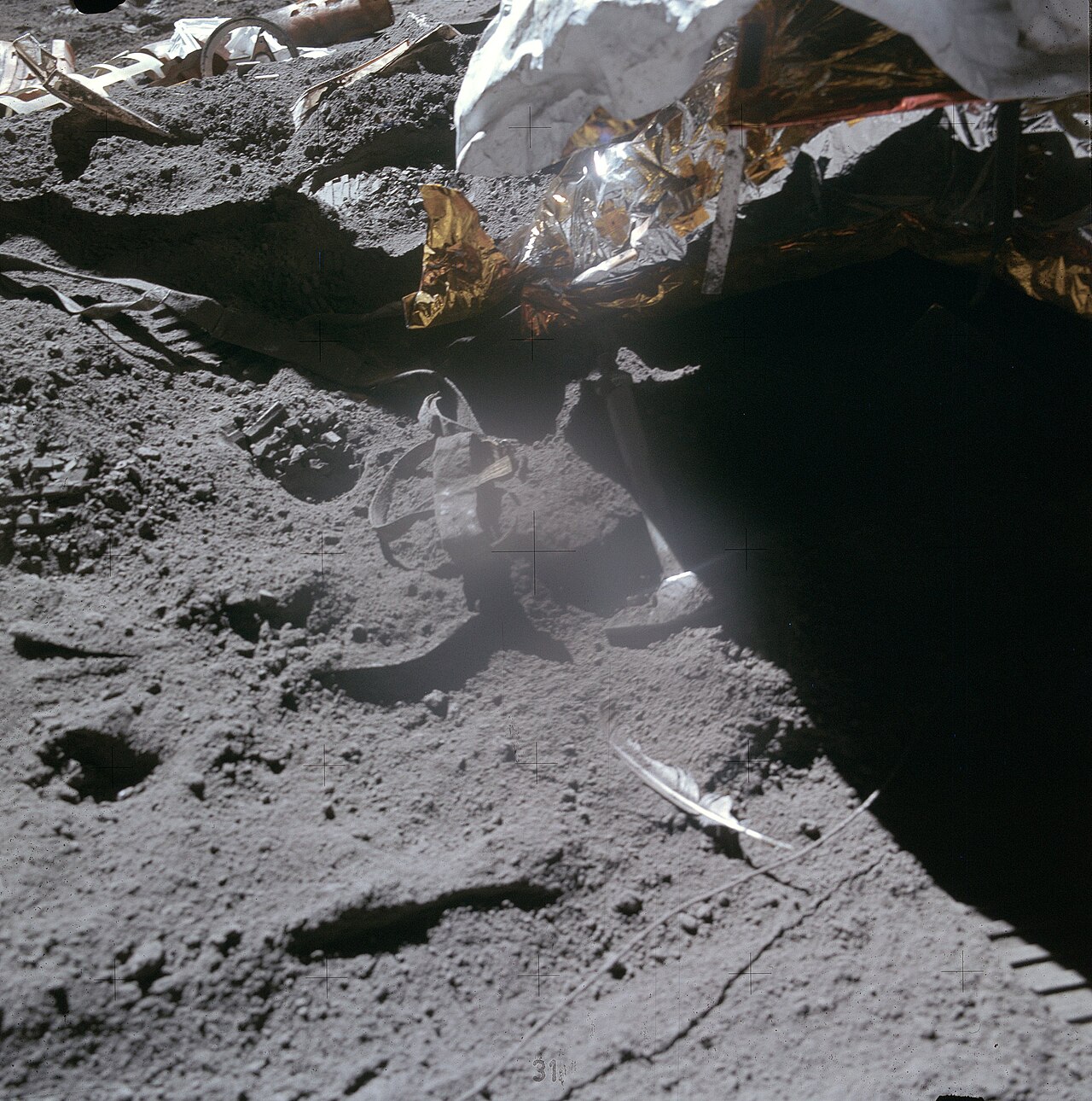
During Apollo 15, David Scott released a geological hammer and a feather together. With essentially no atmospheric drag, they reached the lunar surface together within the accuracy of the demonstration. The cover photograph shows the objects afterward.
The hammer experienced a greater gravitational force because it had more mass. It also had proportionally greater inertia. In the equation for free-fall acceleration, those mass factors cancel, leaving the same local g for both objects.
Air resistance changes the familiar result on Earth, especially for a feather. The lunar demonstration illustrates free fall; it does not mean that the hammer and feather had equal masses or equal gravitational weights.
Why do astronauts float if Earth still pulls on them?#
The International Space Station and its contents fall around Earth together. Objects float relative to the cabin because a floor is not supporting them in the way it supports a person standing on Earth.
A force-sensitive scale measures a contact force. In ideal free fall, an object and the scale fall together, so the object does not press on the platform as it would while standing on a surface. A near-zero reading therefore does not imply zero mass or an absence of Earth’s gravity.
The same distinction helps explain why microgravity changes liquid-metal experiments. The laboratory changes how objects support and move relative to one another; it does not remove their material or inertia.
Keep exploring
Sources & further reading
Follow the original research, records, and explanations behind this story.
- SI Units — Mass NIST
Kilogram mass, newton force and inertia; historical standard text not used.
- Planetary Fact Sheet NASA NSSDCA
Rounded values used consistently, not mixed with mean or higher-precision values.
- Mass and Weight OpenStax, University Physics Volume 1
F=ma and W=mg; original examples calculated separately.
- The Apollo 15 Hammer-Feather Drop NASA NSSDCA
Simultaneous arrival within demonstration accuracy; no linked movie opened.
- What Is Microgravity? NASA
Common free fall with substantial Earth gravity.
- How Do We Weigh Planets? NASA Space Place
Mass independent of location in the stated classical example.
- Apollo 15 hammer and feather, image AS15-88-11890 NASA / Wikimedia Commons archival record
NASA photograph of the hammer and feather after the demonstration; a public-domain NASA work.
Follow the thread