
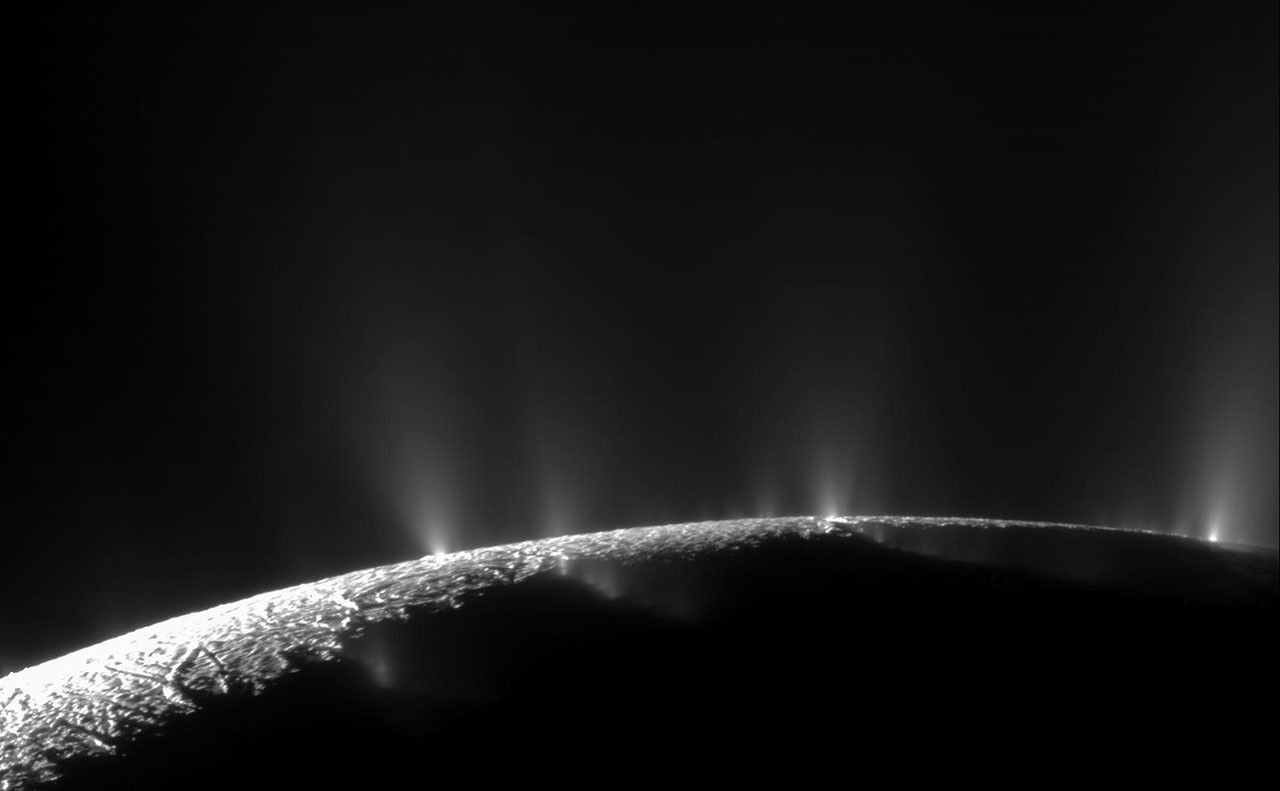
Enceladus sends water vapor and icy particles into space through fractures near its south pole. Cassini flew through this escaping material and measured its chemistry, giving scientists access to clues from an ocean hidden beneath the moon's ice. The samples contain salts and organic compounds. They have not established that life exists there.
The evidence comes from several kinds of observation. Images show the eruptions, rotation measurements reveal a mechanically separated ice shell, and instruments analyze gases or grains. Each answers a different question about the same small moon.
How does material escape from the hidden ocean?#
Long fractures in the south polar terrain connect the active surface region with water below. These fractures are often called tiger stripes. Cassini's published image mosaic shows material spraying from multiple places along them.
The escaping material includes vapor and ice grains. Some particles contribute to Saturn's diffuse E ring, so the moon leaves a trail that a spacecraft can encounter beyond the immediate plume. Sampling that ring and sampling close to a fracture do not necessarily provide identical material: grains have different travel histories and exposure to space.
The cover photograph records the visible spray. It does not show the ocean floor or reveal chemical composition by itself. Those conclusions require the other measurements.
How do scientists know the ocean is global?#
A local water reservoir could help explain an eruption. The argument for a global ocean also uses the way Enceladus rotates.
Thomas and colleagues tracked surface landmarks across seven years of Cassini observations. They measured a small periodic wobble, called physical libration, that was too large for a model in which the icy surface was rigidly connected to the rocky interior. A liquid layer separating the shell from the interior explains the motion.
The measurement implies mechanical separation. The ocean allows the shell to respond differently from the deeper body. The study reported a libration of 0.120 plus or minus 0.014 degrees, with the stated uncertainty at two standard deviations. It is a small angle with implications for the moon's internal structure, not an optical view through the ice.
Sources: [2]
How did Cassini analyze an ice grain?#
The Cosmic Dust Analyzer measured particles that struck the spacecraft. During the fast 2008 E5 encounter, the relative speed was about 18 kilometers per second. The impact broke up the grains and produced charged particles that the instrument could analyze.
A mass spectrometer sorts those ions according to their mass relative to charge. Researchers interpret the resulting pattern using known chemical behavior and comparisons with laboratory measurements. The result is a chemical signature, rather than an intact grain brought home in a bottle.
Breaking the sample apart is part of the measurement method. It can expose useful chemical information, but it also means that identifying the original compounds requires care. Different fragments and combinations must be distinguished from one another.
Sources: [3]
What did the phosphate discovery establish?#
A 2023 analysis identified sodium phosphates in salt-rich ice grains originating from Enceladus and sampled in the E ring. Phosphates contain phosphorus, an element used in essential biological chemistry on Earth.
The researchers combined the grain measurements with laboratory experiments and geochemical modeling. They inferred that dissolved phosphate could be abundant in the plume-forming ocean water. This is a stronger claim than merely finding an isolated phosphorus atom, but the inferred concentration still depends on the link between grains and ocean chemistry.
The discovery supplies evidence for an ingredient that potential organisms could use. It does not show that organisms have used it. Rocks and water can produce biologically useful chemistry without biology being responsible.
Sources: [4]
Why did the 2025 study focus on fresh grains?#
Grains in the E ring may spend years exposed to radiation and other space conditions. Material sampled directly in the plume can be much younger. The 2025 study revisited grains encountered close to Enceladus, only minutes after ejection.
Researchers found a broader set of organic chemical signatures, including compounds associated with ester and ether families. Detecting diverse organics in recently ejected material supports their availability close to the ocean source, rather than requiring long exposure in the ring to create every signature.
Fresh refers to the grains' short journey before measurement. It does not mean Cassini collected new data in 2025. The spacecraft recorded the relevant impacts in 2008; later analysis extracted more information from the archived measurements.
Sources: [3]
Does organic mean biological?#
In this context, organic refers to carbon-based chemistry. It is not a label establishing that a substance was produced by an organism. The molecules can participate in reactions of interest to astrobiology while remaining compatible with nonbiological origins.
There are several steps between finding useful ingredients and identifying life. Researchers must establish what compounds are present, how they could form under local conditions, and whether a proposed biological explanation predicts something that competing chemical processes do not.
A mixture containing organic compounds is therefore a reason to investigate the ocean further. Calling the mixture life would skip the test that matters most: whether the evidence requires a biological process.
Where could usable energy come from?#
Cassini detected molecular hydrogen in the plume. Together with other measurements, the finding supports reactions between water and rock inside Enceladus. Silica-rich particles also provided evidence consistent with hydrothermal activity.
Such chemistry matters because an ocean under ice does not receive sunlight in the way Earth's surface ocean does. Chemical reactions can provide an alternative source of energy. On Earth, some organisms use chemical energy associated with water-rock systems.
That comparison identifies a plausible kind of energy supply. It does not establish the rate available everywhere in Enceladus's ocean, nor demonstrate that an ecosystem is consuming it. Water, ingredients and usable energy are separate requirements whose presence helps assess habitability.
Sources: [5]
Is a plume sample representative of the whole ocean?#
A particle has to travel from its source through fractures and into space before reaching an instrument. Dissolving, evaporating, freezing and condensation can distribute chemicals differently between vapor and ice. Some substances may be easier to carry into a detectable grain than others.
NASA's account of the 2019 organic-compound work describes molecules dissolving in ocean water, entering vapor and then freezing onto ice grains in the fractures. That pathway explains why a measured grain should not automatically be treated as a perfectly preserved miniature bottle of bulk ocean water.
Scientists use physical and chemical models to connect the sample to its origin. Comparing many grains and several instruments makes that interpretation more useful than treating a single impact as a complete survey of the ocean.
Sources: [6]
Why can a finished mission still make discoveries?#
The measurements survive after the spacecraft stops operating. New laboratory comparisons, analysis methods and scientific questions can expose patterns that were difficult to interpret when the data first arrived.
The phosphate and fresh-organic studies illustrate this process: the observations were already on Earth when researchers extracted the later results. The archive remains available for new analyses after the mission ends.
Cassini's final descent is covered in the story of its Grand Finale. Its Enceladus measurements remain a guide to what a future investigation would need to distinguish: the chemistry of a potentially habitable ocean and evidence that something actually lives there.
Keep exploring
Sources & further reading
Follow the original research, records, and explanations behind this story.
- Bursting at the Seams: the Geyser Basin of Enceladus NASA Photojournal
Published plume mosaic and south-polar fractures.
- Enceladus’s measured physical libration requires a global subsurface ocean Thomas et al. / Icarus
Measured rotation and global-ocean inference.
- NASA Cassini Study Finds Organics Fresh From Ocean of Enceladus NASA/JPL
Particle impacts recorded in 2008 and organic analysis published in 2025.
- NASA Cassini Data Reveals Building Block for Life in Enceladus Ocean NASA/JPL
Phosphate detection, laboratory comparisons and ocean inference.
- Cassini at Enceladus: A Decade-Plus of Discovery NASA Science
Silica, ocean and hydrogen findings.
- New Organic Compounds Found in Enceladus Ice Grains NASA/JPL
Grain transport and distinction between organic chemistry and life.
Follow the thread