
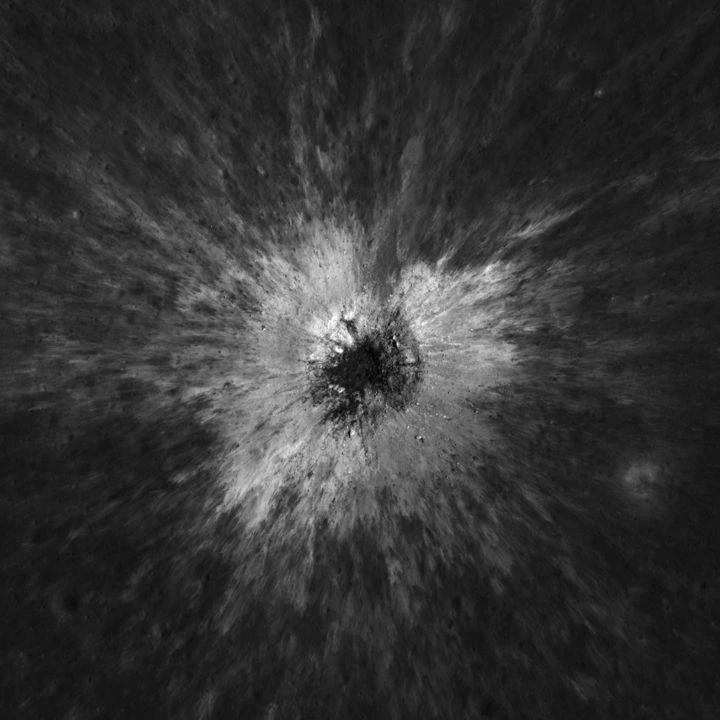
Before-and-after photographs can show when a crater formed even when nobody saw the collision. Images of the same ground preserve the old landscape and the changed surface that appeared between observations.
McGetchin crater is an unusually large example. It formed on the Moon in spring 2024, but its discovery came in 2025. Its 222-meter average rim diameter is only one measure of the event. Visible surface disturbances and a nighttime temperature anomaly reveal changes far beyond that rim, and they measure different things.
When did the impact happen, and when was it discovered?#
NASA places the formation between April 11 and May 22, 2024, and reports that image-processing specialist Robert Wagner discovered the change on October 24, 2025. The first dates bracket the physical event; the last dates a person recognizing its evidence. None supplies an exact impact time.
The distinction follows from repeat coverage. An observation showing the old surface sets an earlier boundary; an observation showing the new disturbance sets a later one. The collision must fall between them. A much older “before” image can illustrate the change clearly without being the observation that narrows the event to those six weeks.
NASA's exact discovery date is more specific than the LROC feature's description of an initial identification in “late summer 2025.” We follow NASA's dated account here; the reports do not explain that difference. The scientific paper describes discovery in fall 2025.
The name is official. The International Astronomical Union adopted McGetchin on May 4, 2026, honoring planetary scientist Thomas R. McGetchin. The crater lies near 1.35° north, 67.18° east, on the Moon's eastern near side.
How did orbital images expose a crater nobody watched form?#
The broad search detected disturbed ground before close-up images resolved its shape. Both observations came from NASA's Lunar Reconnaissance Orbiter, or LRO. Its LROC camera system includes a Wide Angle Camera, WAC, and two Narrow Angle Cameras, NACs.
WAC images have roughly 100-meter pixels. They cover enough ground to compare large areas, but McGetchin's rim spans only a few such pixels. Its much broader ejecta pattern made the event conspicuous. Ejecta is material thrown out during crater formation; the bright patch in a wide view is larger than the excavated bowl.
For the scientific analysis, the team combined an average of 540 pre-impact observations and 60 post-impact observations at each location. They aligned the images so that the same ground occupied the same map position, and corrected their brightness to a common illumination and viewing geometry. Stacking repeated observations reduces random noise. Dividing the later mosaic by the earlier one highlights places where reflectance changed.
A changed pixel is a candidate, not a verdict. A slightly displaced image puts the edges of old craters in different places. A different Sun angle lengthens shadows or changes which slopes look bright. NASA describes hundreds of false alarms from lighting and shadow differences, requiring manual inspection. The close-up NAC observations supplied the decisive recognizable structure: a new depression, a raised rim, and surrounding ejecta where earlier images showed ordinary terrain.
The illustrated NAC pair is sampled at one meter per pixel. Its lighting is similar enough to compare the terrain, though the Sun angles are not identical. The yellow circle marks the approximate future rim in the earlier frame; it does not mark a previously hidden crater.
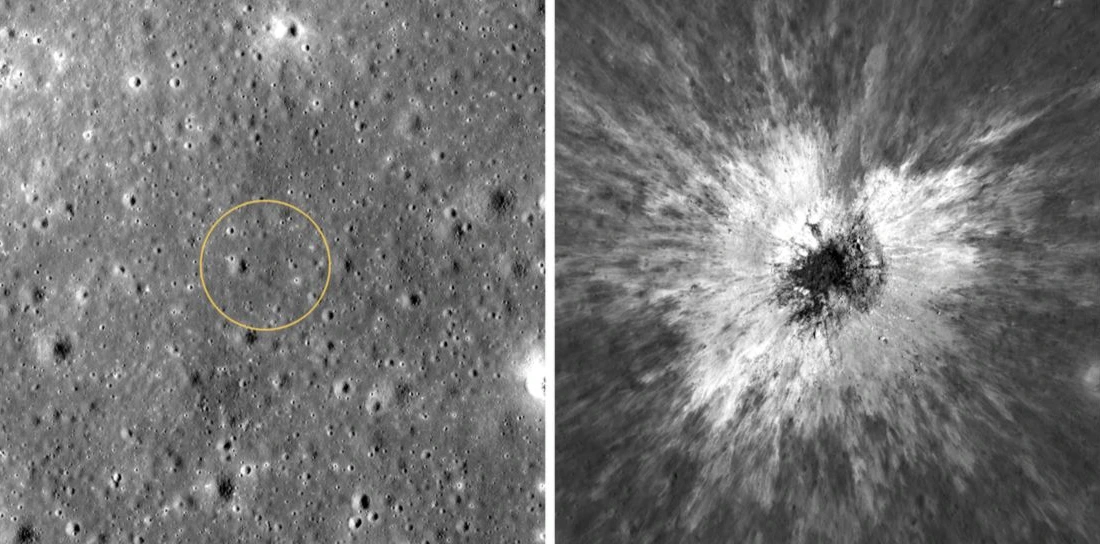
Image unavailable.
NAC before and after images: a yellow circle on old terrain at left and a new crater with bright ejecta at right.
What do 222 meters across and 43 meters deep actually measure?#
These are measurements of the crater's topography, rather than the width of its white splash. The team used NAC images taken from different viewing positions to make a stereo digital terrain model: a map assigning elevations to the surface. The same principle lets two views reveal depth that a single overhead photograph cannot establish on its own.
The rim is not a perfect circle. In the study it ranges from 213 to 231 meters across in different directions, giving the quoted 222-meter average. The researchers traced the crest where the outward surface slope changes from climbing up the inner wall to descending over the ejecta.
The 43-meter depth is the difference between the median rim elevation and the lowest mapped point inside the bowl. It is not a measurement from an assumed flat plain down to the floor. The rim itself stands about eight meters above the pre-impact surface on average.
The post-impact terrain model has a three-meter grid and reported vertical precision better than 1.5 meters. Its accompanying image mosaics have one-meter pixels. Those are properties of the mapping products, not a promise that every reported dimension has the same uncertainty. A coarser pre-impact terrain model from Japan's Kaguya mission helps estimate how the old surface changed. The authors explicitly warn that some differences between the before and after profiles away from the crater reflect uncertainty in that older model.
Why is the nighttime cold spot so much bigger than the crater?#
Diviner, LRO's thermal radiometer, found a roughly seven-kilometer-wide region that is eight to nine kelvin cooler at night than nearby terrain. A temperature difference of one kelvin equals a difference of one degree Celsius. The anomaly is therefore about eight to nine Celsius degrees of extra nighttime cooling, not an absolute temperature of eight or nine degrees.
The crater's rocky center and nearby ejecta remain relatively warm at night. The cold spot surrounds them. Its diameter is about thirty times the rim diameter, because an impact can change the physical texture of ground well beyond the excavated hole.
The leading interpretation is that the impact loosened the upper regolith, the layer of broken rock and dust covering the Moon. Lower-density material transfers heat less effectively. Its thermal inertia, its resistance to changing temperature, is lower, so its surface cools more rapidly through the lunar night.
Diviner first targeted the site on November 1, 2025, about a year and a half after formation. That was far too late to measure heat left over from the collision. The map shown here uses post-impact nighttime data collected from November 15, 2025, to February 18, 2026, with temperatures interpolated to local midnight for comparison.
Cooling supports a change in near-surface structure, but it does not uniquely reveal that structure. The study tested both a gradually increasing density with depth and a thin, uniformly loosened upper layer. Neither reproduces the whole nighttime cooling curve perfectly. The depth of loosening is inferred through thermal models, rather than measured by digging into the soil. Ejecta-driven disturbance and seismic shaking are among the proposed mechanisms; their relative roles remain under investigation.
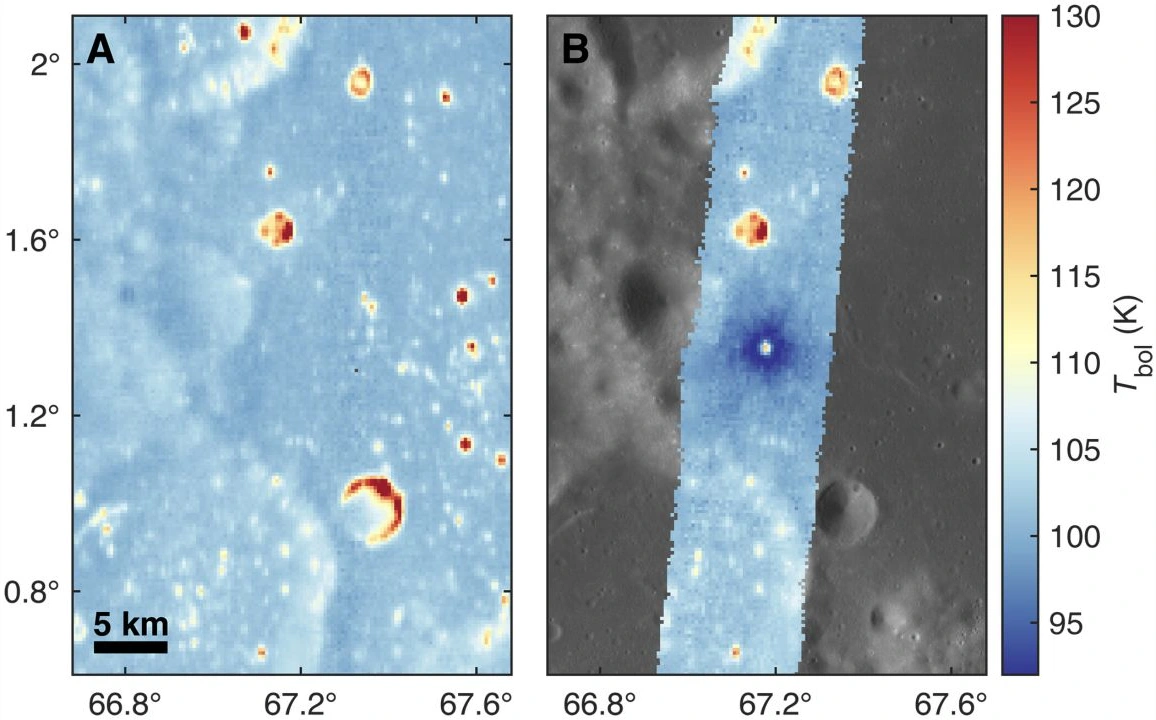
Image unavailable.
Diviner maps before and after impact show a dark blue cold halo surrounding a small warm center in the new targeted strip.
Are the bright rays, cold spot, and distant disturbance the same boundary?#
They are separate footprints of one event. The rim bounds the bowl. The nearby continuous ejecta blanket marks deposited material around it. The cold spot maps altered nighttime thermal behavior. Still fainter visible changes extend much farther away.
The WAC study detected reflectance disturbances more than 100 kilometers from the crater, including localized changes around 140 kilometers away. These distant traces are not a 140-kilometer crater or a cold spot of that size. Visible light can respond to changes in the texture of the very top grains; nighttime temperatures require changes that affect heat transfer through a deeper layer.
Brightness also carries information about composition. McGetchin formed near a boundary between dark volcanic basalt and brighter ancient highland material. The impact brought previously buried material to the surface, producing an uneven ejecta pattern. A bright patch alone cannot prove a crater formed recently: rock type, surface texture, lighting, and weathering all influence reflected light. Here the before-and-after record establishes recency directly.
An ancient impact crater can preserve a recognizable bowl while later impacts and surface weathering alter its rim and ejecta. A collapse pit has a different origin: ground falls into an underlying void rather than being excavated by a projectile. The questions about what a dark opening reveals below ground are explored in Marius Hills Pit. McGetchin's new rim, excavation, and outward ejecta identify an impact feature.
What can one new crater tell us about future impacts?#
It supplies a dated test of crater-formation and impact-frequency models. Current production models predict an event of this size somewhere on the Moon about once every 132 years on average. That is a statistical rate across the whole Moon, not a schedule and not the odds for one particular landing site.
One event cannot establish that rate by itself. The observing interval is short compared with a century, coverage and image quality vary, and small craters are harder to detect. Continued monitoring provides a sample of events against which predictions can be tested. McGetchin is especially useful because its unchanged earlier surface and relatively pristine aftermath are both available.
Can the crater reveal the impactor’s size and speed?#
The crater can constrain plausible impactors through models, but it does not uniquely reveal the object's size or speed. The impactor's mass and speed were not directly measured by these before-and-after pictures. The crater paper includes an energy estimate that assumes a projectile density and impact speed; those assumptions are inputs to a calculation. Crater size also depends on target properties and collision conditions, so a measured hole does not uniquely determine the object that made it. Its precise origin and trajectory remain outside what these observations establish.
An impact modifies more ground than it excavates. Visible images measure one part of that change, topography another, and nighttime temperatures another. Reading them together turns a newly noticed spot into a record of an event that happened between observations.
Sources: [2]
Keep exploring
Sources & further reading
Follow the original research, records, and explanations behind this story.
- NASA’s Moon Orbiter Spots New, ‘Once-in-Century’ Moon Crater NASA
Formation bracket, exact discovery date, dated NAC cover, camera roles and false detections.
- A new 222-m diameter lunar crater Science Advances / Robinson et al.
Stereo measurement definitions, registration and photometric normalization, ejecta footprints, assumed impact energy and production model.
- New lunar crater reveals extensive distal regolith modification Science Advances / Powell et al.
Diviner observation dates, thermal map, temperatures, regolith interpretation, model and mechanism limits.
- Spectacular McGetchin Crater LROC Science Operations Center
Before/after image provenance, morphology and geologic context; discovery-season wording conflicts with NASA.
- Gazetteer of Planetary Nomenclature: McGetchin USGS / IAU
Official name, adoption date, coordinates; rounded geographic diameter is not the science rim measurement.
- Marius Hills Pit - Lava Tube Skylight? LROC Science Operations Center
Collapse into a lava-tube roof as distinct origin; the trigger of collapse can itself include an impact.
See the story in motion
Watch our illustrated video, then explore another question below.
Watch on YouTubeFollow the thread