The circular building on Bulgaria’s Buzludzha peak was built to tell a political story. During its working years, visitors entered a museum and ceremonial venue whose art presented the ruling Communist Party’s version of the past.
Why was the monument built on a mountain?#
The site linked the ruling party to an earlier socialist gathering. In 1891, delegates met on Buzludzha to form a Bulgarian socialist organization that was a precursor of the Communist Party. The Buzludzha Project Foundation reports that the gathering used an annual commemoration of the 1868 rebel Hadzhi Dimitar as cover. The peak also carried associations with that earlier battle and with a 1944 partisan battle.
The memorial house opened in August 1981, 90 years after the socialist congress. The foundation says workers lowered the peak by nine metres and excavated rock for the foundations. This was an intervention in a landscape already rich with political and national meaning: the site itself helped connect the party’s present to its chosen history.
Sources: [1]
What did visitors do inside?#
The building functioned as a political museum and a ceremonial venue. According to the foundation’s historical account, groups were admitted on a schedule, followed a fixed route and stayed with a guide. The tower was reserved for technical access. These rules describe an organized visit, though they do not tell us how every visitor interpreted the experience.
The foundation reports that more than two million people visited during its eight years of use. That is the foundation’s historical estimate. The building’s opening and the organized route show how architecture and presentation could turn a mountain memorial into a public experience of party history.
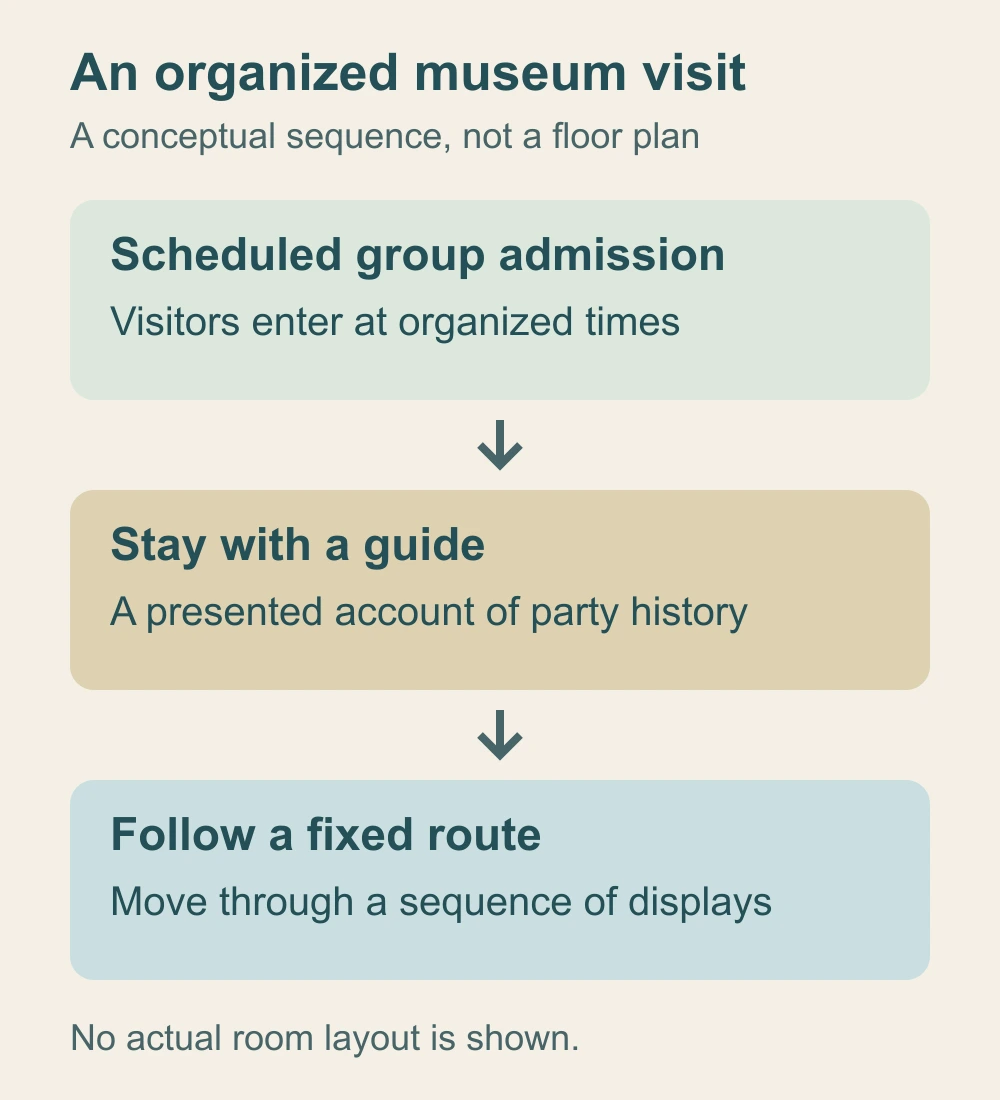
Image unavailable.
Three linked panels show scheduled group admission, staying with a guide, and following a fixed route. The sequence is conceptual and contains no room layout.
Sources: [1]
What did the mosaics communicate?#
The monument’s interior mosaics depicted Bulgarian historical episodes and figures associated with the Communist era. The foundation describes the building’s original purpose as displaying communist achievements. These images were part of the institution’s message, not neutral proof that its account of history was complete.
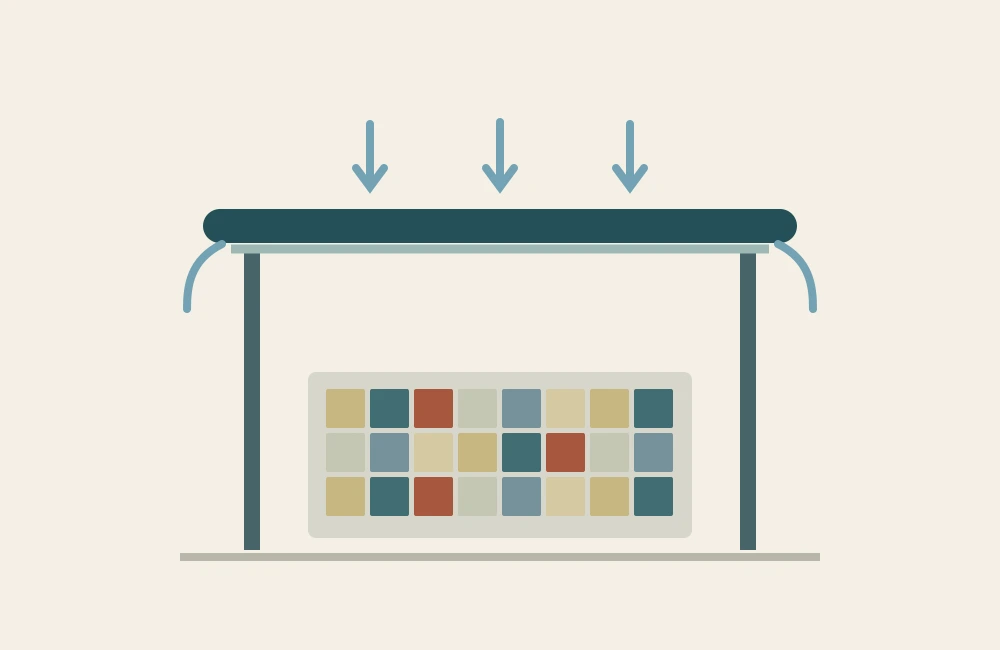
Mosaic is made from small pieces set together to form an image. When the building’s protective envelope failed, those pieces and the surfaces holding them became exposed to mountain weather.
Why did it become a ruin, and what has been saved?#
After the end of communist rule in 1989, the building lost its original role and was abandoned. The foundation reports theft and vandalism, including the removal of copper roof covering. Europa Nostra describes damaged windows and roof leaving the mosaics exposed to water, snow and ice. Abandonment and damage developed over years, rather than at one single moment.
Conservation has focused on keeping surviving material in place. The foundation reports that a team documented the mosaics, collected fallen pieces and mechanically stabilized vulnerable areas. A temporary independent shelter and water-repellent, air-permeable textile were used to buffer the mosaics from weather. It reports that emergency stabilization reached the dome in 2022 and protective sheets were reinforced in 2025. These measures protect surviving work; they do not mean the whole building has been restored.
The Eiffel Tower’s changing fortunes offer a different example of how a landmark’s future can diverge from its first intended life.
Keep exploring
Sources & further reading
Follow the original research, records, and explanations behind this story.
- History Buzludzha Project Foundation
Mountain history, building, use and abandonment.
- Our Work Buzludzha Project Foundation
First-hand account of stabilization and protective measures.
- The Buzludzha Monument, Bulgaria: How to transform contested heritage into a place for dialogue, education and culture Europa Nostra
Damage and the foundation’s conservation work.
See the story in motion
Watch our illustrated video, then explore another question below.
Watch on YouTubeFollow the thread