
Scientific experiments and military wireless communication helped the Eiffel Tower survive beyond its initial land-use concession. The familiar twenty-year term concerned an agreement with the City of Paris, rather than the physical lifetime of the ironwork.
Built for the 1889 Paris World's Fair, the tower offered an elevated place to measure the atmosphere and support aerial wires. As the original arrangement approached its end, those uses gave the city reasons to keep a structure built for an exhibition.
Why was such a tall tower built?#
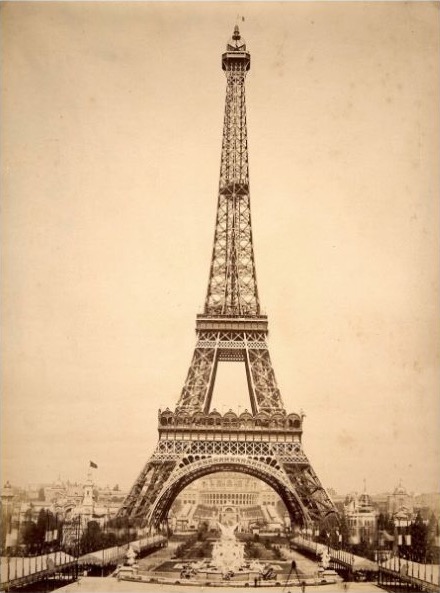
The tower was conceived for the 1889 World's Fair, which marked the centenary of the French Revolution. A competition asked entrants to study a 300-metre iron tower on the Champ de Mars. That height, about 984 feet, approached the symbolic milestone of 1,000 feet. The finished structure would advertise the fair and demonstrate what contemporary engineering could build.
The idea came from Maurice Koechlin and Émile Nouguier, chief engineers in Gustave Eiffel's company, in 1884. Their concept took the form of four open-lattice piers, far apart at the ground and converging upwards, connected by horizontal girders. Architect Stephen Sauvestre reworked its appearance; his proposed arches survived, although other decorative features were simplified. The accepted scheme was associated with all four men, including Eiffel as entrepreneur.
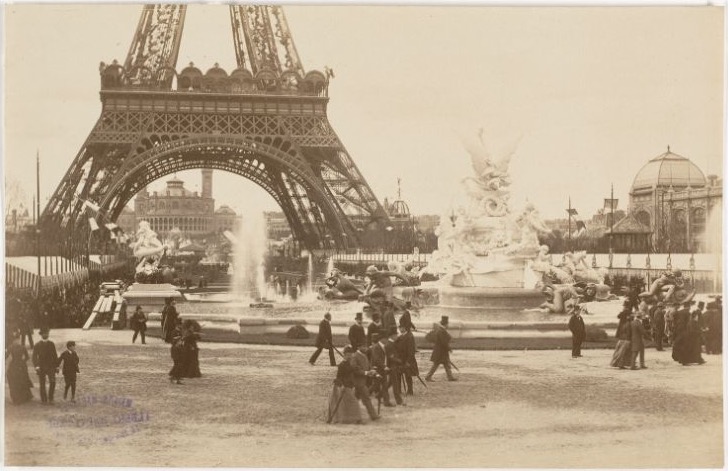
Image unavailable.
Visitors walk near a fountain beneath the tower’s lower arch at the 1889 fair.

Sources: [1]
How did the tower resist the wind?#
The tower's four spreading legs transfer its weight through their iron members into concrete foundations. The members form an open lattice, with diagonal braces joining the larger pieces. Instead of filling the sides with solid walls, the builders used connected ironwork to make a tall, stiff framework with much less surface for wind to strike.
Wind creates a second problem besides weight. A horizontal push high above the ground tends to overturn the tower, like a hand pushing a tall pole. The widely separated supports give the structure a broad base over which to resist that turning effect. Forces travel through the connected girders and legs to the foundations; the legs' curves were calculated with wind pressure in mind. The curved outline and the load-bearing system are part of the same design.
Openings do not make the tower immune to wind. Even a lattice presents individual bars and surfaces to moving air, and their combined forces matter at this height. Eiffel's response to the 1887 protest explicitly defended the curves and openwork as expressions of the effort to resist wind.
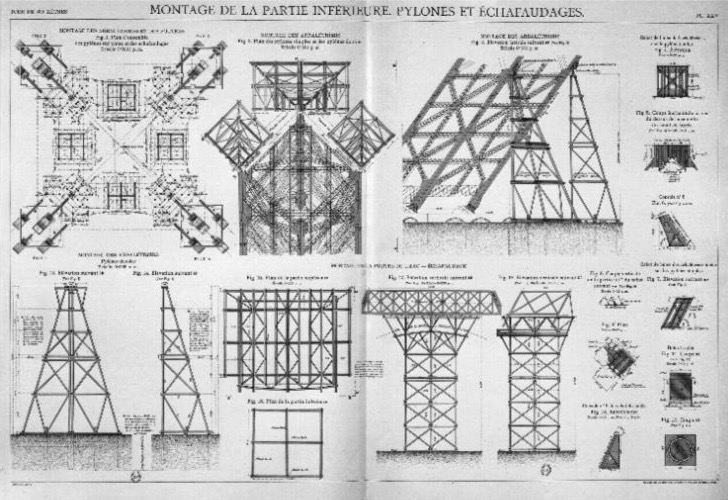
Image unavailable.
A historical engineering plate showing plans and elevations of temporary supports and scaffolding for the tower’s lower structure.

Sources: [1]
How was the tower assembled?#
The workshop and the building site had different jobs. At Levallois-Perret, Eiffel's team prepared and fitted individual pieces into larger sections before they travelled to Paris. The official history counts 18,038 metal pieces and 2.5 million rivets. Initial bolts held components together while joints were assembled; heated rivets then replaced them. A rivet's end was shaped while hot, and the metal contracted as it cooled, tightening the joint. Roughly two-thirds of the rivets were installed in the workshop and the rest on site.
Each leg needed firm support below ground before it could carry the framework. On the Seine side, the foundations lay below the water level. Workers used watertight metal caissons supplied with compressed air, creating a working space from which water could be kept out. Concrete foundations spread the forces from the ironwork into the ground.
The leaning legs could not simply be stacked like vertical columns. Temporary timber scaffolds supported the rising structure while steam cranes lifted the prepared sections. At the first platform, the four great legs had to meet the horizontal girders accurately. Hydraulic jacks and sand-filled supports allowed builders to adjust their positions before permanent wedges took over. The temporary works could then be removed as the connected structure became self-supporting.
Work began on 26 January 1887; the top and assembly were completed on 31 March 1889. Factory preparation and temporary adjustments made it possible to join the prefabricated pieces accurately.
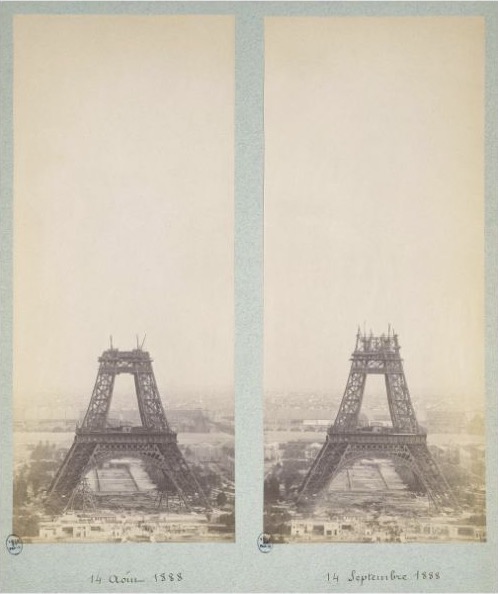
Image unavailable.
Two album photographs show the tower partly built, each with a handwritten date below it.

Sources: [1]
Why did artists object?#
The protest was an argument about the appearance and identity of Paris. On 14 February 1887, writers, painters, sculptors and architects published a petition in Le Temps addressed to the exhibition's director of works. They feared an immense industrial-looking object would overwhelm the city's older monuments. Their complaint called the tower useless and described it as a factory chimney looming over Paris.
Eiffel answered that engineering strength could itself produce beauty. He pointed to the calculated curves and openings as visible expressions of resistance to wind. The protest was signed by prominent figures, but it was not a vote by all Parisians. The tower's official history records around two million visitors during the fair, evidence of substantial public interest in the completed attraction.
Sources: [1]
What did the twenty-year agreement mean?#
The twenty years described a concession to use the land, not a predicted physical lifetime for the ironwork. Eiffel had an agreement with the City of Paris allowing him to use the site for that period. When it expired, the city's decision would determine what happened next; continuing to operate the tower depended on a further arrangement.
Historian Bertrand Lemoine describes the tower's future after 1909 as uncertain and dependent on the City Council. The tower's official science history says the concession was renewed on 1 January 1910. Its account also describes dismantling as the expected outcome, but a fixed expiry date for an agreement should not be confused with proof that an irrevocable demolition order had already been issued.
The tower had been erected as an exhibition attraction, but its scientific and communications work gave the city reasons to consider its continuing usefulness.
Why was the tower useful to science?#
Height made the tower a ready-made observing platform. From 1889, equipment included barometers, anemometers and lightning conductors. A barometer measures atmospheric pressure; an anemometer measures wind speed. Eiffel and physicist Éleuthère Mascart established a weather station at the summit. Its daily records of temperature, pressure, humidity, rainfall and wind created a series of observations over time, allowing conditions to be compared rather than inferred from one day's weather.
Eiffel also turned the tower into a test rig for air resistance. Between 1903 and 1905, objects of different shapes and sizes slid down a cable stretched from the second platform to the ground. A measuring device attached to the falling objects recorded the resistance they met. Comparing shapes offered a way to investigate how air pushes back against a moving body—an issue for structures exposed to wind and for the emerging field of flight.
In 1909, he built an aerodynamics laboratory at the tower's foot. There the arrangement was reversed: air was blown past fixed objects, making it easier to vary the air speed and take measurements. The official history reports about 5,000 trials through 1911. These uses were valuable in themselves, and they also showed that a very tall structure could serve purposes beyond the fair.
How did wireless communication change its future?#
The tower's height offered a place to support aerial wires above the surrounding city. Wireless telegraphy sent coded signals using electromagnetic waves instead of a continuous wire between the sending and receiving stations. At the sending end, electrical signals controlled a transmitter connected to an aerial. The aerial radiated waves; at the receiving end another aerial and receiver detected the signal so that its coded pattern could be interpreted. Height helped provide an elevated position for aerials, although range also depended on equipment and conditions. A cable ran from the summit towards the Champ de Mars. Eiffel supported experiments; he did not invent radio. Nikola Tesla’s work on electricity belongs to the wider history of the field.
On 5 November 1898, Eugène Ducretet conducted a wireless trial between the tower and the Panthéon, about four kilometres away. The official history places the transmitter at the tower's summit. In 1903 Eiffel offered Captain Gustave Ferrié the use of the tower for military wireless experiments and financed the work. Ferrié installed antennas and set up near the south pillar. By 1909, the official account says, a military radiotelegraph station had been established underground.
The station's strategic value preceded the renewal of Eiffel's concession on 1 January 1910. Wireless use continued to develop after that decision: the tower transmitted to much greater distances and served military communications during the First World War. From 1921 the station also broadcast experimental civilian radio programmes; by 1925 these included spoken news. Television followed in the 1930s.
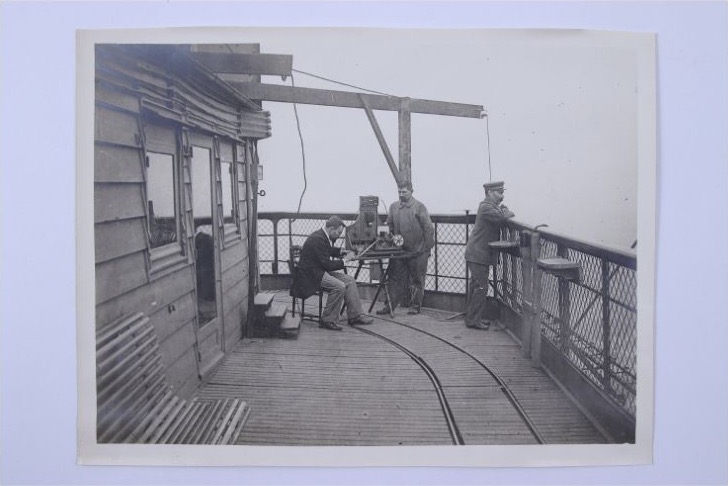
Image unavailable.
Three people stand and sit beside apparatus on a platform high on the Eiffel Tower.

Keep exploring
Sources & further reading
Follow the original research, records, and explanations behind this story.
- Origins and construction of the Eiffel Tower Société d’Exploitation de la Tour Eiffel
Design, engineering, construction, and excerpts from the protest and response.
- The Eiffel Tower laboratory Société d’Exploitation de la Tour Eiffel
Scientific use, wireless trials, military station and institutional account of concession renewal.
- How the Eiffel Tower was a science lab? Société d’Exploitation de la Tour Eiffel
Bertrand Lemoine on the land concession, weather station, falling-body experiments and antenna.
- Marconi and the South Wellfleet Wireless U.S. National Park Service
General early wireless transmitter, receiver, raised aerial and Morse-code context; not Paris apparatus specifics.
See the story in motion
Watch our illustrated video, then explore another question below.
Watch on YouTubeFollow the thread