
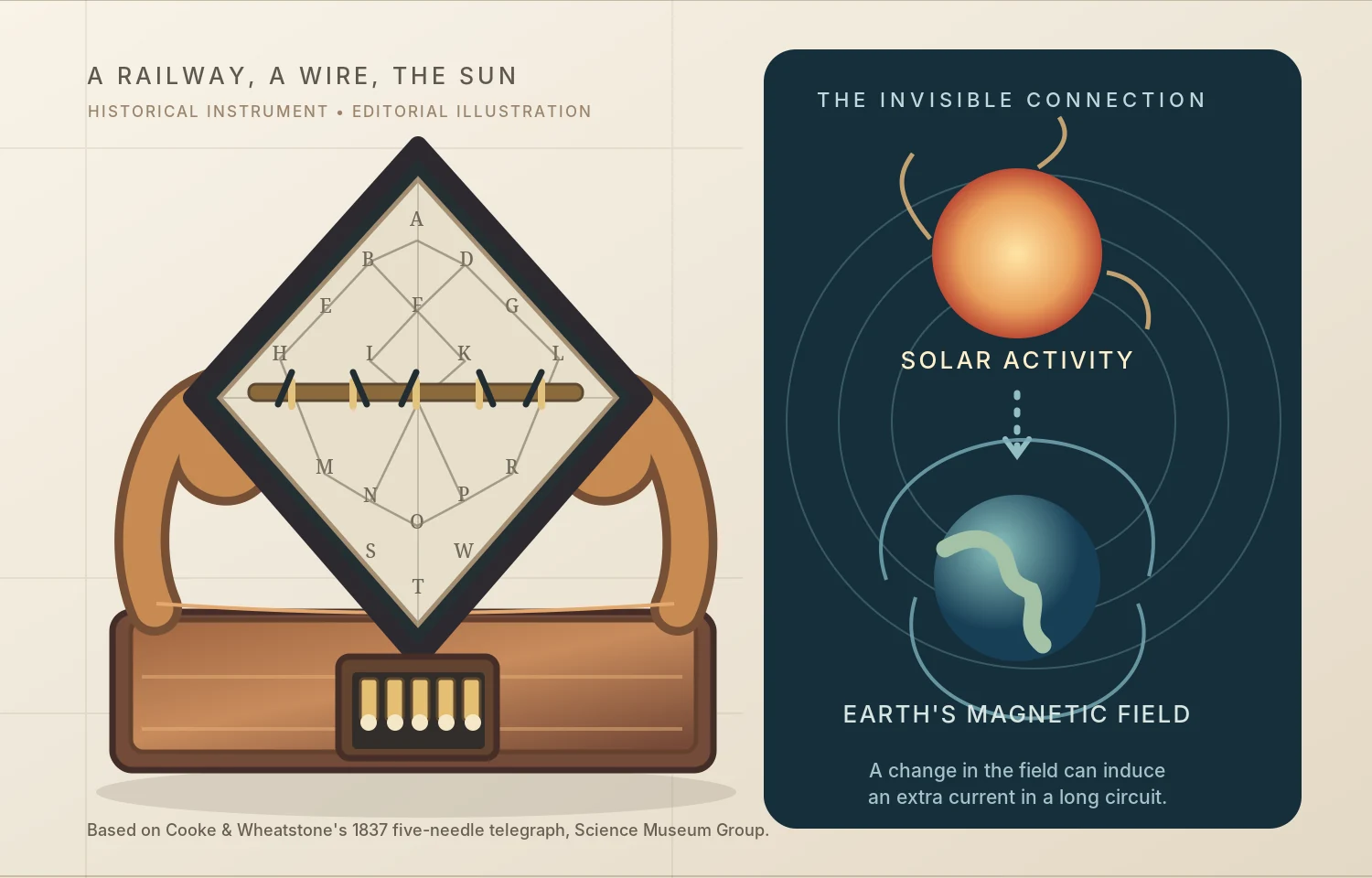
A solar disturbance can change Earth's magnetic environment, inducing an electric field that drives unwanted current through a long telegraph circuit. That extra current can make a message unreliable.
A message that could not be trusted was enough to hold a railway train. In an account published in 1871, an express train at Exeter was reportedly delayed for 16 minutes because staff could not confirm that the line ahead was clear. The suspected culprit was an unusual electrical disturbance. Its possible source lay far beyond the railway: the Sun.
The story is more revealing than a simple tale of a solar storm stopping a train. Its date turns out to be wrong, the surviving evidence has important limits, and the physics explains why a wire on the ground can respond to changes in Earth's magnetic environment. Following that chain also makes it easier to understand today's very different risks to power networks, satellites and navigation.
How did a Victorian railway check the line ahead?#
Early railway telegraphs let people at different points along a route exchange electrical signals about the track between them. A train could only be allowed to proceed when the staff responsible for that section had sufficient confirmation that it was clear. If a message could not be read reliably, the safe decision was to withhold permission rather than assume the track was empty.
A typical needle telegraph used a battery to send controlled electrical currents along a wire. At the receiving instrument, those currents acted on a magnetic needle. Operators interpreted a sequence of indications according to the system's code. Cooke and Wheatstone developed several forms of this technology as railways began using electrical communication in the 1830s and 1840s.
The particular telegraph model used at Exeter has not been established by the evidence discussed here. The cover drawing is based on a documented 1837 Cooke and Wheatstone instrument; it does not identify the equipment involved in the reported delay. Nor was this an automatic track circuit: the reported problem concerned communication between staff, whereas a track circuit detects trains electrically through the rails.
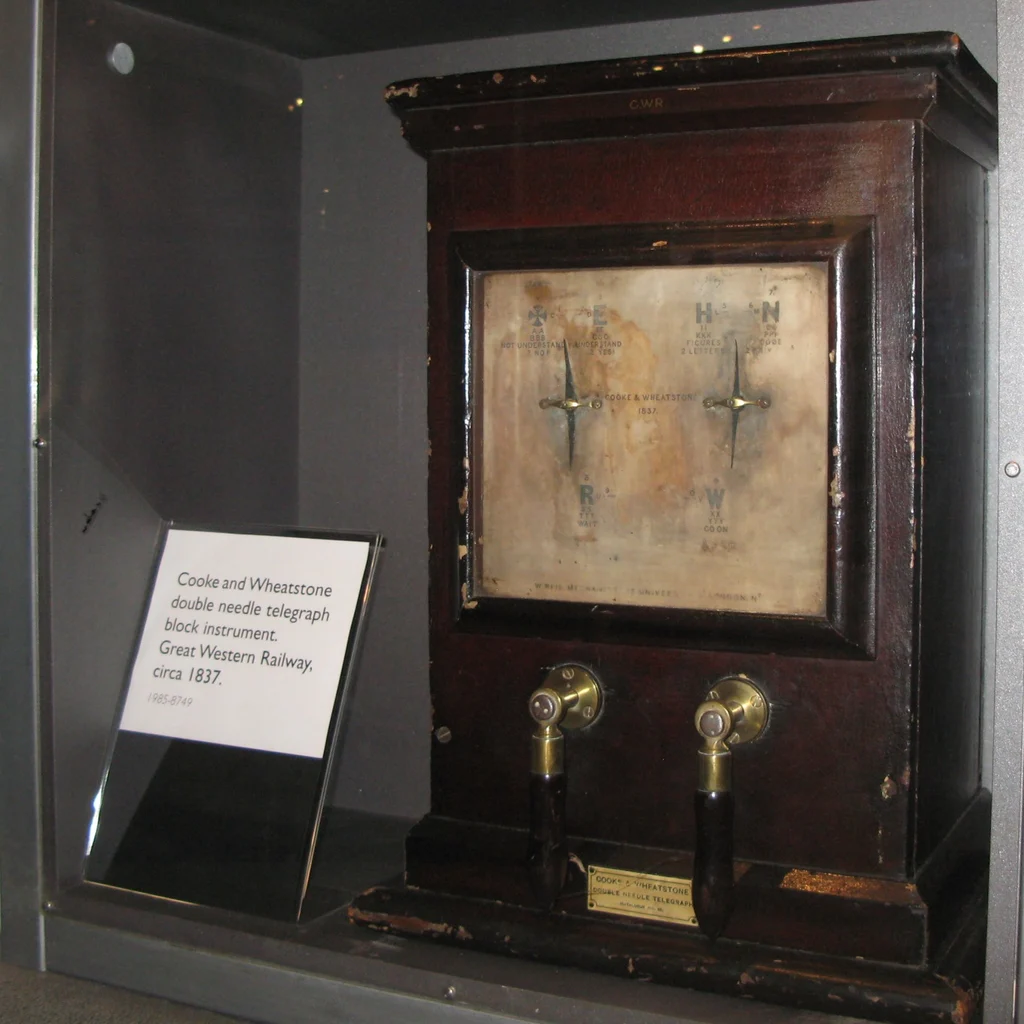
Image unavailable.
A preserved Cooke and Wheatstone double-needle telegraph in a wooden case, photographed on display at the National Railway Museum.

Was the Exeter train really delayed in 1841?#
The famous 16-minute figure comes from an account printed in Nature in October 1871. It said that a 10:05 p.m. departure from Exeter had been held on 18 October 1841 because telegraph interference prevented staff from establishing whether the line was clear at Starcross. But this report appeared roughly 30 years after the date it supplied, without an identifiable contemporary train-delay record.
There is a decisive problem with 1841: the relevant railway section through Starcross did not open until 30 May 1846. In a 2026 investigation, James Wild and colleagues compared railway timetables, contemporary newspapers, sunspot observations and magnetic records. A 10:05 p.m. departure appears in the timetables for a later period, and a surviving magnetogram from Greenwich shows strong magnetic disturbances on the evening of 18 October 1848. Its horizontal magnetic-field component changed by approximately 310 nanoteslas in about 20 minutes. A nanotesla is one billionth of a tesla, the unit used to measure magnetic-field strength; the rate of change is particularly relevant to induction. Accounts of auroras and observations of sunspots strengthen the case for that date.
The researchers therefore argue that the original report probably printed 1841 instead of 1848. This is a well-supported historical reconstruction, not the discovery of a station log independently recording that specific 16-minute delay. Greenwich's magnetic measurements were also taken well away from Exeter; they document a regional storm, not the actual current in a particular railway wire. And the Exeter episode is not the first credible technical impact of space weather: a report concerning the Midland Railway on 19 March 1847 predates it.
How can a solar disturbance create current in a railway wire?#
The electrical effect starts with Earth's changing magnetic environment. The Sun continually releases a solar wind: a flow of charged particles carrying magnetic fields. Under favorable conditions, a strong disturbance in that flow transfers energy into Earth's magnetosphere, the region shaped by the planet's magnetic field. Electric currents in space and the upper atmosphere change, and the magnetic field measured at the ground changes with them.
A magnetic field that varies over time generates an electric field. That is electromagnetic induction. During a geomagnetic storm, the induced electric field extends across the ground and can produce an electrical potential difference along an extended route. If a conducting circuit offers a path, an additional current can flow. This is called a geomagnetically induced current, or GIC.
A telegraph already carries its own intended signalling current. An unwanted current could reinforce, oppose or otherwise disturb the signal the receiver was meant to interpret. The disturbance does not require a burst of electricity to leap directly from the Sun into the wire. The intervening magnetosphere, time-varying magnetic field and geoelectric field are essential parts of the explanation. This mechanism is established physics; it cannot, by itself, identify a particular solar eruption or prove exactly what happened to the Exeter instrument.
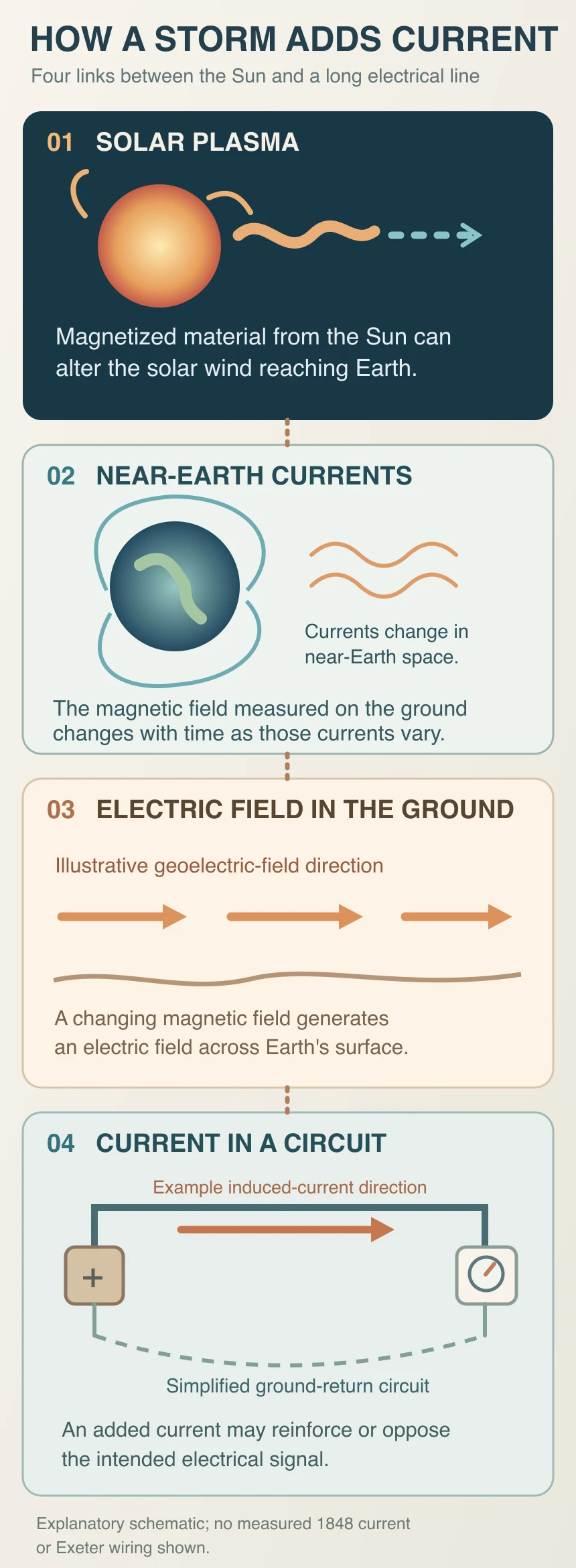
Image unavailable.
Four-stage mechanism diagram showing magnetized solar material, changing near-Earth currents, an induced ground electric field, and extra current in a long grounded circuit.
Why are long lines and ground connections important?#
A ground-level electric field can produce a greater voltage along a longer conducting route, particularly when much of that route points in the field's direction. The relevant quantity is the electric field integrated along the path, rather than the length of wire alone. A line at a different orientation may experience a smaller effect even during the same storm.
Grounding changes the circuit too. In a system with an earth return, current can travel along a wire and complete the path through the ground. Differences in electrical potential between grounded ends help drive unwanted current around that circuit. Local geology matters because rock and soil have different electrical conductivities, so the same magnetic disturbance does not create the same electric field everywhere.
This is why a single dramatic number cannot be assigned to the Exeter line. Its actual wiring, earth connections and local electric field are not recovered from the historical account. The principle nevertheless explains the continuing concern for long, grounded conductors such as power-transmission networks and pipelines.
Is a solar flare the same thing as a coronal mass ejection?#
A solar flare is a rapid release of electromagnetic radiation. Its X-rays and extreme ultraviolet light reach Earth in about eight minutes, changing the ionosphere on the sunlit side. That can weaken or interrupt high-frequency radio communication. A nineteenth-century wire telegraph did not depend on this radio path.
A coronal mass ejection, or CME, is an enormous outflow of magnetized solar plasma. If one is directed toward Earth, its journey typically takes many hours to several days. Its magnetic field can interact strongly with Earth's magnetic environment and trigger a geomagnetic storm, especially when the arriving field has a favorable orientation. High-speed solar-wind streams can also cause geomagnetic storms. Flares and CMEs can occur together, but they are different phenomena with different direct effects.
The observations from October 1848 are consistent with disturbed space weather. They do not give us a direct observation of a specific CME, its launch time or its magnetic orientation. Those details cannot be reconstructed just by knowing how induction works.
Which modern technologies face which risks?#
Long, grounded power lines can carry storm-induced currents into transformers. Those relatively slow currents can push a transformer's magnetic core outside its normal operating range and cause heating or operational problems. Pipelines and other extended grounded conductors can also experience additional electrical effects. These are consequences of geoelectric induction at the surface.
Satellites face different hazards. Energetic particles can interfere with electronics and cause charging, while geomagnetic storms can heat Earth's upper atmosphere and increase drag on low-orbit spacecraft. Navigation systems such as GPS and other GNSS constellations have another vulnerable link: their radio signals must pass through the ionosphere. When it changes unpredictably, position estimates can become less accurate or receivers can lose signal lock. Solar flares can separately disrupt high-frequency radio on Earth's sunlit side.
Modern railways are not simply Victorian telegraphs with better cases. Their track detection, communication and power systems differ, and possible space-weather failures need to be evaluated for each design. A geomagnetic storm is a common environmental cause; the failure mechanism depends on the technology it encounters.
Did a solar superstorm nearly cause a global blackout in 2012?#
On 23 July 2012, a remarkably fast CME crossed Earth's orbital distance and struck NASA's STEREO-A spacecraft, which was elsewhere along Earth's orbit. Earth itself was not in the path. The spacecraft made direct measurements, and researchers subsequently modeled how severe the geomagnetic response could have been if a similar disturbance had reached Earth.
That distinction matters. The event was observed in space; its hypothetical effects on Earth's electrical networks were modeled. The much-discussed global catastrophe did not take place in July 2012. The near miss is important because it gives scientists unusually good measurements of an extreme eruption and a way to test scenarios for infrastructure that was never exposed to that particular impact.
Sources: [13]
Can forecasters warn us before a dangerous storm arrives?#
Solar telescopes and coronagraphs can reveal an eruption and help forecasters estimate whether a CME may reach Earth, how fast it is moving and when it may arrive. NOAA can issue geomagnetic storm watches as much as three days ahead. These are useful planning signals, but the timing and intensity remain uncertain.
The magnetic direction inside an approaching CME strongly affects how severe a storm becomes. That quantity is much better constrained when upstream spacecraft directly sample the solar wind, often allowing only tens of minutes to roughly an hour of additional warning before arrival. Operators can combine forecasts with local measurements, system models and their own procedures, but no forecast guarantees a harmless outcome or names the date of the next extreme storm.
The Exeter account, with all its historical uncertainty, captures the practical point: a long electrical connection is also a connection to its environment. The Sun can alter that environment without ever touching the equipment. The engineering task is to recognize which systems can pick up the resulting current, how much disruption it might cause, and what confirmation or protection is needed before relying on a signal.
Keep exploring
Sources & further reading
Follow the original research, records, and explanations behind this story.
- Did Space Weather Delay the 10:05 p.m. Train Departure From Exeter on 18 October 1841? Wild et al.; AGU, Space Weather
Late-1871 report, evidence for 1848, 1847 precedent, and limits of the Exeter reconstruction
- Mystery of one of the earliest recorded space weather impacts solved British Geological Survey
Research-institution account of the corrected date and historical significance
- Cooke and Wheatstone five-needle telegraph Science Museum Group Collection
Preserved 1837 telegraph mechanism and 1839 railway application; basis for original cover drawing
- A long engagement – railways, data and the information age Science Museum Group Journal
Distinguishes railway signalling telegraphs from later electrical track circuits
- Geomagnetic Storms NOAA/NWS Space Weather Prediction Center
CME and high-speed solar-wind triggers; magnetosphere/ionosphere currents and impacts
- Geoelectric Field 1- minute NOAA/NWS Space Weather Prediction Center
Induced ground electric fields, conductor/path integration and geology
- Magnetic storms and geoelectric hazards U.S. Geological Survey; publication of Love et al.
Electrical conductivity/geology, long-line hazards, and limits of simple field-to-current estimates
- Electric Power Transmission NOAA/NWS Space Weather Prediction Center
Ground-induced current in long power grids, transformer performance risks
- Solar Flares (Radio Blackouts) NOAA/NWS Space Weather Prediction Center
Electromagnetic flare radiation, sudden ionospheric ionization and HF radio disruption
- Coronal Mass Ejections (CME) Space Weather Phenomena NOAA/NWS Space Weather Prediction Center
Magnetized plasma, travel time, magnetic orientation and partial independence from flares
- Space Weather Impacts NOAA/NWS Space Weather Prediction Center
System-specific impacts to electronics, satellites, radio, GNSS and grounded equipment
- Space Weather and GPS Systems NOAA/NWS Space Weather Prediction Center
Ionospheric signal propagation, GNSS accuracy and loss of lock
- Near Miss: The Solar Superstorm of July 2012 NASA Science
Observed 23 July 2012 impact at STEREO-A, missed Earth, conditional simulations of terrestrial effects
- Subscription Services NOAA/NWS Space Weather Prediction Center
Storm-watch vs warning vs alert timing and confidence
- NASA Missions Help Explain, Predict Severity of Solar Storms NASA Science
Typical spacecraft at L1 directly sample approaching CME about 10–60 minutes before impact
- GWR Cooke and Wheatstone double needle telegraph instrument Geof Sheppard / Wikimedia Commons
Photograph of an early Great Western Railway double-needle instrument on display at the National Railway Museum; source and CC BY-SA 4.0 reuse terms. Not identified as the Exeter apparatus.
Follow the thread