
Nikola Tesla helped make alternating current useful for driving machinery. His work also reached into a different problem: making electrical oscillations fast enough to produce unusual discharges, light lamps and carry commands without a connecting wire.
A motor transfers energy into a turning shaft. A radio receiver responds to information. An experimental coil can create a very high voltage without creating energy. Tesla's patents, lectures and later recollections let us separate these accomplishments from the legends that have gathered around his name.
Who was Tesla, and where did his electrical work take shape?#
Tesla was an inventor and electrical engineer whose career connected European electrical workshops with the expanding American power industry. Born on July 10, 1856, in the Austrian Empire, in what is now Croatia, he moved to the United States in 1884 and initially worked for Thomas Edison. He became a US citizen in 1891.
The documents give his work a more useful setting than a contest between two famous personalities. His 1887 motor patent application identifies him as a resident of New York and assigns a half interest to Charles F. Peck. Westinghouse licensed his motor patents in 1888. A surviving Westinghouse motor in The Henry Ford's collection, dated 1889–1895, connects the patent story to manufactured equipment.
By 1892, Tesla was presenting high-frequency experiments to scientific audiences in London and Paris. His opening acknowledgments credited William Crookes and other investigators whose experiments had influenced him. The image of an inventor working entirely outside the knowledge and institutions of his time fits these records poorly.
How can alternating current make a magnetic field rotate?#
Alternating current, or AC, repeatedly changes direction. Put differently timed alternating currents through coils pointing in different directions, and their combined magnetic field can turn even though the coils remain still.
An electric current creates a magnetic field. Reverse the current in a coil and its magnetic north and south reverse too. One coil supplied with AC therefore produces a field that strengthens, weakens and reverses along one axis. That alone does not provide a continuously advancing magnetic direction.
A polyphase supply has two or more alternating currents with a controlled timing difference, called a phase difference. In a two-phase arrangement, one current reaches its maximum a quarter of a cycle after the other. With the coil sets at right angles, the field from one is strongest while the other passes through zero. Between those moments, both contribute. Their combined direction progresses around the motor.
Tesla's US Patent 381,968 describes this progressive shifting of magnetism. Its drawings pair successive generator positions with the resulting field directions in the motor. The important motion is initially in the magnetic pattern. A shaft can then be made to follow it.
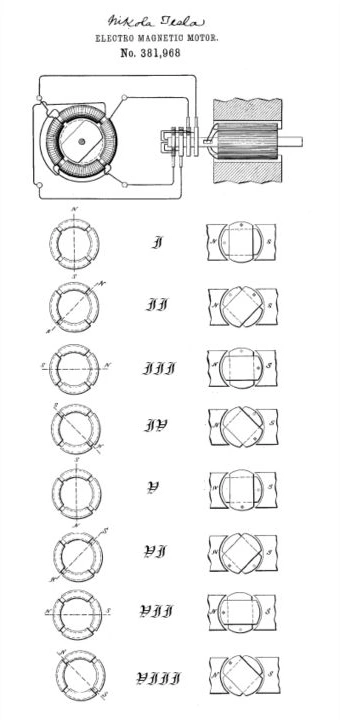
Image unavailable.
Patent illustration with a motor and generator above eight paired diagrams of changing generator and motor-field positions.

How does an induction motor turn that field into useful work?#
An induction motor uses the moving magnetic field to induce currents in its rotor, the part that turns. Those currents interact with the field and produce torque: a turning force on the shaft.
The stationary outer part, called the stator, carries the driven coils. As its field moves relative to the rotor's conducting material, the magnetic flux through that material changes. Electromagnetic induction produces an electrical driving effect, and closed conducting paths allow currents to flow. The magnetic forces on these currents push the rotor around. Electrical energy from the supply becomes mechanical work, with some lost as heat and friction.
That offers a practical way to run machinery from an alternating supply without using a commutator to reverse the motor current mechanically. A commutator is a segmented electrical switch on a rotating shaft; brushes maintain contact with it. The Smithsonian's surviving Westinghouse Model A has no commutator or contact brushes in the motor.
The distinction matters when reading Tesla's patent. It presents several arrangements, including versions with sliding contacts. Its rotating-field drawings explain a family of machines; they are not a photograph of one standard modern induction motor, and a patent does not establish the tested performance of every illustrated version.
What did the Westinghouse partnership add to an AC system?#
The motor patents gave Westinghouse a way to extend AC beyond lighting into mechanical power. The partnership joined an invention to a company that could develop and manufacture equipment for an electrical system.
A power network needs compatible generators, transmission lines, transformers and useful loads. A lamp can use electrical energy as heat and light; a factory also needs shafts to turn. The Henry Ford's object record explains why licensing Tesla's motor patents in 1888 strengthened the Westinghouse AC lighting system's competition with direct-current systems.
AC also suited transformer technology. A transformer uses changing magnetic flux to transfer energy between coils and change the voltage. Sending a given amount of power at a higher voltage allows a lower current. Because heating in a line rises with the square of its current, that can greatly reduce transmission losses. The voltage can then be reduced near the user. Raising voltage changes the conditions under which energy travels; it does not multiply the energy supplied.
Tesla contributed a crucial set of motor and polyphase ideas within that larger engineering undertaking. The company name on surviving equipment, the maker's work and the many components around a motor belong in the story too. Calling him the inventor of electricity or of every form of AC hides the specific problem he helped solve.
Why were his spectacular coil experiments a different line of work?#
Tesla's high-frequency experiments explored rapidly changing electric fields, high voltages and electrical discharges. Their purpose and operating conditions differed from those of ordinary power distribution.
Voltage describes the electrical energy available per unit of charge. Current describes the rate at which charge flows. Frequency counts how many complete cycles occur each second; one cycle per second is one hertz. A high voltage and a high frequency therefore describe different properties. Neither number, by itself, tells us how much useful power a device delivers.
In his 1892 lecture, Tesla described driving induction apparatus with rapid alternations or with the sudden discharge of a capacitor, then called a condenser. A capacitor stores energy in an electric field. A coil stores energy in a magnetic field. In an oscillating circuit, energy passes between these forms. Coupling such circuits and arranging their oscillations suitably can build a large voltage in a secondary coil: the principle behind the resonant transformer called a Tesla coil.
His lecture reports luminous streams, glowing evacuated tubes and lamps excited in surrounding fields. These were experiments in how electrical energy could produce light and other effects. The apparatus still needed an energy supply. Tesla also discussed losses and the difficulty of transmitting very rapid oscillations through conductors. The beautiful discharge was evidence of an electrical effect, not a measurement of an efficient replacement for a power grid.
What did the radio-controlled boat demonstrate in 1898?#
Tesla's boat demonstrated that wireless signals could control a machine at a distance. The significant connection was between a received electrical signal and an action such as steering.
His US Patent 613,809, filed on July 1, 1898, and granted on November 8 that year, describes control of moving vessels or vehicles without an intermediate wire or cable. A receiving circuit responds to impulses from a remote source. Relays and switching mechanisms then control the propulsion machinery and rudder. In a relay, a relatively small electrical action switches another circuit, allowing a weak received signal to govern a much larger action.
The patent places the power source on the boat: its main battery supplies the machinery. The transmitter tells the boat what to do; it does not send all the energy that turns the propeller. Tesla publicly demonstrated his remotely controlled boat at Madison Square Garden in New York in 1898. That demonstration, the July application and the November patent grant are separate events.
This is a concrete contribution to radio control. It does not make Tesla the sole inventor of radio, a field that combined work on electromagnetic waves, transmitters, detectors, tuning and practical communication. Nor does the boat establish that all of the broader applications proposed in the patent had been achieved.
Why is a wireless command easier to demonstrate than wireless power?#
A command only needs to be detected reliably enough to trigger an action. Wireless power must deliver enough usable energy to operate the load, after losses along the way.
The boat makes the difference visible. Its receiver can respond to a small incoming disturbance because a battery aboard the vessel supplies the much larger energy demand of movement. A power system has a different accounting problem: how much energy leaves the source, how much reaches the intended receiver, and how much spreads elsewhere or becomes heat?
Tesla's glowing-tube experiments also transferred energy through fields. A lamp lighting under specified laboratory conditions is a real result, but it does not establish economical electricity delivery over arbitrary distances. Scale, coupling between transmitter and receiver, insulation, losses and control of where the energy goes all matter.
A wire is one means of guiding energy; removing it does not remove the need for a source. Wireless signaling, wireless energy transfer and energy generation are three different functions. None implies free energy. Electrical systems can also respond to energy they were never designed to receive, as the historical examples in How the Sun Can Disrupt a Railway Telegraph show.
Which Tesla stories can the archive actually support?#
The strongest accounts identify what kind of document is speaking. A patent records a claimed design, a lecture records experiments and interpretations presented to an audience, and an autobiography records how its author later remembered a life.
In his 1919 series My Inventions, Tesla credited his mother's skill at making household tools and textiles. He also described developing inventions through unusually vivid mental visualization. These are valuable statements about his self-understanding, written decades after childhood. They do not independently verify every remembered episode or establish a measured ability to predict every machine's performance without testing.
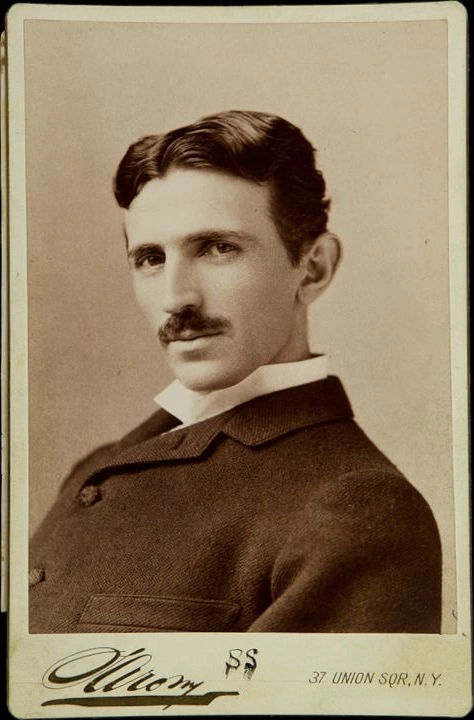
The familiar storm-at-birth story is not needed to explain a rotating field. Neither a dramatic origin story nor a laboratory portrait can supply evidence for a motor's efficiency. The archival portrait accompanying this article shows Tesla as photographed by Napoleon Sarony between 1890 and 1896. It records a person, not an experiment.
Tesla's durable achievement is substantial without these additions: documented ways to organize alternating currents into useful motion, inventive work on high-frequency apparatus, and a striking application of wireless control. Reading those contributions in their engineering and documentary setting gives him a clearer place in history than an unlimited list of inventions attributed to one man.
Keep exploring
Sources & further reading
Follow the original research, records, and explanations behind this story.
- Top 11 Things You Didn't Know About Nikola Tesla US Department of Energy
Birth, arrival in the United States in 1884 and citizenship in 1891.
- US381968A — Electro-magnetic motor United States Patent Office, via Google Patents
Filing and grant chronology; progressive shifting of magnetic poles; several machine arrangements and Peck assignment.
- Westinghouse alternating current induction motor National Museum of American History
Surviving Model A motor; quarter-phase coil currents; no motor commutator or contact brushes.
- Westinghouse Induction Motor, 1889–1895 The Henry Ford
Artifact Overview and Details: 1888 patent licensing, maker and object date.
- Experiments with Alternate Currents of High Potential and High Frequency Nikola Tesla, transcription at Tesla Universe
1892 lecture: high-frequency induction apparatus, capacitor discharges, lighting experiments, losses, and acknowledgments. Historical interpretations are not all modern physics.
- My Inventions I — My Early Life Nikola Tesla, Electrical Experimenter, February 1919; transcription at Tesla Universe
Attributed later recollections of his mother and mental visualization; not independent evidence of childhood events.
- US613809A — Method of and apparatus for controlling mechanism of moving vessels or vehicles United States Patent Office, via Google Patents
Application July 1 and grant November 8, 1898; receiving circuits, relays, steering and onboard battery.
- Tesla’s Remotely Controlled Boat Nikola Tesla Museum
1898 Madison Square Garden demonstration; the museum exhibit is a model.
- University Physics Volume 2, 15.6 Transformers OpenStax, Rice University
Opening paragraphs and equations 15.20–15.22: voltage/current changes, line losses and conservation of energy.
- University Physics Volume 2, 13.6 Electric Generators and Back Emf OpenStax, Rice University
Electric Generators and Back Emf: changing flux, induced emf, current-loop torque and energy conversion.
- File:Nikola Tesla by Sarony c1893.jpg Wikimedia Commons; Harvard Fine Arts Library collection
Photographer Napoleon Sarony, date between 1890 and 1896, object FAL15283 / 119.1976.4699; explicit public-domain statement.
- File:RMFpatent.PNG Wikimedia Commons
Published arrangement of Tesla patent drawings; file author attribution Rotating magnetic field at English-language Wikipedia; explicit CC BY-SA 3.0.
See the story in motion
Watch our illustrated video, then explore another question below.
Watch on YouTubeFollow the thread