
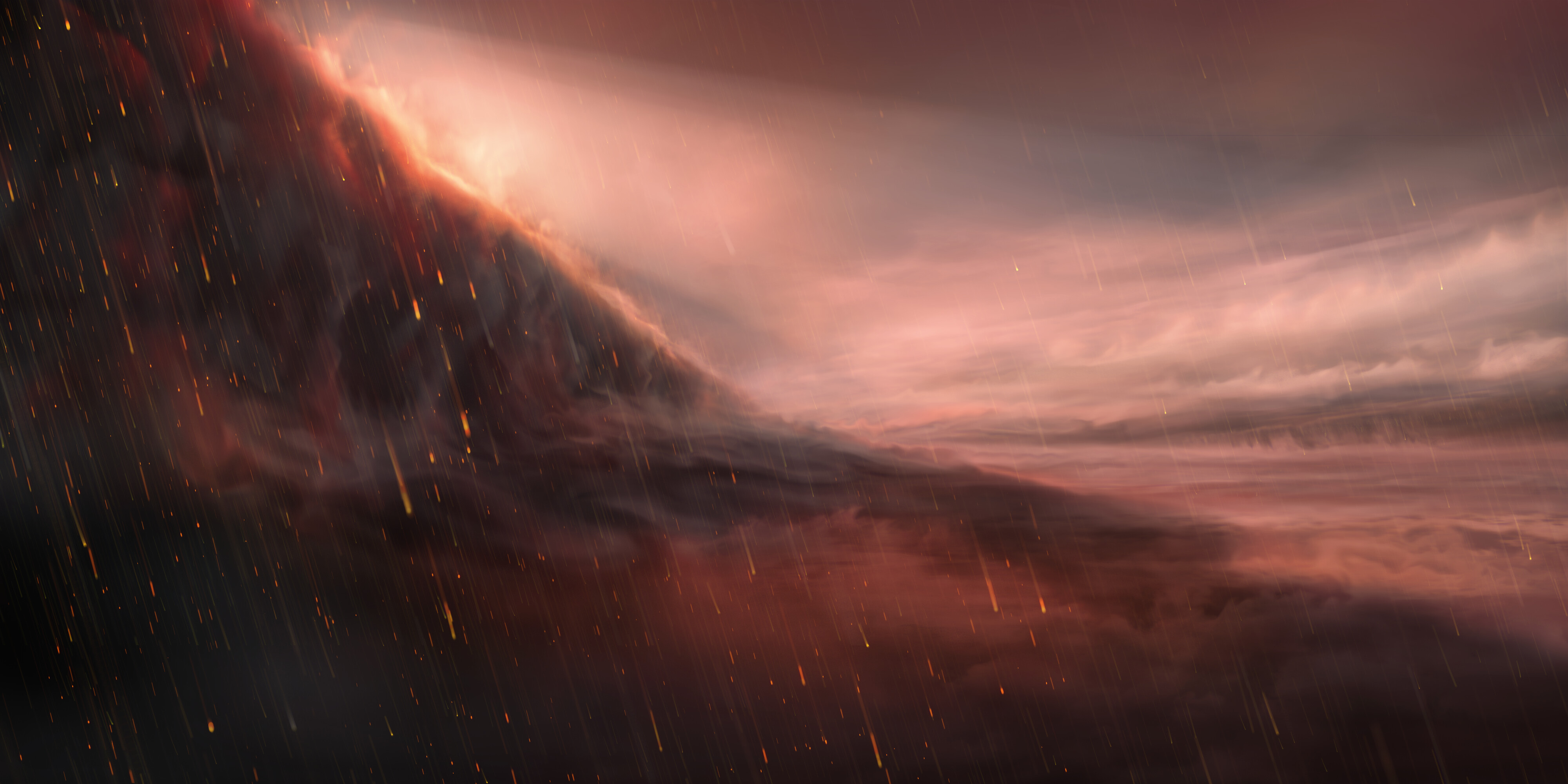
Iron may condense and fall through the atmosphere of WASP-76 b, a giant planet heated intensely by its nearby star. Astronomers detected an uneven signature of iron vapor around the planet. Condensation on the cooler side is one explanation, but the observations do not show individual raindrops, and atmospheric models offer other ways to produce a similar signal.
The distinction matters: detecting iron in an atmosphere, detecting a difference between its two sides, and identifying the process responsible are three separate steps.
What kind of planet is WASP-76 b?#
WASP-76 b belongs to the ultra-hot Jupiter class: giant planets close enough to their stars for their atmospheres to reach extreme temperatures. ESO's 2020 discovery report describes dayside temperatures above 2,400 degrees Celsius. Under those conditions, metals can exist as vapor in the atmosphere.
The planet is expected to keep approximately the same hemisphere facing its star. This is tidal locking: rotation and orbital motion have matching periods. It produces a persistent dayside and nightside, but it does not prevent winds from carrying gas between them.
That circulation connects regions with very different heating. A parcel of gas can leave the strongly irradiated side and enter a cooler environment. Whether one of its ingredients stays gaseous depends on the local temperature and pressure.
Sources: [1]
How could iron become rain?#
Rain is a process of condensation and falling material, not a word restricted to water. On Earth, cooling water vapor can produce droplets. In a much hotter atmosphere, another substance can occupy the role that water plays in familiar weather.
The proposed WASP-76 b cycle begins with gaseous iron in hot regions. Winds transport it toward cooler regions, where iron can condense. If the resulting particles settle, some iron is removed from the atmospheric layer sampled by observations.
A weak vapor signature would then have a physical explanation: the element has changed phase and moved out of the observed gas. It has not ceased to exist. The details of condensation, particle growth and settling require a model of the atmosphere; a headline about rain does not specify them all.
What did the telescope actually measure?#
The key observation was a transmission spectrum. During a transit, the planet passes in front of its star from our viewpoint. Some starlight passes through the thin atmospheric region around the planet's edge before reaching the telescope.
Atoms and molecules absorb light at characteristic wavelengths. A spectrograph separates the light by wavelength so researchers can search for those absorption patterns. ESPRESSO, an instrument on ESO's Very Large Telescope, detected the pattern associated with neutral iron.
The measurement is therefore a change in the received light. Researchers infer the atmosphere's composition by comparing that pattern with expected atomic features and accounting for the star, Earth's atmosphere and the instrument. They are not resolving a landscape of clouds as a spacecraft might do at a nearby planet.
Why compare the morning and evening limbs?#
The terminator is the boundary between day and night. During transit, the atmosphere near this boundary contributes to the light filtering around the planet. The morning and evening limbs sample different parts of the circulating atmosphere.
Researchers found an asymmetric iron signal as the transit progressed. The original interpretation associated stronger absorption with the evening side and a depleted signal with the morning side. If iron condensed while air crossed the nightside, the returning morning-side gas could carry less iron vapor.
The terms morning and evening identify the transition relative to illumination. On a tidally locked planet, they do not imply that every location experiences an Earth-like sunrise and sunset every few hours. Winds move through the illumination pattern even when the planet's rotation keeps that pattern approximately fixed.
Was the iron asymmetry detected again?#
Yes. In a 2021 study, Aurora Kesseli and Ignas Snellen analyzed archival HARPS observations covering four transits and confirmed the asymmetric iron absorption feature. That provided evidence beyond the initial ESPRESSO observations.
Repeating an observation with another instrument helps test whether a feature belongs to the astronomical source or to a particular observing setup. Combining several transits can also make a weak signal easier to detect.
Confirmation of the spectral feature does not automatically settle its physical cause. Different atmospheric models can share an observable result. Establishing that the signal is reproducible strengthens the evidence that needs explaining; choosing among explanations requires additional tests.
Sources: [2]
Can temperature differences mimic iron rain?#
Yes. Wardenier and colleagues modeled WASP-76 b in three dimensions and calculated the iron signals expected during transit. Their 2021 results reproduced the observed behavior with condensation, but also with a sufficiently strong temperature difference between the two limbs without requiring iron condensation.
Temperature changes how much atmosphere contributes to absorption and how spectral lines form. Rotation and winds shift those lines. The signal is therefore sensitive to atmospheric structure and motion as well as to the amount of iron present.
This is a common inverse problem: observers measure the outgoing signal and work backward to the conditions that produced it. If two sets of conditions generate similar spectra, the original observation alone cannot select a unique explanation. That limitation does not erase the detection of iron.
What did more detailed atmospheric retrievals find?#
A 2022 study by Gandhi and colleagues treated the morning and evening regions separately while fitting winds and temperature. It found a more prominent evening-side iron signal during the last quarter of the transit. The morning-side abundance was less tightly constrained and entangled with assumptions about obscuring material.
A retrieval estimates atmospheric parameters by finding model spectra consistent with the measurements. When different parameters compensate for one another, a narrow-looking feature in the data can correspond to a broad range of physical conditions.
A planet-wide average can hide these differences. Different parts of the atmosphere contribute differently as the transit proceeds. A richer model can extract that variation, although its output still depends on the model and the available observations.
Sources: [4]
Would this be liquid metal falling onto solid ground?#
The evidence concerns a giant planet's atmosphere. It does not establish a solid landscape, puddles, droplet sizes or the fate of every particle at greater depth. Describing condensation and downward transport is more precise than picturing a metal shower striking a familiar ground surface.
The ESO artwork used as the cover visualizes the proposed process. Its glowing streaks are an artist's interpretation, not photographed raindrops. The illustration helps explain what condensation might look like, while the spectrum provides the observational evidence.
Weather depends on the substances available and on local conditions. A temperature that is extremely hot by Earth's standards can still be cool enough for a particular material to condense out of an even hotter gas.
What evidence would make the rainfall explanation stronger?#
Useful tests must distinguish changes in composition from changes in temperature, clouds and motion. Repeated transits help establish which features persist. Measurements across more wavelengths and of other chemical species can constrain atmospheric conditions that a single element cannot determine alone.
The aim is to test several explanations against the same observations. A model that matches iron absorption should also remain consistent with the inferred temperatures, winds and other spectral features. Agreement across those measurements is more informative than a vivid picture of falling metal.
For another example of a proposed physical process inferred from remote measurements, see how a stellar flare reveals a wandering black hole. In both cases, the observed light is secure evidence to analyze, while parts of the physical history remain uncertain.
Keep exploring
Sources & further reading
Follow the original research, records, and explanations behind this story.
- ESO Telescope Observes Exoplanet Where It Rains Iron ESO
Original observational interpretation and physical setting.
- Confirmation of Asymmetric Iron Absorption in WASP-76b with HARPS Kesseli and Snellen / ApJL
Independent detection in four archival transits.
- Decomposing the Iron Cross-Correlation Signal of the Ultra-Hot Jupiter WASP-76b Wardenier et al. / MNRAS
Condensation and temperature asymmetry can both reproduce the signal.
- Spatially-resolving the terminator: Variation of Fe, temperature and winds in WASP-76 b Gandhi et al. / MNRAS
Separate-limb retrieval and morning-side abundance uncertainty.
- Artist’s impression of the night side of WASP-76 b ESO
Existing artwork illustrating proposed iron condensation.
Follow the thread