
Astronomers can find an otherwise quiet black hole outside a galaxy's center when a passing star is torn apart and its debris produces a flare. TDE 2025abcr is one such event. Its light appeared far from the center of a galaxy about 750 million light-years away, revealing a black hole estimated to have roughly a million times the Sun's mass.
The flare identifies a location and a physical process. It does not show a black hole traveling across the galaxy in real time. Researchers are still testing how this object reached its unusual surroundings.
What does a wandering black hole mean?#
In this context, wandering describes a massive black hole outside the central region where astronomers usually look for it. A quiet black hole can be difficult to detect because there may be little nearby gas producing visible radiation.
A galaxy can also contain more than one massive black hole. Mergers bring together galaxies and their central objects, while gravitational interactions can change their orbits. Finding one away from the center therefore raises a question about the galaxy's history as well as the black hole itself.
The word does not mean random motion without gravity, and it does not establish that the object has escaped its host. A position outside the visible nucleus is insufficient to reconstruct a complete orbit. That would require additional information about distance, velocity and the surrounding gravitational field.
How can a black hole tear a star apart?#
Gravity changes across an extended object. The near side of a star feels a stronger pull from a black hole than the far side. When that difference overwhelms the star's ability to hold itself together, the encounter can stretch and disrupt it. Astronomers call the resulting phenomenon a tidal disruption event, or TDE.
The important comparison is between forces across the star, rather than simply the pull on its center. A star can orbit a massive object without being torn apart if its orbit stays sufficiently far away. A closer passage changes the difference in gravitational pull across it.
Debris from a disrupted star can collect around the black hole and radiate as it heats up. This makes a previously faint system temporarily conspicuous. The flare is a way to locate an object that was already there before the star approached.
If light cannot escape, where does the flare come from?#
The event horizon is the boundary beyond which light cannot return to a distant observer. The observed radiation comes from material outside that boundary. A glowing accretion flow can therefore reveal a black hole even though light from inside the horizon cannot escape.
Accretion means the collection and inward motion of matter. Gas can remain outside the horizon long enough to produce radiation before some of it falls farther inward. A bright flare should not be described as light escaping from the black hole's interior.
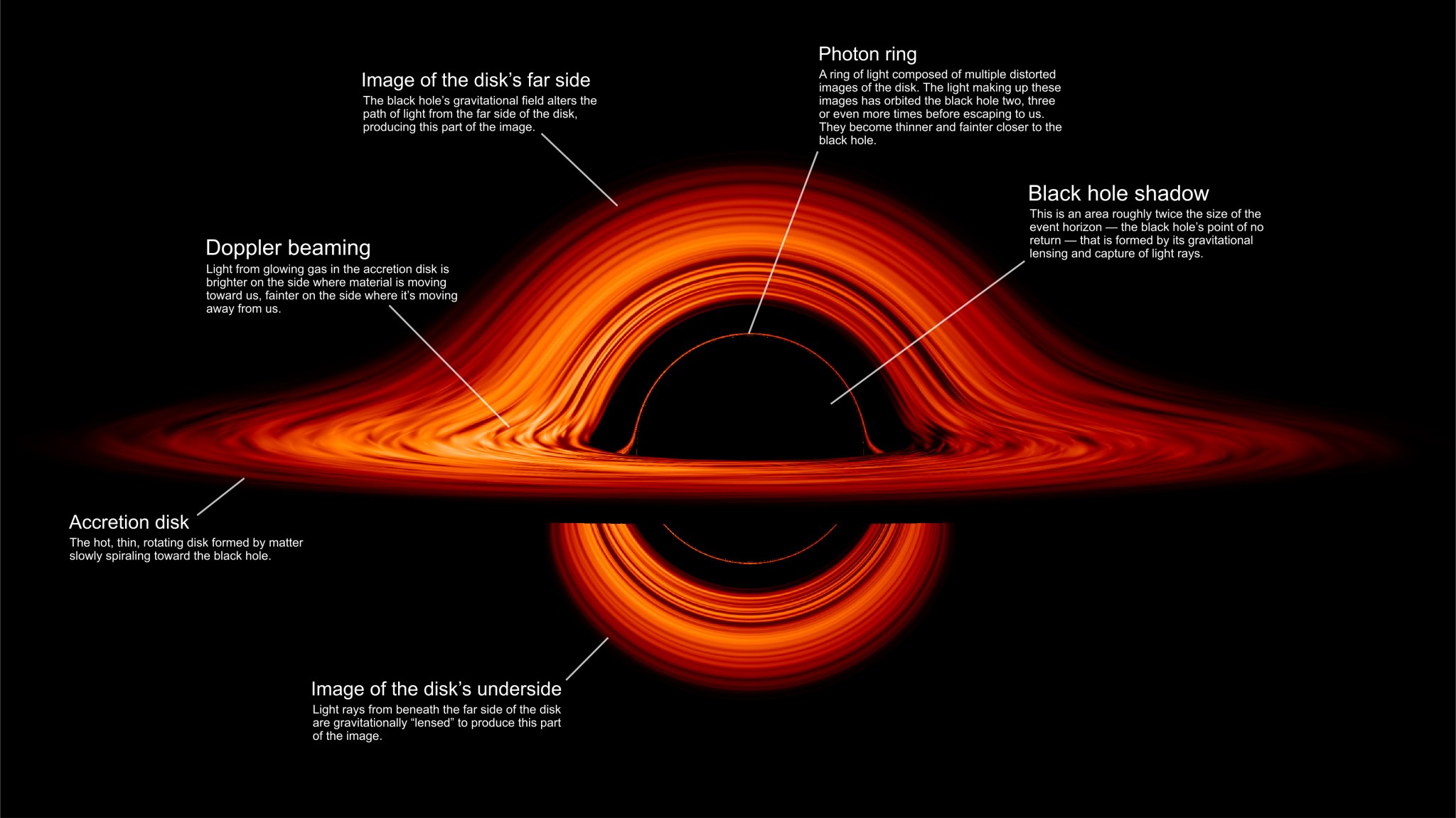
The cover is an existing NASA visualization of an accretion disk, not a close photograph of TDE 2025abcr. It illustrates how the gravitational field bends light from gas around a black hole. Its curved appearance is partly an effect of the path that light takes to the viewer.
The labels distinguish several effects. Light bending reveals parts of the disk's far side and underside. The photon ring contains strongly deflected images of the disk. The dark shadow results from light capture and deflection, while Doppler beaming makes gas moving toward the viewer appear brighter than gas moving away. These visual features explain a model's appearance; they were not individually resolved in the distant flare.
What did ZTF and Swift observe?#
The Zwicky Transient Facility flagged unusual brightening in November 2025. Follow-up observations included spectroscopy with the SOAR telescope and ultraviolet observations with NASA's Swift observatory. These measurements supplied different tests of the flare's interpretation.
A light curve records brightness over time. A spectrum separates light by wavelength, revealing features that a single brightness measurement cannot supply. Ultraviolet measurements extend the view beyond the visible colors recorded in ordinary photographs.
The evidence comes from combining those observations. A newly bright point alone has several possible explanations. Its changing brightness, spectral features and temperature help researchers distinguish a tidal disruption event from other kinds of transient source.
Sources: [1]
How far from the galaxy's center was it?#
The research paper reports a projected separation of 9.3 kiloparsecs, approximately 30,000 light-years. Projected means the separation across the sky after converting an angular offset into a physical distance at the galaxy.
A flat image hides the depth direction. Two objects separated on an image could also lie at different distances along our line of sight. The projected separation therefore does not, by itself, provide their full three-dimensional separation.
The same distinction applies to motion. One measured position cannot tell us how fast the black hole traveled, which route it followed or how long ago it left another location. Those questions require a physical history that is consistent with more than the offset.
Sources: [2]
How was its mass estimated?#
Stein and colleagues used a relation between the flare's peak luminosity and black-hole mass. Their estimate is roughly a million solar masses, with substantial uncertainty. A solar mass is a unit equal to the mass of the Sun; the phrase does not mean that observers counted a million stars inside the object.
A scaling relation uses a measured property to infer another quantity from an empirical or modeled connection. The measurement and the relation both contribute uncertainty. Changing the relation or its assumptions can change the inferred mass even if the measured light stays the same.
That is why rounded language is appropriate here. The estimate places the object in a massive black-hole category without supplying a precision weighing or a direct image of the event horizon.
Sources: [2]
How could it end up outside the nucleus?#
The University of Maryland team described two possibilities. A smaller galaxy might be merging with a larger one, losing many of its stars while retaining its central black hole. Alternatively, an interaction involving several massive black holes could eject the lighter participant from the central region.
These histories predict different surroundings. A remnant stellar system near the flare would be relevant to the stripped-galaxy explanation. An apparently isolated location would need to be interpreted with the depth and sensitivity of the observations in mind: failing to see faint stars does not prove that none exist.
As the transient fades, observations can better separate any persistent surrounding light from the bright flare. The origin remains an open question, so an illustration of an ejection would be a possible scenario rather than a record of what happened.
Is this the same event as AT2024tvd?#
No. AT2024tvd is another tidal disruption event described in a 2025 Hubble report. Its reported offset is about 2,600 light-years from its galaxy's center, much smaller than the roughly 30,000-light-year projected offset of TDE 2025abcr.
The two events support the broader search for massive black holes outside galactic nuclei, but their names, distances and observations must remain separate. A discovery described as the first in a particular survey or in the outskirts of a galaxy is not necessarily the first evidence of any black hole away from a galactic center.
For the optical problem that once limited the telescope, see how Hubble's mirror flaw was corrected. Resolving closely spaced features is a different challenge from collecting enough light to detect a flare.
Why were these objects easy to miss?#
Searches designed to select flares near galaxy centers can reject events outside those centers before follow-up begins. The team's modified classifier searched for TDE-like light curves without requiring a central location. That change allowed an unusual position to become a research question instead of a reason to discard the source.
The resulting sample still has limits. A dormant black hole must encounter a suitable star, produce a detectable flare and be observed at the right time. A survey must then distinguish the transient from other changing sources and obtain enough follow-up evidence.
The number of detected flares is therefore not a direct count of all wandering black holes. Estimating their abundance also requires understanding the probability of each object producing a detectable event. The discovery demonstrates a way to find them; the population size remains a separate measurement problem.
Keep exploring
Sources & further reading
Follow the original research, records, and explanations behind this story.
- NASA’s Swift Sees “Wandering” Mega Black Hole Shredding Star NASA
Discovery chronology and observing instruments.
- TDE 2025abcr: A Tidal Disruption Event in the Outskirts of a Massive Galaxy Stein et al. / The Astrophysical Journal Letters
Projected offset, mass estimate and alternate origins.
- First-Ever “Wandering” Black Hole Spotted at the Edge of a Galaxy University of Maryland
Search method and possible merger histories.
- Anatomy of a Black Hole NASA Science
Event horizon and emission from surrounding matter.
- NASA’s Hubble Pinpoints Roaming Massive Black Hole NASA Science
Separate AT2024tvd event and its smaller offset.
- NASA Visualization Shows a Black Hole’s Warped World NASA Goddard
Published simulated disk illustration and gravitational lensing explanation.
Follow the thread