
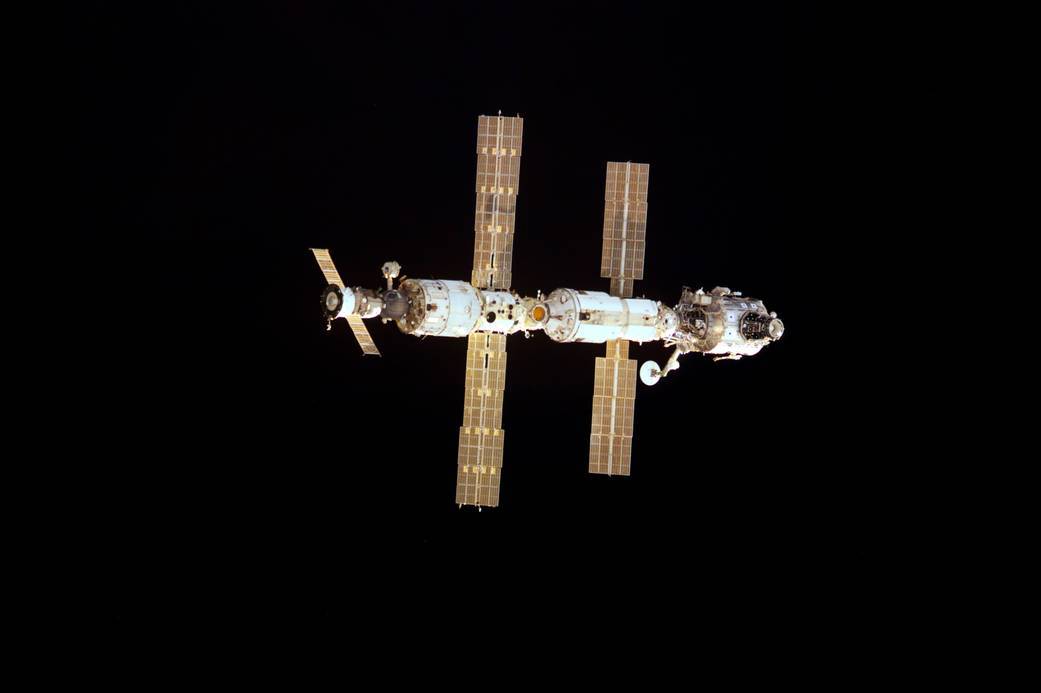
The International Space Station's continuous habitation began on 2 November 2000, when the Expedition 1 crew moved in. Successive crews have kept the outpost operating through changes of spacecraft, expanding laboratories and years of repairs. The phrase describes an unbroken succession of resident expeditions. It does not mean that someone has occupied the interior of every module at every instant.
When did the first residents arrive?#
William Shepherd, Yuri Gidzenko and Sergei Krikalev launched aboard Soyuz TM-31 on 31 October 2000. Two days later, their spacecraft docked with the Zvezda service module. They opened the hatch and entered the living quarters a little over an hour after docking.
They inherited a working construction site. Their first expedition involved activating equipment and preparing for further assembly, alongside the practical business of making the station habitable. Visiting shuttle crews could deliver a large component and help install it, then leave. The resident crew stayed to operate what had been added.
NASA marked 25 years of continuous human presence on 2 November 2025. That anniversary counts from the arrival of the first residents, rather than from the launch of the first piece of the station.
Why are 1998 and 2000 both called the station's beginning?#
Zarya, the first ISS module, launched on 20 November 1998. Unity followed aboard the shuttle Endeavour that December. Connecting those elements began orbital assembly, almost two years before Expedition 1 arrived.
The station could not be launched as one finished building. Its modules, structural beams and power equipment travelled separately, so each addition had to work with hardware already in orbit. Zvezda launched in July 2000, and later assembly flights continued after people had moved in. The American Destiny laboratory, for example, launched in February 2001.
This separates three milestones that photographs can blur together: launching the first component, establishing a resident crew and adding later facilities. The cover photograph shows the relatively small station in December 2000. It already had residents, although much of the laboratory familiar from later images had yet to arrive.
How can one crew leave without emptying the station?#
Crew rotations replace part of a continuing expedition population. In a direct handover, the incoming group arrives before the departing group leaves. Both groups share the station for a while, exchanging information and transferring responsibilities.
An indirect handover can also preserve habitation. NASA describes the pattern used during much of the Soyuz-only transport period after the shuttle's retirement: three people departed while another three remained. The replacement trio arrived later. The temporary reduction in crew size did not leave the station vacant.
If six residents are divided between two returning spacecraft, the departure of one three-person group leaves three residents. That is different from launching a crew to an empty station after its predecessors have all gone home. Overlapping assignments allow individual missions to end while the station's work continues.
Sources: [4]
Has the station ever had nobody inside?#
Yes, during some operations. On 26 February 2004, Expedition 8 residents Michael Foale and Alexander Kaleri carried out a spacewalk together. NASA's status report explicitly describes it as the first two-person ISS spacewalk without a crew member inside.
Both men remained on their station expedition, working outside the vehicle. Their absence from the pressurised rooms did not end the resident mission or create a period between expeditions. This is why a literal reading of “the home that has never been empty” needs qualification.
For the history of habitation, the useful question is whether the station continued to support a resident expedition. For a particular operation, controllers need the more precise answer: who is inside, who is outside and how can each person return? The two descriptions address different things.
Sources: [5]
What keeps a long-running expedition supplied?#
People require deliveries even when their life-support equipment recycles some of what they use. Food, replacement hardware and research supplies must reach the outpost, while completed experiments and unwanted equipment need somewhere to go.
A NASA operations report from 12 November 2026 gives a concrete example. Crew members were packing a Dragon cargo spacecraft for its return, including research samples requiring freezers or incubators. They also arranged the load to control the capsule's mass distribution. A delivery flight creates work before and after docking: unloading, checking the inventory, preserving samples and preparing the next departure.
These tasks link the station's scientific purpose to its transport system. A sample that cannot be stored or returned as required may lose its value even if the experiment itself worked. The separate explanation of how the ISS keeps its crew alive covers the air, water and cooling systems that also need this continuing maintenance and supply chain.
Sources: [6]
Who keeps working when the astronauts sleep?#
The residents are supported by control centres on Earth. Mission Control in Houston manages the U.S. orbital segment and coordinates station activities with partner centres. The Russian segment is operated from the Moscow control centre. Research operations also involve specialist teams, including the payload operations centre at Marshall and centres supporting the European Columbus and Japanese Kibo laboratories.
An astronaut therefore does not need to diagnose every fault alone. Ground specialists can examine equipment data, compare readings with earlier behaviour and prepare a procedure for the person beside the hardware. Conversely, a remote controller cannot physically replace every failed component. NASA's station FAQ stresses the need for trained people to perform hands-on maintenance in both major segments.
Continuous habitation depends on that division of work. A new crew receives a station whose maintenance history and research plans are already being tracked on the ground. When the previous residents return to Earth, that supporting record continues with the next expedition.
Keep exploring
Sources & further reading
Follow the original research, records, and explanations behind this story.
- Looking Back: International Space Station at the Start of Expedition 1 NASA
Docking, hatch opening and archival station configuration; dated visitor totals omitted.
- The International Space Station Marks 25 Years of Continuous Human Presence NASA
Launch, crew roles and dated 2025 anniversary.
- Building the International Space Station ESA
Zarya, Unity, Zvezda and Destiny launches; the page’s 30 October crew-launch typo is not used.
- Top Things to Know about Space Station Crew Handovers NASA
Six-person Soyuz-era example and overlapping crew rotations; later fleet predictions and erroneous STS-131 year omitted.
- Expedition 8 Status Reports NASA
Both resident crew members outside on the same spacewalk; no implication that every cabin was always occupied.
- Crew Packs Dragon with Science and Cleans Spacesuits NASA
Dated example of cold storage and balanced cargo packing; no predicted return outcome asserted.
- Ground Facilities NASA
Division of station and science operations; obsolete fleet descriptions not used.
- International Space Station Frequently Asked Questions NASA
Hands-on maintenance requirement; changing retirement dates and propulsion exclusivity omitted.
Follow the thread