
A sealed room in orbit needs more than a supply of oxygen. People exhale carbon dioxide, release moisture, use water and produce heat. Equipment adds heat and contaminants of its own. The International Space Station remains habitable because several systems continually move, clean and replenish the material inside it, while crews and ground teams maintain the machinery.
Where does the breathing oxygen come from?#
One of the station’s oxygen sources begins with water. The Oxygen Generation System uses electricity to split water into oxygen and hydrogen, a process called electrolysis. Oxygen enters the cabin atmosphere. The hydrogen can be vented or used in another chemical process.
NASA describes a Sabatier reactor that combines hydrogen with carbon dioxide to produce water and methane. The water can return to the system; the methane is released into space. These connections explain why air and water processing cannot be treated as entirely separate jobs.
Recycling does not create matter. It changes the chemical form and location of material already aboard. Nor does an oxygen generator make the whole cabin safe by itself: pressure, ventilation and unwanted gases also require control. The station’s Environmental Control and Life Support System, usually shortened to ECLSS, covers those wider functions.
Sources: [1]
Why must carbon dioxide be removed separately?#
Breathing consumes oxygen and adds carbon dioxide to the cabin. Replacing the oxygen does not remove the exhaled gas. A sealed habitat therefore needs a way to capture carbon dioxide as well as a way to supply oxygen.
NASA’s technical description of the Carbon Dioxide Removal Assembly explains how air passes through beds that remove moisture and then capture carbon dioxide using zeolite material. The equipment alternates between collecting gas and regenerating the collecting material. Heating and exposure to vacuum release captured carbon dioxide from a bed so that it can be used again.
That repeated use reduces dependence on a fresh disposable cartridge for every cycle. It does not eliminate maintenance. The same NASA description identifies replacement parts and upkeep as continuing requirements. A regenerating filter is still a machine with valves, seals and material that must remain in working condition.
Sources: [2]
Why do fans matter in microgravity?#
On Earth, warm air can rise and cooler air can replace it through buoyancy-driven circulation. That familiar process does not work in the same way inside the freely falling station. Forced airflow moves air through occupied spaces and toward the equipment that treats it.
ESA’s description of sleeping aboard the ISS emphasises ventilation near a sleeper. Without adequate mixing, exhaled air can accumulate locally. A cabin-wide supply of oxygen is of limited use if fresh air is not reaching the place where a person is breathing.
Airflow is therefore part of life support, even when its most noticeable effect is background noise. Blocking a ventilation opening with a bag would affect a different part of the problem from changing an oxygen supply setting. The distinction also helps explain why sleeping in space involves choosing and maintaining a suitable sleeping location, not simply floating anywhere.
Sources: [3]
Is the drinking water really recycled?#
Yes. The recovery system collects moisture from breath and sweat as well as wastewater. A urine processor uses vacuum distillation to separate recoverable water, leaving a concentrated brine. Additional processing can extract more water from that remainder.
In June 2023, NASA reported that the addition of a brine processor helped demonstrate 98% total water recovery. This was a reported performance milestone for the tested system, not a claim that every water-processing operation always returns exactly that fraction.
Collected water passes through specialised filters and a catalytic reactor. Sensors check its purity, and unacceptable water is processed again. The product is drinking water that has undergone treatment, rather than untreated urine entering a drinks container.
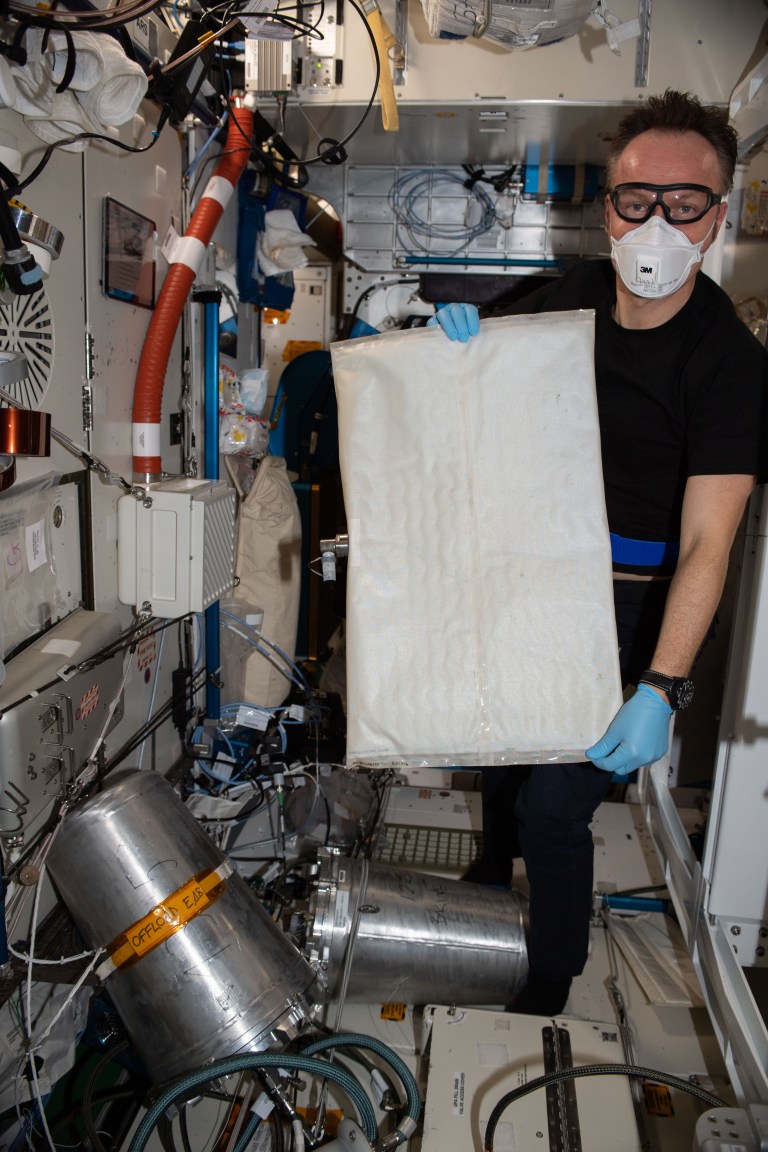
The photograph shows Matthias Maurer replacing a bladder in the Brine Processor Assembly. It makes an easily missed point about recycling: the process depends on equipment that people service. A high recovery fraction reduces the amount that must be supplied from Earth, but does not remove losses or the need to keep the hardware functioning.
Sources: [4]
What powers life support when the station is in shadow?#
Solar arrays convert sunlight into electricity for station operations, including life support and research. NASA has added roll-out arrays to augment the older power-generating surfaces. Those exterior structures support activities deep inside the pressurised modules.
The station also needs power while passing through Earth’s shadow. Batteries store electrical energy during sunlit portions of the orbit and provide it during eclipse. A NASA battery-system account describes this charge-and-discharge cycle and the replacement of older nickel-hydrogen batteries with lithium-ion units.
Stored energy bridges a period without sunlight; it is not an independent energy source. Over repeated orbits, the generation, storage and electrical loads must work together. A water processor or ventilation fan depends on that supply just as a scientific instrument does. Life support consequently extends well beyond the racks labelled with air or water functions.
Why does a spacecraft need cooling in space?#
Operating machinery produces heat that must be carried away. The station’s external cooling equipment circulates ammonia through pumps, reservoirs and radiators. The radiators release heat to space, allowing the coolant to carry away more heat from the station.
NASA’s account of its Robotic External Leak Locator describes why keeping this circuit intact matters. Ammonia leaks and component failures have required investigation and repairs. The robotic instrument helps operators locate escaping gas and check whether a repair has worked.
A documented example came in May 2013, when Chris Cassidy and Tom Marshburn replaced a leaking pump unit during a spacewalk. Cooling thus involves both continuous operation and the ability to intervene when hardware fails. Having a radiator attached to the station is not enough if the coolant cannot circulate through the necessary path.
Does the station produce its own food?#
The regular food system depends on food prepared on Earth. NASA’s food laboratories develop and package items for flight, taking account of nutrition, safety, storage space and the limited preparation equipment aboard the station.
Different foods need different treatment. Some are freeze-dried and need water added before eating. Others are heat-stabilised in pouches. Powdered drinks are packaged so that water can be injected through a valve. Packaging helps contain food and liquids where they would otherwise float away.
Food also has to be acceptable to the people eating it over a long mission. NASA includes preferences and personal favourites within the menu system. Recycling air and water cannot substitute for a dependable food supply: recovering one consumable does not automatically close every other material cycle aboard the station.
Sources: [9]
Is the ISS a self-sufficient home?#
Its systems reuse valuable resources, but the station remains connected to Earth through supplies, replacement hardware and operational support. The water-processing photographs, battery replacements and cooling repairs are examples of that continuing dependence.
The practical question is often which part of a system can be restored, replaced or temporarily worked around. Mission-specific crew training prepares astronauts for equipment and procedures they may need, while ground specialists help plan and interpret the work.
An inhabited station is therefore an operating process as much as a structure. Air must keep moving, water must keep passing quality checks and heat must keep leaving. The crew’s ordinary maintenance belongs to the same chain of actions as the visible solar arrays and radiators outside.
Keep exploring
Sources & further reading
Follow the original research, records, and explanations behind this story.
- Environmental Control and Life Support Systems NASA
Electrolysis, Sabatier process and wider environmental functions; rounded water percentage not used.
- OCHMO-TB-004 Carbon Dioxide NASA
Regenerating zeolite beds and maintenance; no medical threshold asserted.
- Daily Life ESA
Used only for forced airflow and local exhaled-air accumulation; dated operational figures omitted.
- NASA Achieves Water Recovery Milestone on International Space Station NASA
Dated 98% demonstration, processing stages and NASA-credited Maurer maintenance photograph.
- Power Up: Roll Out Solar Arrays Boost Space Station Power Supply NASA
Solar generation supports life support; no changing installed count asserted.
- International Space Station Lithium-Ion Battery Status NASA
Charge during sunlight and discharge during eclipse; historical replacement programme.
- Robotic External Leak Locator NASA
Ammonia circuit, radiators, leaks and robotic leak localisation; deployment schedule not treated as current.
- Leak Repaired on International Space Station ESA
Cassidy and Marshburn replaced leaking pump unit.
- Space Food Systems NASA
Freeze-dried and heat-stabilised food, packaging, nutrition and preferences.
Follow the thread