
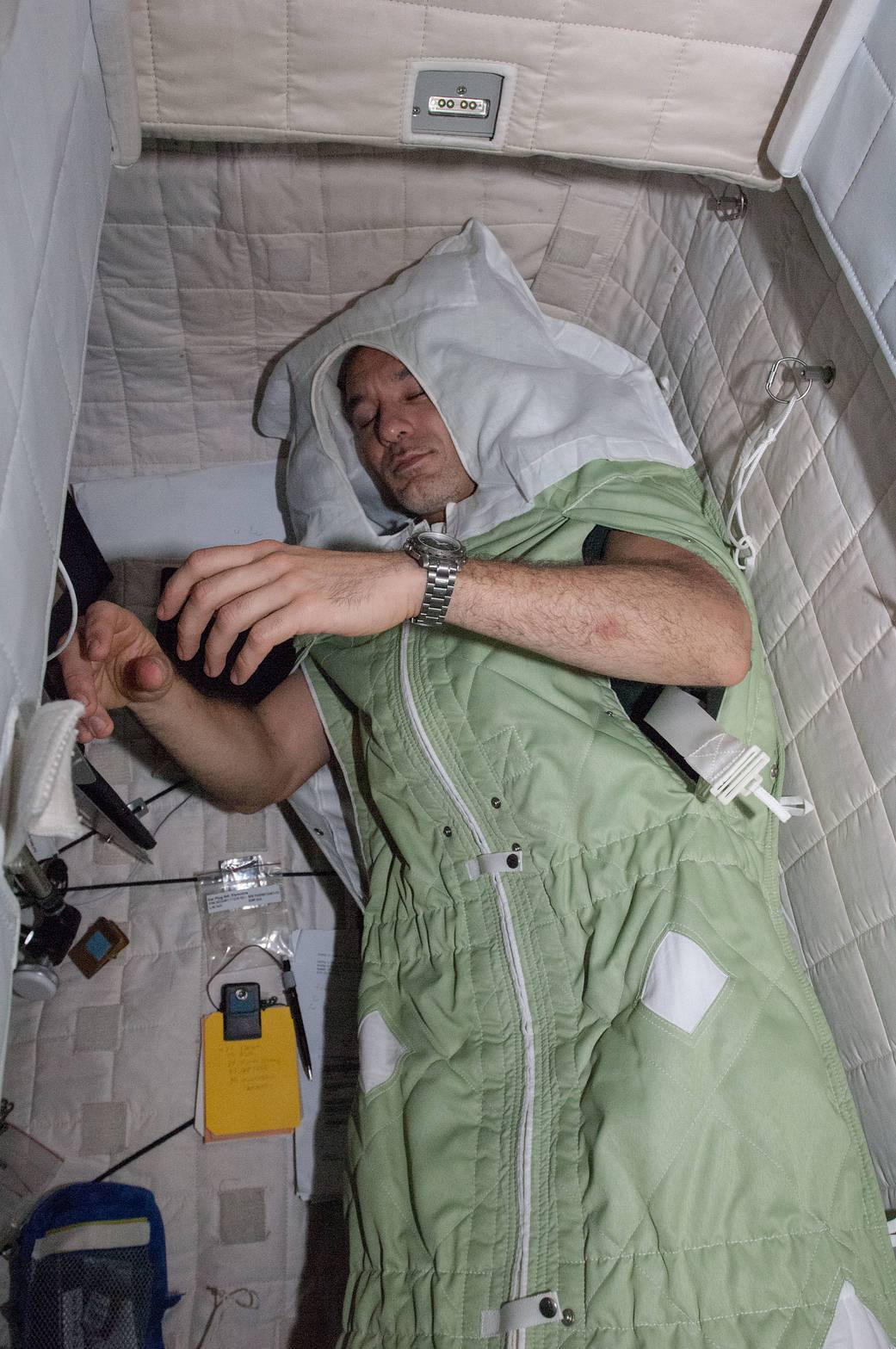
Astronauts on the International Space Station usually sleep in a sleeping bag secured inside a small compartment. The bag keeps them from drifting through the cabin. They can be oriented along a wall without feeling as though they are standing up, because the station and everything inside it are falling around Earth together.
A useful sleep space still needs moving air, manageable light and noise, and time protected from work. The unusual sleeping position is only one part of getting rest in orbit.
Why can an astronaut sleep on a wall?#
On Earth, a mattress supports your weight and stops you falling toward the floor. On the ISS, the astronaut and the surrounding cabin share nearly the same free fall. A surface labelled as a wall does not pull the sleeper sideways in the way that sleeping upright would feel at home.
Earth’s gravity remains substantial at the station. It provides the acceleration that keeps the spacecraft in orbit. Weightlessness describes the experience of falling together, rather than gravity being switched off. The distinction is also useful when comparing mass and weight on different worlds.
The labels floor, wall and ceiling remain useful for describing where equipment is installed. They do not dictate a sleeper’s posture in microgravity. A photograph rotated on your screen can therefore make the same arrangement look upright, sideways or upside down without changing the astronaut’s physical situation.
Sources: [1]
Why use a sleeping bag if there is no bed to fall out of?#
A sleeping bag provides restraint and a familiar enclosure. JAXA describes crew members securing themselves in small compartments or bags so that they do not gradually float away during sleep.
A person who is not secured can move relative to the cabin after a small push or through contact with moving air. The concern is drifting into equipment or another part of the station. Restraint keeps the sleeper in the intended location; it does not create Earth gravity.
The cover photograph shows an ISS crew member using a sleep restraint. It illustrates the arrangement, without establishing how comfortable that individual felt or how deeply they were sleeping. Those are separate questions that require a report or measurement.
What is inside a space-station sleeping compartment?#
The Canadian Space Agency describes a small personal compartment with a sleeping bag, lamp, air vent, laptop and storage for belongings. The precise arrangement depends on the part of the station and the accommodation in use. Temporary sleeping arrangements can also be necessary when crews overlap.
Privacy matters in a workplace where people live together for months. NASA’s habitability requirements treat sleep space and environmental control as part of supporting crew health and performance. Noise, vibration, temperature and light can all disturb rest.
The compartment is therefore more than a place to attach a bag. It provides some separation from activity elsewhere and lets the occupant manage aspects of the immediate environment. Its usefulness depends on those functions, not on resembling a bedroom on Earth.
Why must air move around a sleeping astronaut?#
Exhaled air contains carbon dioxide. Space agencies emphasise ventilation around a sleeper’s head so that exhaled air is carried away and mixed with the cabin atmosphere. A sleeping position must work with that airflow.
Descriptions sometimes call a local accumulation of exhaled gas a carbon-dioxide bubble. This is a way to explain inadequate mixing, not a sealed bubble with a visible surface like a floating water drop. The relevant issue is the gas concentration near the person who is breathing.
Securing the sleeping bag in an appropriate place and maintaining ventilation solve different problems. The restraint controls position; the moving air controls local circulation. A bag attached to a convenient surface is not, by that fact alone, a suitable sleeping arrangement.
How do astronauts choose bedtime with so many sunrises?#
The ISS experiences roughly 16 sunrises and sunsets in 24 hours. Crew members do not try to sleep once per orbit. They follow a daily timetable that coordinates work and rest.
ESA describes a usual allocation of about eight hours for sleep. The Canadian Space Agency gives about eight and a half hours. These rounded descriptions concern scheduled opportunity, not a claim that every astronaut sleeps exactly that long on every mission day.
Eye masks and window coverings can block unwanted light. Lighting is also studied as a way to help maintain the circadian rhythm, the body’s daily timing system. An orbital sunrise outside a window and the planned start of the crew’s working day are different events.
Does floating guarantee a good night’s sleep?#
No. Removing the need for a mattress does not remove noise, workload, unfamiliar sensations or interruptions. ESA notes that excitement and motion sickness can disturb sleep. NASA’s sleep research also distinguishes the scheduled sleep period from the amount and quality of sleep actually obtained.
Research methods include activity and light sensors, sleep logs, and electrical recordings used to study sleep. For ESA’s Sleep In Orbit investigation, recordings on Earth before and after a mission provide a baseline for comparison with observations in space.
That comparison helps avoid a simple mistake: treating the absence of a complaint, or a photograph of someone in a sleeping bag, as proof of adequate rest. Individual reports and physiological measurements provide different kinds of information.
Would astronauts sleep the same way on the Moon or Mars?#
A surface habitat has a persistent downward gravitational pull. It is weaker than Earth’s, but an unsupported sleeper would still fall. NASA’s habitability guidance therefore calls for horizontal sleeping surfaces in partial-gravity environments, with body support and orientation taken into account.
The wall-mounted ISS arrangement should not be copied into a lunar or Martian bedroom without considering that difference. Air circulation, privacy and control of light and noise would remain relevant, while the way the body is supported would change.
Sources: [5]
Keep exploring
Sources & further reading
Follow the original research, records, and explanations behind this story.
- What Is Microgravity? NASA
Common free fall explains weightlessness; Earth gravity remains substantial.
- Everyday Life on the ISS JAXA
Sleep restraints and compartments. The page’s simplified gravity wording is not repeated.
- Sleeping in space Canadian Space Agency
Equipment, ventilation and about 8.5 hours of scheduled sleep. No video or transcript opened.
- Sleeping in space ESA Kids
About eight hours scheduled; 16 orbital sunrises and sunsets. Historical crew-count details omitted.
- 7.0 Habitability Functions NASA
Sleep environment, privacy and horizontal support in partial gravity.
- Science in Space: Sleep on Station NASA
Historical 2023 research overview; measurement and circadian timing, without a population-wide sleep-duration claim.
- Sleeping in Space NASA
ISS crew member wearing a sleep restraint. Publication date is not asserted as the exposure date.
Follow the thread