
An astronaut assigned to the International Space Station does not arrive knowing every experiment, spacecraft control and maintenance procedure by heart. The assignment begins a more specific kind of preparation. A qualified astronaut must learn the work planned for that flight and practise it with the people who will share the spacecraft, operate the station and support them from Earth.
What changes when an astronaut gets a mission assignment?#
ESA describes a progression from basic training through pre-assignment work to training for a particular mission. The early stages build shared knowledge of spacecraft systems, science, operations and the skills needed to function in a crew. Later preparation applies that knowledge to a specific set of tasks.
For an ISS flight, those tasks can include operating research equipment, maintaining station systems and using the transport spacecraft. An astronaut’s previous qualifications provide a starting point, not a substitute for learning unfamiliar equipment.
There is no single useful answer to how long all astronaut training takes. Initial qualification, waiting and working before assignment, refresher courses and preparation for a particular flight are different periods. The content also depends on the vehicle, mission and individual responsibilities. A course schedule describes those requirements more accurately than a universal countdown to launch.
Sources: [1]
Why train inside a full-size station mock-up?#
A diagram shows where equipment belongs. A mock-up lets someone discover what it is like to reach that equipment, move through a hatch or handle a large object in the available space. NASA’s Space Vehicle Mockup Facility includes station modules and more focused trainers for particular tasks.
The facility supports practice in maintenance, scientific payload operations, handling and stowage, as well as emergencies. Some sessions concern ordinary jobs rather than dramatic failures. Knowing where to secure an object or how to access a panel can prevent a planned task from becoming an improvised search.
Physical models also support procedure development and troubleshooting. A team can try an operation on the ground before asking a crew to perform it in orbit. The mock-up does not reproduce every flight condition; it makes geometry, access and equipment interfaces available for repeated inspection and practice.
Sources: [2]
Does the training pool switch off gravity?#
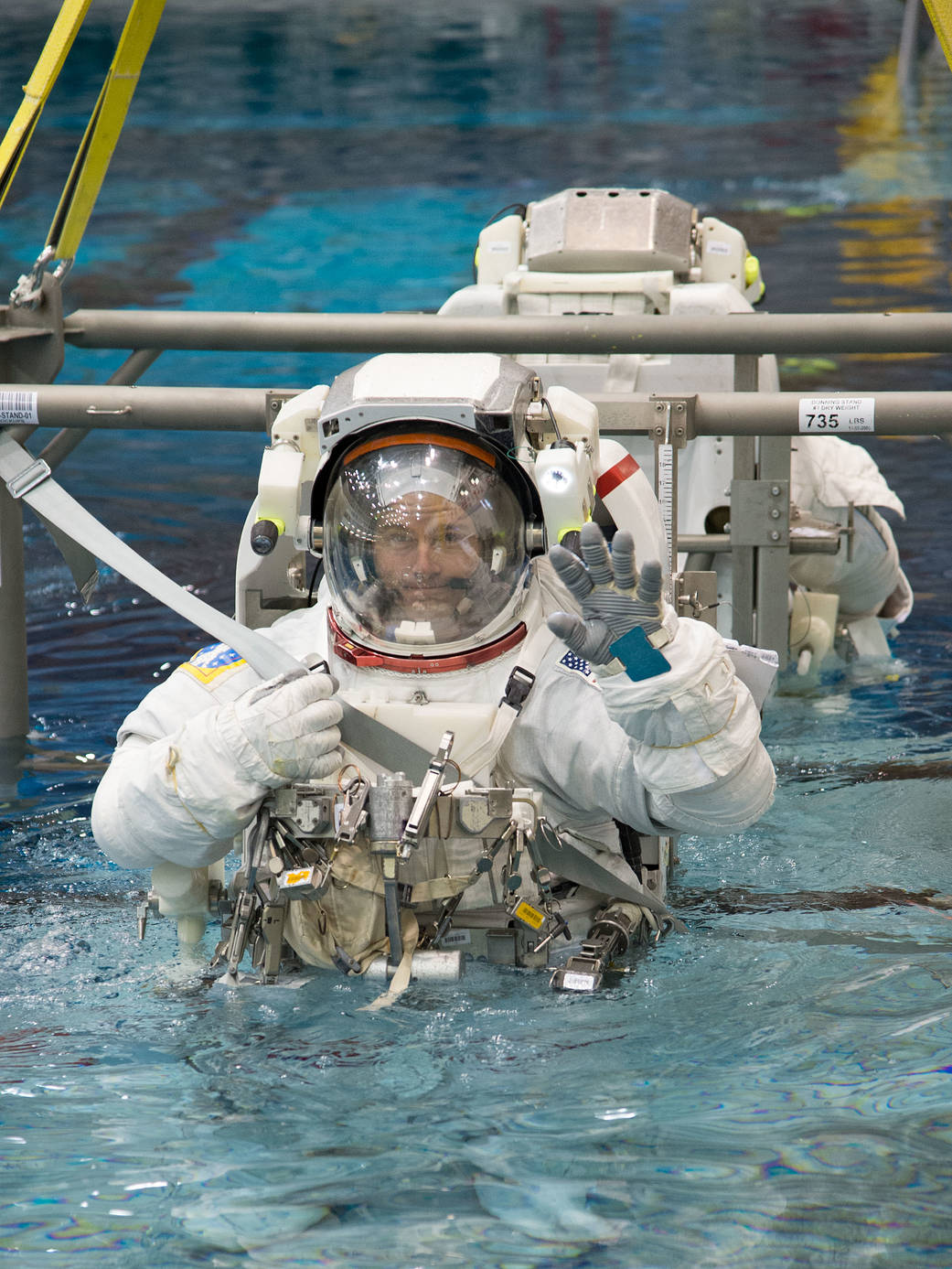
No. In neutral-buoyancy training, the upward buoyant force approximately balances the weight of the suited person and equipment. The trainee can practise working without standing on a floor, but gravity remains present. Water also resists motion, whereas an astronaut moving outside the station is surrounded by near-vacuum.
The pool is useful because it supports long rehearsals around large submerged structures. A crew can practise reaching a worksite, placing a restraint and handling tools while wearing a training suit. Brief periods of weightlessness in parabolic aircraft flights cannot provide the same uninterrupted working time.
The cover photograph shows Reid Wiseman and Alexander Gerst rehearsing in NASA’s Neutral Buoyancy Laboratory in November 2012. It documents preparation for exterior station work, not a spacewalk. The differences between water and space are part of how instructors interpret the rehearsal, rather than evidence that the exercise reproduces orbit exactly.
How do robotics and science enter the training plan?#
The Canadian Space Agency describes preparation for operating Canadarm2, including capturing suitable cargo vehicles and moving astronauts during spacewalks. These operations require the operator to understand the arm’s motion in relation to surrounding structures. Learning a control interface is only part of learning to use it safely.
Research preparation has a different emphasis. Astronauts learn the equipment they will operate and the station systems that support it, including data handling, electrical power, temperature control and communications. A scientific task may depend on connecting the correct services and following a carefully timed procedure.
Crew members do not need to become the principal investigator for every experiment. They need enough understanding to carry out their assigned work, recognise when something differs from the plan and give the ground team useful information. Training connects a scientist’s intended measurement to the actions possible aboard the station.
Sources: [4]
What happens in an emergency simulation?#
In a documented example from the 2023 Ax-2 mission preparations, instructors presented crew members inside NASA’s ISS mock-ups with simulated fire, cabin pressure loss or a toxic leak. The trainees had to apply what they had learned in classrooms and earlier practical sessions to an unfolding situation.
The roles were specific to that mission. Axiom’s account explains that the resident station expedition crew would lead an emergency response, while the visiting crew still needed to protect itself and be capable of leaving in its spacecraft if necessary.
This is why practising as a group matters. One person’s action can depend on another person’s report or position. A simulation can expose a missed call, a misunderstood responsibility or a procedure that is difficult to carry out in the allotted space. Successfully rehearsing a scenario reduces uncertainty about the response; it does not prove that every possible failure has been anticipated.
Sources: [5]
Why train for an automated transport spacecraft?#
Automation does not remove the crew from the flight. NASA describes Crew Dragon as autonomous while also providing for monitoring and control by the astronauts and the ground team. People still need to interpret the spacecraft’s state and understand the operations around them.
NASA’s account of preparations for Demo-2 gives a concrete example. In March 2020, Bob Behnken and Doug Hurley participated in a launch-and-docking simulation in SpaceX’s flight simulator, with teams at Kennedy, Hawthorne and Houston involved. The exercise joined the crew’s tasks to work at several control locations.
Training is also vehicle-specific. A crew must prepare for the spacecraft carrying it, including its displays, suits and procedures. Experience aboard another vehicle can help with judgement, but it cannot replace familiarity with the controls and emergency actions of the one being flown.
Sources: [6]
What does it mean to be ready as a crew?#
Readiness is broader than individual recall. The crew must be able to carry out assigned tasks together and work with its support teams. A technically correct action performed at the wrong point in a shared sequence can still create a problem.
The different training environments answer different questions. A physical mock-up tests access and handling. A pool supports extended suited work. A simulator lets a team practise operations and responses that would be unsafe or impractical to stage in flight. None substitutes for all the others.
The difficulties of Leonov’s first spacewalk show why the return path and human movement matter alongside equipment functions. Training for a mission brings those parts together while there is still an opportunity to repeat the task, revise the procedure and try again.
Keep exploring
Sources & further reading
Follow the original research, records, and explanations behind this story.
- Training for Space ESA
General skills followed by preparation for the assigned mission; no universal duration asserted.
- Space Vehicle Mockup Facility NASA
Full-scale modules, part-task trainers, maintenance, stowage and payload procedures.
- Building on a Mission: Neutral Buoyancy Facilities for Spacewalk Training NASA
Neutral buoyancy permits sustained task rehearsals; parabolic weightlessness is brief.
- Mission-specific Training Canadian Space Agency
Robotics and research-equipment preparation across partner facilities.
- ISS Training: Emergency Simulations Axiom Space
Concrete Ax-2 training example: fire, pressure loss, toxic leak and crew responsibilities.
- Commercial Crew Program Press Kit NASA
Vehicle-specific training and joint simulations despite spacecraft automation.
- Spacewalk Training at the Neutral Buoyancy Laboratory NASA
Reid Wiseman and partly obscured Alexander Gerst preparing for exterior ISS work.
Follow the thread