

A hoard of eight X-shaped copper ingots has been reported in the Dedza area of Malawi. Their form connects them with a wider history of copper objects found across south-central Africa. Their outline alone cannot tell us where the metal was mined or how it reached the site.
Archaeologists can investigate those questions by combining the objects' shapes and findspots with chemical measurements. A 2023 study of ingots from Zambia and Zimbabwe shows how that process works, including why apparently similar objects can have different sources. Its laboratory results concern those samples, rather than the Malawi hoard.
What copper ingots have been reported in Malawi?#
In their 2023 study, Jay Stephens, David Killick and Shadreck Chirikure describe a single hoard of eight large HXR ingots in the Dedza area. HXR is a classification used for a particular form of copper cross: four arms radiate from a central join, with a raised flange around the outside and a patterned centre.
The researchers place the Malawi find alongside HXR objects from the eastern Copperbelt, the Zambezi Valley and northern Zimbabwe. The Copperbelt is a copper-rich geological region extending across parts of present-day Zambia and the Democratic Republic of the Congo. A shared form helps archaeologists compare objects across these locations. Establishing the source of the metal requires further evidence.
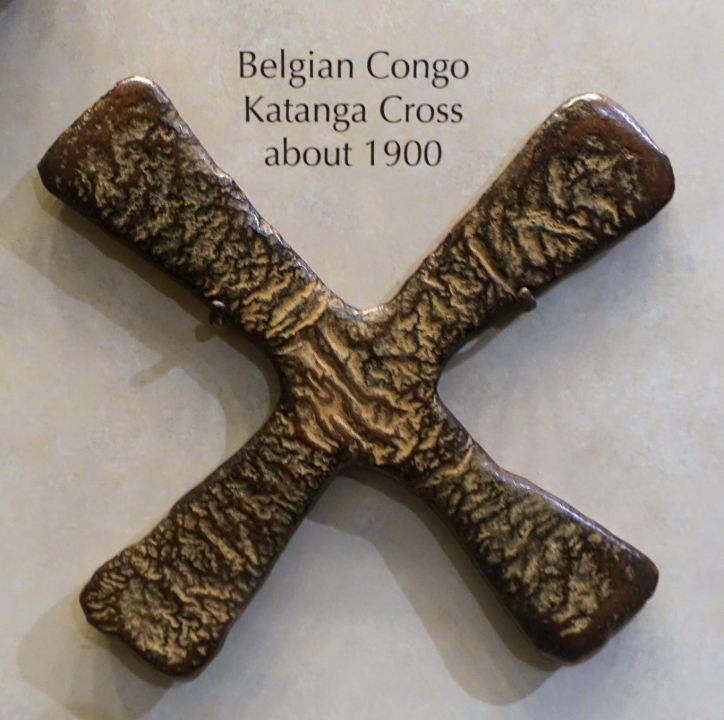
Cross-shaped copper objects also changed over time. Later, flat crosses without the raised flange belonged to a different form known as handa. The museum object pictured above dates to about 1900; it is a contextual example of a later copper cross, not one of the Malawi ingots. Treating every copper cross as the same type would erase distinctions that help establish its history.
Were copper crosses used as money?#
Some related ingots were used as currency and prestige goods, while others supplied metal for making smaller objects. The regional evidence includes historical descriptions of trade in copper crosses, whole ingots placed in burials, and broken pieces that could be worked again. These observations support several uses, rather than a single purpose for every object.
An ingot is copper cast into a portable form. It can store material for a craft worker and also carry value in an exchange. The word currency therefore needs care: evidence that copper crosses circulated does not establish a modern cash system, a fixed price or the particular transactions involving the Malawi hoard. The presence of several ingots at one spot does not by itself identify the transaction or reason for deposition.
Sources: [1]
How can lead isotopes help identify a copper source?#
Copper ores contain traces of lead. Lead occurs in different isotopic forms, meaning atoms of the same element with different masses. The proportions of those forms vary with the geological history of an ore deposit. The 2023 paper explains that smelting preserves these lead-isotope ratios.
Researchers measure ratios in an ingot and compare them with measurements from possible ore sources. Chemical analysis adds another kind of evidence: the small quantities of other elements carried with the copper. If both kinds of measurement agree with a deposit's characteristics, they can strengthen a source assignment.
The comparison depends on the reference data. Several deposits can have overlapping signatures, so a result may identify a broad district without identifying one mine. The researchers found this problem across much of the Copperbelt. They also describe Kipushi as a deposit whose distinctive combination of isotope ratios and chemistry allowed a more specific match for some of their sampled ingots.
These measurements answer a different question from the radioactive contamination described in Marie Curie's notebook. Here, researchers use the proportions of isotopes in the metal to investigate its geological source.
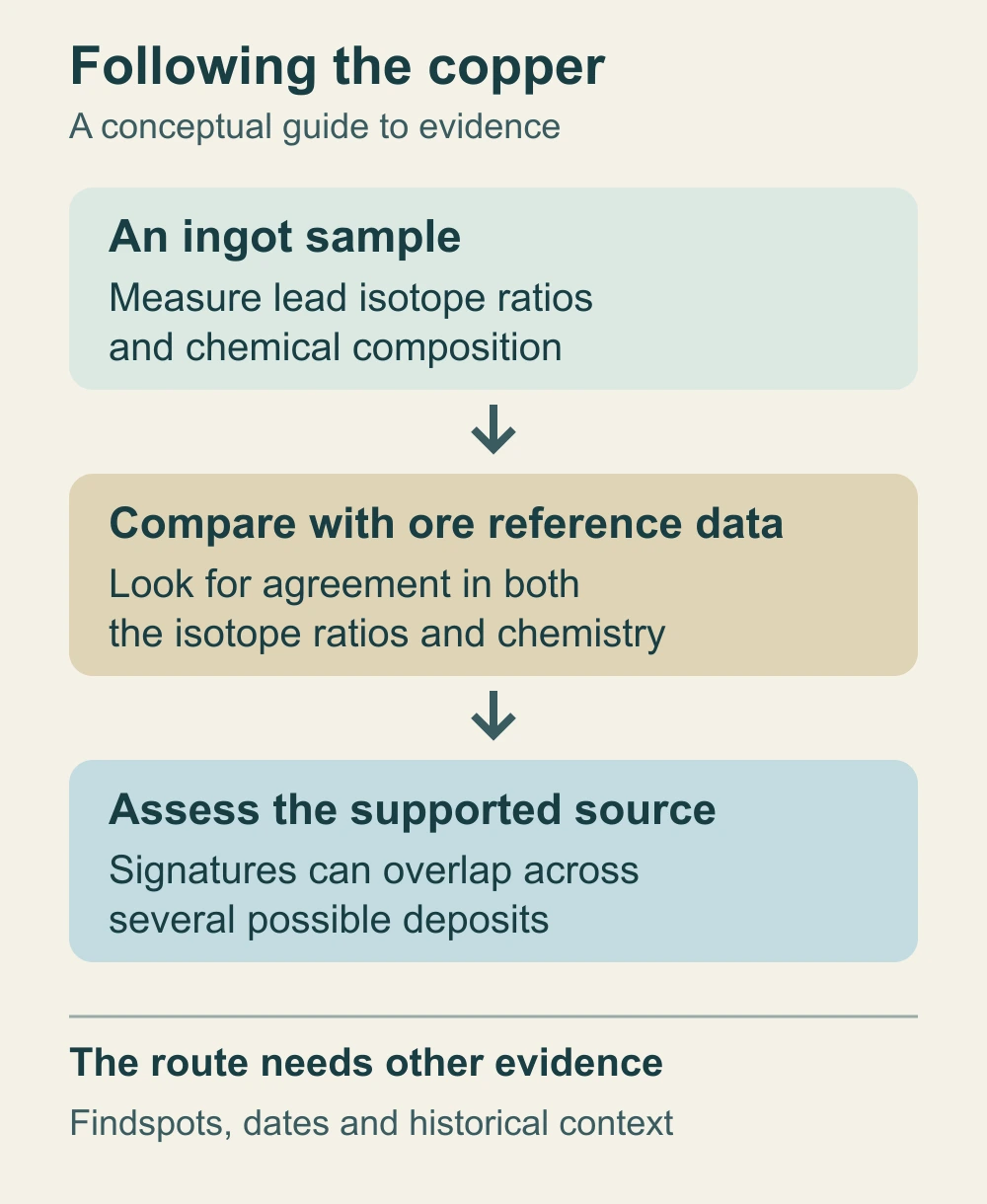
Image unavailable.
A sequence shows measuring an ingot’s lead isotope ratios and chemistry, comparing them with ore reference data, and assessing possible sources. A separate note identifies findspots, dates and historical context as route evidence.
Sources: [1]
Can the same shape conceal different sources?#
Yes. The 2023 study compared archaeological ingots from Zambia and Zimbabwe, together with an experimental ingot made from a known ore source. The Malawi hoard appears in its regional discussion; the reported laboratory sample set does not include its objects.
Many of the studied ingots had isotope and chemical characteristics consistent with Copperbelt ores, including a group matching Kipushi. An HXR ingot from Kent Estates in Zimbabwe was different. Its best match was to the Magondi Belt in Zimbabwe, although the authors called for more ore measurements to improve that comparison.
The Kent Estates object shows how a form associated with one region can be copied using copper from another. A recognizable outline therefore does not prove that every object of that shape came from the same mine. In this case, combining shape, chemistry and archaeological context made the comparison more informative than shape alone.
Sources: [1]
Can a source match reveal the whole journey?#
A source match can connect metal with a geological area; it cannot by itself identify every carrier, exchange or stop along the way. The location where ore formed, the place where people smelted or cast it, and the final findspot can be different places.
The 2023 study describes ore being smelted near some mines and transported elsewhere for smelting in other cases. Its regional findings support movement of copper over long distances to the studied sites. Those results make trade and transport important questions, but they do not supply an itinerary for the Malawi hoard.
Reconstructing a route requires evidence beyond the metal signature, such as dated settlements, production sites, distribution patterns and historical accounts. The inference must fit the particular objects and period. A line joining a possible source and a findspot on a map would show their relationship, not a recovered ancient road or river journey.
Sources: [1]
How precisely can the ingots be dated?#
The 2023 synthesis places the manufacture of the larger HXR type broadly between the 14th and 18th centuries, while acknowledging that dates for these ingots are scarce. This is a range for the type, not a direct date for the deposition of the Malawi hoard.
Shape comparison can place an object within a wider sequence of changing forms. Dated archaeological contexts provide a different kind of constraint: an ingot found in a dated burial, for example, can be connected with that context. An object may also have circulated before it was deposited, so manufacture, exchange and burial need separate treatment.
Sources: [1]
Keep exploring
Sources & further reading
Follow the original research, records, and explanations behind this story.
- Reconstructing the geological provenance and long-distance movement of rectangular, fishtail, and croisette copper ingots in Iron Age Zambia and Zimbabwe PLOS ONE
Regional ingot forms, the eight-ingot Dedza-area find, provenance methods and results for Zambia/Zimbabwe samples, and limits of source identification.
- File:Katanga Cross, Belgian Congo, c. 1900 - National Museum of American History - DSC00285.jpg Wikimedia Commons; photograph by Daderot
Identity, date description and CC0 provenance of the later contextual museum object, which is not a Malawi hoard specimen.
See the story in motion
Watch our illustrated video, then explore another question below.
Watch on YouTubeFollow the thread