


Marie Curie's laboratory left written records of its work, including logbooks that survive in the Musée Curie archives. The story of radioactive notebooks raises a separate question: what is actually present on a particular volume, and what would it take to know its significance?
The answer begins with the way Curie looked for new elements. Her measurements turned faint emissions into a guide through difficult chemistry. The same physics also explains why radioactive material can remain detectable long after an experiment ends.
What was Curie trying to discover?#
After Henri Becquerel discovered radiation from uranium, Marie Curie investigated whether other substances behaved similarly. She found that some uranium minerals were more active than their known uranium content seemed to explain. That discrepancy suggested the presence of another, strongly radioactive substance.
Marie and Pierre Curie followed that clue through chemical separations. Their work led to the identification of polonium and radium. In her 1911 Nobel lecture, Marie described the discoveries as joint work and explained how years of further chemistry established radium as an element.
Sources: [1]
How did Curie use radiation as a laboratory tool?#
She measured the electrical effect of radiation on air. Radiation ionized the air between charged plates, allowing a small current to pass; that current served as a measure of a sample's activity. Her account describes repeating a measurement after chemical separations to see which fraction carried the activity.
This made radioactivity a way to follow material present in quantities too small to weigh easily. A surprisingly active fraction was a clue for the next separation, rather than a direct view of a new element.
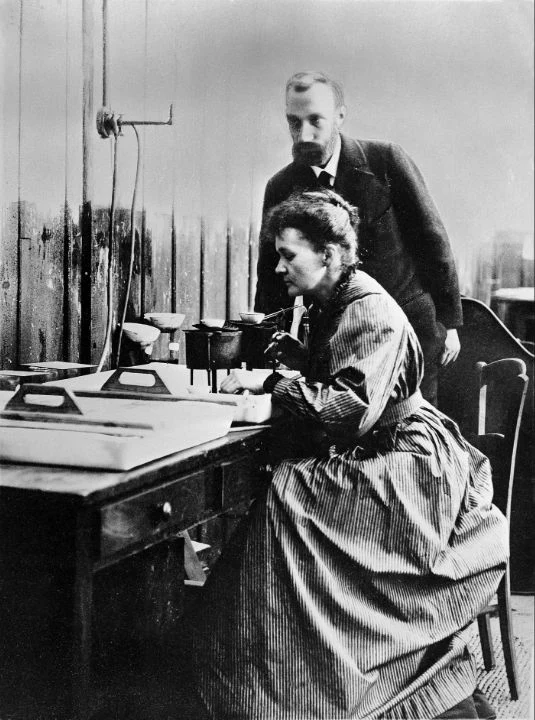
Image unavailable.
Marie Curie sits at a laboratory bench with measuring instruments while Pierre Curie stands behind her.

Sources: [1]
What do Curie's surviving logbooks record?#
The Musée Curie's Radium Institute archives include three logbooks and fourteen activity reports that record the life of the Curie laboratory over nearly 60 years. According to the museum, the first two logbooks contain Marie Curie's handwriting as she recorded events connected with her laboratory. The first covers 1898 to 1927 and was restored in 2013.
These are records of a laboratory's activity, not necessarily a continuous account of every experiment. The museum says the documents were digitized with Paris Sciences et Lettres and made available online; its archives page links to the digitized Curie laboratory collection. The surviving words can be studied independently of claims about the physical condition of a particular volume.
Sources: [5]
What are radium and polonium?#
They are chemical elements, not names for radiation itself. The Curies found that one active component followed bismuth through their separations and named it polonium; another followed barium and became known as radium. Polonium's name recalled Marie Curie's native Poland.
An element can have different forms called isotopes. A radioactive isotope has an unstable nucleus that changes over time, emitting radiation. Knowing the element's name alone does not specify every isotope or its decay rate.
How can paper become contaminated?#
Contamination means radioactive material is present where it is unwanted. In a laboratory, material could reach a surface through contact or deposited particles. If radioactive atoms remain on or in paper, they can continue to decay there; the writing itself does not have to be radioactive.
That is a physical explanation of how a document could retain a trace. It does not establish when, where or how any particular Curie notebook acquired material. Those details require evidence about the object itself.
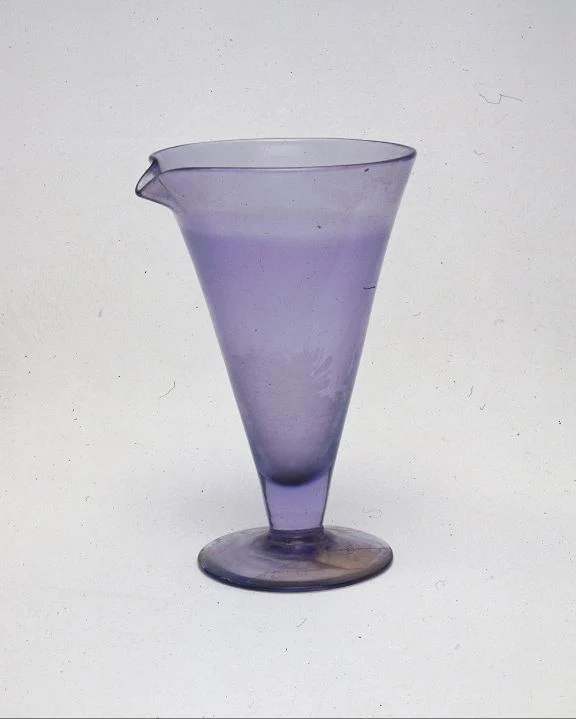
Image unavailable.
A violet, conical glass vessel with a pouring lip and a broad circular foot.

Sources: [3]
Is contamination the same thing as radiation?#
No. Radioactive material is the source; radiation is the energy or particles emitted as unstable atoms change. Exposure means radiation reaches a person or object. Contamination means the radioactive material is on or inside something, so the source can remain there or be transferred.
Different kinds of ionizing radiation travel and penetrate differently. Alpha particles, for example, travel only a short distance and are stopped by paper, while gamma rays penetrate much farther. The kind of material and the route of exposure both matter.
Sources: [4]
Why might a trace remain for so long?#
Radioactive atoms do not all decay at once. Each radionuclide has a characteristic half-life: the time in which half of an initial population of its atoms decays. After two half-lives about one quarter remains, and after three about one eighth, assuming no material is added or removed.
A long-lived isotope can therefore remain present for many decades or longer. Decay can also create other radioactive products. The age of a document alone does not tell us which radionuclides it contains or how much remains.
Sources: [3]
Does a half-life tell us a notebook's danger?#
No. Half-life describes a decay rate, not a deadline after which an object suddenly becomes safe, and not a measurement of a notebook's radiation. For a real object, the identity and amount of radioactive material, its location, the radiation emitted and the conditions of exposure all matter.
Activity is the number of nuclear decays per unit of time. Dose describes energy deposited in matter or, with additional conventions, its biological significance. A half-life by itself supplies neither an object's measured activity nor a person's dose. Claims that a notebook will be deadly for a fixed number of years need actual measurements and an exposure scenario.
How do archives approach a potentially contaminated object?#
An archive has two jobs: preserve the historical object and understand any hazard before people handle it. An assessment can distinguish a document's condition from the properties and distribution of any radioactive material. A digital copy may let readers study the writing without handling the original.
Storage and access arrangements depend on the collection and the assessment. A claim that a specific notebook requires a particular box, protective clothing or waiver should come from the institution responsible for that object; it cannot be inferred from the story of radium alone.
Sources: [4]
What is the lasting scientific legacy?#
Curie's research helped turn radioactivity into a field in which scientists could detect and study matter through its emissions. Radium also became important in early medical work, although ionizing radiation can damage living tissue and its uses require care.
Her measurements link this story to other ways of learning from signals that the eye cannot see. The instruments in Chandra's search for faint X-ray sources work in a very different setting, but share the broader problem of extracting evidence from radiation.
Keep exploring
Sources & further reading
Follow the original research, records, and explanations behind this story.
- Radium and the New Concepts in Chemistry Nobel Prize Outreach
Curie’s 1911 account of measurement, separation, radium and polonium.
- Marie Curie – Biographical Nobel Prize Outreach
Biography, the name polonium and early medical work.
- Radioactive Decay US Environmental Protection Agency
Decay, decay chains and half-life.
- Radiation Basics US Environmental Protection Agency
Radiation, ionization and alpha, beta and gamma.
- Les archives du Musée Curie Musée Curie
Radium Institute archive, logbooks, Marie Curie’s handwriting, restoration and digitization.
Follow the thread