
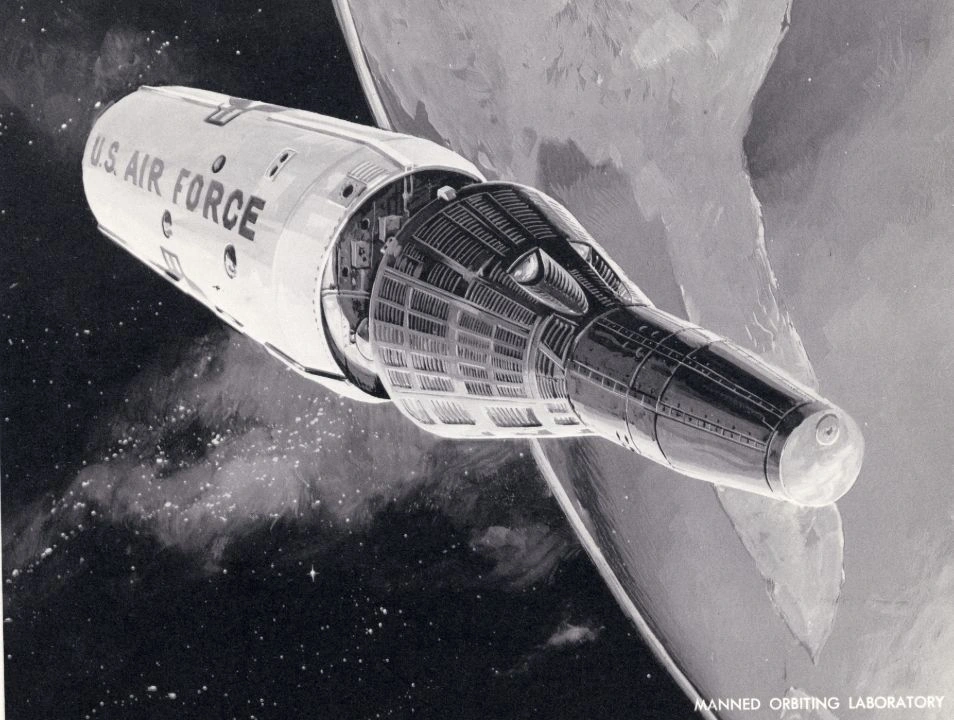
The astronauts selected for the Manned Orbiting Laboratory were preparing for a job that combined spaceflight with photographic intelligence. Two people would spend about a month in orbit, helping a powerful camera decide which parts of Earth deserved a closer look. Their station never carried a crew.
The cancellation is only half the story. MOL also tested an idea about the value of human judgment inside an increasingly automated machine. Following that idea explains why the program seemed promising, why its justification weakened, and how seven of its pilots eventually reached orbit aboard a very different spacecraft.
What was the laboratory really for?#
MOL was a U.S. Air Force and National Reconnaissance Office project with a public experimental mission and a classified photographic reconnaissance mission. Its central intelligence payload was Dorian, also designated KH-10: an optical system intended to photograph targets of military interest on the ground.
The public existence of the program was no secret. Defense Secretary Robert McNamara announced it in December 1963, and President Lyndon Johnson formally approved development in August 1965. What remained concealed was the reconnaissance capability behind the laboratory's name. The NRO's account describes a deliberate public explanation: MOL would investigate the usefulness of people in space while its intelligence objectives remained classified.
The distinction matters when looking at its pictures. An artist's station in orbit illustrates a proposal; a person inside a mockup shows work on Earth. Neither is evidence that a crewed American spy station operated above the Soviet Union.
Why put people beside a reconnaissance camera?#
The hoped-for advantage was choosing useful photographs while the scene was still passing below. A human operator could recognize cloud cover, reconsider a target's priority and avoid spending limited photographic film on an obscured scene. In the NRO's history, former MOL pilot Richard Truly explains the rationale in terms of saving film and acting during the flight.
That is a specific job for judgment. A camera can expose an image perfectly and still record something an analyst cannot use. If clouds hide an installation, better optics alone do not uncover it. An operator might decide to use the available opportunity elsewhere, subject to what the spacecraft could see and reach during that pass.
The decision window was short. According to the NRO's account of the software effort, crewmembers were expected to assess whether an area should be photographed and instruct the computer in less than 25 seconds. Richard Truly and Lachlan Macleay helped develop software that could incorporate changing priorities. The astronaut would make a choice; the computer would turn inputs and priorities into instructions for imaging.
This was the program's intended advantage, never an operational result demonstrated by MOL astronauts. Local decisions also should not be confused with instant delivery of finished intelligence to Washington. Recognizing a target, exposing film and getting usable photographs to an analyst are separate steps. The accounts of quick target selection do not establish a continuous live image feed.

Image unavailable.
Three-step proposed workflow: assess the scene, tell the computer in less than 25 seconds, and adjust imaging to use limited film usefully.
How would the crew get into the station?#
The plan joined a modified Gemini-B capsule to a cylindrical laboratory before launch. The two astronauts would ride in the capsule, then move internally into the laboratory once in orbit. At the end of the planned 30-day stay, they would return to the capsule for the trip home.
The unusual doorway was in Gemini-B's heat shield. A hatch there connected to a narrow transfer tunnel behind the spacecraft. It let the astronauts move between the capsule and laboratory without going outside. It also placed a demanding requirement on the return vehicle: the shield, including its hatch, still had to protect the capsule during atmospheric reentry.
This arrangement avoided making an orbital rendezvous and docking the first step in occupying the laboratory. The capsule and laboratory were to launch together. NASA's Gemini 8 mission tested the different problem of joining vehicles after they were already in space.
Inside MOL, the imaging system would use a primary mirror 72 inches across, about 1.83 metres. A mirror gathers and directs incoming light toward the imaging system; it does not, by its diameter alone, specify what an intelligence analyst will recognize in the resulting photograph. The telescope, pointing, atmosphere and recording process all matter. Giving the mirror's size is therefore more defensible than attaching an unsupported claim about reading a particular object on the ground. No operational KH-10 imagery was produced by a crewed MOL mission.

Image unavailable.
Functional diagram links Gemini-B to a laboratory by internal transfer, with two people and a planned 30-day mission observing Earth below.
Sources: [1]
What did training for this job involve?#
The selected pilots helped develop the machine they expected to fly. The NRO describes crewmembers working on flight controls, computer programming and pressure suits, alongside training for emergencies and spacecraft operations. Their work was broader than practicing how to press a camera button.
Photographic intelligence demanded its own education. At the National Photographic Interpretation Center, the pilots learned subject recognition and photographic intelligence. The connection to the mission is straightforward: someone asked to choose an important target quickly needs to understand what makes the scene important, as well as how to operate the equipment.
Physical and emergency preparation addressed a different set of demands. The NRO records Navy dive-school attendance to prepare for underwater training, use of NASA simulators and preparation for emergency deorbiting in events such as spacecraft leaks. The flexible suit developed for MOL also had to accommodate movement through the narrow transfer tunnel. These were preparations for the proposed mission, rather than accounts of life aboard an occupied station.
Seventeen pilots were selected in three groups between 1965 and 1967, from the Air Force, Navy and Marine Corps. One was Robert H. Lawrence Jr., the first African American selected as an astronaut by a national space program. He died in an F-104 crash in December 1967, before MOL was cancelled. Selection into this program did not mean that all seventeen survived to its end, transferred to NASA or flew in space.
Did any part of MOL actually fly?#
Yes. An uncrewed test launched on November 3, 1966, carrying a Gemini-B capsule and a laboratory mockup on a Titan IIIC rocket. The capsule and mockup then had different flights. Treating them as one operational station obscures what the test established.
The capsule was refurbished from NASA's previously flown Gemini 2 vehicle. It made a 33-minute suborbital flight and reentered the atmosphere, successfully demonstrating the heat-shield hatch design. Suborbital means that its trajectory returned it to Earth without completing an orbit. The test supplied evidence about the return vehicle, including its unusual doorway, without putting people at risk inside it.
The laboratory mockup entered Earth orbit. It did not carry the KH-10 imaging payload. NASA records that it released three satellites and carried ten experiments under the name Manifold; its transmissions stopped after 30 days. That was real flight activity, but it was neither a staffed laboratory nor a successful orbital demonstration of the Dorian reconnaissance mission.
Why cancel a program that had reached testing?#
The government ended MOL on June 10, 1969, as costs, delays and improving uncrewed reconnaissance weakened the case for continuing. A successful component test did not settle whether the complete system was the best use of the next round of funding.
MOL had to justify the added requirements of carrying people: a habitable laboratory, life support, suits, crew training and a safe return vehicle. Its supporters argued that the crew's flexibility and very detailed imagery made those requirements worthwhile. Critics questioned whether the improvement in intelligence justified the expense of a crewed system. The NRO's history records that argument well before cancellation; it was not an objection invented after the program failed to fly.
Delay also changed the comparison. While MOL's schedule slipped, uncrewed reconnaissance technology continued to advance. The alternative against which a crewed camera had been judged early in the decade was improving while the crewed system remained unfinished. Under the Nixon administration, a review sought savings among major reconnaissance efforts, and MOL lost that competition for resources.
Calling the decision sensible is an assessment of those tradeoffs, not a result that the surviving hardware can prove. Calling the entire effort worthless overlooks work that other programs could use. The historical evidence supports both the failure to deliver an operational crewed station and the survival of useful people, equipment and techniques.
Where did the astronauts go instead?#
Seven MOL pilots transferred to NASA on August 14, 1969: Karol Bobko, Robert Crippen, C. Gordon Fullerton, Henry Hartsfield, Robert Overmyer, Donald Peterson and Richard Truly. They became NASA's Group 7 astronaut class. All seven eventually flew aboard the space shuttle, on different missions.
The transfer did not bring an immediate flight. Nearly twelve years passed before the first of them reached orbit. The long wait gives the change of direction its scale: training for a month at a reconnaissance station became preparation that could contribute to a reusable spacecraft program years later.
Hardware and technical work found other destinations too. NASA's history records the transfer of MOL's laboratory simulator and its operating computer, suit technology and the waste-management system that later flew on Skylab. Such transfers show specific ways work survived cancellation; they do not mean that the original spy station was completed under a new name.
Following the pilots changes what the ending means. MOL never delivered the crewed reconnaissance missions it was funded to develop. Seven of its astronauts nevertheless carried their experience into NASA and eventually flew. Those two outcomes belong in the same history.
Keep exploring
Sources & further reading
Follow the original research, records, and explanations behind this story.
- 55 Years Ago: Manned Orbiting Laboratory Cancellation NASA
John Uri, June 11, 2024. Mission architecture, mirror, selections, uncrewed test, cancellation and NASA transfers. Retrospective institutional history; no operational MOL imagery.
- The story of the Manned Orbiting Laboratory – part one National Reconnaissance Office
Public and classified purposes; Truly’s recollection of choosing targets and saving photographic film.
- The story of the Manned Orbiting Laboratory – part two National Reconnaissance Office
Contractors, selection, crew involvement and photographic-intelligence training.
- The story of the Manned Orbiting Laboratory – part three National Reconnaissance Office
Expected sub-25-second decision and instruction interval; programming and contemporary criticism.
- The story of the Manned Orbiting Laboratory – part four National Reconnaissance Office
Budget pressures, competing priorities, June 10, 1969 termination and seven pilots’ later shuttle flights. Broad “never made it to space” phrase is qualified against NASA’s test-flight account.
- Manned Orbiting Laboratory National Museum of the United States Air Force
Image gallery, VIRIN 120210-F-XN622-009. Provenance, U.S. Air Force credit and explicit public-domain/republication notice for the archival concept illustration.
Follow the thread