

The deepest known part of the ocean lies nearly 11 kilometers below the surface. That is a vertical journey of about 6.8 miles, into water where sunlight cannot reach and the weight of the ocean creates immense pressure.
The number is an estimate, not a mark on a ruler fixed to the bottom. To understand what it means, it helps to distinguish the long Mariana Trench from the smaller area called Challenger Deep, and to see how scientists measure a place they cannot simply look down into.
Where is the Mariana Trench?#
The Mariana Trench is in the western Pacific Ocean. Its southern end lies several hundred kilometers southwest of Guam. It is a long depression in the seafloor, whose floor varies in depth along its length. The ocean floor along that depression does not all sit at the same depth.
Challenger Deep is the deepest known area within the trench, near its southern end. Think of the trench as a long valley and Challenger Deep as its deepest neighborhood; the actual seafloor has complicated ridges and depressions, rather than a smooth, narrow slot.
Sources: [1]
How deep is Challenger Deep?#
NOAA gives an approximate depth of 10,935 meters, or 35,876 feet. Rounded for a memorable comparison, that is about 11 kilometers or 6.8 miles below sea level. Other published estimates can differ, so the rounded figure is more useful than treating the last digit as a permanent answer.
A depth is a vertical distance from a reference surface, not the distance a vessel must travel along its actual route.
Sources: [1]
How does this compare with the average ocean?#
The average ocean depth is about 3.7 kilometers according to NOAA. Challenger Deep, at about 11 kilometers, is roughly three times as deep. That comparison uses two rounded vertical distances; the seafloor rises and falls across the ocean, and no single depth describes the entire Mariana Trench.
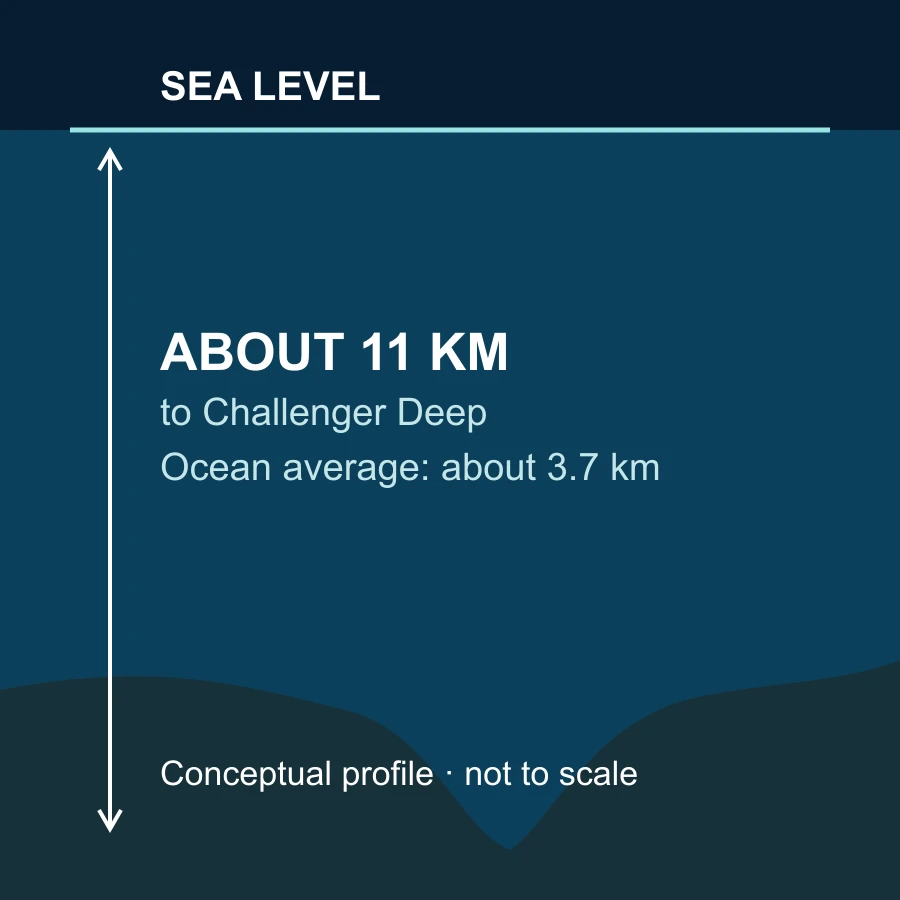
Image unavailable.
Conceptual ocean profile with an arrow from sea level to Challenger Deep, labeled about 11 kilometers and an ocean average of about 3.7 kilometers.
Sources: [1]
How can scientists measure a depth they cannot see?#
A ship can send a pulse of sound toward the seabed and time its echo. The sound makes a round trip, so a basic estimate of depth is sound speed multiplied by travel time and divided by two. Modern multibeam sonars send many beams across a swath, building a picture of the terrain rather than measuring just one point beneath the ship.
A sounding gives the depth at the location the sound reaches. A ship collects many soundings to build a wider picture of the floor.
Sources: [2]
Why do depth estimates differ?#
The floor is uneven, so measurements at different locations can produce different depths. Surveys cover only the areas sampled, and each measurement has uncertainty. As instruments and survey coverage improve, reported estimates can change. That is why a rounded figure is useful when comparing the depth with familiar distances.
Sources: [2]
How much pressure is at the bottom?#
The pressure is roughly 110 megapascals, or about 1,100 times atmospheric pressure at sea level. For an illustrative calculation, assume seawater has a constant density of 1,025 kilograms per cubic meter, gravity is 9.81 meters per second squared, and the depth is 11,000 meters. Multiplying density, gravity and depth gives about 111 million pascals of water pressure; adding surface atmospheric pressure changes the rounded result very little.
Real density and gravity vary, so this is a model, not a pressure reading from a particular dive. Pressure acts in every direction. A crewed submersible needs a pressure-resistant enclosure, while instruments and vehicles must be designed to withstand or accommodate the surrounding water pressure.
Sources: [3]
Is there sunlight at the bottom?#
No sunlight reaches Challenger Deep. The pressure is extreme, but darkness does not mean the deep ocean is empty. Animals and microbes have been found in the trench; they live with conditions very different from those near the surface.
Trench amphipods, small crustaceans, are among the animals scientists have sampled. A finding at one location or depth does not describe every part of the trench.
Has anyone reached Challenger Deep?#
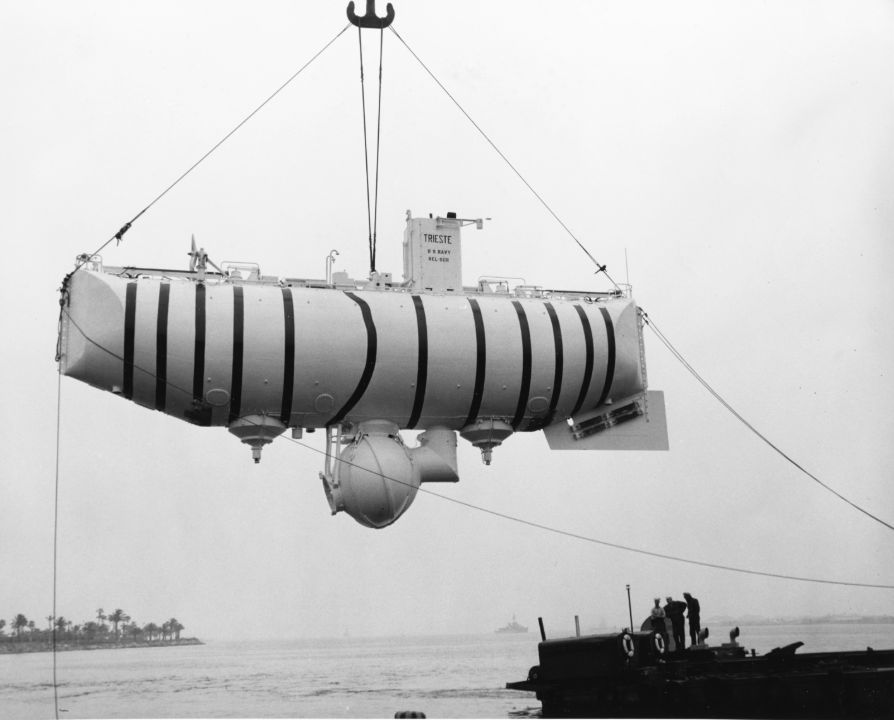
Yes. On January 23, 1960, the bathyscaphe Trieste carried a two-person crew to Challenger Deep. Later scientific expeditions used deep-sea vehicles and equipment to investigate the ocean and collect information.
The first visit did not make the entire trench fully mapped or understood. Each dive and survey covers only part of a large, difficult environment; repeated observations can reveal different aspects of it.
What does plastic tell us about such a remote place?#
Distance and depth do not isolate the trench completely from the surface. Our story about a plastic bag in the Mariana Trench follows what one observation can—and cannot—tell us about the reach of human-made debris. The depth explains why getting evidence from there is difficult; the separate story examines the object and its implications.
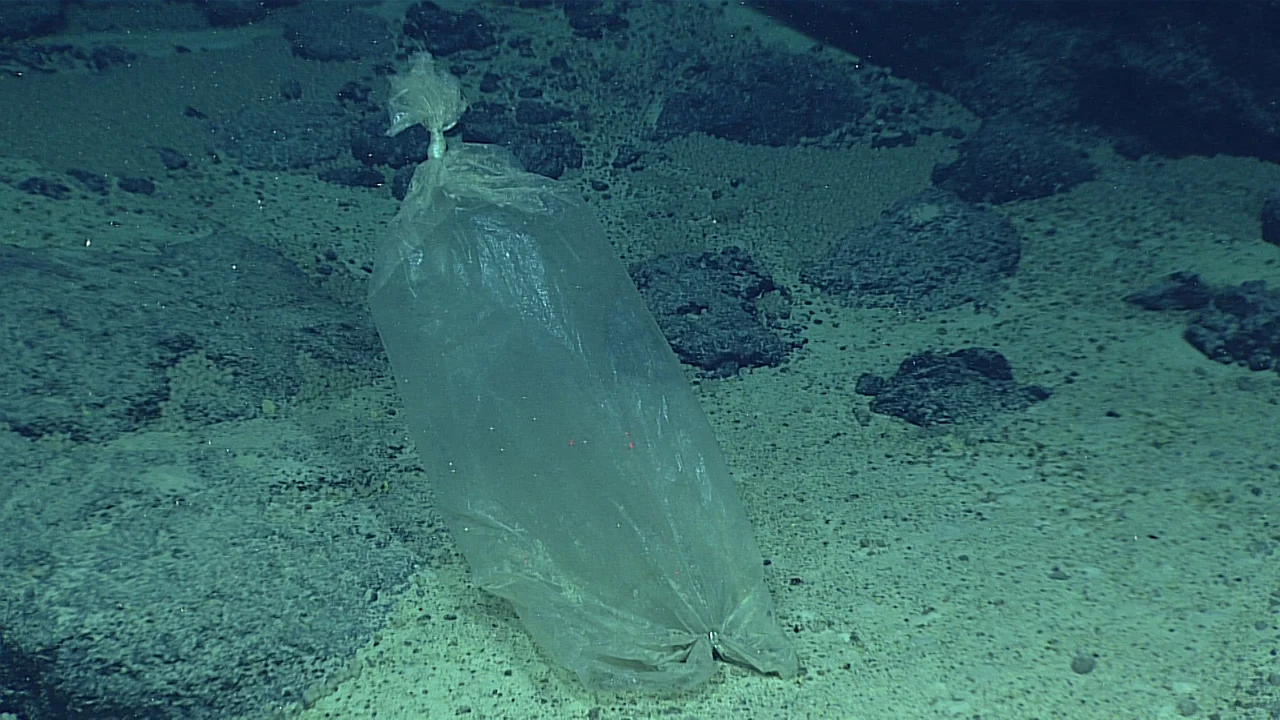
Image unavailable.
A translucent plastic bag on the rocky seabed illuminated by a remotely operated vehicle.
Keep exploring
Sources & further reading
Follow the original research, records, and explanations behind this story.
- How deep is the ocean? NOAA National Ocean Service
Challenger Deep location and approximate depth; average ocean depth and Challenger sounding in 1875.
- What is sonar? NOAA National Ocean Service
Active sonar pulses, returning echoes and timing for range.
- How does pressure change with ocean depth? NOAA National Ocean Service
Water pressure increases by about one atmosphere per 10 meters.
- World’s deepest waters becoming ultimate sink for plastic waste Newcastle University
Reports sampled trench amphipods and ingested particles; does not characterize all animals or depths.
- Our Approach: Deep-sea Debris Database JAMSTEC
Deep-sea research archive and sampling context.
- Deep-sea Debris in the Western and Central Pacific NOAA Ocean Exploration / Diva Amon
Separate 2016 Enigma Seamount bag photograph; not Challenger Deep.
- File:Bathyscaphe Trieste.jpg Wikimedia Commons / U.S. Navy
Photograph record describes 1960 descent with Piccard and Walsh; photo depicts Trieste at port in 1958–59, not at the bottom.
- How far does light travel in the ocean? NOAA National Ocean Service
Sunlight does not penetrate below 1,000 m; hadal zone begins at 6,000 m.
See the story in motion
Watch our illustrated video, then explore another question below.
Watch on YouTubeFollow the thread