
At some locations on Mercury, the Sun can rise, slip back below the horizon and rise again. The planet keeps rotating in the same direction. What reverses briefly is the Sun's apparent motion across its sky, because Mercury's orbital motion near the Sun temporarily overtakes its slow rotation.
This is a prediction from the planet's measured motions, not a sunrise sequence filmed by a person on its surface. Understanding it requires two different clocks: rotation relative to distant stars and the return of sunlight to the same place.
How can the Sun rise, set and rise again?#
A sunrise occurs when the Sun crosses the observer's horizon upward. If its apparent motion then reverses while it is still near that horizon, it can disappear again. Once the usual motion resumes, another sunrise follows.
NASA describes this sequence for some parts of Mercury, with a corresponding reversal around sunset elsewhere. Location matters. A reversal that happens near the horizon for one observer can happen higher in the sky for another. The phrase double sunrise describes a particular view of the motion, rather than an extra Sun or a planet-wide event happening everywhere at once.
Sources: [1]
Why does orbital speed affect the sky?#
Imagine an arrow drawn from a planet toward its star. As the planet moves around its orbit, the arrow changes direction relative to distant stars. Meanwhile, the ground beneath an observer turns as the planet rotates. The Sun's position relative to that ground depends on both changes.
For Mercury, rotation normally carries the Sun across the sky in one direction. Near perihelion, the closest part of its elliptical orbit, the orbital contribution becomes strong enough to reverse that apparent motion briefly. The planet itself does not need to reverse its spin.
This explanation compares angular motion: how quickly a direction changes. A spacecraft's speed in kilometers per second and a planet's rotation in degrees per day cannot simply be compared as bare numbers. They must first describe the same kind of motion.
Sources: [1]
What does a 3:2 spin-orbit resonance mean?#
Mercury makes three rotations relative to distant stars during two complete trips around the Sun. This relationship is called a 3:2 spin-orbit resonance. It differs from the 1:1 relationship in which a body's same face remains directed toward its companion throughout an idealized circular orbit.
The ratio describes motion accumulated over whole orbits. It does not say that Mercury advances around its orbit at a constant angular speed. That distinction allows an average relationship of three turns per two orbits to coexist with a short interval in which the Sun appears to move backward.
A useful comparison is a runner completing a lap in a fixed time while speeding up and slowing down along the way. The lap time tells you the average pace; it does not tell you the speed at every point. The comparison distinguishes average pace from speed at a particular instant.
Sources: [2]
Why is a solar day longer than Mercury's year?#
Mercury rotates once in about 59 Earth days and orbits the Sun in about 88. Its complete solar day lasts roughly 176 Earth days. These rounded values describe different intervals, so they do not contradict one another.
The resonance gives a simple way to follow the geometry. Over two orbits, Mercury turns three times relative to distant stars. The direction toward the Sun also goes around twice. Subtract those two revolutions from the three rotations, and the ground has completed one full turn relative to sunlight.
That is why two Mercury years correspond to one full solar cycle. A brief reversal near sunrise does not add another complete day to the count. It is a small backtrack within the longer cycle, just as moving a clock hand backward briefly would not create an additional full revolution.
Does every place experience the same sunrise?#
No. An observer's longitude determines where the Sun is in the local sky when the orbital reversal occurs. For the rise-set-rise sequence, the Sun must be close enough to the horizon for the reversal to carry it across that boundary.
The distinction can be understood without choosing a specific landing site. Put two observers at different longitudes. At the same instant, one may have the Sun low near a horizon while the other has it well above the ground. The same change in apparent direction can produce a horizon crossing for the first observer and merely a pause followed by backward movement for the second.
A precise forecast would also need latitude, surface topography and a definition of sunrise, such as the first visible edge of the solar disk. The general mechanism does not supply an exact timetable for an unspecified location.
Sources: [1]
How did astronomers measure Mercury's rotation?#
Radar changed the interpretation of Mercury's day in 1965. A contemporary paper by McGovern, Gross and Rasool discussed radar measurements giving a rotation period of 59 plus or minus 5 days, in conflict with the previously quoted 88-day period based on visual surface markings.
Their analysis showed that the visual observations could be reconciled with the radar result. They reported an improved estimate of 58.4 plus or minus 0.4 days from that reassessment. These are historical measurements and uncertainties, not today's recommended precision for calculating a landing-site sunrise.
The episode separates an observation from its interpretation. Seeing similar markings at favorable observing opportunities had suggested a particular rotation period. Radar supplied another constraint, and the earlier observations could then be reinterpreted. A repeated-looking view does not by itself show how many turns occurred between observations.
Sources: [3]
Why did Mercury settle into this resonance?#
Solar tides exchange angular momentum with Mercury's rotation. Models of its spin history also include its changing orbit and interactions between its interior and outer layers. The present resonance is therefore a dynamical outcome to explain, rather than an arbitrary numerical coincidence.
Correia and Laskar's 2009 study examined how friction at the core-mantle boundary affects capture into resonances. In their calculations, changes in orbital eccentricity could destabilize an earlier resonance and allow subsequent evolution. Their results depended on the modeled orbital history.
That work addresses how Mercury could have reached its current state. Explaining today's double sunrise requires a narrower step: use the present rotation and orbital motion to calculate the Sun's direction. The two questions are related, but an uncertain detail of ancient spin evolution does not make the current geometry unknowable.
Sources: [2]
Is the cover image a picture of the double sunrise?#
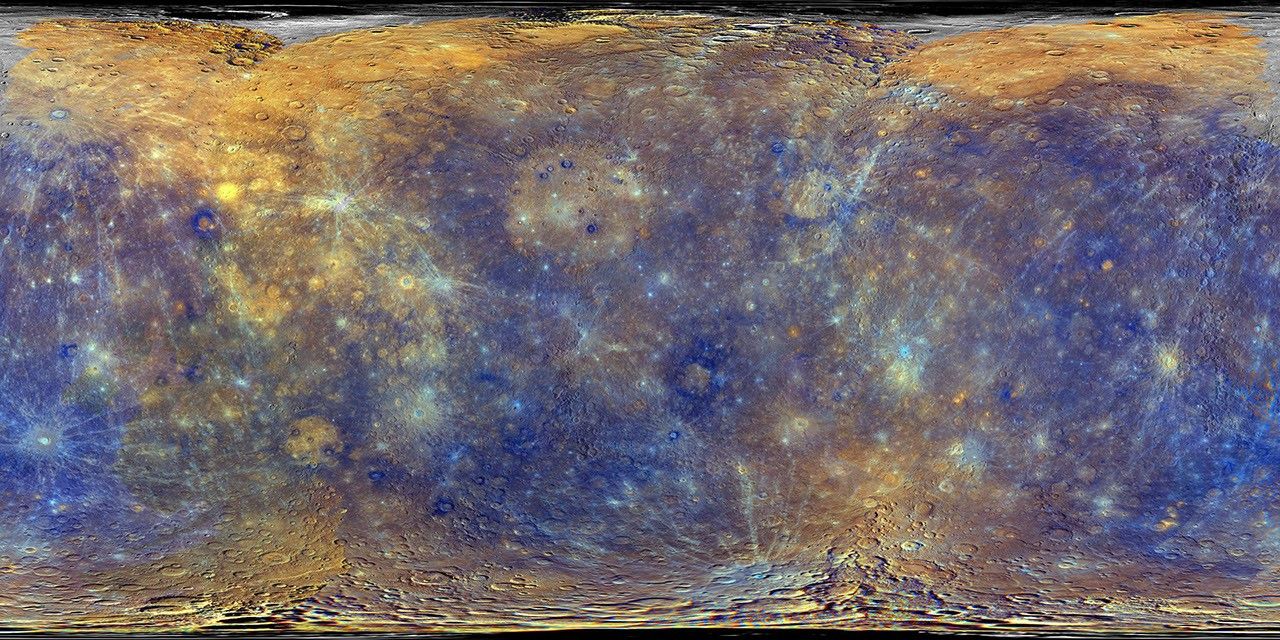
No. The cover is a published MESSENGER map assembled from spacecraft images. Its enhanced colors emphasize differences in Mercury's surface materials. They are not the colors a human observer would necessarily see, and the map does not show the Sun crossing a horizon.
A map helps locate the surface on which the imagined observer stands. A sunrise prediction requires adding the planet's orientation, orbital position and local horizon to that location. The map alone cannot show the predicted motion of the Sun.
Another example of viewing geometry is Earth's eventual last total solar eclipse: the sizes and positions seen by an observer determine what appears in the sky.
Sources: [4]
Keep exploring
Sources & further reading
Follow the original research, records, and explanations behind this story.
- Mercury Facts NASA Science
Present periods and double sunrise.
- Mercury’s capture into the 3/2 spin-orbit resonance including the effect of core-mantle friction Correia and Laskar / Icarus
Resonance and modeled spin history.
- Rotation period of the planet mercury McGovern, Gross and Rasool / Nature
Historical radar and visual estimates.
- Enhanced Color Mercury Map NASA/JHUAPL/Carnegie
Map construction and enhanced-color interpretation.
Follow the thread