
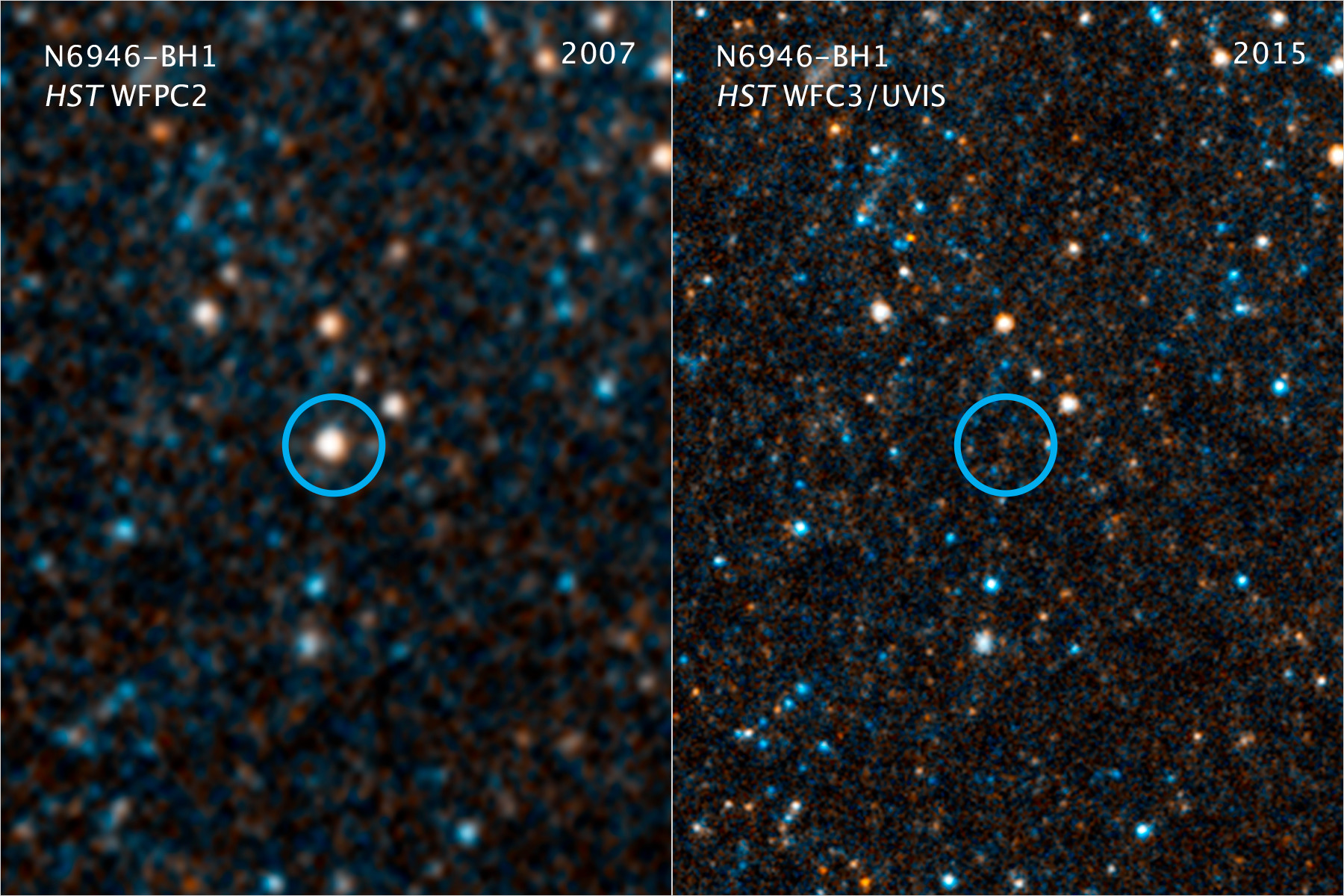
N6946-BH1 brightened in 2009 and then faded dramatically in visible light. It became a leading candidate for a failed supernova: a massive star collapsing into a black hole without the brilliant explosion normally used to discover a stellar death. Infrared emission remains at its position, however, and interpreting that emission is central to the case.
Webb observations made the picture more complicated by separating neighboring sources and revealing the dusty infrared remnant. Researchers have argued for both collapse and a stellar merger. A 2026 reanalysis strengthened the case against the merger explanation, but the observations still need to be distinguished from the model used to explain them.
What disappeared in 2009?#
The source's visible-light brightness fell after an outburst. It did not become undetectable at every wavelength. The phrase vanished star refers here to optical fading.
The Hubble comparison on this page shows the field in 2007 and 2015. The bright source visible in the earlier panel is absent from the later view at the corresponding position. The images demonstrate a substantial change in that observing band. They do not show an event horizon or directly identify what now occupies the location.
The original 2017 image caption presented collapse into a black hole confidently. This article uses the image as evidence of fading and treats the proposed cause in light of the later research.
What is a failed supernova?#
In this hypothesis, a massive star's core collapses, but the process does not produce the successful bright explosion expected from an ordinary core-collapse supernova. A black hole forms while some outer material may be expelled in a much weaker transient.
Failure refers to the explosion mechanism, not to an absence of all observable activity. An outburst followed by fading can therefore fit the hypothesis. Material and dust remaining around the new compact object may continue to radiate.
The name also describes a proposed physical outcome, rather than a complete observational diagnosis. A candidate must be tested against other events that can brighten, make dust and subsequently look faint.
Sources: [4]
Why does infrared light matter?#
Dust can absorb shorter-wavelength light and emit energy in the infrared. If a luminous star merely becomes hidden behind newly formed dust, its energy does not automatically disappear. Observations over a wider wavelength range help test whether the source remains powerful but obscured.
Astronomers combine measurements into a spectral energy distribution: an estimate of how the received energy is spread across wavelength. They then fit models of the emitting source and surrounding material. The inferred total luminosity depends on that modeling, including how dust is arranged and which measured light belongs to the object.
A faint optical point and a bright infrared point can therefore be parts of the same physical system. Conversely, two nearby points in a crowded image need not belong to the same system at all.
What did Webb reveal about blended sources?#
Beasor and colleagues reported that earlier observations combined light from at least three sources. Their Webb study found a persistent infrared object and estimated a total luminosity between 13 and 25 percent of the progenitor's, depending on the comparison adopted.
Blending matters because a telescope has limited angular resolution. Several close sources can contribute to what looks like one point. Assigning all of that light to the vanishing star can change both the inferred properties before the outburst and the brightness attributed to its aftermath.
The study also found that the infrared spectral shape could be consistent with emission from polycyclic aromatic hydrocarbons, complex carbon-containing molecules commonly abbreviated PAHs. The authors considered a stellar merger plausible while leaving the failed-supernova interpretation open. This was an interpretation of the infrared measurements, not a direct view of two stars merging.
Sources: [2]
Why did another analysis favor a dusty collapse remnant?#
Kochanek, Neustadt and Stanek analyzed Webb mid-infrared measurements together with Hubble near-infrared data and optical monitoring. They inferred a dusty source with roughly 10 to 15 percent of the progenitor's luminosity.
Their model favored silicate dust with large grains, a result they connected to expectations for dust produced after a failed supernova. They also described the source as very faint in the near-infrared and found no optical variability above their stated observational limit.
Those conclusions depend on how the measured emission is assigned and modeled. A non-detection of variability means that any changes were below the sensitivity of those observations; it does not establish that the object emits exactly constant light.
Sources: [3]
What changed in the 2026 reanalysis?#
Forés-Toribio and Kochanek reanalyzed the Webb images and identified four near-infrared stellar neighbors within about a tenth of an arcsecond. They argued that these neighbors are unrelated to the candidate's mid-infrared emission.
They also compared the candidate with a sample of known stellar mergers. In their analysis, merger remnants remained much brighter than their progenitors at late times, whereas the failed-supernova candidates were much dimmer. The authors argued that disk-shaped dust distributions could not explain the large difference between those groups.
This supplies a specific challenge to the merger interpretation: explain the low remaining luminosity while also matching the observed spectrum and nearby sources. It is stronger than relying only on the dramatic optical disappearance. It remains a research conclusion based on source separation, luminosity modeling and the comparison sample.
Sources: [4]
Has a black hole been proved to exist there?#
The observations make N6946-BH1 a serious failed-supernova candidate. Calling it a candidate preserves a distinction between the fading source, which is observed, and the compact remnant inferred from a model.
The 2024 papers reached different assessments of the infrared evidence. The 2026 comparison adds an argument against mergers, so it would also be misleading to present the debate as if nothing had changed since the first Webb images. Each explanation must account for the measured infrared emission as well as the optical fading.
This differs from a wandering black hole revealed by a disrupted star. There, the flare is evidence of material interacting with an existing massive black hole. Here, the question is whether the disappearance marks the formation of a new stellar remnant.
What could further observations settle?#
Continued infrared monitoring can test how the remnant changes. Spectroscopy can distinguish competing explanations for broad-band colors, including features associated with particular dust or molecular components. Improved source separation can reduce contamination from neighboring stars.
The useful prediction is more specific than whether something remains visible. A model should account for the amount of emitted energy, its distribution across wavelength and its evolution with time. Measurements that contradict one of those predictions can narrow the possibilities.
Until those tests establish a firmer conclusion, the concise description is that N6946-BH1 faded optically after a 2009 outburst, still has an infrared counterpart, and remains an important test of how massive stars can die.
Keep exploring
Sources & further reading
Follow the original research, records, and explanations behind this story.
- N6946-BH1 ESA/Hubble
Historical image documents fading; original causal caption is stronger than later evidence.
- JWST reveals a luminous infrared source at the position of the failed supernova candidate N6946-BH1 Beasor et al. / ApJ
Blending, luminosity and merger interpretation.
- The Mid-IR Counterpart to N6946-BH1 Kochanek, Neustadt and Stanek / ApJ
Dust model and low remnant luminosity.
- The neighboring stars of N6946-BH1 and the observational characteristics of failed supernovae Forés-Toribio and Kochanek / Open Journal of Astrophysics
2026 source separation and merger comparison.
Follow the thread