
NEAR Shoemaker reached asteroid Eros by changing its orbit and using a sequence of braking manoeuvres to reduce its speed before contact. On 12 February 2001 it became the first spacecraft to land on an asteroid, despite having been built as an orbiter rather than a lander.
Eros’s weak gravity made a slow touchdown possible, but did not make navigation automatic. The team had to manage the spacecraft’s motion around an irregular, rotating body while keeping its camera and radio antenna usefully pointed. The descent returned close views of the ground, and the spacecraft survived to send more science from the surface.
Why attempt a landing with an orbiter?#
NEAR had already spent about a year studying Eros from orbit. NASA’s mission account records orbit insertion on 14 February 2000, followed by changes in orbital height and close passes that gave researchers different views of the asteroid.
At the end of that investigation, a controlled descent offered an opportunity to obtain much finer images. NASA’s contemporary report identifies returning high-resolution pictures as the first priority and bringing the spacecraft down safely as the second. The mission’s original science goals had already been completed.
That order of priorities explains the decision. It was an additional experiment using a spacecraft whose main work was done. Survival at the end would add scientific value, but it was not the condition on which all the earlier orbital observations depended.
How did the spacecraft slow down?#
The descent began with a manoeuvre that changed NEAR’s orbit so that it would approach the surface. Four further braking manoeuvres reduced its motion during the approach. The team was controlling a trajectory through space, not simply switching off an engine and letting the craft drop vertically from rest.
The published landing analysis gives a vertical impact speed of 1.5 to 1.8 metres per second and a much smaller sideways component. Those speeds describe motion relative to the local surface. They are different from the speed of Eros around the Sun or the distance NEAR had travelled during its interplanetary journey.
Slow contact still carries mechanical risk. A spacecraft can strike a rock, rotate on contact or settle in an orientation that prevents communication or power generation. NASA’s immediate follow-up reported that NEAR had reached a favourable orientation and that a backup firing intended to improve communications was no longer needed.
Does an asteroid have enough gravity to land on?#
Yes. Eros attracts nearby objects even though its gravity is far weaker than Earth’s. A NASA explanation puts the surface pull below one-thousandth of Earth’s. Weak gravity changes the speeds and timescales of an approach; it does not remove gravity altogether.
Nor is Eros a smooth sphere. Its elongated shape, mass distribution and rotation affect the local direction in which material tends to move. The NEAR science team combined radio tracking, images and laser ranging to study those effects. A point that looks high in a photograph is not automatically high in the relevant gravitational sense.
The spacecraft also retained its mass and inertia. It still required a force to change its motion, even where its weight was small. The distinction is the same one explained in our comparison of mass and weight: a weaker gravitational pull does not make an object effortless to accelerate or stop.
Could controllers steer it by watching live pictures?#
They could receive images and tracking information, but the distance ruled out instant feedback. The landing paper gives a one-way light-travel time of about 17 minutes 35 seconds on that date. The braking manoeuvres were programmed to occur at specified intervals.
This delay also explains an apparent discrepancy in historical accounts. A time assigned to contact at the spacecraft is earlier than the time when Earth receives evidence of that contact. Those are two locations in the same sequence of events, not two separate landings.
As a simple consequence, a controller reacting to a newly received picture would be reacting to an earlier situation. A command would then need another light-travel interval to arrive. Planning the trajectory and its timed operations was therefore essential; a human could not pilot the final seconds as if operating a nearby drone.
Sources: [3]
What does the last photograph show?#
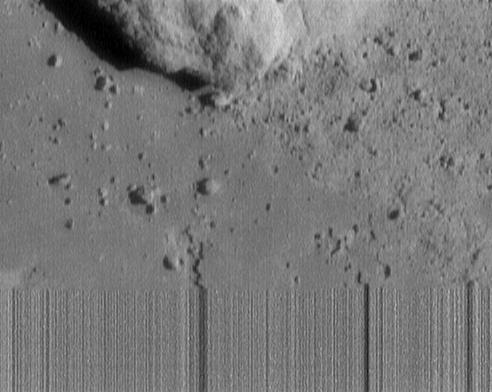
The image above is the last frame received from NEAR Shoemaker. JPL’s caption places the camera about 120 metres above the surface and describes a view roughly 6 metres wide. Part of a large rock appears at the top, with smaller fragments scattered across the ground.
The streaks at the bottom are a transmission effect: signal was lost during the image’s delivery as the spacecraft touched down. They are not long grooves cut into the asteroid. Preserving that incomplete portion shows the limit of what actually arrived.
The landing study examined the wider descent sequence and described blocky terrain giving way to a smoother deposit called a pond. In this context, the term describes a smooth accumulation of surface material, not a pool of liquid water. Close images helped expose textures that were difficult to distinguish from farther away.
How did the team know NEAR had survived?#
The evidence was radio contact after touchdown. JPL reported a beacon and subsequent reception by the Deep Space Network. A signal from a spacecraft resting on the ground demonstrates something different from a final image sent while it was still descending.
Survival was also more than avoiding a destructive impact. A useful surface mission needed electrical power, working electronics and a communication path. NEAR’s favourable resting position allowed the team to continue receiving telemetry and to consider additional observations.
The engineers planned a controlled approach, but could confirm the orbiter’s ability to work on the surface only after contact.
What science came back after touchdown?#
The gamma-ray spectrometer collected measurements from the surface. Johns Hopkins APL’s account says mission extensions enabled readings through 28 February 2001, the date of the final contact, and that the team retrieved seven days’ worth of gamma-ray data.
The NASA archive describes clear signatures of elements in these measurements. Comparing such signatures with meteorite compositions helps researchers investigate relationships between asteroids and rocks collected on Earth. This was remote measurement by an instrument on Eros, not the return of a physical sample to a terrestrial laboratory.
The interval between landing and final contact should not be mistaken for uninterrupted recording by every instrument. Mission duration, instrument observing time and usable data volume are separate quantities. NEAR’s surface measurements added a new vantage point to the much larger set of observations it had already gathered in orbit.
Keep exploring
Sources & further reading
Follow the original research, records, and explanations behind this story.
- NEAR Shoemaker NASA Science
Orbital mission history and first asteroid landing.
- NEAR Shoemaker’s Historic Landing on Eros Exceeds Science, Engineering Expectations NASA / Johns Hopkins APL
Science priorities, controlled descent and favourable resting orientation.
- The landing of the NEAR-Shoemaker spacecraft on asteroid 433 Eros Veverka et al. / Nature 413,390–393
Spacecraft-event time, signal delay, impact components and descent imaging.
- Eros From Orbit NASA APOD
Weak surface gravity; no uniform gravity value is assumed.
- NEAR Science Results from Asteroid 433 Eros NASA NSSDC / NEAR Project
Shape, spin and radio tracking; elemental signatures from surface data.
- Final Eros Images: Last, Closest Image of Eros NASA/JPL/JHUAPL
Image scale and transmission streaks at touchdown.
- NEAR Shoemaker Phones Home for the Last Time Johns Hopkins Gazette / Helen Worth, APL
Final contact and seven days of usable gamma-ray data.
- The landing of the NEAR-Shoemaker spacecraft on asteroid 433 Eros USGS publication record / Veverka et al.
Blocky terrain and smooth pond interpretation; same underlying paper as paper source.
Follow the thread