
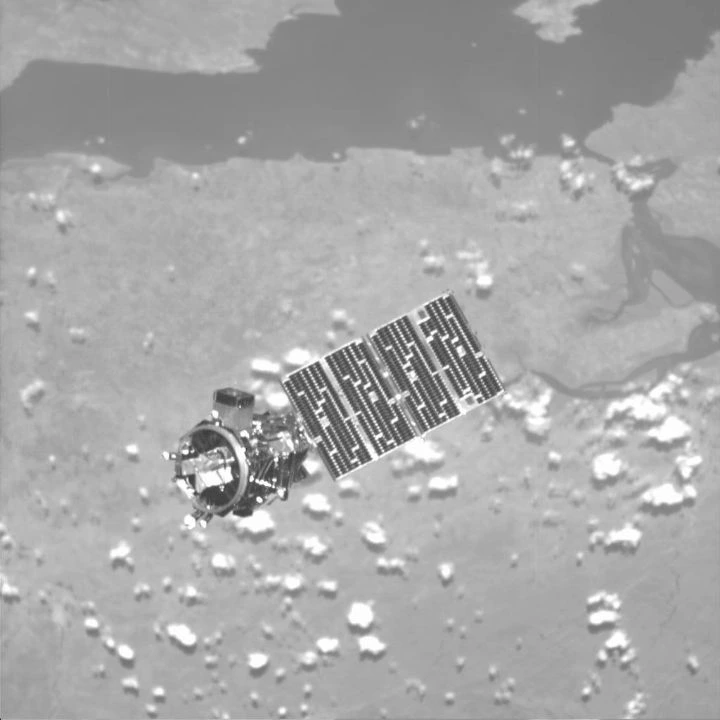

In 2007, a robotic spacecraft transferred a battery to another satellite and connected it to the recipient’s power system. The same mission moved liquid propellant between the two vehicles. No astronaut was outside handling the equipment.
DARPA’s Orbital Express paired ASTRO, Boeing’s servicing spacecraft, with NextSat, a serviceable client built by Ball Aerospace. Their experiment asked whether machines could perform a sequence usually associated with a workshop: approach the equipment, secure it, connect a supply line and exchange a component.
The battery is the memorable object. The more consequential achievement was making the surrounding operations work together. Understanding that chain also explains the mission’s limits: these spacecraft were designed for servicing, and a successful demonstration was not a universal satellite repair service.
What problem was Orbital Express trying to solve?#
A satellite can remain useful even when it needs more propellant or could benefit from newer electronics. Orbital Express tested ways to replenish or reconfigure a spacecraft after launch, rather than treating its original supplies and equipment as an unchangeable package.
DARPA identified two distinct benefits. Refueling could let a satellite maneuver more often or continue operating longer. Exchanging electronics could introduce improved equipment without launching an entirely new satellite. These were the program’s intended advantages; the demonstration did not establish a guaranteed life extension or a cost saving for every mission.
The distinction between a consumable and a component matters. A propellant transfer fills a tank through a fluid connection. A battery transfer moves a solid equipment package into a compatible mounting and electrical interface. The two jobs share a need for controlled contact, but they require different machinery once contact has been made.
How did ASTRO find and approach NextSat?#
ASTRO used a suite of relative-navigation sensors to determine where NextSat was and how it was oriented. For the final approach, knowing distance alone was insufficient. The servicing spacecraft also needed the direction to its partner and the alignment of the surfaces that would meet.
One of those sensors was NASA’s Advanced Video Guidance Sensor, or AVGS. It illuminated special retroreflecting targets on NextSat with lasers at two different wavelengths. A retroreflector sends incoming light back toward its source. Comparing the two images helped remove background light and reflections that did not belong to the targets.
The remaining bright target pattern let the system calculate relative position and orientation. Near the spacecraft, this meant six degrees of freedom: movement along three directions and rotation about three axes. Put more simply, ASTRO had to know both where NextSat was and which way it was pointing.
NASA’s flight report says the mission configured the navigation system to use AVGS at distances of 120 meters or less, although the sensor acquired its target farther away during some operations. That is a description of this sensor’s assigned role, not the maximum separation the entire mission could handle. Other sensors and the overall guidance system performed other parts of the approach.
NextSat’s prepared targets are an important part of the result. This was demonstrated navigation toward a compatible partner, rather than proof that the same sensor could dock with any unmarked object. The earlier Gemini 8 docking joined two spacecraft with astronauts aboard; Orbital Express explored how machines could perform the approach and contact sequence.
Sources: [3]
Why did the connection matter as much as the robot arm?#
The two vehicles needed compatible interfaces before any servicing operation could succeed. DARPA describes ASTRO as a prototype servicing satellite and NextSat as a surrogate next-generation serviceable satellite. Their mechanical and electrical interfaces were part of the experiment’s design.
A connection has several jobs. It must hold the vehicles in the required relationship, allow the servicing equipment to reach its destination and support whatever utilities the operation needs. A robotic arm can move an object, but that movement only becomes useful maintenance when the receiving spacecraft can accept and use it.
Orbital Express tested rendezvous, docking and capture as well as the transfers themselves. NASA’s AVGS report describes arm-assisted berthing and sensor checkout maneuvers before free-flight operations. The arm moved the vehicles relative to one another to check the navigation sensors. The team could therefore test individual parts of the servicing chain before asking the spacecraft to separate and find one another again.
That progression changes how the battery footage should be read. A successful equipment transfer and a successful free-flight rendezvous were separate achievements within a larger program. One image cannot establish that the entire sequence happened without intermediate tests or ground supervision.
How did fuel move from one satellite to the other?#
Orbital Express transferred hydrazine, a liquid propellant, through a connected fluid-transfer system. ASTRO supported two ways of driving the flow: a pressure-fed mode and a pump-driven mode. Before the demonstrations, the team checked that the spacecraft could remain connected and maintain a seal.
A liquid moves through a line when there is a pressure difference to drive it. In the pressure-fed demonstration, called ullage recompression, incoming propellant reduced the space available to gas in the receiving tank. Ullage means that gas-filled part of a tank. Compressing it raises its pressure, so the transfer system has to work within the pressure conditions of both tanks. The pump mode provided another way to drive the transfer. Neither method depended on pouring fuel downward under gravity.
Boeing’s report of April 17, 2007 gives useful evidence of scale. The pressure-fed test moved approximately 31.97 pounds of hydrazine into NextSat, about 14.5 kilograms. That met the stated target of 32 pounds. A pump-driven test moved about 19.2 pounds, or 8.7 kilograms, exceeding its 17-pound target. The team then demonstrated a pump transfer in the reverse direction, from NextSat to ASTRO.
These are amounts reported for particular tests, not the capacity of a future refueling service. The small difference between 31.97 and 32 pounds also should not become an invented failure: Boeing explicitly reported the objective as satisfied. The converted kilogram values are rounded to match the explanatory purpose.
The physical connection is central to the achievement. Propellant traveled through the transfer system; the robotic arm was not carrying an open container between spacecraft. Refueling called for a sealed fluid path and controlled flow, whereas exchanging the battery called for precise handling of a removable package.

Image unavailable.
Two conceptual diagrams show pressure-fed hydrazine transfer and pump-driven transfer between ASTRO and NextSat.
Sources: [2]
What did the battery transfer actually repair?#
The battery demonstration showed that ASTRO could move a usable component to NextSat and integrate it into the client’s electrical system. Boeing reported that the robotic manipulator placed the battery on NextSat and that the battery was successfully incorporated into its power system afterward.
That final step matters. Carrying a box from one vehicle to another would demonstrate manipulation. Making the receiving spacecraft use the transferred battery demonstrated a servicing function. The operation joined mechanical handling with a prepared electrical connection.
The modular approach packages equipment so that it can be handled and connected as a unit. The useful analogy is an exchangeable assembly with a defined interface. The demonstration addressed replacing an assembly, rather than diagnosing and repairing every circuit inside it.
There is no need to invent a broken battery to explain the result. The cited mission report describes a planned transfer and integration test; it does not establish that NextSat had suffered an unexpected battery failure. Here, “repair” means demonstrating a capability that could support replacement or upgrades on a suitably designed spacecraft.
This distinction also limits what the robot proved. It did not demonstrate opening any satellite, discovering an unknown fault or manufacturing a replacement part in orbit. It demonstrated a carefully prepared physical and electrical exchange.

Image unavailable.
A schematic robot arm carries a battery from ASTRO toward a prepared receptacle on NextSat while the vehicles remain connected.
Was it autonomous if people were still involved?#
Yes. Orbital Express could execute servicing operations automatically while people still chose experiments, checked performance and controlled how far the system could proceed. Autonomy described the execution of tasks within an engineered mission, rather than the absence of a human team.
The first transfer demonstrations used a low autonomy level. Boeing’s April report says they required several ground-based approvals to proceed. Those pauses let the team monitor and evaluate the operation before authorizing its next stage. The system also supported higher autonomy levels that did not require those confirmations.
The flight record gives a useful reminder that automatic operation still needs fault handling. During a later 30-meter separation scenario, the operation was aborted while the spacecraft were about 10 meters apart on the return approach. NASA’s AVGS report says the spacecraft remained separated for eight days, at ranges of about 1 to 6 kilometers, before recovery and remating.
During that recovery approach, AVGS began tracking its long-range target at 150 meters, beyond the mission’s planned limit for using the sensor, and served as the primary sensor for the autonomous rendezvous and docking. This supports a specific account of sensor performance and recovery. It does not justify treating the entire episode as an unsupervised rescue or declaring every part of the spacecraft flawless.
Could the same system service any satellite?#
Orbital Express established feasibility for a prepared pair. Its client had been built to receive service, and the experiment brought together compatible navigation targets, interfaces and equipment. Extending that success to a different spacecraft would require answering those compatibility questions again.
A prospective client needs a safe way to be approached and secured. Its propellant system must accept the intended transfer, and any equipment to be exchanged must be accessible and compatible with the servicing machinery. Those are design requirements inferred from the demonstrated operations, rather than a claim that one standardized port would solve every maintenance problem.
The program therefore supports a practical argument for considering serviceability before launch. Engineers can decide which resources or modules are valuable enough to make replenishable or replaceable. Whether that is worthwhile depends on the mission and the added hardware and operating effort; the sources here do not establish a universal economic answer.
The enduring result is concrete: Orbital Express combined robotic approach and capture with propellant transfer and the integration of a transferred battery. Launch had ceased to be the final opportunity to change those spacecraft’s supplies and equipment. The demonstration showed what prepared interfaces could make possible, while leaving the much wider problem of servicing arbitrary satellites open.
Keep exploring
Sources & further reading
Follow the original research, records, and explanations behind this story.
- Orbital Express Defense Advanced Research Projects Agency
Program objectives, prototype ASTRO and serviceable surrogate NextSat, compatible non-proprietary interfaces; objectives do not establish universal repair or economic benefit.
- Boeing Orbital Express Conducts First Autonomous Spacecraft-to-Spacecraft Fluid and Component Transfer Boeing
April 17, 2007 contractor report: launch, hydrazine, pressure-fed and pump tests and masses, sealed connection, integrated battery, and ground approvals during early demonstrations.
- Orbital Express Advanced Video Guidance Sensor NASA Technical Reports Server / NASA Marshall Space Flight Center
Detailed public abstract read: retroreflective targets, image subtraction, relative position and orientation, sensor role and range, arm-assisted checkout, eight-day separation and recovery; full PDF was not read.
- File:Orbital Express NextSat 1.jpg Wikimedia Commons; photograph attributed to DARPA
Specific photograph provenance, date, author and public-domain U.S. government rights statement; used for the cover, not technical mission conclusions.
Follow the thread