
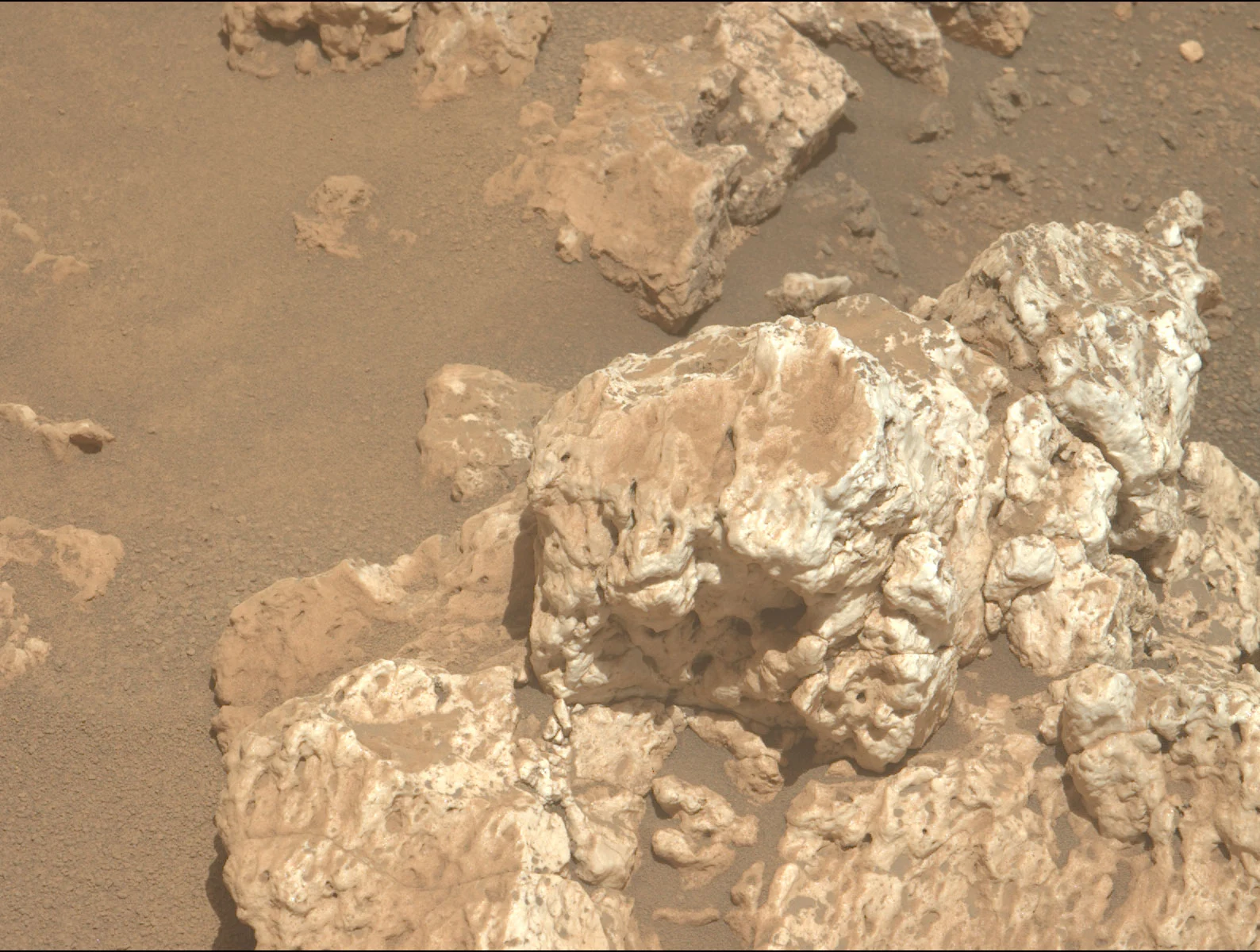
On October 29, 2026, a camera on NASA’s Perseverance rover photographed pale, pitted rock against darker ground at a place the team calls Idubi. The color told them where to look. Measurements from the rover’s SuperCam then showed that the rocks were rich in hydrated silica, a material that can record an episode when water moved through or altered rock.
The pieces are large enough for the rover to examine close up. That gives the team a way to narrow down which kind of water left the silica behind.
Where are the pale rocks, and what first drew the team to them?#
Idubi lies in Lac de Charmes, an area of ancient crust beyond the western rim of Jezero crater. Pale boulders are scattered across parts of that terrain. Perseverance’s left Mastcam-Z camera photographed the particularly bright Idubi rock on the mission’s 2,023rd Martian day, alongside the dust and stones that made it so easy to spot.
Some of the broader region’s light-toned rocks were already turning out to be gabbro, which forms as magma cools slowly below the surface. The November mission update describes a different set of targets. The unusually bright Idubi rocks studied with SuperCam were rich in hydrated silica. Looking pale can be common to rocks with very different histories, even on the same hillside.
How can a rover identify silica without picking up a rock?#
SuperCam combines several ways of studying small spots on a rock from a distance. One laser technique removes a tiny amount of material and measures the light from the resulting plasma, an extremely hot gas. The pattern of that light identifies elements. Infrared reflectance spectroscopy instead looks at sunlight reflected by the rock and measures which wavelengths the material has absorbed. Some combinations of elements and absorption bands can indicate a particular kind of mineral.
Earlier work inside Jezero shows how those clues can complement one another. One target had strong silicon enrichment and absorbed infrared light at wavelengths associated with water and with bonds involving silicon, oxygen and hydrogen. Taken together, the measurements pointed to hydrated silica. That published spectrum is from a separate target. The November Idubi update reports the resulting identification without publishing the full measurements for the new rocks.
What does “hydrated” mean, and what kind of water was involved?#
Silica is made of silicon and oxygen. Hydrated forms can contain water molecules, or oxygen and hydrogen chemically bound in the material, or both. The word describes the solid. For geologists, it is a clue to the conditions under which that material formed or changed.
Earth offers several ways to make hydrated silica. It can form in hot water systems, in groundwater or as minerals change in soils. A hot spring is one possible setting, but the name of the mineral alone supplies neither a location nor a temperature for the water. To distinguish among those origins, the team needs evidence from the textures, associated minerals and surroundings of the fragments.
Why do bigger pieces make a difference?#
Perseverance had previously found silica-rich rocks on Jezero’s inner rim. The targets were too small for the close-range work the team wanted to do on them. At Idubi, bigger pieces give the rover room to examine separate patches and compare their textures and chemistry with its close-range instruments.
On the same Martian day as the Mastcam-Z photo, WATSON, a camera on the rover’s robotic arm, photographed a rock surface at Idubi from much closer. The view resolves cavities and fine surface texture that are easy to miss in the wider shot. An image like that helps put chemical measurements in context. A measurement from one patch can mean something different if it came from a thin surface coating or a material that runs through the rock.
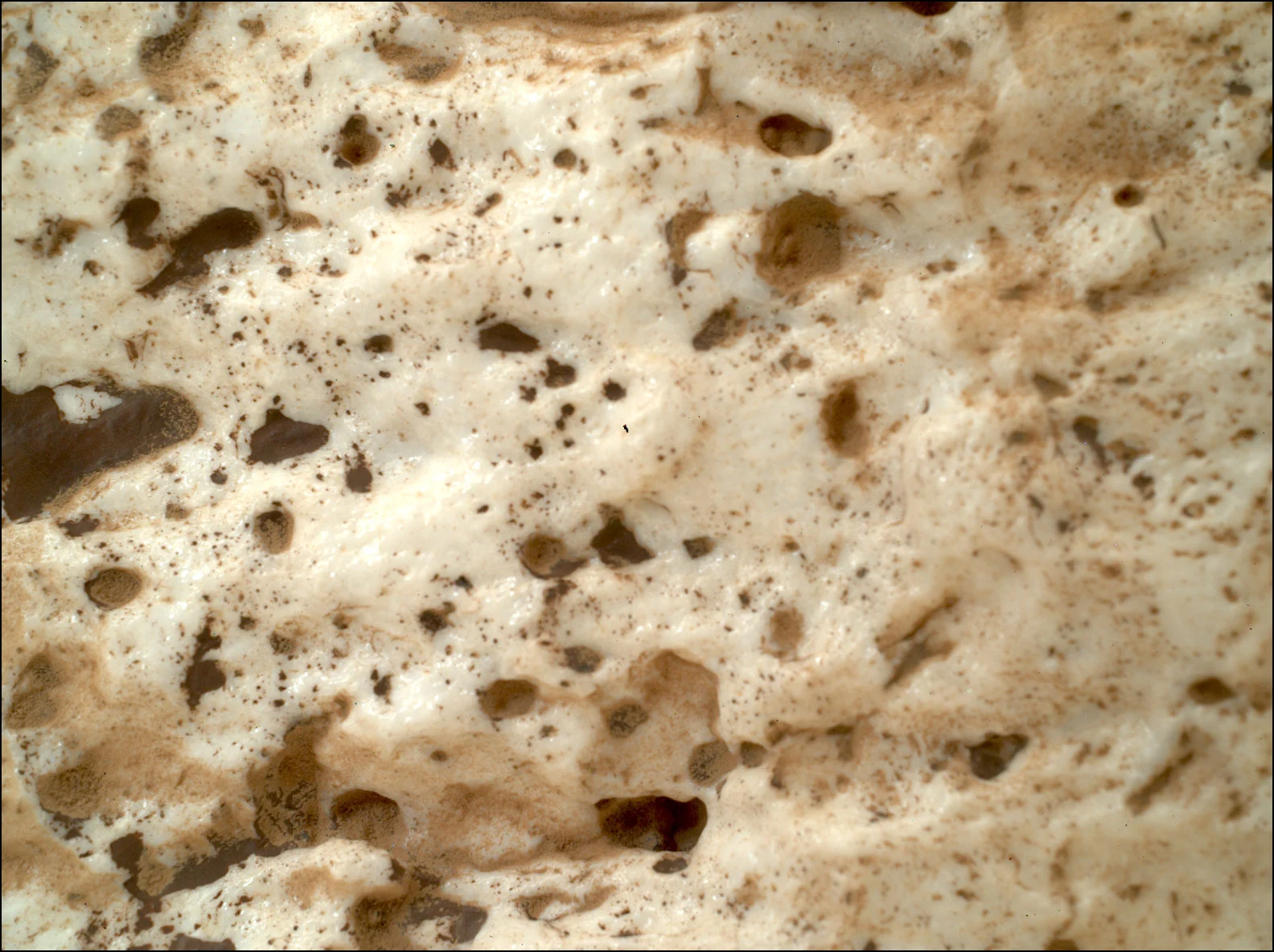
Image unavailable.
Close-up of the pale rock surface, with irregular cavities and many dark or reddish-brown spots.
Sources: [1]
Could the silica preserve evidence of past life?#
On Earth, some silica deposits have preserved microscopic remains. Silica can accumulate around an organism early and encase details that would otherwise be lost as the softer material breaks down or the sediment changes. This is why some very old silica-rich rocks contain features that are still recognizable at microscopic scales.
The Idubi measurements identify a material worth searching. The mission update reports no fossil there. Even if a future close-up reveals a shape that resembles an organism, researchers would need to test how the shape formed and look for independent evidence of a biological origin. At Idubi, the next question is which water system made the rocks and what traces it left in their texture and chemistry.
Keep exploring
Sources & further reading
Follow the original research, records, and explanations behind this story.
- Perseverance Update: The Ghostly Rocks of ‘Idubi’ — Bright Remnants of Aqueous Systems from Long Ago NASA Science
Mars 2020 team report of the Idubi measurements and the two camera views.
- A Journey to the Depths of Ancient Mars? NASA Science
Setting beyond Jezero’s western rim and the earlier reports of light-toned gabbro in the wider area.
- Mars 2020 Perseverance Rover Spectrometer and Micro-Imager Suite NASA Planetary Data System
SuperCam’s independent remote-sensing techniques.
- SuperCam Can Hear Hardness NASA Science
How a laser pulse produces a small plasma that the instrument can read with a spectrometer.
- The SuperCam Infrared Spectrometer for the Perseverance Rover of the Mars2020 mission Space Science Reviews
How SuperCam measures reflected infrared light and identifies absorption bands.
- From hydrated silica to quartz: Potential hydrothermal precipitates found in Jezero crater, Mars Earth and Planetary Science Letters
The definition of hydrated silica, a worked example from Jezero and mechanisms of microfossil preservation.
Follow the thread